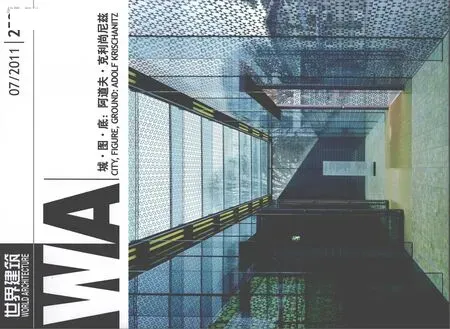
書展會中的奧地利展館,法蘭克福,德國
2011-07-30 12:36:36阿道夫·克利尚尼茲,徐知蘭
世界建筑
2011年7期
展館常代表曇花一現之美和一種近乎擬人的維度:它們程式化地出現在“錯誤”的地點,轉瞬即逝,卻仍可以(也許)成功地使人們產生正確的意識。建筑的物質性消失了,取而代之的將是其重要意義——這是一種可與寫作相媲美的現象。文字,無論是打印、鐫刻或繪制的,都擁有某種紀念性的特點。當一個個字母被組織為詞匯、語句和文章段落時,字母便消失了,轉而為文字的含義所替代。這座展館和文字的聯系也產生了內涵。□(徐知蘭 譯)
Pavilions represent the beauty of transience,an almost anthropomorphic dimension: They are stylised, transitory appearances at the 'wrong' place but can still, possibly, succeed in creating a correct consciousness. The physicality of the building disappears to be replaced by its significance - a phenomenon comparable with that of writing.Lettering, whether typed, chiselled or painted,possesses a certain monumental character which,when the letters are arranged to form words,sentences and texts, disappears to be replaced by meaning. The pavilion and the lettering are engaged in a relationship which produces meaning. □
業主/Client: 奧地利共和國/Republic of Austria
合作者/Collaborator: Eric Red

1 外景/Exterior view(攝影/Photo: Margherita Spiluttini)

2 剖面/Section

3 平面/Plan

4 外景/Exterior view

5 外景/Exterior view

6 內景/Interior view(4-6 攝影/Photo: Margherita Spiluttini)
登錄APP查看全文