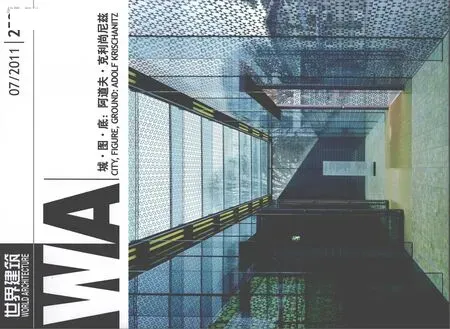
哈德鎮示范住宅,維也納,奧地利
2011-07-30 12:36:44阿道夫·克利尚尼茲,馬克斯·杜德勒,奧托·施泰德勒等
世界建筑 2011年7期
關鍵詞:建筑

1 外景/Exterior view(攝影/Photo: Pez Hejduk)

2 位置圖/Situation
它并非獨戶獨棟的住宅,也不是多層公寓住宅區。
該項目是位于維也納市郊的一個示范住宅開發項目。它的目標與1932年的維也納Werkbundsiedlung住宅區相似,希望能夠為維也納的大眾提供一種城市邊緣優質生活的范例。這種優質生活作為一種都市概念,并沒有采用臺地式住宅的作法,它的密度介于獨戶住宅與多層公寓之間。這樣的描述本身就體現了市鎮規劃與建筑之間的結構型銜接。
整個住宅區的平面肌理直接來源于給定的可供開發基地的原有布局。這些基地相互鄰接,并且可根據各基地獨立的規劃來建造不同形式的建筑。在最大限度的設計自由之下,這些建筑同時還須高度忠實于同質性以及與環境的統一。地塊只是作為誕生空間的區域,而并不一定要反應出其私有財產的屬性,例如,從建筑語匯的維度上來說,它可以成為一種抽象的區劃概念的邊界。

3 2號住宅外景(建筑師:阿道夫·克利尚尼茲)/House 2, exterior view (Architect: Adolf Krischanitz) (攝影/Photo: Pez Hejduk)
這些尺度大致相同的基地彼此相連,通過不同建筑師的作品最終形成了整個住宅區內部的變化,同時又在多種多樣的變化當中生成了內在的一致性。□(李璠 譯)
Neither a single family house nor a multi-storey apartment block.
The project envisages erecting a model housing development on the urban periphery of Vienna.Similar to the aim of the Viennese Werkbundsiedlung of 1932, it is planned to build houses that offer the populace of Vienna excellent examples of ways of living on the edge of the city. Excellent in the sense of an urban concept which, while not a terrace housing development, has a density that lies between that of a single-family housing estate and a multi-storey housing development. This description itself indicates a continuous structural linking of town planning and architecture.

4 外景,左:10號住宅(建筑師:阿道夫·克利尚尼茲)/Exterior view, left House 10 (Architect: Adolf Krischanitz)(攝影/Photo:Pez Hejduk)
The particular grain of the development plan results from the constraint of fixed areas to be built upon (zoned lots) that can be developed using one or more buildings. These building sites lie beside each other and, according to the wishes of the individual planners, allow differently shaped buildings. These buildings, while permitting a maximum of design freedom, should also offer a high degree of homogeneity and urban consistency.The lot is here intended as an area that generates space but is not necessarily to be understood in the sense of a private property; it can also be only an abstract zoning boundary, i.e. a grammatical dimension.
The largely consistent size of the sites that adjoin each other ultimately evokes, through the different architects working here, a potential of variation and differentiation within the development, which aims at achieving generative consistency within the variety. □

5 1號住宅外景(建筑師:彼得·馬爾克利)/House 1, exterior view (Architect: Peter M?rkli)

6 3號住宅外景(建筑師:漢斯·科爾霍夫)/House 3, exterior view (Architect: Hans Kollhoff)

7 4號住宅外景(建筑師:奧托·施泰德勒)/House 4, exterior view (Architect: Otto Steidle)

8 5號住宅外景(建筑師:梅利&彼得建筑事務所)/House 5, exterior view (Architect: Meili & Peter Architekten)(5-8攝影/Photo: Pez Hejduk)
業主/Client: ?SW/?sterreichisches Siedlungswerk合作者(克利尚尼茲事務所)/Collaborators (Office Krischanitz): Patrick Fessler (項目建筑師/Project Architect), Katrin Steinbacher, Ulrich Huhs, Zeljko Ivosevic, Dominic Schmid, Katrin Steinbacher, Julia Steinert, Annette Gro?kinsky

9 6號住宅外景(建筑師:羅格·迪納)/House 6, exterior view (Architect: Roger Diener)

10 7號住宅外景(建筑師:海因茨·特薩)/House 7, exterior view (Architect: Heinz Tesar)

11 8號住宅外景(建筑師:馬克斯·杜德勒)/House 8, exterior view (Architect: Max Dudler)

12 9號住宅外景(建筑師:赫爾曼·切赫)/House 9, exterior view (Architect: Hermann Czech)(9-12攝影/Photo: Pez Hejduk)
猜你喜歡
北方建筑(2021年6期)2021-12-31 03:03:54
文苑(2020年10期)2020-11-07 03:15:36
現代裝飾(2020年6期)2020-06-22 08:43:12
現代裝飾(2020年4期)2020-05-20 08:55:08
攝影之友(影像視覺)(2019年2期)2019-03-05 08:27:16
藝術家(2017年3期)2018-01-26 08:54:49
文學自由談(2016年3期)2016-06-15 13:01:16
福建農業科技(2016年10期)2016-03-07 09:46:49
少兒科學周刊·兒童版(2015年6期)2015-11-24 03:49:38
中國工程咨詢(2015年4期)2015-02-14 03:49:56