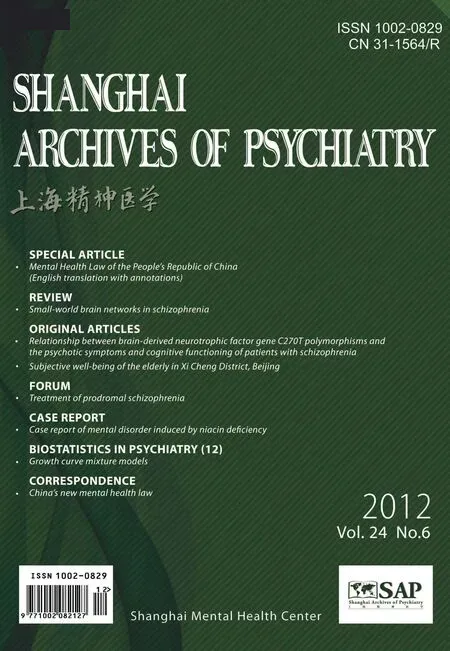
Shanghai Archives of Psychiatry Ethics Policy
2012-04-12 07:56:20
上海精神醫學 2012年6期
Shanghai Archives of Psychiatry Ethics Policy
TheShanghai Archives of Psychiatryascribes to the Committee on Publication Ethics (COPE)Code of Conduct and Best Practice Guidelines for Journal Editors[1]and expects that authors who submit manuscripts to the journal be familiar with and follow the ethical requirements specified in theUniform Requirements for Manuscripts Submitted to Biomedical Journals.[2]The first authors of all manuscripts submitted to the journal must complete theAuthor’s Declaration of Compliance[3]with this policy prior to publication of the manuscript. These requirements are summarized below with links to the relevant documentation.
1. Human subjects in research
Studies using human subjects must follow the guidelines set forth by theHelsinki Declaration.[4]These guidelines stipulate that whenever human subjects are used in research the study must be approved by a research ethics committee or institutional review board (IRB) of the sponsoring institution. Authors must submit documentary proof of IRB approval when submitting a manuscript. When it is uncertain whether or not specific parts of the study conform with the Helsinki guidelines authors will be asked to provide explicit IRB approval for those components of the study.
Any participants in a study must give expressed written consent, free of coercion, to take part in the study. If participants are minors, incapacitated or otherwise unable to provide written consent, researchers must obtain consent from a parent, legal guardian or next of kin. But, as specified in section 8.05 of the American Psychological Association’sEthical Principles of Psychologists and Code of Conduct,[5]when a study uses anonymous questionnaires and in a few other specific situations written informed consent of participants may not be necessary.
Researchers should strive to address any issues raised by participants and to respond to their questions about the study before, during and after completion of the study. When performing a study it is the researcher’s responsibility to inform participants of: a) the purpose and duration of the study; b) how the confidentiality of the information collected will be maintained; c) how the results of the study will be used; d) any potential risks involved in the study process, including but not limited to physical, mental or emotional discomfort and distress; e) any potential benefits including financial or other compensation for participating in the study; and f) who to contact in case of any questions.
Research participants who are recorded, videotaped, photographed or described in case reports must be informed of the purpose of the recording and how the material will be used. All participants must give written consent for personal material to be published. In cases where the participant is identifiable they should be shown a copy of the manuscript prior to publication and informed whether or not the information will be available online as well as in print. When the participant places conditions on material being published (such as removal of details which may risk patient confidentiality), the author must inform the editors about these conditions.
For more information about ethical requirements in human subject research, authors should consult Subsection E of Section II of theUniform Requirements for Manuscripts Submitted to Biomedical Journals.[2]
2. Animal subjects in research
TheShanghai Archives of Psychiatryrequires the first author of manuscripts about studies that use animals to certify that the study met all local and national laws and standards concerning the use of animals in research and conformed to the ethical principles for the use of laboratory animals stipulated in theHarmonization of Guidance on Ethical Review and Training[6]of theInternational Council for Laboratory Animal Science.[7]
The first author of manuscripts about studies that use animals should submit a scanned version of the signedAuthor’s Declaration Regarding Use of Animals in Research[8]when submitting their manuscript.
3. Publication ethics
TheShanghai Archives of Psychiatryhas an ethical obligation to publish negative studies so authors are encouraged to submit manuscripts of any carefully done study of an important question whether or not the results are statistically significant.
All named authors must take ethical responsibility for the content of their manuscripts. When submitting a manuscript to theShanghai Archives of Psychiatryall authors must sign aStatement of Authorship Form[9]certifying that the manuscript is the original work of the listed authors and that the content does not include falsified or misleading data and has not been fabricated or plagiarized. The authors must also certify that thecontent of the manuscript has not been previously published and is not currently under consideration by another journal.
TheShanghai Archives of Psychiatrytakes intellectual dishonesty seriously and any breach or suspected breach in this area will be dealt with following the guidelines recommended by theCommittee on Publication Ethics(COPE).[10]
4. Statement of authorship
Only persons who make a substantial intellectual contribution to the work should be listed as authors. Intellectual contributions can include substantial participation in the conceptualization and design of the study, in the collection of data, in the analysis and interpretation of the data, or in the drafting and editing of the manuscript. All named authors should read and approve the final version of the manuscript before submission to theShanghai Archives of Psychiatry. The number of listed authors should generally be six people or fewer. Do not list a 'research group' as the author, though a few authors could be the representatives of a 'research group', the members of which are listed in the acknowledgment section. The order of the authors and the person assigned as the corresponding author need to be determined at the time of submission, they cannot be changed later. The journal can occasionally accept two 'co-first authors' or two 'co-corresponding authors' but the reason for this needs to be explained in the cover letter for the manuscript to the editor. We will not accept more than two first authors or more than two corresponding authors. All named authors should submit a separateStatement of Authorship Form.[9]
5. Conflicts of interest
To make informed decisions about submitted manuscripts, the editorial staff of theShanghai Archivesof Psychiatryneeds information about all potential conflicts of interest from the authors of every submitted manuscript. Each named author for a manuscript is required to list all potential conflicts of interest in ourStatement of Authorship Form,[9]even if the author believes a specific relationship or arrangement does not constitute a conflict of interest. The editors of theShanghaiArchives of Psychiatrywill publish conflict of interest information if they believe it important for readers to know when judging the published report.
A conflict of interest is any relationship whether financial or personal which could influence or bias the outcome, interpretation or reporting of a study. These include, but are not limited to, direct financial support; indirect support through research grants, honoraria or funding for travel; being a consultant for or a board member of an organization or institution that would be affected by the results of the research; or having family members that would benefit from the results or who are consultants or board members of an organization of institution that would be affected by the research results. Conflicts of interest can also occur because of personal relationships, academic competition or intellectual passion.
6. Funding and role of sponsor
If the original research study reported in the manuscript or the preparation of the manuscript was supported by one or more grants, the title and number of the grant(s) and the name of the institution(s) that provided the grants or financial support to conduct, analyze or write-up the study should be specified in the manuscript. The role of the funder in the design, implementation and analysis of the study, and in the preparation of the paper also needs to be explained in the manuscript.
Links for documents referred to in this document:
1. http://publicationethics.org/files/Code_of_conduct_for_journal_editors.pdf
2. http://www.icmje.org/urm_full.pdf
3. http://saponline.org/upload/2012/0929/A.pdf
4. http://www.wma.net/en/30publications/10policies/b3/
5. http://www.apa.org/ethics/code/index.aspx
6. http://www.iclas.org/Document/Ethical%20review%20-%20training%20article%20for%20Laboratory%20Animals%20-%20Official%20DOC%20Juin%202010.pdf
7. http://www.iclas.org/
8. http://saponline.org/upload/2012/0929/B.pdf
9. http://saponline.org/upload/2012/0929/C.pdf
10. http://publicationethics.org/files/All%20Flowcharts%20English%2017%20July%202012.pdf