群落水平食物網能流季節演替特征
2013-12-08 07:43:43溫周瑞
生態學報 2013年15期
徐 軍,周 瓊,溫周瑞,謝 平
(1.中國科學院水生生物研究所,武漢 430072; 2.華中農業大學水產學院, 武漢 430070;3. 湖北省水產科學研究所, 武漢 430071)
群落水平食物網能流季節演替特征
徐 軍1,*,周 瓊2,溫周瑞3,謝 平1
(1.中國科學院水生生物研究所,武漢 430072; 2.華中農業大學水產學院, 武漢 430070;3. 湖北省水產科學研究所, 武漢 430071)
穩定碳、氮同位素比值分析技術是研究生態系統中物質循環與能量流動的有效技術。δ13C可以用來判斷食物網中不同生物的能量來源;δ15N主要用于確定生物在食物網中所處的營養位置。通常用δ13C—δ15N圖來表征某一特定時間或空間的食物網結構,但是這種方法在比較不同時間和空間食物網結構中功效較差。同時這種定性描述食物網結構也無法滿足食物網復雜變化下的假說驗證。應用環形統計方法,以太湖梅梁灣魚類群落為例,定量評價了群落水平食物網能流季節演替特征。結果表明太湖梅梁灣魚類營養生態位移動的季節特征明顯。進一步物種水平分析結果表明,各種魚類角度和幅度隨季節均有變化。Rayleigh檢驗結果表明,群落中不同種類在秋冬、冬春和夏秋均有顯著的一致的方向變化;而春夏期間不顯著。Watson-William檢驗結果表明,群落水平的魚類營養生態位移動在秋冬和冬春季節轉換中有顯著差異。引起魚類群落水平營養生態位在食物網空間中季節性移動的主要因素為可利用資源穩定同位素的季節變化和不同魚類種群自身的食性季節性轉變。同時,由于梅梁灣食物網魚類群落雜食性水平高,季節性浮游初級生產力成為食物網能量流動的重要驅動作用。因此,在富營養化生態系統中,食物網群落水平營養生態位季節波動也暗示了系統穩定性的下降。定量評價食物網變化有助于認識和理解食物網結構與功能在生態學和生態系統管理等方面的重要。
群落水平;食物網;營養生態位;攝食策略;穩定同位素;富營養化水域
水域生態系統中的物質循環和能量流動過程一直是生態學研究中的熱點問題[1- 3]。在自然群落中,食物網研究主要用于描述消費者之間,及其與初級消費者的營養關系[1]。但是,消費者之間的營養關系常因一些因素的影響而變得錯綜復雜,例如資源可利用性[2]、種內與種間競爭[3],以及生境改變[4]等。因此,研究食物網結構與功能,能夠揭示群落內部生物之間的競爭關系,可以評估和預測消費者、資源和食物網結構的生態效應[1]。
生物體內天然存在的碳(δ13C)、氮(δ15N)穩定同位素比值變化可反映生物長期消化吸收的食物來源、營養位置和食物網結構[5]。許多研究表明,δ13C在食性相同或者相近的物種間差異小于1‰[6- 7]。因此,δ13C可以用來判斷食物網中不同生物的能量來源。δ15N的富集普遍存在于動物中,包括脊椎動物和無脊椎動物;每增加一個營養級,δ15N的值相應增加3‰—4‰。因此,δ15N主要用于確定生物在食物網中所處的營養位置[6- 7]。因此,穩定同位素分析技術可以定量研究如生物雜食性、外源物質輸入、物種入侵、人類活動導致的污染物排放等問題對食物網結構與功能的影響[8- 11]。
隨著穩定同位素技術在生態領域的廣泛應用,其它的一些研究方法也與穩定同位素技術結合起來探討和分析淡水生態系統中的一系列問題。穩定同位素分析與腸含物分析結合揭示水體食物網中消費者的食物源與營養關系[12];與C / N比、脂肪酸分析[13- 14]結合解決水生生態系統中有機物的來源以及能量的流動;與混合模型[15- 16]結合解決水體消費者的各種食物源對消費者的貢獻以及不同來源的有機物對食物網的能量貢獻。此外,也有學者探討了利用穩定同位素研究群落水平生態位寬幅的可行性,提出了δ15N區間、δ13C區間、生態位總面積等一系列概念[17- 18]。
目前,國內有關研究大多是針對單個物種,且采用的多是傳統的腸含物分析方法,缺少對群落水平食物網能流季節演替特征的比較研究。本研究利用碳、氮穩定同位素技術,結合Schmidt等人提出的環形統計分析方法[19],以太湖梅梁灣魚類群落為研究對象,探討群落水平食物網能流季節演替特征,為從生態系統水平解釋食物網物質循環與能量流動提供理論與方法支撐。
1 研究地點與方法
1.1 研究區概況
太湖位于經濟發達的長江三角洲上,是我國的三大淡水湖泊,跨江蘇無錫蘇州和浙江湖州等城市(30°56′—31°56′ N, 119°54′—120°36′ E),面積為2338 km2,平均深度1.89 m,最大水深不超過3 m。梅梁灣(31°31′—325′N, 120°09′—340′E)位于太湖的北部。近10年以來,由于該湖灣周邊地區工農業的發展和城市人口的劇增,導致湖灣每年5—9月份藍藻水華的頻繁暴發,該湖灣已成為太湖污染最嚴重的水域之一[20]。
1.2 魚類樣品采集與測定概述
本研究所用數據中魚類消費者為2004年到2005年秋、冬、春、夏的周年采集樣品。用于穩定同位素分析的肌肉組織取自魚類背部,因為背部肌肉可代表整個魚類個體的穩定同位素值[20]。肌肉組織樣品于烘箱中60℃條件下烘至恒重,并研磨至均勻細粉。分析所用的儀器為中國科學院水生生物研究所Carlo Erba EA- 1110元素分析儀與Delta Plus Finnigan同位素比率質譜連用儀;樣品分析精度為0.3‰[20]。
1.3 同位素數據的環形統計
依據角度數據計算[21],本研究計算了季節變化過程中,魚類群落穩定同位素比值在食物網空間中變化的幅度與方向。由于生物地球化學循環過程,會影響穩定同位素對生物營養生態位的指示作用,因此許多研究采用了穩定同位素基準校正消費者穩定同位素[22- 25]。太湖梅梁灣系統富營養化嚴重,因此同位素基準季節性變異大。但由于本研究中沒有各季節統一的基準生物,因此本研究在環形統計中,未對魚類群落直接進行校正;而是在討論對其潛在影響進行分析。本研究計算了碳氮兩種穩定同位素屬性季節變化的方向(角度)和幅度。對魚類群落水平的平均變化特征,本研究計算了所有種類變化的平均特征。角度變化的標準差用于反映相關特征的離散程度。上述統計指標主要用于反映種類或群落在營養生態位空間中的季節變化。
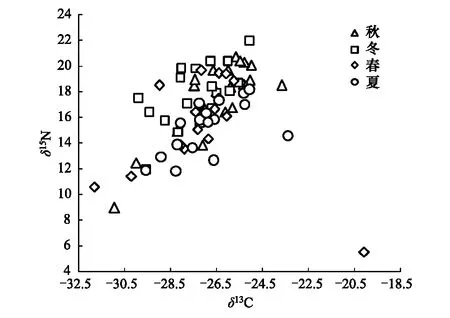
圖1 太湖梅梁灣魚類群落穩定同位素食物網特征(數據來源[20])Fig.1 Stable isotope food web diagram for all seasonal types of the fish community in Meiliang Bay, Lake Taihu 圖中各點位為不同季節魚類碳氮穩定同位素均值;便于直觀,各數據點標準差未在圖中標注
在群落水平上,用直觀的箭頭圖評價了角度和幅度的季節變化。箭頭圖顯示了太湖梅梁灣魚類營養生態位移動的角度和幅度。Rayleigh檢驗用于評價角度分布的均一性,其零假設為分布均一。生態學意義為群落中各消費者營養生態位移動的角度在所有方向上相同,也就是說沒有特定的變化。如果檢驗結果為顯著水平,則說明群落水平的營養生態位移動不是隨機的,而是在食物網生態位空間里有方向性的。Watson-William雙樣本檢驗用于評價不同時間(如季節)或空間(如棲息地)角度變化的差異。該檢驗的零假設為兩組樣本角度無差異。本研究中,Watson-William雙樣本檢驗可以用于說明群落水平的營養生態位在食物網生態位空間里的移動在季節是否有顯著變化。本研究與環形統計有關的計算、做圖和統計檢驗均在R軟件中完成(Package ‘circular’)[26]。
2 結果
本研究共涉及到太湖梅梁灣沿岸帶收集的18種魚類的穩定同位素。研究區間包括4個季節:2004年到2005年秋、冬、春、夏。秋季魚類δ13C與δ15N值主要集中在(-27.5±0.6)‰—(-25.0±0.5)‰(δ13C)和(13.8±0.9)‰—(20.7±1.3)‰(δ15N)區間。冬季魚類穩定同位素主要集中在(-28.8±1.3)‰—(-25.3±0.4)‰(δ13C)和14.9‰—(20.4±0.8)‰(δ15N)的區間變化。春季魚類消費者穩定同位素主要在-28.1‰—(-25.8±1.4)‰(δ13C)和(13.5±1.9)‰—(19.7±0.9)‰(δ15N)區間變化。夏季魚類消費者穩定同位素主要在(-28.3±0.3)‰—(-25.1±0.9)‰(δ13C)和(11.8±2.2)‰—(18.2±0.9)‰(δ15N)的區間變化(圖1),詳細描述參見Zhou等[20]。
在群落水平上,我們用直觀的箭頭圖評價了角度和幅度的季節變化(圖 2)。與δ13C—δ15N圖(圖1)的模糊特征相比,箭頭圖清晰顯示了太湖梅梁灣魚類營養生態位移動的角度和幅度。結果表明太湖梅梁灣魚類營養生態位移動的季節特征明顯。進一步物種水平分析結果表明,各種魚類角度和幅度隨季節均有變化(表1)。Rayleigh檢驗結果表明,群落中不同種類在秋冬、冬春和夏秋均有顯著的一致的方向變化;而春夏期間不顯著(表2)。Watson-William檢驗結果表明,群落水平的魚類營養生態位秋冬動在秋冬和春冬季節轉換中有顯著差異(表2)。

圖2 魚類穩定同位素角度季節變化特征Fig.2 Arrow diagrams for angle of change for fishes along a gradient of seasons箭頭方向指示物種在營養生態位空間上的移動方向;箭頭大小指示物種移動幅度;同心環指示幅度的大小;圖中直線指示群落水平的移動方向,而外緣弧線指示群落移動角度的95%置信區間

種類Species秋冬Autumntowinter角度Angle幅度Magnitude冬春Wintertospring角度Angle幅度Magnitude春夏Springtosummer角度Angle幅度Magnitude夏秋Summertoautumn角度Angle幅度Magnitude紅鰭原鲌Cultrichthyserythrop-terus357.301.91203.1855.46163.1972.1518.5052.164翹嘴鲌Culterdabryi199.3595.4925.7725.819黃顙Pelteobagrusfulvidraco240.011.42200.4932.114刀鱭Coilianasus249.652.56214.2741.634113.3052.83112.0953.436大銀魚Protosalanxhyalocra-nius206.053.01銀魚Salangichthystankahkeii239.932.85182.7176.117餐條Hemiculterleucisculus265.400.87201.3293.382125.0221.55111.4174.193鳑鲏Rhodeusocellatus277.791.92190.2292.70325.562.29576.6451.429
續表
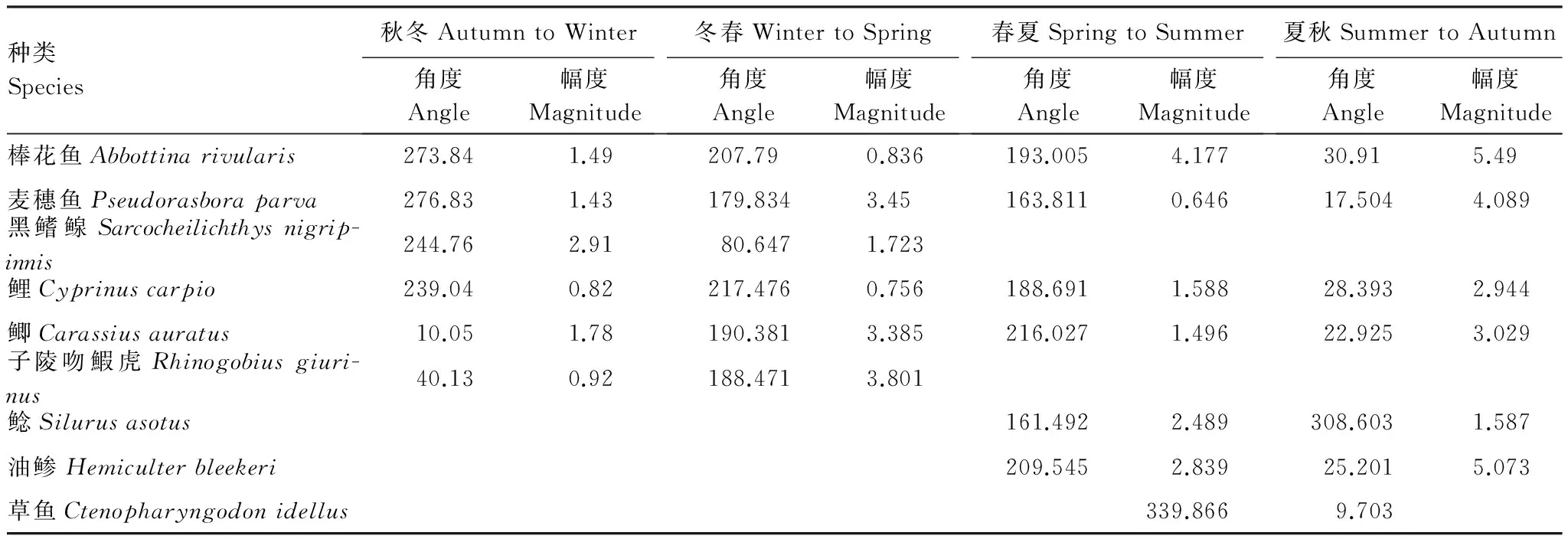
種類Species秋冬AutumntoWinter角度Angle幅度Magnitude冬春WintertoSpring角度Angle幅度Magnitude春夏SpringtoSummer角度Angle幅度Magnitude夏秋SummertoAutumn角度Angle幅度Magnitude棒花魚Abbottinarivularis273.841.49207.790.836193.0054.17730.915.49麥穗魚Pseudorasboraparva276.831.43179.8343.45163.8110.64617.5044.089黑鰭鳈Sarcocheilichthysnigrip-innis244.762.9180.6471.723鯉Cyprinuscarpio239.040.82217.4760.756188.6911.58828.3932.944鯽Carassiusauratus10.051.78190.3813.385216.0271.49622.9253.029子陵吻鰕虎Rhinogobiusgiuri-nus40.130.92188.4713.801鯰Silurusasotus161.4922.489308.6031.587油鲹Hemiculterbleekeri209.5452.83925.2015.073草魚Ctenopharyngodonidellus339.8669.703
表2太湖梅梁灣魚類群落在同位素生態位空間中方向季節變化特征的統計結果
Table2DirectionalstatisticsquantifyingchangeinisotopenichespaceforfishcommunitiesinMeiliangBay,LakeTaihu,overseasons;Pvaluesinboldfacetypearesignificantattheα=0.05level

時間Time種類數No.species平均值Meanvector方向Direction長度Length標準差CircularSDRayleigh'stestZPWatson-William'stestFP秋冬Autumntowinter14265.0990.63854.3035.7020.00216.679<0.001冬春Wintertospring13192.2020.87229.9739.880<0.00010.2460.625春夏Springtosummer13172.0160.45771.6792.7180.0630.5120.481夏秋Summertoautumn1220.4880.89826.5789.677<0.0001
3 討論
3.1 群落水平食物網能流季節演替
已有研究多關注食物資源和消費者穩定同位素值特征;然而,消費者營養生態位變化,尤其是高營養級消費者的變化在維持水生態系統的穩定性中扮演重要角色,決定了食物鏈長度和物質能量傳遞效率[27]。太湖富營養化問題嚴重,生態健康狀況逐年退化,關注太湖魚類消費者種群與群落水平的食物網動力學特征具有重要意義[20, 28- 29]。
太湖初級生產者(例如懸浮顆粒有機物和附著藻類)穩定同位素有顯著季節變化[20, 28- 29];而本研究結果也表明消費者穩定同位素特征也隨季節波動,這說明食物網中可利用資源的穩定同位素值時間變化會通過食物鏈傳遞到高營養級消費者[8- 9, 30]。此外魚類在生活史過程中食性轉變現象普遍[23, 31]。在太湖梅梁灣,腸含物分析表明,許多魚類為泛食性消費者(例如紅鰭原鲌、湖鱭和餐條),其食物來源隨著時間而發生改變[32]。因此,引起魚類群落水平營養生態位在食物網空間中季節性移動的主要因素為可利用資源的季節變化和不同魚類種群自身的食性季節性轉變。結合基準校正的穩定同位素混合模型結果也表明太湖梅梁灣食物網底層可利用資源(例如顆粒有機物)和初級消費者(如浮游動物)的穩定同位素的季節變化顯著,且魚類底棲與浮游能量來源比例季節變化顯著[20]。
本研究表明,群落中不同種類在秋冬、冬春和夏秋均有顯著的一致的方向變化。與附著藻類與水生植物相比,浮游初級生產者是梅梁灣食物網重要可利用資源。碳同位素特征也表明懸浮顆粒有機物在支持梅梁灣食物網碳源驅動中的重要性[20]。同時,由于梅梁灣食物網魚類群落雜食性水平高,因此魚類群落水平的營養生態位移動的一致性可以歸因于季節性浮游初級生產力對食物網能量流動的驅動作用。此外,梅梁灣春末、夏季、秋季浮游植物快速繁殖與生長是季節性驅動食物網能量流動的另一個特征。因此,群落水平的魚類營養生態位移動僅在秋冬和冬春季節轉換中有顯著差異也在一定程度上進一步支持了本結論。富營養化生態系統中,食物網群落水平營養生態位季節波動也暗示了系統穩定性的下降[20]。
3.2 環形統計效果評價
在群落水平上,本研究用直觀的箭頭圖評價了角度和幅度的季節變化(圖2)。與δ13C—δ15N圖(圖1)的模糊特征相比,箭頭圖清晰顯示了太湖梅梁灣魚類營養生態位移動的角度和幅度。應用穩定同位素研究群落水平的營養關系是近年來一個關注的焦點,因此應用定量評價技術手段分析群落同位素數據顯得尤為重要[33- 35]。Schmidt等應用環形統計分析手段定量評價了兩個生態系統中節肢動物群落空間梯度和魚類群落時間梯度下的食物網能流特征,并對解釋數據的生態學意義進一步提升[19]。本研究結果也表明環形統計在分析富營養湖泊魚類群落相對復雜的季節性食物網變化特征方面有很大優勢。與δ13C—δ15N圖的趨勢特征相比[20],環形統計給出了定量評價季節性食物網能流變化的結果;這也為進一步探究生態系統穩定性、抗干擾能力和恢復力提供了定量判別手段。
不同時空中生物與非生物因子均會影響生態系統生物地球化學循環特征,進而生物的穩定同位素比值。因此,近年來同位素生態學研究中,通常根據所研究的生態系統自身特征,選擇基準生物來評價食物網[6]。基于以下兩個因素,本研究未對魚類群落的穩定同位素進行基準校正。第一,由于梅梁灣食物網魚類群落雜食性水平高,許多種類食物來源在兩個營養級以上,評價魚類群落水平的營養生態位移動不能簡單確定唯一同位素營養級富集指數[1]。第二,由于梅梁灣富營養化嚴重,同位素生物地球化學循環季節變化劇烈;在缺乏不同季節同一物種作為基準的情況下,也不便于用不同同位素周轉特征的食物網底層生物作為校正基準[37]。綜上,為進一步提升食物網定量統計分析的精度,仍需進行基準校正下的食物網營養生態位定量研究。
[1] Post D M. Using stable isotopes to estimate trophic position: models, methods, and assumptions. Ecology, 2002, 83: 703- 718.
[2] Zimmerman M S, Schmidt S N, Krueger C C, Vander Zanden M J, Eshenroder R L. Ontogenetic niche shifts and resource partitioning of lake trout morphotypes. Canadian Journal of Fisheries and Aquatic Sciences, 2009, 66: 1007- 1018.
[3] López-Bao J, Palomares F, Rodríguez A, Ferreras P. Intraspecific interference influences the use of prey hotspots. Oikos, 2011, 120: 1489- 1496.
[4] Schindler D E, Scheuerell M D. Habitat coupling in lake ecosystems. Oikos, 2002, 98: 177- 189.
[5] Xu J. Ecological studies on the food web structures and trophic relationships of freshwater lakes in China using stable carbon and nitrogen isotopes. PhD thesis. Institute of Hydrobiology,Chinese Academy of Sciences.2005.
[6] Xu J, Zhang M, Xie P. Variability of stable isotopic baselines and its consequence for trophic modeling. Journal of Lake Sciences, 2010, 22: 10- 23.
[7] Xu J, Zhou Q, Zeng Q, Zhang M, Zhang L, Wen Z, Wang, Y. Stable carbon and nitrogen isotopes in aquatic ecology: Theories and applications//Duan, C. (ed.) Advances in Ecological Sciences. Higher Education Press, 2010: 35- 80.
[8] Xu J, Xie P, Zhang M, Yang H. Variation in stable isotope signatures of seston and a zooplanktivorous fish in a eutrophic Chinese lake. Hydrobiologia, 2005, 541: 215- 220.
[9] Xu J, Xie P, Zhang M, Zhou Q, Zhang L, Wen Z, Cao T. Icefish (Salangidae) as an indicator of anthropogenic pollution in freshwater systems using nitrogen isotope analysis. Bulletin of Environmental Contamination and Toxicology, 2007, 79: 323- 326.
[10] Xu J, Zhang M, Xie P. Stable carbon isotope variations in surface bloom scum and subsurface seston among shallow eutrophic lakes. Harmful Algae, 2007, 6: 679- 685.
[11] Xu J, Zhang M, Xie P. Primary consumers as bioindicator of nitrogen pollution in lake planktonic and benthic food webs. Ecological Indicators, 2011, 14: 189- 196.
[12] Rudnick D, Resh V. Stable isotopes, mesocosms and gut content analysis demonstrate trophic differences in two invasive decapod crustacea. Freshwater Biology, 2005, 50: 1323- 1336.
[13] Logan J, Jardine T, Miller T, Bunn S, Cunjak R, Lutcavage M. Lipid corrections in carbon and nitrogen stable isotope analyses: comparison of chemical extraction and modelling methods. Journal of Animal Ecology, 2008, 77: 838- 846.
[14] Van den Meersche K, Van Rijswijk P, Soetaert K, Middelburg J J. Autochthonous and allochthonous contributions to mesozooplankton diet in a tidal river and estuary: Integrating carbon isotope and fatty acid constraints. Limnology and Oceanography, 2009, 54: 62- 74.
[15] Phillips D L, Gregg J W. Uncertainty in source partitioning using stable isotopes. Oecologia, 2001, 127: 171- 179.
[16] Parnell A C, Inger R, Bearhop S, Jackson A L. Source partitioning using stable isotopes: coping with too much variation. PLoS One, 2010, 5: e9672.
[17] Newsome S D, Martinez del Rio C, Bearhop S, Phillips D L. A niche for isotopic ecology. Frontiers in Ecology and the Environment, 2007, 5: 429- 436.
[18] Layman C A, Arrington D A, Montaa C G, Post D M. Can stable isotope ratios provide for community-wide measures of trophic structure?. Ecology, 2007, 88: 42- 48.
[19] Schmidt S N, Olden J D, Solomon C T, Vander Zanden M J. Quantitative approaches to the analysis of stable isotope food web data. Ecology, 2007, 88: 2793- 2802.
[20] Zhou Q, Xie P, Xu J, Liang X, Qin J, Cao T, Chen F. Seasonal trophic shift of littoral consumers in eutrophic Lake Taihu (China) revealed by a two-Source mixing model. The Scientific World Journal, 2011, DOI 10.1100/tsw.2011.134.
[21] Batschelet E. Circular statistics in biology. New York, USA: Academic Press New York, 1981.
[22] Vander Zanden M J, Vadeboncoeur Y. Fishes as integrators of benthic and pelagic food webs in lakes. Ecology, 2002, 83: 2152- 2161.
[23] Xu J, Zhang M, Xie P. Size-related shifts in reliance on benthic and pelagic food webs by lake anchovy. Ecoscience, 2007, 14: 170- 177.
[24] Xu J, Zhang M, Xie P. Stable isotope changes in freshwater shrimps (ExopalaemonmodestusandMacrobrachiumnipponensis): trophic pattern implications. Hydrobiologia, 2008, 605: 45- 54.
[25] Xu J, Zhang M, Xie P. Sympatric variability of isotopic baselines influences modeling of fish trophic patterns. Limnology, 2011, 12: 107- 115.
[26] R Development Core Team.R:ALanguageandEnvironmentforStatisticalComputing. R Foundation for Statistical Computing, Vienna, Austria. 2009, http://www.R-project.org.
[27] Vander Zanden M J, Fetzer W W. Global patterns of aquatic food chain length. Oikos, 2007, 116: 1378- 1388.
[28] Zhou Q, Xie P, Xu J, Ke Z, Guo L. Growth and food availability of silver and bighead carps: evidence from stable isotope and gut content analysis. Aquaculture Research, 2009, 40: 1616- 1625.
[29] Zhou Q, Xie P, Xu J, Ke Z, Guo L, Cao T. Seasonal variations in stable isotope ratios of two biomanipulation fishes and seston in a large pen culture in hypereutrophic Meiliang Bay, Lake Taihu. Ecological Engineering, 2009, 35: 1603- 1609.
[30] Zhang L, Xu J, Xie P, Zang X, Qiu G, Zeng J. Stable isotope variations in particulate organic matter and a planktivorous fish in the Yangtze River. Journal of Freshwater Ecology, 2007, 22: 383- 386.
[31] Wang Y, Yu X, Xu J. Decreased trophic position as a function of increasing body size of a benthic omnivorous fish from the largest freshwater lake in China. Environmental Biology of Fishes, 2011, 91: 505- 512.
[32] Jialin Ye. Community assembly and feeding ecology of littroral fish in Meilang Bay, Lake Taihu. Master thesis. Huazhong Agricultural University,2006.
[33] Schmidt S N, Vander Zanden M J, Kitchell J F. Long-term food web change in Lake Superior. Canadian Journal of Fisheries and Aquatic Sciences, 2009, 66: 2118- 2129.
[34] Vander Zanden M J, Chandra S, Allen B C, Reuter J E, Goldman C R. Historical food web structure and restoration of native aquatic communities in the Lake Tahoe (California-Nevada) basin. Ecosystems, 2003, 6: 274- 288.
[35] Solomon C T, Carpenter S R, Rusak J A, Vander Zanden M J. Long-term variation in isotopic baselines and implications for estimating consumer trophic niches. Canadian Journal of Fisheries and Aquatic Sciences, 2008, 65: 2191- 2200.
[37] Xu J, Zhang M, Xie P. Sympatric variability of isotopic baselines influences modeling of fish trophic patterns. Limnology, 2011, 12: 107- 115.
參考文獻:
[5] 徐軍. 應用碳、氮穩定性同位素探討淡水湖泊的食物網結構和營養級關系. 2005. 中國科學院水生生物研究所.
[6] 徐軍, 張敏, 謝平. 氮穩定同位素基準的變異性及對營養級評價的影響. 湖泊科學, 2010, 22: 10- 23.
[7] 徐軍, 周瓊, 曾慶飛, 張敏, 張亮, 溫周瑞, 王玉玉. 碳、氮穩定同位素技術及其在水域生態學研究中的應用. 生態科學進展第五卷. 北京: 高等教育出版社, 2010: 35- 80.
[32] 葉佳林. 太湖梅梁灣沿岸帶魚類組成和攝食生態研究. 華中農業大學碩士論文, 2006.
Seasonaldynamicsoffoodwebenergypathwaysatthecommunity-level
XU Jun1,*, ZHOU Qiong2, WEN Zhourui3, XIE Ping1
1InstituteofHydrobiology,ChineseAcademyofSciences,Wuhan430072,China2CollegeofFisheries,HuazhongAgriculturalUniversity,Wuhan430070,China3HubeiFisheryScienceInstitute,Wuhan430071,China
Stable isotopes analysis, especially carbon and nitrogen, are now commonly used to study material circulation and energy flow within ecosystems. Carbon isotope ratios (δ13C) are used to trace food sources of consumers, while nitrogen isotope ratios (δ15N) are mainly used to quantify trophic levels of organisms. Traditionally,δ13C vs.δ15N bi-plots have been used to describe food web structure for a single time period or ecosystem, but this method show less power in comparisons of food webs across time and space. Meanwhile, simple qualitative descriptions of food webs cannot test hypotheses regarding food web complex changes. Here we present statistical methodologies for quantitatively comparing stable isotope food web data. We demonstrate the utility of circular statistics and hypothesis tests for quantifying directional food web differences using a case study, a freshwater fish community from Meiliang Bay, Lake Taihu, over seasons. We used arrow diagrams for angle of change for fishes along a gradient of seasons, in which each arrow represents a single species and the direction in trophic niche space the species moved. The length of the arrow represents the magnitude of change for that particular species. Concentric circles correspond to magnitude of change. The straight line is the mean vector of change among all species; the curved line on the rim indicates the 95% confidence interval around the mean vector of change. Directional change (magnitude and angle) and statistics quantifying change in isotope niche space for fish communities were also calculated. Based on these results, we found that most species from the freshwater fish community showed statistically significant shift in the same direction in food web space toward more pelagic-based production except summer to autumn seasons. In support of these patterns, the Rayleigh′s test indicated significant pattern of consistent change among species in autumn to winter, winter to spring and spring to summer seasons. The Watson-William′s test for comparison of the community in different time indicated that significant difference between the directional change in the fish community between autumn to winter and winter to spring seasons. Seasonal dynamics of food web energy pathways at the community-level in the current study was attributed to seasonal dynamics of stable isotope composition of available resources and foraging shifts of fish species. Meanwhile, because of the high omnivory in fish community in the current system, temporal variations in pelagic primary productivity strongly drive the energy flows in local food web. Therefore, seasonal dynamics of food web energy pathways at the community-level in eutrophic ecosystem may imply the decrease of food web stability in this eutrophic system with the dynamics of resource availability. As an understanding of food web structure and functioning is of growing importance in ecology theory and ecosystem management, our study demonstrate the quantifying food web differences from the standard stable isotope analysis.
community-level; food web; trophic niche; feeding strategy; stable isotope; eutrophic aquatic ecosystem
國家自然科學基金資助項目(31170439);國家科技重大專項資助項目(2012ZX07101-001-04)
2012- 05- 13;
2012- 10- 23
*通訊作者Corresponding author.E-mail: xujun@ihb.ac.cn
10.5846/stxb201205130700
徐軍,周瓊,溫周瑞,謝平.群落水平食物網能流季節演替特征.生態學報,2013,33(15):4658- 4664.
Xu J, Zhou Q, Wen Z R, Xie P.Seasonal dynamics of food web energy pathways at the community-level.Acta Ecologica Sinica,2013,33(15):4658- 4664.
猜你喜歡
今日農業(2021年11期)2021-08-13 08:53:34
保健醫苑(2021年7期)2021-08-13 08:48:02
學生天地(2020年36期)2020-06-09 03:12:30
小學科學(學生版)(2020年5期)2020-05-25 07:11:32
小學科學(學生版)(2020年4期)2020-05-21 07:30:46
小學科學(學生版)(2020年3期)2020-03-25 13:31:22
中國生殖健康(2019年8期)2019-01-07 01:18:24
幸福(2018年33期)2018-12-05 05:22:46
作文周刊·小學一年級版(2017年17期)2017-06-27 19:32:55
廣東第二課堂·小學(2017年2期)2017-02-20 15:10:08