
十溴聯苯醚環境修復技術的研究進展
2014-03-29 00:49:08李艷玲杜克久
化工環保 2014年3期
才 滿,李艷玲,杜克久
(1. 河北農業大學 林學院,河北 保定 071000;2. 河北農業大學 河北省林木種子資源與森林保護重點實驗室,河北 保定 071000)
隨著現代工業的發展,添加型阻燃劑多溴聯苯醚(PBDEs)的污染狀況越來越嚴重。十溴聯苯醚(BDE-209)是溴代阻燃劑同系物中溴含量最高的化合物,具有高親脂性、低水溶性、難揮發性等特點[1-2]。因其價格低廉、阻燃性能優越、且在所有溴代阻燃劑同系物中急性毒性最低[3-5],被廣泛用于紡織品和電子產品等領域[6]。據統計,BDE-209阻燃劑用量約占國際溴代阻燃劑市場總量的80%[7]。在大氣、土壤、沉積物以及人、動物等生物試樣中均可檢出BDE-209,其中,部分電子垃圾回收廠室外灰塵試樣中BDE-209的含量達到18 996.8 ng/g[8],一些焚燒點土壤中BDE-209的含量可高達48 600 ng/g[9],甚至被抽檢的人體血液試樣中BDE-209的含量也高達3 100 ng/g[10]。
BDE-209排放到環境中后,可經光降解、高溫分解、生物及微生物降解等過程轉化為多溴二苯并二噁英、多溴二苯并呋喃以及低溴代的聯苯醚,這些降解產物更易進入生物體內,產生更強的毒性作用[11-18]。小鼠毒理學研究發現,BDE-209具有潛在的致癌性和神經毒性,同時,可對子代的免疫功能產生影響,并會隨子代年齡的增長而惡化[19]。鑒于BDE-209存在環境穩定性問題及對環境的潛在危害,2008年6月歐盟在電子產品中已禁止使用BDE-209[20]。
本文從BDE-209的光降解、零價鐵降解以及生物降解等方面進行綜述,并提出亟待解決的問題。
1 BDE-209的光降解
在紫外光(280~400 nm)的作用下,BDE-209的分子可丟失溴原子,使溴原子產生重排的可能性[21]。由于太陽光中含有紫外光波段,因此環境中的BDE-209可在太陽光的作用下發生光降解反應。光降解機理為還原脫溴,將高溴代的BDE-209轉化成低溴代聯苯醚。光源、溶劑和介質都會影響BDE-209的光降解特性。
祖耕武等[22]用太陽光和紫外燈分別作為反應所需光源,進行BDE-209的光降解反應。實驗結果表明:與用太陽光照射相比,用紫外燈照射的光降解反應速率較快,兩者的半衰期分別為35 m in和10 m in;在紫外燈照射下,負載在硅膠和氧化鋁上的BDE-209半衰期為 18 m in;BDE-209經光照射后,可降解為低溴代產物;在暗條件下,BDE-209不能發生反應。
在同一光源照射下,BDE-209在不同溶劑中的降解速率不同。張梅等[23]研究發現:在太陽光照射下,BDE-209在不同溶劑中降解速率的快慢順序為甲苯>甲醇>正己烷>正己烷-丙酮>甲醇-水>乙醇-水;在模擬太陽光的光源照射下,降解速率的快慢順序為甲苯>甲醇>甲醇-水>乙醇-水>正己烷>正己烷-丙酮;在紫外光照射下,降解速率的快慢順序為甲苯>甲醇>正己烷-丙酮>正己烷>甲醇-水>乙醇-水。在同一溶劑不同光源照射時,BDE-209降解速率的快慢順序為:紫外光>太陽光>模擬光源。
在同一光源作用下, BDE-209吸附在不同介質上時,光降解半衰期有差異。S?derstr?m等[24]研究發現,在太陽光的照射下,吸附于土壤和沙子中的BDE-209均可降解為低溴代聯苯醚,半衰期為 40~200 h。Ahn等[25]研究了吸附在不同固態基質表面的BDE-209在紫外光照射下的光降解反應,BDE-209半衰期從低到高的基質的順序為蒙脫石和高嶺石(半衰期分別為 36 d和 44 d)<自然沉積物(半衰期為150 d)<氫氧化鋁、氫氧化鐵和二氧化錳(不降解)。
Sun等[26]報道了一種用TiO2快速光降解有機溶劑中BDE-209的新方法。該方法采用360 nm以上的光源照射,7.5 m im后BDE-209開始降解,968 h后完全降解,生成四溴聯苯醚(BDE-47)。BDE-47在大氣、生物體中的含量高,毒性強。
雖然光源、溶劑和吸附介質對BDE-209的降解速率具有一定的影響,但降解過程基本一致,均為經光降解脫溴,生成毒性更強的低溴代聯苯醚。
2 BDE-209的零價鐵降解
零價鐵有較強的還原性,可還原多種污染物,如硝基苯、多氯聯苯、二噁英、滴滴涕和鹵代酚類[27-28]。目前,利用零價鐵降解多溴聯苯醚的研究較少。Keum等[27]利用零價鐵對有機溶劑中BDE-209進行降解時發現,有92%的BDE-209在40 d內脫溴降解成一溴、二溴或三溴代聯苯醚,且未檢測到氧化物的生成;隨多溴聯苯醚原子中溴原子個數的減少,降解速率也逐漸減慢。明磊強等[29]利用零價鐵對水中BDE-209進行還原脫溴反應時發現,在酸性(pH=5)環境、濃度較高、零價鐵顆粒較小(粒徑為74 μm)及溫度較高的條件下,均有利于BDE-209脫溴降解反應的進行。
3 BDE-209的生物降解
3.1 厭氧降解
厭氧降解是通過微生物催化還原反應,使高溴代同系物得到電子的同時釋放出溴離子,轉化為低溴代同系物后再進一步降解。He等[14]報道,從德國微生物保存中心得到的厭氧菌株Sulfurospirillum multivoran可將有機溶劑中BDE-209 降解為七溴和八溴代聯苯醚,但不能將八溴代聯苯醚混合物進一步降解。而脫鹵球菌(Dehalococcoidessp.)可將有機溶劑中八溴代聯苯醚混合物降解為二至七溴代聯苯醚。Tokarz等[30]利用沉積物中的微生物和生物模擬系統研究BDE-209的降解時,得到了BDE-209脫溴代謝的途徑,并發現BDE-209會在微生物體內脫溴降解為毒性更強的低溴代產物。由于多溴聯苯醚具有生物蓄積性,低溴代產物會大量蓄積在生物體內。
在厭氧細菌作用下,降解速率與溴化程度成正比[16]。Gerecke等[16]報道了在厭氧微生物的作用下,BDE-209可脫溴降解為九溴聯苯醚混合物。Tokarz等[30]研究了在厭氧沉積物中,BDE-209可被土著微生物還原脫溴為六至九溴代聯苯醚,且隨溴取代數目的減少,還原脫溴的速率降低。
厭氧還原脫溴反應速率較慢,半衰期可長達700 d[15]。加入多溴聯苯醚同系物或其他芳香族化合物時,可促進BDE-209的脫溴降解。Gerecke等[16]研究發現:加入芳香族化合物時(如 4-溴安息香酸、2,6-二溴聯苯、五溴聯苯酚、六溴環十二碳和十溴聯苯),可使BDE-209的降解速率加快。Zhou等[31]的研究結果表明,吐溫80、環糊精等溶劑使微生物更易接觸溴代阻燃劑,從而增強其生物利用性,促進BDE-209的降解;但吐溫80和環糊精的濃度較高時卻抑制了BDE-209的降解。
3.2 好氧降解
目前篩選得到的好氧菌株可進行甲基化、羥基化或在芳香烴接合處發生鍵斷裂等反應,從而生成新的溴代化合物[32-35]。這些新生成的溴代化合物可作為微生物生長的碳源,在外加酶的作用下開環降解,進入三羧酸循環(TCA)或徹底分解成CO2和H2O,從而降解低溴代聯苯醚[36]。Kim等[36]從污水處理廠活性底泥中分離到1株能利用低溴代聯苯醚作為生長碳源的鞘氨醇單胞菌(Sphingomonassp. PH-07),發現該菌株能利用4-一溴聯苯醚和2,4-二溴聯苯醚作為生長碳源,在體內代謝成溴苯酚、溴兒茶酚和2-羥基黏糠酸,最后進入TCA循環,從而徹底降解低溴代聯苯醚。但該菌種對4,4'-二溴聯苯醚和2,4,6-三溴聯苯醚的降解程度的影響很小,甚至幾乎不降解。溴代聯苯醚的降解圖見圖1。
降解BDE-209的厭氧微生物種類較多,但反應時間長,且僅限于將其降解為低溴代同系物[15,30-31,37];而好氧微生物可降解低溴代同系物,且反應時間短、降解程度高[36]。故采用厭氧和好氧微生物的協同作用,可獲得更好的降解效果。
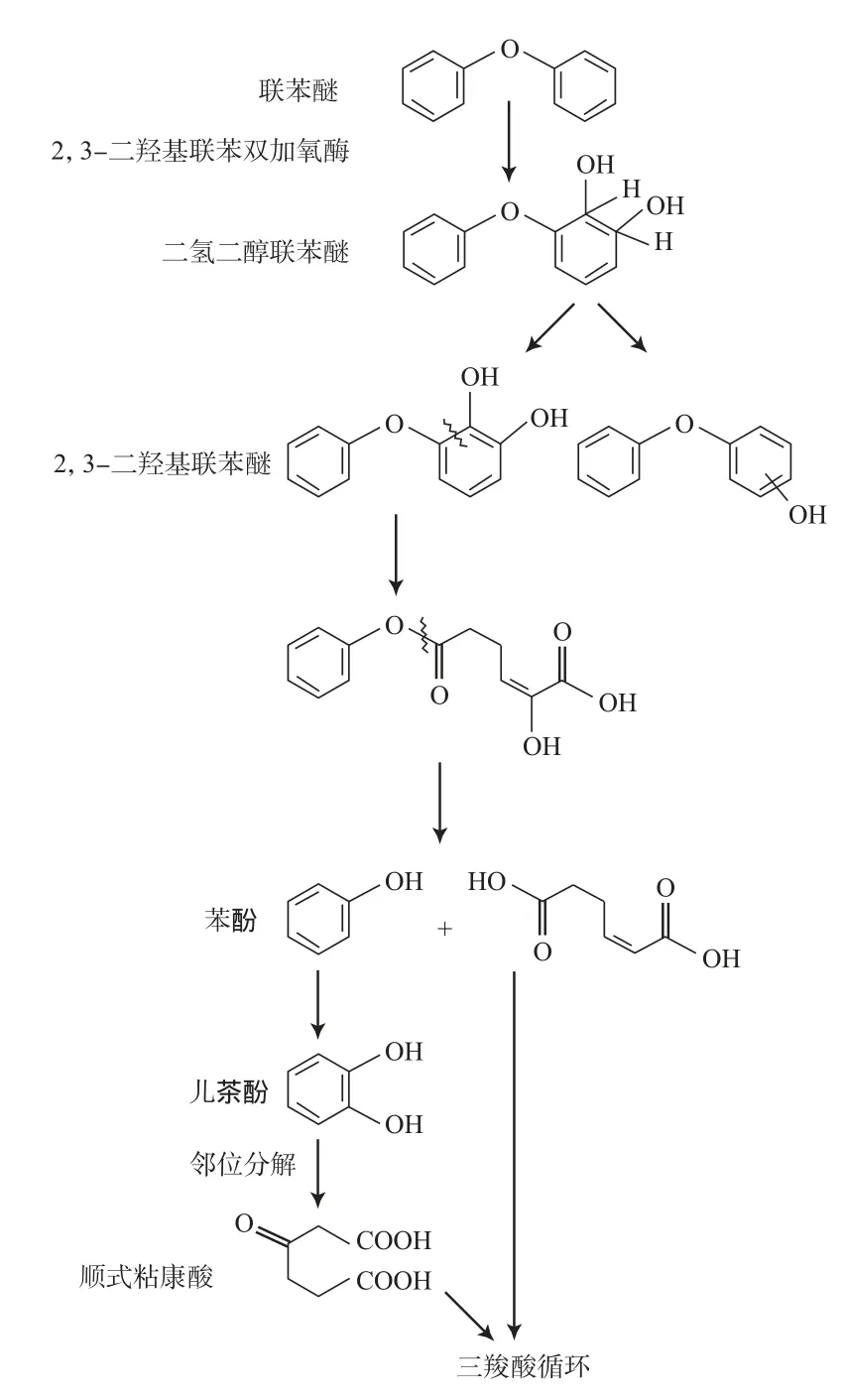
圖1 溴代聯苯醚的降解圖
4 結語與展望
在光降解、零價鐵降解、微生物降解的作用下,BDE-209均可降解為低溴代聯苯醚產物,從而造成環境中低溴代聯苯醚的含量呈上升趨勢,將對生物及人體造成更大危害。因此,應將BDE-209作為新的環境污染物喚起人們更多的關注。目前,亟待解決的問題有以下幾點:
a)光降解、零價鐵降解、微生物降解均還局限于實驗室研究,不能完全代表自然環境中的降解結果,需加強自然條件下降解方法的探索研究。
b)光降解是所有降解方法中降解速率最快的一種,BDE-209經光照后降解成毒性更強的低溴代產物。而好氧微生物能完全開環降解低溴代產物,故應著重研究好氧微生物降解BDE-209的機理及途徑。
致謝 本研究得到河北省強勢學科項目的資助,謹表謝意。
[1] Meironyte G D,Bergman A,Noren K. Polybrominat-ed diphenyl ethers in Swedish human liver and adipose tissue[J]. Arch Environ Contam Toxicol,2001,40:564-570.
[2] Kajiwara N,Kamikawa S,Ramu K,et al. Geographical distribution of polybrominated diphenyl ethers(PBDEs)and organochlorines in small cetaceans from Asian water[J]. Chemosphere,2006,64:287-295.
[3] Huang S C,Giordano G,Costa L G. Comparative cytotoxicity and intracellular accumulation of five polybrominated diphenyl ether congeners in mouse cerebellar granule neurons[J]. Toxicol Sci,2010,114(1):124-132.
[4] Jin Shiwei,Yang Fangxing,Hui Yang,et al.Cytotoxicity and apoptosis induction on RTG-2cells of 2,2′,4,4′-tetrabromodiphenyl ether(BDE-47)and decabrominated diphenyl ether(BDE-209)[J]. Toxicol In Vitro,2010,24(4):1190-1196.
[5] van der Ven L T,van de Kuil T,Leonards P E,et al.A 28-day oral dose toxicity study in Wistar rats enhanced to detect endocrine effects of decabromodipheny l ether(decaBDE)[J]. Toxicol Lett,2008,179(1):6-14.
[6] de Wit C A. An overview of brominated flame retardants in the environment[J]. Chemosphere,2002,46(5):583-624.
[7] Goodman J E. Neurodevelopmental effects of decabromodiphenyl ether(BDE-209) and implications for the reference dose[J]. Regul Toxicol Pharmacol,2009,54:91-104.
[8] 王璟,陳社軍,田密,等. 電子廢棄物處理地下室內外灰塵中多溴聯苯醚的污染及其人群暴露水平[J].環境科學,2010,31(1):173-178.
[9] Leung A O W,Luksemburg W J,Wong A S,et al.Spatial distribution of polybrom inated diphenyl ethers and polychlorinated dibenzo-p-dioxins and dibenzofurans in soil and combusted residue at guiyu,an electronic waste recycling site in Southeast China[J].Environ Sci Technol,2007,41(8):2730-2737.
[10] Bi Xinhui,Thomas G O,Jones K C,et al. Exposure of electronics dismantlingworkers to polybrom inated diphenyl ethers,polychlorinated biphenyls,and organochlorine pesticides in South China[J]. Environ Sci Technol,2007,41(16):5647-5653.
[11] Vorkamp K,Thom sen M,Frederiksen M,et al.Polybrominated diphenyl ethers(PBDEs) in the indoor environment and associations with prenatal exposure[J]. Environ Int,2011,37(1):1-10.
[12] Bezares-Cruz J,Jafvert C T,Hua I. Solar photodecomposition of decabromodiphenyl ether:Products and quantum yield[J]. Environ Sci Technol,2004,38:4149-4156.
[13] Gevao B,Al-Bahloul M,Al-Ghadban A,et al.House dust as a source of human exposure to polybrominated diphenyl ethers in Kuwait[J]. Chemosphere,2006,64:603-608.
[14] He Jianzhong,Robrock K R,Alvarez-cohen L.Microbial reductive debromination of polybrominated diphenyl ethers(PBDEs)[J]. Environ Sci Technol.2006,40(14):4429-4434.
[15] Gerecke A C,Giger W,Hartmann P C,et al.Anaerobic degradation of brominated flame retardants in sew age sludge[J]. Chemosphere,2006,64:311-317.
[16] Gerecke A C,Hartmann P C,Heeb N V,et al. Anaerobic degradation of decabromodiphenyl ether[J].Environ Sci Technol,2005,39(4):1078-1083.
[17] Eriksson J,Green N,Marsh G,et al. Photochemical decomposition of 15 polybrominated diphenyl ether congeners in methanol/water[J]. Environ Sci Technol,2004,38:3119-3125.
[18] Kajiwara N,Noma Y,Takigamu H.Photolysis studies of technicaldecabromodiphenyl ether(DecaBDE)and ethane (DeBDethane) in plastics under natural sunlight[J]. Environ Sci Technol,2008,42(12):4404 -4409.
[19] 杜紅燕,朱琳,陳中智. 十溴聯苯醚的毒理學效應研究進展[J]. 毒理學雜志,2008,22(1):50-52.
[20] Marie Frederiksen,Katrin Vorkamp,Line Mathiesen,et al. Pelseaacrchental transfer of the polybrominated diphenyl ethers BDE-47,BDE-99 and BDE-209 in a human placenta perfusion system:An experimental study[J]. Environ Health,2010,9:32.
[21] Gunilla S?derstr?m,Ulla Sellstr?m,Cynthiaa Dewit,et al. Photolytic debromination of decabromodiphenyl ether(BDE209)[J]. Environ Sci Technol,2004,38(1):127-132.
[22] 祖耕武,文晟,盛國英. 顆粒物上十溴聯苯醚的光降解反應[J]. 生態環境學報,2009,18(1):205-209.
[23] 張梅,林匡飛,劉莉莉,等. 光源和溶劑對十溴聯苯醚光降解的影響[J]. 環境污染與防治,2009,31(1):26-30.
[24] S?derstr?m J,Sellstr?m U,de Wit C A,et al. Pho-tolytic debromination of decabromodiphenyl ether(BDE-209)[J]. Environ Sci Technol,2004,38:127-132.
[25] Ahn Mi-Youn,Filley T R,Jafvert C T,et al. Photodegradation of decabromodiphenyl ether adsorbed into clay minerals,metal oxides and sediment[J]. Environ Sci Technol,2006,40:215-220.
[26] Sun Chunyan,Zhao Dan,Chen Chuncheng,et al.TiO2-Mediated photocatalytic debromination of decabromodiphenyl ether:kinetics and intermediates[J].Environ Sci Technol,2009,43:157.
[27] Keum Young-Soo,Li Q X. Reduction of nitroaromatic pesticides with zerovalent iron[J]. Chemosphere,2004,54(3):255-263.
[28] 付豐連. 零價鐵處理污水的最新研究進展[J]. 工業水處理,2010,30(6):1-4.
[29] 明磊強,何義亮,章敏,等. 零價鐵降解多溴聯苯醚影響條件的研究[J]. 凈水技術,2010,29(2):49-52.
[30] Tokarz J A,Ahn Mi-Youn,Leng J,et al. Reductive debromination of polybrominated diphenyl ethers in anaerobic sediment and a biomimetic system[J]. Environ Sci Technol,2008,42(4):1157-1164.
[31] Zhou Juan,Jiang Weiying,Ding Juan,et al. Effect of tween 80 and β-cyclodextrin on degradation of decabromodiphenyl ether(BDE-209)by White Rot fungi[J]. Chemosphere,2007,70(2):172-177.
[32] Schmidt S,Wittich R M,Fortnage P,et al. Metabolism of 3-methyldiphenyl ether bySphingomonassp.SS31[J]. FEMS Microbiol Lett,1992,96(2/3):253-258.
[33] Seigle-Murandi F M,Krivobok S M A,Steiman R L,et al. Biphenyl oxide hydroxylation by Cunninghamella echinulata[J].J Agric Food Chem,1991,39(2):428-430.
[34] Schauer F,Henning K,Pscheidl H,et al. Biotransformation of diphenyl ether by the yeast Trichosporon beigelii SBUG 752[J]. Biodegradation,1995,6(2):173-180.
[35] Ronen Z,Abeliovich A. Anaerobic-aerobic process for microbial degradation of tetrabromobisphenol A[J].Appl Environ Microbiol,2000,66(6):2372-2377.
[36] Kim Young Mo,Nam In Hyum,Murugesan Kumarasamy,et al. Biodegradation of diphenyl ether and transformation of selected brominated congeners bySphingomonassp. PH-07[J]. Appl Microbiol Biotechnol,2007,77:187-194.
[37] Armeneate P M,Kafkewitz D,Laewandowski G A,et al. Anaerobic-aerobic treatment of halogenated phenolic compounds[J]. Water Res,1999,33(3):681-692.
