任務型閱讀一例
2015-05-30 10:48:04廖英
高中生學習·高三版 2015年1期
關鍵詞:語言
廖英
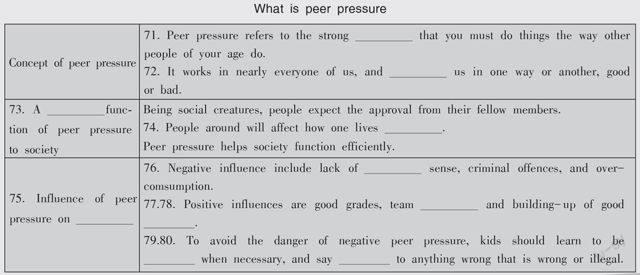
請閱讀下面短文,并根據所讀內容在文章后表格中的空格里填入一個最恰當的單詞。
The expression, “everybodys doing it”, is very much at the center of the concept of peer pressure. It is a strong influence of a group, especially of children, on members of that group to behave as everybody else does. It can be positive or negative. Most people experience it in more than one way during their lives.
People are social creatures by nature, and so it is hardly surprising that part of their self—respect comes from the approval of others. The distinct is why the approval of peers, or the fear of disapproval, is such a powerful force in many peoples lives. It is the same instinct that drives people to dress one way at home and another way at work, or to answer “fine” when a stranger asks “how are you?” even if it is not necessarily true. There is a practical aspect to this: it helps society to function efficiently, and encourages a general level of self-discipline that simplifies day-to-day interaction.
For certain individuals, seeking social acceptance is so important that it becomes like an addiction; in order to satisfy the desire, they may go so far as to abandon their sense of right and wrong. Teens and young adults may feel forced to use drugs, or join gangs that encourage criminal behavior. Mature adults may sometimes feel pressured to cover up illegal activity at the company where they work, or end up in debt because they are unable to hold back the desire to buy a house or car that they cant afford in an effort to “keep up with the Joneses”.
However, peer pressure is not always negative. A student whose friends are good at academics may be urged to study harder and get good grades. Players on a sports team may feel driven to play harder in order to help the team win. This type of influence can also get a friend off drugs, or to help an adult take up a good habit or drop a bad one. Study groups and class projects are examples of positive peer groups that encourage people to better themselves.
Schools try to teach kids about the dangers of negative peer pressure. They teach kids to stand up and be themselves, and encourage them to politely decline to do things that they believe are wrong. Similarly, it can be helpful to encourage children to greet the beneficial influence of positive peer groups.
隨著新課改的實施,2006年起浙江、江蘇、上海等城市陸續采取一種新的高考閱讀理解考查形式,即任務型閱讀。它要求考生根據文中提供的信息用恰當的詞語完成與短文相關的圖表,增加了讀寫的要求。相對于傳統閱讀理解,更突出“表達”強調在語言輸出的基礎上加強語言輸出能力的考察。但萬變不離其宗,任務型閱讀仍屬于閱讀范疇,題目設置和傳統閱讀一樣,都是旨在圍繞不同的閱讀技能和語言運用而展開,涉及詞性轉化、詞語釋義、同意替換、結構分析、細節理解、語法結構、歸納演繹等。我們以上文中的2014年江蘇高考的任務型閱讀為例,在傳統閱讀理解的解題思路基礎上,來學習分四步如何解答這類閱讀題。
1. 先閱讀,再做題。任務型閱讀文章長,詞匯多,句式復雜,考生還是需要先通讀一遍文章才能對文章的話題和結構有大體了解。
2. 分析結構,找主題句。任務型閱讀非常強調考生的語篇分析能力,學生的讀后需要自己歸納總結并提煉語言將其核心詞寫出來。文章結構多為三部分:開頭(引入話題)、主題(探討話題)、結尾(總結觀點),主題句多安排在語段的開頭與結尾。
這篇任務型閱讀圖表設置了三個小標題,它們簡明扼要地概括出了文章的主要內容。我們可借助三個小標題與其下屬的細節信息將文章分成三部分。通過分析,我們得知第二段的主題句在段末,即There is a practical aspect to this: it helps society to function efficiently, and encourages a general level of self-discipline that simplifies day-to-day interaction,第3題屬于歸納詞的原詞再現,答案為practical,主題句可簡化為 A practical function of peer pressure to society。至于75題,3、4、5自然段的主題句都在句首,分別是:For certain individuals, seeking social acceptance is so important that it becomes like an addiction;However, peer pressure is not always negative;Schools try to teach kids about the dangers of negative peer pressure.我們將其歸納概括,即為Influence of peer pressure on individuals。
3. 按圖索驥,鎖定出處。這里的“圖”是指問題中的信號詞,根據它,我們可以在文章中定位出答案依據的大致位置。在根據三個小標題對文章進行分段后,我們可知道作答71、72應鎖定第一段,74題為第二段。同時根據題干中信號詞Negative influences/Positive influences/Kids should learn得知76需定位在第三段,77、78為第四段,79、80則為第五段。
4. 先變形,再答題。傳統閱讀理解在設置正確選項時,極少使用文本中原句,命題人往往是將文本信息用不同語言形式再現出來。任務型閱讀中的題目也強調對文章主要內容的轉述或概述,但這類考察難度更大,學生需寫出來而不再是選出來。所以考生在填寫答案之前,一定要先想一想是否需要轉變表達的形式。題型主要包括原詞重現(73、78)、同義替換(76、79、80)、詞性轉換(72)、提煉概括(71、74、75、77)四大類,四種題型難度指數依次上升。
71題為總結概括題。原文是It is a strong influence of... everybody else does,但題干為Peer pressure refers to the strong ? ? ? ? ?that you must do things the way other people of your age do。題干中所需要的是個抽象名詞,且后面跟的同位語從句的語意決定了答案是feeling而非influence。72題為詞性轉換題,influence的詞性從文中的名詞變成了動詞。74題也是總結概括題。原文:It is the same instinct... it is not necessarily true. (L3, P2) 同樣是這種本能驅使著人們在家和工作時穿不同的衣服,當別人問道“你好嗎?”時回答“我很好!”——盡管事實并不一定如此。此乃天性使然,非故意而為之——所以周圍的人們是無意識地(unconsciously)影響著我們生活。76題涉及到同義替換,原文:In order to satisfy... right and wrong. (L2, P3) 有些人為了滿足自己的需求,可能會泯滅自己的是非觀念,也就是道德觀念(lack of moral sense)。77、78可鎖定原文: Players on a sports team... a good habit or drop a bad one. (L2/3, P4) 通過總結概括與原詞再現可知Positive influences are good grades, team spirit and building-up of good habits. 79、80則涉及到同義替換。原文:Schools try to teach kids... they believe are wrong (L1, P5)中的stand up and be themselves即“be independent”。politely decline to do things that they believe are wrong即say no to anything wrong。
對于湖北考生而言,通過寫來輸出所輸入的文本信息的訓練不多。攻破這類任務型閱讀,大家需一方面不斷提高自己的詞匯量,另一方面可以先從一些涉及詞性詞性轉換的常規題入手,如“用所給詞適當形式填空”。借助于這些基礎題,不斷提高自己對詞性與固定搭配的敏感度,培養語言表達的靈活性與多樣性。
猜你喜歡
中華詩詞(2023年8期)2023-02-06 08:51:28
文苑(2020年4期)2020-05-30 12:35:30
小學生作文(中高年級適用)(2018年3期)2018-04-18 01:24:47
瘋狂英語·新策略(2017年8期)2017-05-31 08:13:46
華北電力大學學報(社會科學版)(2016年4期)2016-12-01 03:59:30
新聞傳播(2016年10期)2016-09-26 12:15:04
玉溪師范學院學報(2015年1期)2015-08-22 02:51:58
少兒科學周刊·少年版(2015年4期)2015-07-07 21:11:17
語文知識(2014年10期)2014-02-28 22:00:56
中學生英語高中綜合天地(2009年10期)2009-12-29 00:00:00