李長永, 張志鋼, 白 元, 秦永文
經皮左心耳封堵裝置研究進展
李長永,張志鋼,白元,秦永文
·綜述General review·
心房纖維顫動(房顫)是最常見的心律失常之一,房顫患者發生腦卒中的風險很大。口服抗凝藥物預防腦卒中存在出血風險,部分患者不能耐受。經皮左心耳封堵在房顫患者預防腦卒中方面安全有效,目前還只適用于存在抗凝禁忌的患者。本文回顧了近年來應用的多種左心耳封堵裝置,分析不同形狀設計的裝置與左心耳形態的關系。
心房纖維顫動;左心耳封堵,心房封閉裝置
心房纖維顫動(房顫)是最常見的心律失常之一,全球范圍內影響約總人口的2%,且發病率呈逐年上升趨勢,預計未來40年內其發病率將上升5倍。房顫患者發生腦卒中的風險較普通人群高5倍;15%~20%缺血性腦卒中與房顫有關[1]。抗凝治療仍然是目前預防房顫腦卒中的主要手段,但相當一部分患者存在抗凝治療的相對或絕對禁忌證。華法林治療窗窄,需要監測凝血酶原時間、國際正常化比值(INR),藥物相互作用多,出血風險較高,患者依從性差[2]。新型口服抗凝藥物,包括達比加群、阿哌沙班、利伐沙班等,被證實不劣于華法林,但仍然存在出血風險,且費用昂貴[3]。抗凝治療的不足促使人們尋求新的手段預防房顫腦卒中。證據表明左心耳是房顫患者血栓形成最常見的部位,約90%血栓形成于此[4]。通過物理手段封閉左心耳來預防腦卒中可用于存在抗凝禁忌的房顫患者,是目前研究熱點。
外科方面,Madden等[5]早于1949年就為房顫患者開胸手術過程中實施左心耳切除術,并提出房顫患者實施開胸手術的過程中,行左心耳切除術預防腦卒中是可行的。左心耳封閉研究(leftatrialappendage occlusion study,LAAOS)首次評估了房顫患者在擇期冠脈旁路移植術中行左心耳封閉的安全可行性,術后8周經食管超聲證實左心耳完全封閉率在裝訂裝置和單純縫扎分別為72%和45%,結果不盡人意[6]。同樣,一份納入5項研究的Meta分析發現外科術中行左心耳封閉并未給患者帶來益處,其主要問題是常常不能完全隔離左心耳,殘余漏的形成反而可能增加血栓栓塞的風險[7]。另外,對于無其他開胸手術指征的房顫患者,單純開胸行左心耳關閉創傷過大,患者一般難以接受。
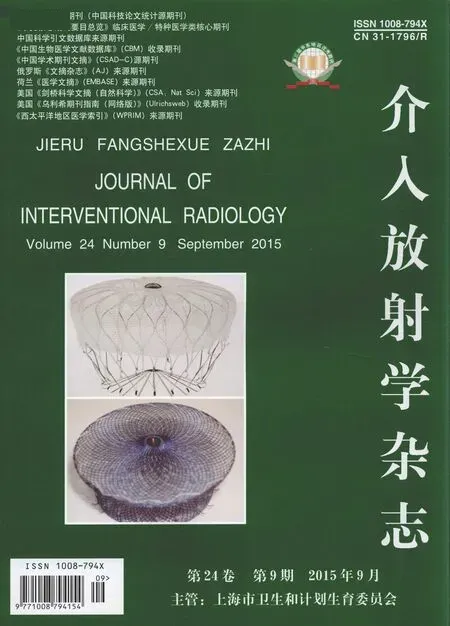
通過介入封堵手段來實現左心耳的封閉創傷小,患者易接受,且已被證實安全可行。目前有多種介入封堵左心耳裝置已用于臨床,其中研究較多的是 PLAATO、Watchman、Amplatzer Cardiac Plug和LARIAT等裝置[8](圖1)。除LARIAT之外,其他裝置均通過股靜脈及房間隔穿刺途徑進入,輸送鞘管一般需9~14 F。LARIAT則需要血管和心包雙途徑,心包途徑的建立僅需胸壁很小的切口[9]。不同封堵裝置的形狀設計差別很大,能否完全封閉左心耳很大程度上取決于左心耳本身的形態,選擇適合心耳形態的封堵裝置可提高封堵成功率。左心耳形態、深度、開口位置和大小,及其與肺靜脈的關系均存在較大變異性,不同形態的心耳形成血栓的風險也不同[10]。心臟MRI、CT和3D經食管超聲被認為對確定左心耳形態具有較高價值[11],而2D經食管超聲被認為會低估左心耳深度和開口大小[12]。利用多種影像手段綜合測量左心耳形態、開口直徑及其與毗鄰結構的關系,選擇合適形狀和大小的裝置,可提高封堵成功率,減少并發癥發生[13-14]。

圖1 目前各類經皮左心耳封堵裝置
PLAATO裝置的動物試驗開始于 2001年[15],2002年便首次用于臨床。封堵器由自膨脹鎳鈦合金籠狀結構和聚四氟乙烯膜組成,骨架上有3排倒鉤,起到固定于左心耳內的作用。直徑為15~32 mm,選擇較左心耳直徑大20%~40%的裝置進行封堵,需14 F輸送鞘[16]。一項研究納入111例有抗凝禁忌征的非瓣膜性房顫患者,成功封堵率97.3%。3例未成功植入封堵器的患者分別因為存在左房血栓、導致股動脈血腫、房間隔穿刺導致心臟壓塞。封堵器可完全回收和再釋放。術后終生服用阿司匹林和氯吡格雷抗栓。6個月隨訪時有2例患者發生缺血性腦卒中,3例患者發生短暫性腦缺血發作(TIA),年腦卒中或TIA發生率為2.2%[17]。5年隨訪年腦卒中或TIA發生率為3.8%,根據患者CHADS2評分,其預計年腦卒中發生率為6.6%[18]。另一項歐洲研究納入180例患者,術中發生6例心臟壓塞和1例裝置栓塞,即刻封堵成功率為90%,術后年腦卒中或TIA發生率為2.3%,該研究出于經費方面的原因提前終止[19]。
Watchman裝置是目前唯一被美國FDA批準的用于左心耳封堵的裝置[20]。封堵器鎳鈦合金骨架形狀類似“水母”,外覆聚酯纖維膜,并有倒鉤起到固定于心耳內的作用。封堵器有21、24、27、30、33 mm 等5種尺寸,選擇較左心耳開口直徑大10%~20%的封堵器,需12 F輸送鞘。借助豬尾巴導管將輸送鞘送至心耳深處,封堵器到位后,通過回撤輸送鞘釋放封堵器。
2007年Watchman裝置首次用于臨床[21]。最初16例患者接受的是Watchman第一代封堵器,發生2例裝置栓塞,1例輸送鞘損壞。通過對封堵器的倒鉤進行改進,隨后的53例患者未發生類似情況。隨訪2年時無腦卒中或TIA事件發生,根據CHADS2評分預計的口服華法林年腦卒中發生率為3.2%[21]。
PROTECT AF研究比較了Watchman在非瓣膜性房顫患者中與抗凝治療的療效與安全性。有效性指標是系統性栓塞、心血管死亡、腦卒中的復合終點。研究中Watchman植入后繼續服用華法林45 d,直至裝置表面內皮化完成,之后服用氯吡格雷6個月,阿司匹林終生。最終試驗組408例患者,裝置植入成功率91%,對照組241例。兩組在大出血方面有統計學差異,分別為4.1%和3.5%。總的腦卒中發生率(包括缺血性和出血性腦卒中)方面,介入組低于對照組。該研究初步證實左心耳封堵是安全有效的[22-24]。
PREVAIL研究與PROTECT AF研究設計思路相似,但納入的患者排除了CHADS2評分為1分的患者。介入組手術相關并發癥較PROTECT AF研究有明顯降低(分別為2.2%和2.67%),相應地,手術成功率也明顯提高(分別為90.9%和95.1%)。這進一步證實了Watchman裝置的安全性。然而研究定義的復合終點包括腦卒中、系統性栓塞、心血管死亡在介入組和華法林組并無差異。
LARIAT除房間隔穿刺途徑(8.5 F鞘管)之外還需要心包途徑(14 F鞘管),需使2個途徑的導絲靠磁性接合,再經心包途徑對左心耳進行套扎。由于心腔內不植入異物,不會導致裝置栓塞及裝置血栓形成。
最初一項研究納入了21例不適合抗凝治療的房顫患者。術中發生1例右室穿孔導致心臟壓塞需外科處理,1例患者心包積液需心包引流,3例患者術后出現心包炎再次住院。左心耳封堵成功率為100%,平均隨訪1年余,左心耳均未再開通[25]。另一項研究納入了27例患者,92.4%患者成功封堵,1例患者發生左心耳穿孔,1例患者未能成功對左心耳進行套扎[26]。LARIAT裝置導致的心包炎在術后并不少見,常需要抗炎治療,目前考慮主要與心耳套扎線引起的局部炎癥有關。圍術期存在右室破裂、心耳穿孔等嚴重并發癥,可能與裝置本身缺陷及術者操作經驗少有關。
ACP裝置是由鎳鈦合金和聚酯纖維膜組成,包括一葉狀結構和一個盤片組成,中間細腰連接,盤片比葉狀結構稍大,覆蓋于左心耳口,通過10~13 F鞘管輸送。裝置根據葉狀結構的直徑,裝置有16~30 mm不同型號,通常選擇比左心耳體部最小直徑大10%~20%的裝置[27]。葉狀結構放置于距心耳開口約1 cm處,通過回撤輸送鞘釋放盤面覆蓋于心耳口。
1項歐洲研究納入了143例患者,成功封堵率96%,5例發生心包積液,3例缺血性腦卒中,2例裝置栓塞[28]。德國的1項小型研究納入了34例患者,發現術后雙抗血小板的患者有17.6%存在食管超聲證實的裝置血栓形成,大多數血栓位于盤面中間螺絲的位置,研究者認為ACP裝置盤面比Watchman大,有更大的血栓形成的風險[29]。
基于以上這些缺陷,第二代ACP進行了改進,葉狀結構更長,盤面也更大,型號變為16~34 mm,可以用來封堵更大的左心耳,一般推薦選擇較左心耳口大3~6 mm的裝置。葉狀結構上的倒鉤增多,硬度較前變大,可以更好地固定于左心耳體部。裝置預載于輸送鞘內,減少了空氣栓塞、裝置栓塞的發生[30]。
LAmbre由一盤面和帶有倒鉤的傘狀結構組成,中間有一腰連接。盤面比傘狀結構大4~6 mm,裝置有16~36 mm不同型號,通常選擇較左心耳大4~8 mm的裝置。輸送鞘管送至左心耳近端,通過前送推送桿將傘狀結構送至合適的錨著位置后,再回撤輸送鞘管釋放盤面時期覆蓋于左心耳口。裝置有二大優勢:更小的輸送鞘管、倒鉤設計使其可安全回收和再釋放[31]。
尚有一些新型裝置正在研究之中。AEGIS系統是由心包途徑對左心耳進行圈,Coherex WaveCrest與大多數經血管途徑裝置相似,這2種裝置還在動物實驗階段[32]。Transcatheter Patch設計較為獨特,該裝置沒有鎳鈦合金骨架,僅有一補片和支撐球囊組成,二者分別為乳膠和聚氨酯泡沫,均為可吸收材料。球囊放置于左心耳內,通過外科粘合劑固定于心耳內,減少穿孔機會,補片覆蓋于左心耳口,已經應用于20例患者[33]。
經皮左心耳封堵已被證實在房顫患者預防腦卒中方面安全有效,目前還只適用于存在抗凝禁忌的患者。目前的各類裝置設計差別很大,根據左心耳的形態特點選擇合適的封堵器可能會較少并發癥的發生。目前裝置尚存在一些不足,新型裝置也在不斷研發之中,隨著裝置的不斷改進,經皮左心耳封堵預防房顫腦卒中有很大的應用前景。
[1]Wilke T,Groth A,Mueller S,et al.Incidence and prevalence of atrial fibrillation:an analysis based on 8.3 million patients[J]. Europace,2013,15:486-493.
[2] Dzeshka MS,Lip GY.Warfarin versus dabigatran etexilate:an assessmentofefficacyandsafetyinpatientswithatrial fibrillation[J].Expert Opin Drug Saf,2015,14:45-62.
[3]Marijon E,Le Heuzey JY,Connolly S,et al.Causes of death and influencingfactorsinpatientswithatrialfibrillation:a competing-risk analysis from the randomized evaluation of long-term anticoagulant therapy study[J].Circulation,2013,128:2192-2201.
[4]Alli O,Holmes DR Jr.Left atrial appendage occlusion for stroke prevention[J].Curr Probl Cardiol,2012,37:405-441.
[5]Madden JL.Resection of the left auricular appendix;a prophylaxis for recurrent arterial emboli[J].J Am Med Assoc,1949,140:769-772.
[6]Healey JS,Crystal E,Lamy A,et al.Left atrial appendage occlusion study(LAAOS):results of a randomized controlled pilot study of left atrial appendage occlusion during coronary bypass surgery in patients at risk for stroke[J].Am Heart J,2005,150:288-293.
[7]Dawson AG,Asopa S,Dunning J.Should patients undergoing cardiac surgery with atrial fibrillation have left atrial appendage exclusion?[J].Interact Cardiovasc Thorac Surg,2010,10:306-311.
:[8]周勇,蔣逸風.經皮穿刺左心耳閉合裝置的研制及臨床應用[J].介入放射學雜志,2013,22:698-700.
[9]Don CW,Fuller CJ,Reisman M.Transcatheter left atrial appendage occlusion.Cardiol Clin,2013,31:363-384.
[10]Di Biase L,Santangeli P,Anselmino M,et al.Does the left atrial appendage morphology correlate with the risk of stroke in patients with atrial fibrillation?Results from a multicenter study [J].J Am Coll Cardiol,2012,60:531-538.
[11]Agner BF,Kühl JT,Linde JJ,et al.Assessment of left atrial volume and function in patients with permanent atrial fibrillation:comparison of cardiac magnetic resonance imaging,320-slice multi-detector computed tomography,and transthoracic echocardiography[J].Eur Heart J Cardiovasc Imaging,2014,15:532-540.
[12]Fatkin D,Kelly RP,Feneley MP.Relations between left atrial appendage blood flow velocity,spontaneous echocardiographic contrast and thromboembolic risk in vivo[J].J Am Coll Cardiol,1994,23:961-969.
[13]Park YM,Kim MN,Choi JI,et al.Intra-procedural imaging of the left atrium and pulmonary veins with rotational angiography:acomparison of anatomy obtained by pre-procedural cardiac computed tomography and trans-thoracic echocardiography[J].Int J Cardiovasc Imaging,2013,29:1423-1432.
[14]楊志宏,吳弘,胡建強,等.左心耳造影方法的建立及最佳投照體位的研究[J].介入放射學雜志,2006,15:494-496.
[15]Nakai T,Lesh MD,Gerstenfeld EP,et al.Percutaneous left atrial appendage occlusion(PLAATO)for preventing cardioembolism:first experience in canine model[J].Circulation,2002,105:2217-2222.
[16]Sievert H,Lesh MD,Trepels T,et al.Percutaneous left atrial appendage transcatheter occlusion to prevent stroke in high-risk patients with atrial fibrillation:early clinical experience[J]. Circulation,2002,105:1887-1889.
[17]Ostermayer SH,Reisman M,Kramer PH,et al.Percutaneous left atrial appendage transcatheter occlusion(PLAATO system)to prevent stroke in high-risk patients with non-rheumatic atrial fibrillation:results from the international multi-center feasibility trials[J].J Am Coll Cardiol,2005,46:9-14.
[18]Block PC,Burstein S,Casale PN,et al.Percutaneous left atrial appendage occlusion for patients in atrial fibrillation suboptimal for warfarin therapy:5-year results of the PLAATO(Percutaneous Left Atrial Appendage Transcatheter Occlusion)Study[J].JACC Cardiovasc Interv,2009,2:594-600.
[19]Bayard YL,Omran H,Neuzil P,et al.PLAATO(Percutaneous Left Atrial Appendage Transcatheter Occlusion)for prevention of cardioembolic stroke in non-anticoagulation eligible atrial fibrillation patients:results from the European PLAATO study [J].EuroIntervention,2010,6:220-226.
[20]Whitlock RP,Hanif H,Danter M.Nonpharmacologic approaches to stroke prevention in atrial fibrillation.Can J Cardiol,2013,29 (7 Suppl):S79-S86.
[21]Sick PB,Schuler G,Hauptmann KE,et al.Initial worldwide experience with the WATCHMAN left atrial appendage system for stroke prevention in atrial fibrillation[J].J Am Coll Cardiol,2007,49:1490-1495.
[22]Holmes DR,Reddy VY,Turi ZG,et al.Percutaneous closure of the left atrial appendage versus warfarin therapy for prevention of stroke in patients with atrial fibrillation:a randomised noninferiority trial[J].Lancet,2009,374:534-542.
[23]Reddy VY,Doshi SK,Sievert H,et al.Percutaneous left atrial appendage closure for stroke prophylaxis in patients with atrial fibrillation:2.3-Year Follow-up of the PROTECT AF(Watchman Left Atrial Appendage System for Embolic Protection in Patients with Atrial Fibrillation)Trial[J].Circulation,2013,127:720-729.
[24]Reddy VY,Holmes D,Doshi SK,et al.Safety of percutaneous left atrial appendage closure:results from the Watchman Left Atrial Appendage System for Embolic Protection in Patients with AF (PROTECT AF)clinical trial and the Continued Access Registry [J].Circulation,2011,123:417-424.
[25]Massumi A,Chelu MG,Nazeri A,et al.Initial experience with a novel percutaneous left atrial appendage exclusion device in patientswithatrialfibrillation,increasedstrokerisk,and contraindications to anticoagulation[J].Am J Cardiol,2013,111:869-873.
[26]Stone D,Byrne T,Pershad A.Early results with the LARIAT device for left atrial appendage exclusion in patients with atrial fibrillation at high risk for stroke and anticoagulation [J].Catheter Cardiovasc Interv,2015,86:121-127.
[27]Lam YY,Yip GW,Yu CM,et al.Left atrial appendage closure with AMPLATZER cardiac plug for stroke prevention in atrial fibrillation:initial Asia-Pacific experience[J].Catheter Cardiovasc Interv,2012,79:794-800.
[28]Park JW,Bethencourt A,Sievert H,et al.Left atrial appendage closure with Amplatzer cardiac plug in atrial fibrillation:initial European experience[J].Catheter Cardiovasc Interv,2011,77:700-706.
[29]Plicht B,Konorza TF,Kahlert P,et al.Risk factors for thrombus formationontheAmplatzerCardiacPlugafterleftatrial appendage occlusion[J].JACC Cardiovasc Interv,2013,6:606-613.
[30]Freixa X,Chan JL,Tzikas A,et al.The amplatzer?cardiac plug 2 for left atrial appendage occlusion:novel features and first-inman experience[J].EuroIntervention,2013,8:1094-1098.
[31]Lam YY.A new left atrial appendage occluder(Lifetech LAmbre Device)for stroke prevention in atrial fibrillation[J].Cardiovasc Revasc Med,2013,14:134-136.
[32]Bruce CJ,Stanton CM,Asirvatham SJ,et al.Percutaneous epicardial left atrial appendage closure:intermediate-term results [J].J Cardiovasc Electrophysiol,2011,22:64-70.
[33]Toumanides S,Sideris EB,Agricola T,et al.Transcatheter patch occlusion of the left atrial appendage using surgical adhesives in high-risk patients with atrial fibrillation[J].J Am Coll Cardiol,2011,58:2236-2240.
Devices used for percutaneous occlusion of left atrial appendage:recent progress in research
LI Chang-yong,ZHANG Zhi-gang,BAI Yuan,QIN Yong-wen.Department of Cardiology,General Hospital of Jinan Military Command,Jinan,Shandong Province 250000,China
QIN Yong-wen,E-mail:qyw2009@163.com
Clinically,atrial fibrillation(AF)is one of the most common cardiac arrhythmia,and patients with arterial fibrillation carry high risk of stroke.Oral administration of anticoagulation such as warfarin for the prevention of stroke has some risks to induce bleeding;moreover,some patients are not able to tolerate the medication.Percutaneous occlusion of the left atrial appendage is safe and effective for the prevention of stroke in patients with atrial fibrillation,although at present it is only used for the patients who have contraindications to anticoagulation medication.This paper aims to review a variety of left atrial appendage occlusion devices and to analyze the relationship between the different shape design of occluder and the left atrial appendage morphology.(J Intervent Radiol,2015,24:830-834)
atrial fibrillation;occlusion of left atrial appendage;atrial closure device
R541.75
A
1008-794X(2015)-09-0830-05
2015-02-03)
(本文編輯:俞瑞綱)
10.3969/j.issn.1008-794X.2015.09.022
250031濟南 濟南軍區總醫院心內科(李長永);第二軍醫大學長海醫院心內科(張志鋼、白元、秦永文)
秦永文E-mail:qyw2009@163.com