空無與體驗
2015-11-29 06:08:07王小松教授藝術家
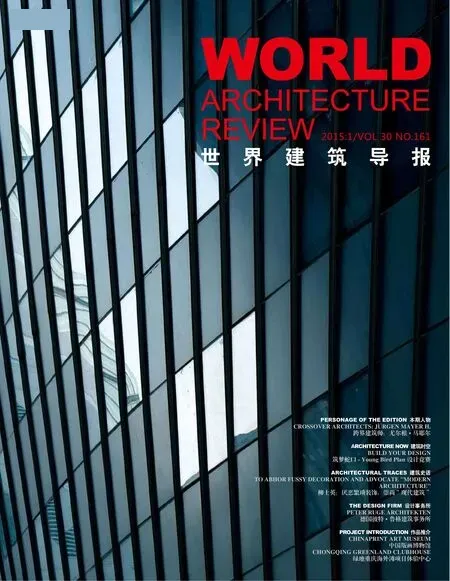
世界建筑導報 2015年1期
王小松教授, 藝術家
Prof. dr. Wang Xiaosong, Artist
空無與體驗
BEING WITH NONBEING AND ITS EXPERIENCE
王小松教授, 藝術家
Prof. dr. Wang Xiaosong, Artist
三十輻共一轂,當其無,有車之用。埏植以為器,當其無,有器之用。鑿戶牖以為室,當其無,有室之用。故有之以為利,無之以為用。
上面這段文字出自老子的《道德經》第十一章,從古至令諸家注釋版本眾多,但總的來說,基本都在“虛”與“實”、“有”與“空”之間展開辯論。
針對上述學界中的各種專家注釋,候幼彬先生在《中國建筑之道》一書中曾有過詳細的闡述。候幼彬先生引用了大量不同時期的考證版,特別提到希臘著名哲學家亞里士多德(Aristot élēs)的著名“四因說”——亞里士多德把事情的存在和變化歸結為4種原因:質料因、形式因、動力因和目的因,并把形式因、動力因、目的因合在一起,總稱為“形式”。亞里士多德認為:事物都是由質料和形式構成的,質料是事物的最初基質,形式是它的結構,是事物的本質。質料只是潛能的存在,只有具有了形式,才能使其潛能得以實現,成為現實。
蘭喜并在《老子解讀》中闡釋說:老子的“有”與“無”之論與亞里士多德的潛能與現實、質料與形式的思想有相似的地方。在老子看來,任何事物都包含兩個方面,即“有”與“無”。“有之以為利,無之以為用”。“有”是潛能,是“質料”,通過“無”使“潛能”實現,使“利”成“用”。“無”使“有”具有了意義。
孫以楷在《老子通論》中闡釋說:老子在本章講的不是“有”與“無”的主次問題,而是講“無”是事物的本質……沒有中空,就不是“轂”,而只能是木頭;沒有中空,就不是茶杯,而只能是一團泥;沒有中空,就不是房屋,而只是磚堆。正是中空,木頭才成了轂,陶土才成了茶杯,磚堆才成了房屋。老子所講的“無”,不是虛無,而是事物的本質。本質是無形的,它與“有”結合在一起。有,提供了可資利用的質料,這叫做“有之以為利”;無是事物的本質所在,事物的不同本質是通過不同的功用表現出來的,這叫做“無之以為用”。
如此,我們可以這樣認為:沒有本質的意義的建筑,只是水泥的堆砌。正如萊特(Frank ·Lloyd·Wright)所說:“建筑的實質是供人居住的空間”。正是“空”的存在才使我們稱之為“屋”的存在。而不是虛無。“空”是事物的本質。因此,這種“無”實際上是建筑的形式造型。而這種造型必須在“空無”之中才可以達到心靈的凈化與流傳,決定建筑本質的不是材料的堆積,是事物的本質決定結構,質料因結構的需求而存在。
人對空的要求形成了一切質料的選擇與運用。而這種需要即是人性空靈凈化的最為本質的一種向往。建筑在今天已經由權力化的象征走向碎片化的回歸——回歸人性本質的自然屬性。消滅不必要的空間累贅也同時就是選擇了一種思想境界和精神狀態。秩序與空間的流動,將“虛”作為空間的美學細節而進行探討,—這已經成為當代建筑師首先要思考和解決的問題。
因此,我們可以這樣理解:“有”是建筑的質料,“無”是建筑的存在。這就是我們常說的:墻的間隙構成了建筑。日本建筑師高松伸(SHIN TAKAMATSU)指出:建筑如同書法,其力量并非在于結構,而在于周圍的空間。
今天的建筑設計若只是為了單純滿足入住的功能而被賦予建筑的本體形式,那么,這樣的建筑實體已經不能成為時代精神的最佳體現。
那么,什么才是這個時代的建筑愿望呢?
可持續發展、低碳、綠色、健康環保智能化的建筑無疑是21世紀建筑的發展趨勢。不久前在浙江省長興竣工的由德國建筑師 Peter Ruge 教授設計的朗詩布魯克被動房酒店,讓我們看到了今天中國的建筑設計已經由批量設計生產方式逐步邁向多元化與生態化的轉型間隙中,一種作為潛能存在的建筑思潮已經冉冉升起。先目睹一下有關的報道:
朗詩長興研發基地規劃設計是著名的中國房地產開發集團朗詩集團的旗艦項目,其位于太湖湖畔,占地近4萬m2,朗詩集團將在該基地嘗試建設各種類型的節能建筑予以學習借鑒。
在規劃設計之前根據甲方的使用要求,設計師 Peter Ruge 以及其團隊通過前期詳細的多方位建筑物理模擬,得出準確的規劃設計參數。例如:朝向、采光、能耗優化、自然通風等數據。結合當地城市發展狀況、自然景觀特色、規劃法規條例,通過建筑功能的合理布局,完善區域交通流線,最終呈現出一個美觀、實用、節能、可持續發展的生態區域規劃設計。基地內包括辦公、實驗、居住、餐飲等含有不同使用功能的建筑。其中布魯克被動式酒店為長興研發中心的核心項目。該酒店大樓共計五層,建筑面積約2500平方米,由36間一室的員工公寓、6間兩室的行政套房和4間三臥室的樣板公寓組成。被動式建筑設計的團隊這樣描述他們的建筑:由于長三角地區惡劣的氣候條件(夏熱冬冷)。我們不得不在前期詳盡的建筑物理模擬后開始考慮在建筑設計上有可能地揚長避短,通過設計來提高建筑的節能環保及居住品質。
為了能夠使入住客人擁有一個良好的視野及優質的采光條件,我們全部的南向窗戶均采用了大尺寸落地窗,精確的遮陽設計使得夏季直射陽光被遮擋,冬季陽光反而可以照進室內,溫暖房間。高度絕緣的被動式外圍護設計及精確的無冷橋節點設計有效保證了建筑自身的能耗損失,外立面彩色陶棒的設計運用,不僅美化了立面視覺效果還對建筑物的外墻起到了很好的保護作用,使其免受強烈日光的傷害。由于布魯克項目設計參數達到德國被動房標準,因此其夏季房間內溫度在不采取主動制冷的措施下不會超過26℃,冬季不會低于22℃。達到恒溫、恒濕、恒氧。此外,通過多重過濾新風系統24小時不間斷提供新鮮空氣,可以過濾PM2.5 超過90%。與中國普通住宅建筑相比,被動式房屋可以節省95% 的能耗。從上面的報道中我們可以發現,建筑在今天已經在空的狀態下轉化為體驗與過程。Peter Ruge 在他設計理念中曾提到:個體規范構成了策略,策略定義了個體規范。自然而然。因此我們在新的設計無法忽略在建設項目的最小解決方案與現有的最大經驗中尋求平衡點。關于這一點,在杭州重型機械廠的(INH)建筑遺產改造與保護中,Peter Ruge 的設計理念得到體現:在未來打造的新天地(INH)空間中心區域,保留通高原有敞開的中央空間,并設置兩個白色閃光的橢圓球體,橢圓球體的結構形式與原有工業建筑的結構形式形成了鮮明的對比,兩個球體像是懸浮于空中,猶如兩朵球狀的白云,輕盈飄逸。在視覺上融合為一個整體的空間,球體頂部設置空中花園,下部穿透道路兩側的玻璃墻懸挑于永福橋路上方,遠望上去,球體的連廊與空中花園錯落跌宕,一個細膩精致,一個粗獷豪放。所謂的建筑結構在此時已被忘記。撲面而來的則是視覺動力的演繹與藝術效果的呈現。放棄了功能上的刻意追求,得到卻是空間的詩意。
在這里,平衡的原則又一次讓我們想起了老子的“虛無空間”。因為只有在虛無的空間,一切經驗才可以被接納。而這種經驗是流動,是穿越,是有形與無形。空間在被動的主動經驗下,一次又一次在“有無”之間開展人性的體驗與感悟的對話,在這里,質料與空不是各自孤立的,而是涌動的美學與文化相互擁抱的狂歡。正如柯布西耶(Le Corbusier)在《走向新建筑》這本書里寫道:
清晰地表述一個作品,賦予生動的統一性,使之具有一個基本的姿態與特性:這就是純精神的創作……小客廳、廁所、散熱器、鋼筋混凝土、拱頂或尖拱等等等等。這些都是構筑,不是建筑。建筑只有在產生詩意的時刻才存在。柯布西耶這句話與哲學家海德格爾(Martin Heidegger)同出一轍,即:“當人安然棲居時,大地便成為大地”。
在結束這篇短文時,布魯克被動式酒店已經開業,業內的設計師們紛紛前去觀摩,此時此刻,我不知道他們每個人在想什么,但有一個問題始終將擺在所有建筑師面前:“建筑到底是什么?”
老子似乎已經答復了此問題,但似乎又將此問題再次留給我們,這或許就是空無在當下,在未來,我們必需進行的遐思與體驗。
The thirty spokes unite in the one nave; but it is on the empty space (for the axle), that the use of the wheel depends. Clay is fashioned into vessels; but it is on their empty hollowness, that their use depends. The door and windows are cut out (from the walls) to form an apartment; but it is on the empty space within, that its use depends. Therefore, what has a (positive) existence serves for profitable adaptation, and what has not, that for (actual) usefulness. ------Translated by James legge
The above text was from laozi ‘s "dao de Jing" Chapter 11. There are various versions of comments and insights about this sentence in history, but in general, it is basically a debate between "virtual" and"real", and between "being" and "non-being".
In response to the variety of comments by different experts, Mr. Hou Youbin has given a detailed explanation in his book "The Principals of Chinese Architecture". Mr. Hou Youbin cited a number of versions from different periods,with particular reference to the famous greek philosopher Aristotle, who had a famous theory of "Four Causes". He pointed out that the causes of change or movement can be categorized into four fundamental types: material cause,formal cause, moving cause and final cause. And he put formal cause, moving cause and final cause together, referred to as "form." Aristotle said: “Things are constituted by material and form, the material is the original base of things, the form is its structure. Form is the essence of things. because in the absence of form, material is only potential existence which can hardly become reality”.
As lan Xibing wrote in his book "Interpretation of laozi”, laozi's notion of "being" and "nonbeing" is similar to Aristotle's ideas of "potential" and "reality”,"material" and "form". According to laozi's ideology, everything consists of two aspects, namely "being" and "non-being." "What has a (positive) existence serves for profitable adaptation, and what has not, that for (actual) usefulness." "being" is the potential, is the "material". Without "non-being", the "being" cannot achieve, so that "non-being" creates the meaning of "being".
As sun YiKai interpreted in his book "general Theory of laozi”, laozi did not address the sequence of "being" and "non-being”. The problem is not which one is major and which one is minor; instead, he described "non-being" as the essence of things. From his "dao de Jing", without the hollow, there is no nave,but only some wood; without the hollow, there is no cup, but only mud; without the hollow, there are no living spaces, but only bricks. It is the hollow, which makes the wood into a hub of wood, which makes clay into a cup, makes bricks into houses. laozi said that the "non-being" is not nothing, but the essence of things. Essence is invisible; it is the same thing as "being". The material to be used "has a (positive) existence that serves for profitable adaptation"; whereas "non-being" is the essence of things, the different nature of things is manifested through different functions,"that which has not, has that which is for (actual)usefulness." In other words, "non-being "is different way of function.
As a result, we can sum it up in this way: if there is no essential meaning of the building, there is just a pile of concrete. As Frank lloyd Wright stated: "The essence of buildings is the space for human habitation." It is the "empty" which forms the space known as "house" instead of nothingness. "Empty" is the essence of things. Thus, the "empty" is actually a form of architectural modality. And this form must be in the "empty" before being able to purify and spread to the soul. It is not the accumulation of material that determines the nature of the building; it is the essence of things that determines the structure. Material exists due to the demands of structure.
The requirement for the "empty" informs the selection and usage of materials. And this is a kind of longing of humanity for the purification of the natural soul.
Today the building has been transformed from a symbol of power towards a fragmentation of regress — the return to the natural character of human beings. To eliminate unnecessary space is also to choose a realm of thought and a mental state. The flow of order and space makes the "virtual" space an aesthetic detail to explore — it has become the most important contemporary problem that architects need to think about and solve.
Therefore, we can understand it in this way: "being" is the building material;"non-being" is the existence of the building. This is what we often say: spaces between walls constitute a building. Japanese architect sHIn TAKAMATsU has stated: “Architecture is calligraphy, its power is not in the structure, but depends on the spaces”.
Today, architectural design, if it is only done to satisfy the simple aim of function, and the form of the building is determined in this way, this cannot be the building which embodies the spirit of the times.
so, what is the desirable way of building that embodies the spirit of the times?
sustainable development, low-carbon, green, healthy environment, intelligent building: these are undoubtedly the development trends of architecture in the 21st century. Finished recently, Changxing Passive House bruck, designed by german architect Professor Peter Ruge, can be seen as an example of a trend that building design nowadays in China is in a transition gap, a gap which has gradually changed from quantity construction to diversification and ecological design. Here is a potentialarchitectural idea that has already arisen.
The planning and construction of an R&d base is a flagship project of the wellknown Chinese real estate firm landsea development group. It is located on Tai lake, and covers an area of nearly 40,000 m2. landsea group has constructed various types of energy efficient buildings at the base to be learned from as a reference.
According to the requirements of the client, Peter Ruge and his team began by making preliminary detailed multi-faceted building physics simulations to achieve accurate planning and designparameters. For example: orientation,day lighting, energy optimization, natural ventilation and other data were examined. Integrated with the local urban development, natural landscape features, planning laws and regulations, the rational distribution of functions of the building improve regional traffic flow lines, and in the end demonstrate a beautiful, practical, energy saving, eco-regional sustainable development planning.
The R&d centre in Changxing, where the Passive House bruck is the core project, includes offices, laboratories, living, dining and other functions with different architectural uses. The five-storey bruck apartment complex accommodates, in approximately 2,200 m2, 36 one-room staff flats, 6 two room executive suites and 4 three-bedroom model apartments. The design team of Passive House bruck describes their building like this: “due to local weather conditions of the Yangtze River delta region (hot and humid in summer and cold in winter), after we had made early detailed physics simulations, we started to think about how we could improve the quality of the living environment and the energy-efficiency of the buildings. In order to have good vision and to ensure the quality of lighting conditions, all south-facing windows are large floor-to-ceiling windows. The precise shade design blocks direct sunlight in the summer, but in winter the sun can shine in to warm the room. The highly insu-lated exterior envelope of passive design, precise and without a cold bridge node, effectively guarantees very little own energy loss,The fa?ade design, using colored ceramic rods, not only beautifies the fa?ade'svisual effects but also gives very good protection to the fa?ade from strong sunlight. since the parameters of the bruck project meet the german passive house standards, in summer the room temperature, without cooling measures,does not exceed 26°C, and in the winter is not lower than 22°C. The building has achieved essentially constant temperature, humidity and oxygen supply. In addition, through a multiple filtration air system 24 hours a day to provide fresh air, it can filter PM2.5 over 90%. Compared with ordinary Chinese residential construction, passive houses can save up to 95% of energy consumption.”
From the above description, we can see that the building has been transformed from the empty state to the experience and the process. Peter Ruge said once in his design philosophy: “The individual criteria form the strategy and the strategy defines each criterion. Close the eyes and the light goes on. Therefore, we cannot ignore, in new design projects, the balance between the smallest construction problems and existing solutions.
On this particular point, for the renovation and protection of the architectural heritage of a heavy machinery plant (InH) in Hangzhou, the design concept of Peter Ruge has generated two white flush oval spheres, set above the previous central open space. The structure of the new oval spheres forms a strong contrast to the existing industrial building. The two spheres are suspended in the air, as two clouds, light and elegant.
On the top of the spheres, there is a roof garden and below them, a glass wall suspended along Yongfu bridge Road. When seen from far away, the corridor of the spheres and the roof garden are refined to a delicate outline.
The so-called architectural structures have been forgotten by this time. Instead the emphasis is on visual effects and artistic interpretation. This design has abandoned the deliberate pursuit of function, to get at its poetic space.
Here, this balance principle reminds us again of laozi‘s ?nothingness of space.“ because of the nothingness of space, all experience can be accepted. And this experience is flow, is tangible and intangible. spaces, in the passive/ active experience, again and again start a dialogue between "being“ and "nonbeing“, about experience and the perceptions of humanity, where material is not isolated with emptiness, but integrated with aesthetics and culture. As le Corbusier wrote in his book Towards a new Architecture “Clearly expressed in a work, giving vivid unity, so that it has a basic attitude and character. This is a pure spirit of creation small living room, toilet, sink, reinforced concrete vault or pointed arches, …” These are constructed, not a building. building exists only after it has its own meaning of concept. The statement of le Corbusier and the sentence of philosopher Martin Heidegger are almost the same: ?When people dwell safely, and the earth will become the earth.“
by now, Passive House bruck has opened to visitors, and the designers of the architecture industry have come to view it. At this moment, I do not know what they are thinking, but there is always the same problem, and it will always be placed before all architects: ?In the end what is architecture?“
laozi seems to have responded to this problem, but the problem seems to leave us again. Perhaps thisis a moment of emptiness, and we must dream and experience in the future.

杭州新天地工廠改造室內效果圖 Hangzhou Xintiandi Factory Interior Pespective
猜你喜歡
中國漫畫(2022年10期)2022-10-27 07:20:48
社會科學戰線(2022年6期)2022-08-25 09:25:34
北方建筑(2021年6期)2021-12-31 03:03:54
文苑(2020年10期)2020-11-07 03:15:36
現代裝飾(2020年6期)2020-06-22 08:43:12
藝術啟蒙(2018年7期)2018-08-23 09:14:18
海峽姐妹(2017年7期)2017-07-31 19:08:17
Coco薇(2017年5期)2017-06-05 08:53:16
兒童故事畫報(2016年2期)2016-04-18 08:24:09
少兒科學周刊·兒童版(2015年6期)2015-11-24 03:49:38