
加夫列拉·米斯特拉爾文化中心,圣地亞哥,智利
2015-12-18 06:58:54建筑設計克里斯蒂安費爾南德斯建筑師事務所橫向建筑與設計事務所
世界建筑 2015年6期
建筑設計:克里斯蒂安·費爾南德斯建筑師事務所,橫向建筑與設計事務所
加夫列拉·米斯特拉爾文化中心,圣地亞哥,智利
建筑設計:克里斯蒂安·費爾南德斯建筑師事務所,橫向建筑與設計事務所
歷史文脈
在智利近年來政治社會分化的一個時期中,這座建筑曾扮演著不可替代的重要角色。該建筑在薩爾瓦多·阿連德執政期間作為“新人類”的標志性杰作而誕生,1973年政變后,作為奧古斯托·皮諾切特政權駐地而成為“統一權力”的代表。近30年中,包括國防部在內的4個政府機關曾使用過該建筑。這些兩極化的歷史使得這座建筑令大眾敬而遠之。
建筑最初的設計與建造是突破性的。為了滿足功能需求,建筑師設計了擁有紀念碑式比例的巨大屋頂。在城市環境的影響下,面向城市干道人行道的一側,建筑呈現出水平延展的體量與比例,另一側則呼應并融入小尺度的居住街區中。
然而,2006年3月5日發生于建筑東側的火災完全摧毀了原有大廳空間。因此,智利政府決定通過國際建筑競賽來完成該建筑的更新,克里斯蒂安·費爾南德斯建筑事務所、橫向建筑與設計事務所的聯合方案從超過55個參賽方案中最終勝出。
城市空間構想
方案希望通過處理周邊建成環境,使建筑與先前被忽略的周圍空間建立起新的聯系。建筑師的設計圍繞4個主要概念展開:通過巨大屋頂下的松散小體量,提升對城市的開放度和關聯度;創建新的公共空間;通過納入社區功能,使建筑向社會開放;通過公眾參與使建筑功能合理化,并為城市建立新標準。
開放性與透明性
藝術與文化建筑應當擁有多變的透明性,不僅要整合直接的使用者,更要喚起整個社會的參與共享。因此,建筑師將公共空間的開放性與內部空間的透明性合二為一。音樂、舞蹈表演大廳和劇院作為“盒子或容器”展示在公眾眼前。
功能與組織
建筑通過3個體量形成水平組織,分別容納3個主要的功能分區:演藝與音樂檔案中心、表演藝術培訓室和容納2000人的大型劇場。這3部分體量在街道層面獨立分開,提供了有遮蔽的多向步行空間。而在地下各層中,它們直接聯系在一起,形成便捷的交通。□(陳茜 譯)
項目信息/Credits and Data
主持建筑師/Principal Architects: Cristián Fernández Eyzaguirre, Christian Yutronic V., Sebastián Baraona R.
合作者/Collaborators: Marcelo Fernández, Carlos Ulloa, Hernán Vergara H., Loreto Figueroa A., Nicolás Olate Vásquez, Natalia Le-Bert, Nicolás Carbone, Juan Pablo Aguilera, Rodrigo Herrera, Eduardo Cid, Sebastián Bravo, Sebastián Medina, Ximena Conejeros, Irene Escobar, Ricardo álvarez, Sebastián Bórquez, Rodrigo Carrión
建筑面積/Floor Area: 一期/Phase 1-24,500m2, 二期/ Phase 2-29,600m2
設計時間/Design Period: 2008-2009
建造時間/Construction Period: 一期/Phase 1, 2009-2010,二期/Phase 2: 2015-
攝影/Photos: Nicolás Saieh(Fig. 2, 5, 7, 8), Marcos Mendizabal(Fig. 3), Juan Eduardo Sepúlveda(Fig. 4, 10)

1 首層平面/Floor 0 plan

2. 3 外景/Exterior views

4 外景/Exterior view
Historical context
This building, like no other, has been a major player during a period in Chile's recent history that was characterized by political and social division. The building was built as a masterpiece, a symbol of the "new man" during Salvador Allende's government. After the coup in 1973 this building housed General Pinochet's regime embodying the "Total Power." During the last three decades four governments have occupied the building including the Ministry of Defense. This has led to a building not wanted by most with a "bipolar" biography.
The original building was designed and built in record time. As a strategy, the architects designed a great cover of monumental proportions to subsequently house the building's program. From the beginning the urban impact was profound, as they installed a huge building with horizontal proportions perched practically on the sidewalk of the main street of the city, with its other side invading a small residential neighborhood.
A fire on March 5, 2006 in the eastern sector of the building completely destroyed the Great Hall.The Chilean government decided to create a future for this building and called for an international architecture competition. Over 55 proposals were received and Cristian Fernandez Arquitectos, teamed with Lateral Arquitectura & Diseno, provided the winning design.
Proposed urban spaces
Their approach was to immediately address the surrounding environment, providing a new relationship to the previously unacknowledged surroundings. The architects decided to focus on four main concepts: openness to the city and its urban relationships across a large deck with loose volumes under it, the creation of new public space, the opening of the building to the community by incorporating community programs, and the legitimacy of the project through the incorporation of as many social agents as possible in shaping a new benchmark for the city.
Openness and transparency
A building for arts and culture should always have varying degrees of transparency and share and engage users not only directly but also to the whole community. Therefore, the architects opted for a design that provided openness in the public spaces and transparency in the interior spaces. The halls for the performing arts of music, dance, and theater are on display to the public as "boxes or containers."
Program and organization
Horizontally the building is organized in three volumes that contain and represent the three major program areas. There are the Documentation Center for Performing Arts and Music, the Training Room for Performing Arts, and the Great Hall Theater that seats 2,000 people. The three buildings are separated at street level, providing multiple covered pedestrian spaces. At the lower levels all three buildings are directly connected.□

5 外景/Exterior view

6 南立面/South elevation
評論
李曉峰:這是一座經歷了烈火煉獄而脫胎換骨的建筑。它是新設計,卻不是全新建筑。之前數十年間,它作為政府機構的駐地,曾經是當地具有宏大敘事象征意義的現代建筑的代表。今天卻成了面向公眾的開放性的城市公共空間。建筑師的智慧著力于3方面:其一,處理周邊建成環境,使其成為適合休閑活動的輕松而積極的公共場所;其二,盡可能將原有建筑的巨大體量化整為零,變宏偉巨構為近人尺度,從而使其具有親和力;其三,通過空間透明性的處理,適合當代“開放性”主題。總之,歷經鳳凰涅槃,這座大樓在新時代煥發了青春。
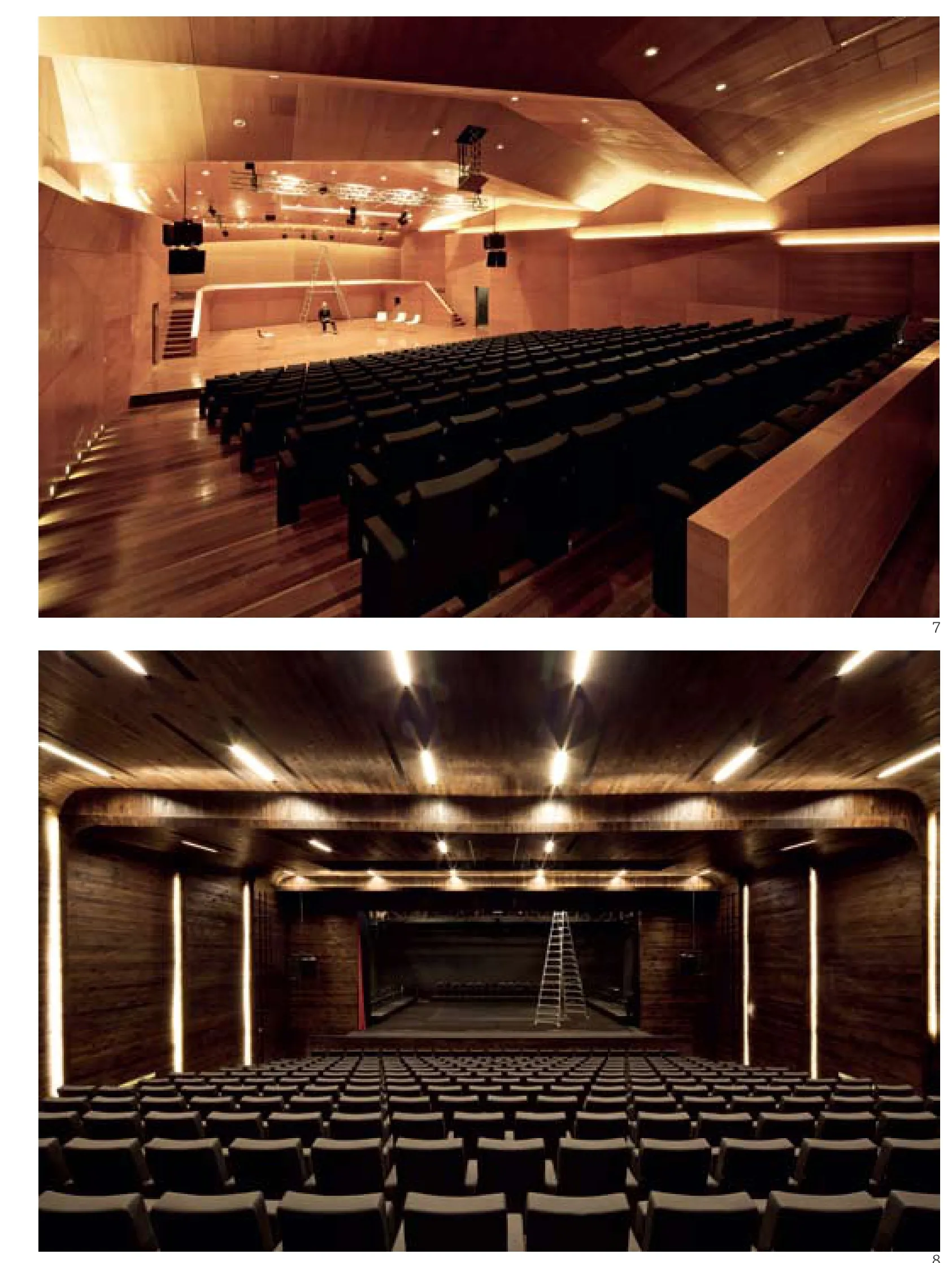
7. 8 內景/Interior views
王舒展:改造后的建筑,無處不透露著“開放”“現代”的氣息,也明確體現著對城市“公共空間”和“公共生活”的關懷。人們該慶幸,它不再是某個政治時期只被少數人獨占的權力機構象征。然而,作為對當地歷史文化相當陌生的旁觀者,對一個“身世”復雜的老建筑的生命,還是不能臆斷。建筑的活力,也許并不在于它設置了多少貌似有活力的文體、觀演空間,而在于當地人們對“公共”“開放”的具體行為達到多少共識;這涉及到建筑留給人們的記憶如何在未來發酵、人們對建筑改造指向的某種新的社會生活有多少向往、信任和決心。無論如何,用公開招標的方式,從幾十份方案中公開選擇,采用平易近人的形式和適當的體量……所有這些,都為這個房子的“新生”開了個好頭。

9 剖面/Section
Comments
LI Xiaofeng: Completely transformed, this building is like a phoenix reborn out of inferno. The design is original, though the building per se is not brand new. As the seat of government for the past decades, it was once a representative work of modern architecture with majestic symbolism. Today it has rather become an urban space opening to the public. The architects' ingenuity is exercised in three aspects: first, the surrounding built environment is made into an active, relaxing public venue suitable for leisure activities; second, the architects did their best to break the original building's enormous volume into parts, bringing a grand structure down to human scale and endowing it with affinity; third, the space is made transparent to suit contemporary motif of "openness". In short, having gone through resurrection, the building is being rejuvenated in the new age.
WANG Shuzhan: The renovated building is brimming with "open", "modern" flavor, which clearly reflects its concerns for the city's "public space" and "public life". One should celebrate that it is no longer any monopolized power symbol of certain political era. However, as spectators unfamiliar with local history and culture, we are in no place to make assumptions about the complex "life" of an old building. The vitality of a building may not consist in the seemingly vigorous spaces it creates for recreations and spectacles, but rather in the level of consensus reached by local people in regards to the specific performance of "publicity" and "openness". This involves how architectural memories would ferment in the future, and how much expectation, belief and determination people would hold for some kind of new social life brought about by the renovation. In any case, public design competitions and selections, as well as the adoption of ordinary forms and appropriate volumes, all herald a promising start of the building's "new life".
Gabriela Mistral Cultural Center, Santiago, Chile, 2015
Architects: Cristián Fernández Arquitectos, Lateral arquitectura & dise?o

10 內景/Interior view
猜你喜歡
北方建筑(2021年6期)2021-12-31 03:03:54
語數外學習·高中版中旬(2021年12期)2021-03-09 01:47:30
文苑(2020年10期)2020-11-07 03:15:36
甘肅教育(2020年6期)2020-09-11 07:45:40
現代裝飾(2020年6期)2020-06-22 08:43:12
藝術啟蒙(2018年7期)2018-08-23 09:14:18
海峽姐妹(2017年7期)2017-07-31 19:08:17
Coco薇(2017年5期)2017-06-05 08:53:16
少兒科學周刊·兒童版(2015年6期)2015-11-24 03:49:38
中國衛生(2014年9期)2014-11-12 13:02:18
