磁敏感加權成像技術鑒別乳頭狀和嫌色細胞腎癌的價值研究
2016-05-17 02:58:54張永成俞勝男陳杰孫軍邢士軍陳銅兵
磁共振成像 2016年12期
張永成,俞勝男*,陳杰,孫軍,邢士軍,陳銅兵
磁敏感加權成像技術鑒別乳頭狀和嫌色細胞腎癌的價值研究
張永成1,俞勝男1*,陳杰1,孫軍1,邢士軍1,陳銅兵2
目的評價磁敏感加權成像(susceptibility weighted imaging,SWI)上腫瘤內磁敏感信號(intratumoral susceptibility signal,ITSS)鑒別乳頭狀腎癌(papillary renal cell carcinoma,pRCC)和嫌色細胞腎癌(chromophobe renal cell carcinoma,CRCC)的價值。材料與方法對經病理證實的21例腎細胞癌(renal cell carcinoma,RCC)病例(其中pRCC12例,CRCC9例)進行回顧性分析。SWI上的ITSS根據形態分為出血和微血管。采用非參數Mann-Whitney檢驗比較SWI上pRCC和CRCC的 ITSS主要結構、瘤內血管和出血灶數目及ITSS與腫瘤面積比值。采用受試者工作特征(receiver operating characteristic,ROC)曲線分析ITSS 4種評價指標鑒別pRCC和CRCC的診斷效能。結果21例RCC中18例腫瘤內可見ITSS。pRCC的ITSS主要結構的評分顯著高于CRCC (P<0.05)。pRCC的ITSS與腫瘤面積比值顯著高于CRCC (P<0.05)。pRCC的瘤內出血灶數目顯著多于CRCC (P<0.05)。pRCC (100%)瘤內出血的出現率顯著高于CRCC (66.67%)。瘤內出血灶數目鑒別pRCC和CRCC的陽性預測值(100%)和特異性(100%)最高,ITSS與腫瘤面積比值鑒別pRCC和CRCC的陰性預測值(87.50%)和敏感性(88.89%)最高。結論通過分析比較ITSS的主要結構、瘤內出血灶和血管數目及ITSS與腫瘤面積比值,SWI可作為評價pRCC和CRCC之間結構差異的有效手段。
磁共振成像;磁敏感加權成像;腎腫瘤;癌,腎細胞;亞型
腎癌(renal cell carcinoma,RCC)是臨床常見的泌尿系統惡性腫瘤。RCC的主要病理類型包括透明細胞(clear cell renal cell carcinoma,CCRCC)、乳頭狀(papillary renal cell carcinoma,pRCC)和嫌色細胞RCC(chromophobe renal cell carcinoma,CRCC)[1]。不同病理類型RCC的治療方法及預后存在很大差異[2]。影像學檢查是術前明確RCC病理類型的主要手段。CCRCC血供豐富,增強明顯強化,與pRCC和CRCC存在明顯差異[3-4]。而pRCC和CRCC的影像表現存在重疊。本研究旨在利用磁共振磁敏感成像技術(susceptible weighted imaging,SWI)觀察pRCC和CRCC瘤內磁敏感信號的差異,為兩者的鑒別提供幫助。
1 材料與方法
1.1 病例資料
回顧性分析我院2011年3月至2015年12月經手術病理證實的48例pRCC和CRCC患者。27例由于未行SWI檢查未納入研究,最終21例患者納入本研究。其中男14例,女7例,年齡27~79歲,平均年齡54歲。
1.2 檢查技術
所有病例MRI檢查均使用Siemens Verio 3.0 T超導MRI,12通道相位陣列體部線圈。先行冠狀位T2WI定位,然后行橫斷位T1WI、T2WI,TE 2.5/96 ms,TR 161/700 ms,FOV 285 mm× 380 mm,矩陣180×320/285×320,層厚5 mm,間隔1 mm。橫斷位多次屏氣2D-SWI序列TR/ TE,162/10.3 ms,FOV 285 mm × 380 mm,矩陣187×384,層厚5 mm,間隔1.0 mm,翻轉角20°,帶寬 620 Hz/pixel,掃描過程中屏氣2~3次,每次持續約12~16 s,兩次屏氣間隔5 s自由呼吸,總掃描時間約1 min。
1.3 影像分析
所有SWI圖像由兩位經驗豐富的影像科醫生獨立分析,結果不一時,協商決定。腫瘤內磁敏感信號(intratumoral susceptible signal,ITSS)根據形態劃分為出血和微血管兩類。出血為點狀或斑片狀直徑大于0.5 cm低信號;微血管表現為瘤內線樣低信號[5]。
ITSS的主要結構劃分為:0=腫瘤內無ITSS;1=ITSS主要為微血管結構;2=微血管與出血分布近似;3=ITSS主要為出血[6]。
瘤內出血灶和血管使用半定量方法計數。出血灶數目分為4個級別:0=瘤內無ITSS;1=1~10個點狀或斑片狀ITSS;2=11~20個點狀或斑片狀ITSS;3=大于20個點狀或斑片狀ITSS。瘤內血管數目同樣劃分為4個等級:0=瘤內無ITSS;1=1~5條線樣ITSS;2=6~10個線樣ITSS;4=大于10個線樣ITSS[7]。
使用3級劃分標準評價ITSS與腫瘤的面積比:0=瘤內無ITSS;1=任意層面比值<50%;2=任意層面比值≥50%[8]。
1.4 統計學分析
使用MedCalc11.4.2.0統計分析軟件,結果以均數±標準差表示。使用非參數Mann-Whitney檢驗比較pRCC和CRCC之間ITSS的主要結構、瘤內出血灶和瘤內血管數目及ITSS與腫瘤面積比之間的差異。使用受試者工作特征(receiver operating characteristics,ROC)曲線分別評價ITSS的主要結構、瘤內出血灶和血管數目及ITSS與腫瘤面積比鑒別pRCC和CRCC的診斷效能,并計算敏感性、特異性、陽性預測值及陰性預測值。P<0.05認為差異有統計學意義。
2 結果
2.1 病理學結果
21例腎臟腫瘤中,12例為pRCC,9例為CRCC。其中1例左腎CRCC患者術后出現復發性右腎CRCC,于外院行根治性右腎切除術。
2.2 SWI結果
21例腎臟腫瘤中,18例可見ITSS,另3例未見ITSS的病理為CRCC。ITSS主要結構的平均分值、瘤內出血灶和血管數目及ITSS與腫瘤面積的比值見表1。pRCC在SWI上ITSS主要結構的平均分值顯著高于CRCC (P<0.05),見圖1。
4例pRCC (4/12)的腫瘤內出血灶融合成大片狀出血。pRCC (12/12,100%)瘤內出血的出現率高于CRCC (6/9,66.67%),且pRCC的瘤內出血數目顯著多于CRCC (P<0.05),見圖2。
5例pRCC (5/12)和5例CRCC (5/9)可見瘤內血管。pRCC的瘤內血管數目較CRCC少,但兩者之間差異無統計學意義(P>0.05)。
7例pRCC (7/12)和1例CRCC (1/9)的任意層面ITSS與腫瘤面積比值超過50%。pRCC的ITSS與腫瘤面積比值顯著高于CRCC (P<0.05),見圖3。
2.3 ROC曲線分析結果
ITSS主要結構、瘤內出血灶和血管數目及ITSS與腫瘤面積比值鑒別pRCC和CRCC的曲線下面積(area under ROC,AUC)分別為0.866、0.750、0.625和0.806(圖4)。ITSS主要結構與瘤內血管數目的AUC之間存在顯著差異。ITSS主要結構、瘤內出血灶和血管數目及ITSS與腫瘤面積比值鑒別pRCC和CRCC的臨界值見表2。

表1ITSS 4項評價指標的平均值Tab.1Mean scores of four indices for ITSS

表2ITSS不同指標鑒別pRCC和CRCC的診斷效能Tab.2Diagnostic value of different indices of ITSS in differentiating pRCCs from CRCCs
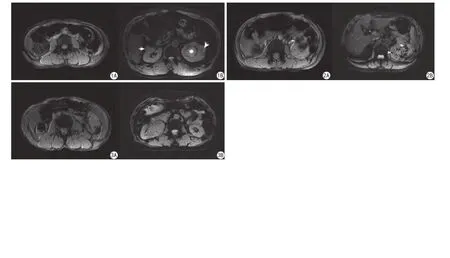
圖1pRCC與CRCC的ITSS主要結構。A:1例右腎pRCC,ITSS主要結構呈點狀低信號,提示為出血灶;B:1例右腎CRCC,腫瘤內未見明顯ITSS (箭),左腎可見腎盂積水(星狀)及一枚復雜性囊腫(箭頭)圖2pRCC和CRCC的瘤內出血灶數目的差別。A:1例左腎pRCC,瘤內可見斑片狀低信號出血灶(箭);B:1例左腎CRCC,瘤內出血灶(箭頭)數目較A少,而線狀ITSS(箭)數目較A多圖3pRCC和CRCC的ITSS與腫瘤面積比值。A:1例右腎pRCC,ITSS面積大于腫瘤面積的50%;B:1例右腎CRCC,ITSS面積小于腫瘤面積的50%Fig. 1Difference of dominant structures of ITSSs between pRCC and CRCC. In the case with right renal pRCC, the dominant structures of ITSSs are prominently dot-like hypo-intensities, which indicate intratumoral hemorrhage (A). In the other case with right renal CRCC (B), no significant ITSSs was seen in the tumor (arrow). Hydronephrosis (star) and a complicated cyst (arrow head) also were present in the left kidney.Fig. 2Difference of the number of intratumoral hemorrhagic lesions between pRCC and CRCC. In the case with left renal pRCC, many hemorrhagic lesions are present, which reveal patchy hypo-intensities on SWI (arrow) (A). In the other case with left renal CRCC, the number of intratumoral hemorrhagic lesions (arrow head) decreases on SWI (B), while the number of linear ITSSs significant increases (arrow).Fig. 3Difference of the ratio of ITSS area to tumor area between pRCC and CRCC. In the case with right renal pRCC, the ratio is larger than half of the tumor on SWI (A). On the contrary, the ratio is less than half of the tumor on SWI in the other
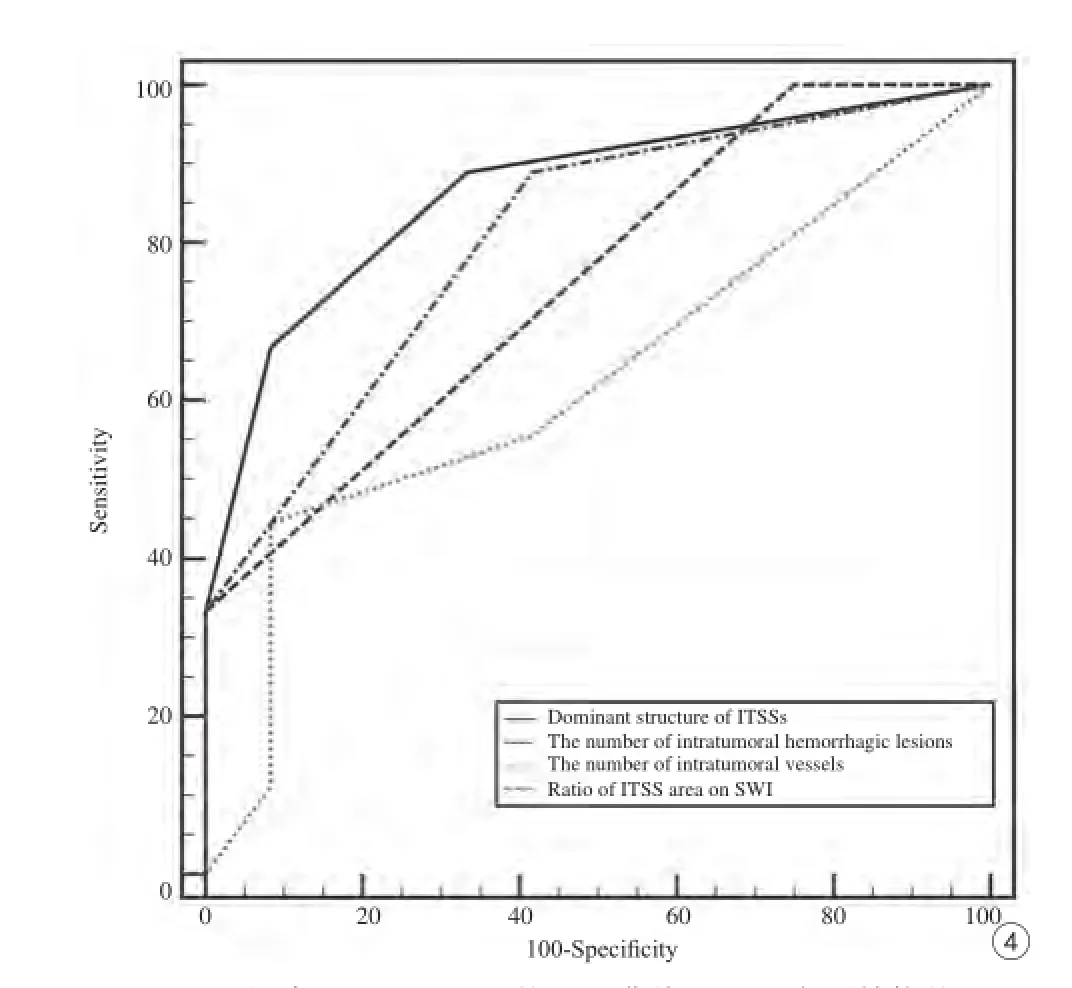
圖4ITSS鑒別pRCC和CRCC的ROC曲線。ITSS主要結構的AUC (0.866)大于瘤內出血灶(0.750)和血管數目(0.625)以及ITSS與腫瘤面積比值(0.806)Fig. 4ROC curve for the ITSSs in differentiating pRCCs from CRCCs. The area under ROC curve (AUC) for dominant structures of ITSSs (0.866) is greater than those for the number of intratumoral hemorrhagic lesions and vessels, and the ratio of ITSS area on SWI (0.750, 0.625 and 0.806 respectively).
3 討論
本研究結果顯示pRCC與CRCC在SWI上ITSS主要結構、瘤內出血灶和血管數目及ITSS與腫瘤面積比值存在顯著差異。ITSS主要結構鑒別pRCC和CRCC的AUC大于瘤內出血灶和血管數目及ITSS與腫瘤面積比值。與其他評價指標相比,瘤內出血灶數目的特異性(100%)和陽性預測值(100%)最高,而ITSS與腫瘤面積比值的敏感性(88.89%)和陰性預測值(87.50%)最高。
與其他影像學技術相比,SWI對磁性物質非常敏感[9-11]。Park等[7]的研究顯示細線狀和點狀ITSS混合存在多見于IV級腦膠質瘤,而細線狀ITSS多見于III級腦膠質瘤。另外,Ding等[12]研究發現高級別膠質瘤和腦轉移瘤在SWI上檢出的瘤內出血灶和血管數目顯著高于原發性中樞神經系統淋巴瘤。本研究的結果顯示,SWI可檢出所有pRCC和CRCC的ITSS,且pRCC的ITSS主要結構的平均分值顯著高于CRCC。當ITSS主要結構的分值小于1(即SWI上瘤內無ITSS)時,敏感性、特異性、陽性預測值和陰性預測值分別為66.67%、 91.67%、85.7%和78.6%。
pRCC的病理學檢查可見由上皮細胞構成乳頭狀結構,內部可見出血、囊變及含鐵血黃素顆粒[13-14]。瘤內出血較常見,且有時很明顯,而含鐵血黃素則常見于腫瘤細胞和巨噬細胞的胞漿內[15]。Pedrosa等[16]曾報道pRCC (60%)瘤內出血的出現率顯著高于CRCC (20%)。本研究結果也證實這一觀點。本研究中pRCC瘤內出血的出現率為100%,CRCC的出現率為66.67%,均高于文獻報道。出現這一結果的原因可能是SWI對血液成分特別敏感,與常規MRI相比能檢出更多出血灶[11]。
血管增生是惡性腫瘤最顯著的生物學行為之一[17]。本試驗組先前的研究發現,與高級別ccRCC相比低級別ccRCC可見更多血管結構、較少出血灶[8]。這一研究結果表明瘤內血管數目與腫瘤惡性程度呈負相關。CRCC被認為是RCC的一種亞型,其預后較好。Kattan等[18]研究發現CRCC的惡性程度不及pRCC。本研究中,pRCC的瘤內血管數目較CRCC少,提示pRCC惡性程度更高。
本研究存在以下局限性:(1)所有入選患者均行根治性腎切除術,因此本研究為回顧性研究;(2)由于pRCC和CRCC較少見,本研究樣本量不大;(3)本研究沒有分析其他少見RCC亞型之間ITSS的差異。隨著病例數的增加,本試驗組將對可能存在的差異展開研究。
綜上所述,通過分析比較ITSS主要結構、瘤內出血灶和血管數目及ITSS與腫瘤面積比值,SWI可作為評價pRCC和CRCC之間結構差異的有效手段。
[References]
[1] Nguyen DP, Vertosick EA, Corradi RB, et al. Histological subtype of renal cell carcinoma significantly affects survival in the era of partial nephrectomy. Urol Oncol, 2016, 34(6): 1-8.
[2] Udager AM, Mehra R. Morphologic, molecular, and taxonomic evolution of renal cell carcinoma: a conceptual perspective with emphasis on updates to the 2016 World Health Organization Classification. Arch Pathol Lab Med, 2016, 140(10): 1026-1037.
[3] Young JR, Margolis D, Sauk S, et al. Clear cell renal cell carcinoma: discrimination from other renal cell carcinoma subtypes and oncocytoma at multiphasic multidetector CT. Radiology, 2013, 267(2): 444-453.
[4] Wang HY, Su ZH, Xu X, et al. Dynamic contrast-enhanced MR imaging in renal cell carcinoma: reproducibility of histogram analysison pharmacokinetic parameters. Sci Rep, 2016, 6: 29146.
[5] Li RK, Zeng MS, Rao SX, et al. Using a 2D multibreath-hold susceptibility-weighted imaging to visualize intratumoral hemorrhage of hepatocellular carcinoma at 3.0 T MRI: correlation with pathology. J Magn Reson Imaging, 2012, 36(4): 900-906.
[6] Chen J, Sun J, Xing W, et al. Prediction of nuclear grade of clear cell renal cell carcinoma with MRI: intratumoral susceptibility signal intensity versus necrosis. Acta Radiol, 2014, 55(3): 378-384.
[7] Park MJ, Kim HS, Jahng GH, et al. Semiquantitative assessment of intratumoral susceptibility signals using non-contrast-enhanced highfield high-resolution susceptibility-weighted imaging in patients with gliomas: comparison with MR perfusion imaging. AJNR Am J Neuroradiol, 2009, 30(7): 1402-1408.
[8] Chen J, Ding J, Dai Y, et al. Assessment of intratumoral micromorphology for patients with clear cell renal cell carcinoma using susceptibility-weighted imaging. PLoS One, 2013, 8(6): 65866.
[9] Xing W, He X, Kassir MA, et al. Evaluating hemorrhage in renal cell carcinoma using susceptibility weighted imaging. PLoS One, 2013,8(2): 57691.
[10] Niwa T, Aida N, Osaka H, et al. Intracranial hemorrhage and tortuosity of veins detected on susceptibility-weighted imaging of a child with a type IV collagen alpha1 mutation and schizencephaly. Magn Reson Med Sci, 2015, 14(3): 223-226.
[11] Schelhorn J, Gramsch C, Deuschl C, et al. Intracranial hemorrhage detection over time using susceptibility-weighted magnetic resonance imaging. Acta Radiol, 2015, 56(12): 1501-1507.
[12] Ding Y, Xing Z, Liu B, et al. Differentiation of primary central nervous system lymphoma from high-grade glioma and brain metastases using susceptibility-weighted imaging. Brain Behav, 2014, 4(6): 841-849.
[13] Klatte T, Said JW, Seligson DB, et al. Pathological, immunohistochemical and cytogenetic features of papillary renal cell carcinoma with clear cell features. J Urol, 2011, 185(1): 30-35.
[14] Verine J. Papillary renal-cell carcinoma. N Engl J Med, 2016, 374(20): 1990-1991.
[15] Gargouri MM, Bargaoui W, Kallel Y, et al. Papillary renal cell carcinoma: clinic and pathological study about 27 cases. Tunis Med, 2015, 93(6): 381-385.
[16] Pedrosa I, Chou MT, Ngo L, et al. MR classification of renal masses with pathologic correlation. Eur Radiol, 2008, 18(2): 365-375.
[17] Kisseleva EP, Krylov AV, Lyamina IV, et al. Role of vascular endothelial growth factor (VEGF) in thymus of mice under normal conditions and with tumor growth. Biochemistry (Mosc), 2016, 81(5): 491-501.
[18] Shim SR, Kim SJ, Kim SI, et al. Prognostic value of the Glasgow Prognostic Score in renal cell carcinoma: a meta-analysis. World J Urol. 2016. doi:10.1007/s00345-016-1940-1.
Susceptibility weighted imaging in differentiating papillary from chromophobe renal cell carcinoma
ZHANG Yong-cheng1, YU Sheng-nan1*, CHEN Jie1, SUN Jun1, XING Shi-jun1, CHEN Tong-bing2
1Department of Radiology, Affiliated Third Hospital of Suzhou University, Changzhou 213000, China
2Department of Pathology, Affiliated Third Hospital of Suzhou University, Changzhou 213000, China
ACKNOWLEDGMENTSThis work was part of National Natural Science Foundation of China (No. 81371513).
Objective:To differentiate papillary RCC (pRCC) from chromophobe RCC (CRCC) based on intratumoral susceptibility signals (ITSSs) detected on SWI.Materials and Methods:A retrospective review was performed on patients with CRCC (n=9) or pRCC (n=12) classified by pathology. The ITSSs were classified into hemorrhage and microvessels based on their morphology. Nonparametric Mann-Whitney test was used to compare the differences in the dominant structure of ITSSs, the number of intratumoral vessels and hemorrhagic lesions, and the ratio of ITSS area on SWI between pRCC and CRCC. The diagnostic values of the dominant structure of ITSSs, the number of intratumoral vessels and hemorrhagic lesions, and the ratio of ITSS area on SWI in differentiating pRCCs from CRCCs were compared by receiver operating characteristics (ROC).Results:ITSSs were seen in 18 of 21 patients. No ITSSs were seen in 3 patients with CRCC. Mean scores of dominant structures of ITSSs on SWI were significantly higher for pRCCs than that for CRCCs (P<0.005). There was significant difference of the ratio of ITSS area on SWI between pRCCs and CRCCs (P<0.05). The number of hemorrhagic lesions in pRCCs was significantly larger than thatin CRCCs (P<0.05). The occurrence of intratumoral hemorrhage was more common in pRCCs (12/12, 100%) than that in CRCCs (6/9, 66.67%). The number of intratumoral hemorrhagic lesions revealed the highest positive predictive value (100%) and specificity (100%) as compared with other features, while the ratio of ITSS area on SWI showed the highest positive predictive value (87.5%) and sensitivity (88.89%).Conclusion:SWI is a useful technique to analyze the structural difference between pRCC and CRCC by the dominant structures ITSSs, the number of intratumoral hemorrhagic lesions, as well as the ratio of ITSS area on SWI.
Magnetic resonance imaging; Susceptibility weighted imaging; Kidney neoplasms; Carcinoma, renal cell; Subtype
Yu SN, E-mail: 15851921163@163.com
Received 28 Sep 2016, Accepted 8 Nov 2016
國家自然科學基金面上項目(編號:81371513)
1.蘇州大學附屬第三醫院放射科,常州 213000
2.蘇州大學附屬第三醫院病理科,常州 213000
俞勝男,E-mail:15851921163@163. com
2016-09-28
接受日期:2016-11-08
R445.2;R737.11
A
10.12015/issn.1674-8034.2016.12.006
張永成, 俞勝男, 陳杰, 等. 磁敏感加權成像技術鑒別乳頭狀和嫌色細胞腎癌的價值研究. 磁共振成像, 2016, 7(12): 921-925.*
猜你喜歡
音樂探索(2022年2期)2022-05-30 21:01:37
體育科技文獻通報(2022年3期)2022-05-23 13:46:54
哲學評論(2021年2期)2021-08-22 01:53:34
遼金歷史與考古(2021年0期)2021-07-29 01:06:54
科技傳播(2019年22期)2020-01-14 03:06:54
中華詩詞(2019年7期)2019-11-25 01:43:04
小天使·一年級語數英綜合(2019年8期)2019-08-27 02:23:00
民用飛機設計與研究(2019年4期)2019-05-21 07:21:24
小學科學(學生版)(2018年7期)2018-08-13 09:33:04
影視與戲劇評論(2016年0期)2016-11-23 05:26:01