English in the Classroom
2016-07-02 04:27:38
瘋狂英語·新策略 2016年1期
?
English in the Classroom
This series of articles from the British Council aims to help you think about your teaching and bring new ideas and activities into your classroom. The series covers topics including homework, working with large classes and fnding resources. Today we look at English in the classroom.
Why speak English in class?
Do you agree with Hanan and Kazimierz?
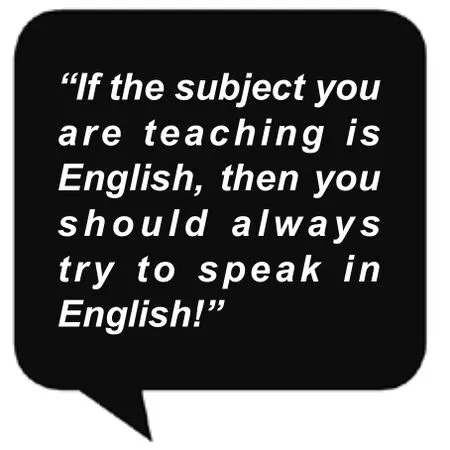
Hanan, Egypt
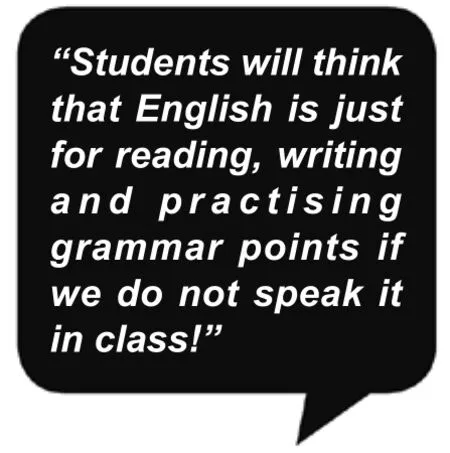
Kazimierz, Malaysia
Getting started
■ You might feel nervous about using English in the classroom. Start by thinking of some useful expressions for you and your students to use. Write them down and practise them. For example: Good morning. Turn to page 12. Repeat this. Please close your books. Find a partner and work in pairs.
■ You can use just a little English in each lesson, and gradually increase it.
Try to use English in all stages of your lessons.
■ When you give instructions, demonstrate with humour and gestures to make your message clear; a hand next to your ear to demonstrate “l(fā)isten”: make a book with your hands to show “open/close your books”. Use drawings and write the phrase on the blackboard.
■ If you translate to make something clear, go back to English as soon as possible and encourage your students to do the same.
■ Try to personalise your lessons by talking about our own experiences. Perhaps tell your students about something that happened to you recently. You can exaggerate and use gestures; pointing backwards as you say “yesterday” to indicate it happened in the past, for example.
■ Think about what younger children enjoy—games, songs, stories, etc.Teach your students the language needed to do these activities in English, for example, “It's my turn.” “Throw the dice.”
■ Encourage students to speak English to you and praise them when they do.
■ The beginnings and ends of lessons are a good opportunity to chat more informally with your students;you can talk about the weekend…or even the weather!
Using English in the classroom demonstrates that it really is a language for communicating. If we prepare well it is easy to use a lot more English in our lessons.
What do you think?
Kuheli from Zambia writes:
My younger students love singing and chanting so we use songs and chants in English for all parts of the class routines. I start each class with a “hello” chant like this—Teacher: Hello students. Students: Hello teacher. Teacher: How are you? Students: How are you? Teacher: Very well thank you. Students: Very well thank you. Teacher: I am too. Students: I am too.
With older students, I get them to make “classroom language” posters. They write useful expressions like “Sorry I'm late”, “Can I have a pencil please?” “Have a good weekend”, “I don't understand” and draw pictures for each phrase. We put the posters on the wall so there's no excuse for not using English in class!
A classroom activity—experience
Give students the language they need to talk about their own experiences in English with this activity.
■ Write 3 yes/no questions on the board with the words in the wrong order. For example:
? English/at/Did/you/speak/the/weekend?
? you/read/a/book/yesterday/Did?
? this/morning/for/breakfast/Did/you/eat/cereal?
■ The students sort the words to make questions. (Did you speak English at the weekend? Did you read a book yesterday? Did you eat cereal for breakfast this morning?)
■ Now the students can ask you the questions. Answer either “Yes I did” or “No I didn't”.
■ Students ask and answer the questions in pairs.
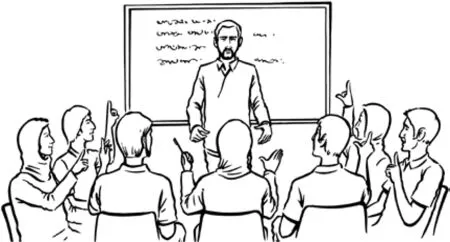
■ You could fnish by saying “Hands up if you spoke English at the weekend”. “Hands up if you…” and indicate hands up with a gesture.
Tip: If you are more confdent at speaking then add more information to your answers—“Yes, I did. I spoke to some tourists in the city centre.” Encourage the students to do the same.
Glossary
A gesture is a movement of moving your hand or body to explain ideas.
In personalised activities students communicate real information about themselves, e.g., talking about their favourite sport.
A syllabus is a list of language items in the order that they will be taught on a course.
A yes/no question is a question that can be answered by yes or no, e.g., Do you like chocolate?
Think about
■ When you plan future lessons, build up your confdence by aiming to be a step ahead of your students.
■ If you are following a text book or a syllabus and you know what is coming up, then look at future units—check the key language in a dictionary and think about what instructions and conversations you will need in English to introduce and practise the language. Then write it down!