離散元法之振動磨介流數值模擬與試驗
2016-08-12 09:29:26楊小蘭劉極峰周亞軍王治金
振動工程學報 2016年3期
楊小蘭 劉極峰 周亞軍 王治金
摘要: 為研究磨介細觀運動過程及粉碎機理,構建基于離散元法之振動磨磨介流數值模擬模型,按頻幅大小設定兩種振強等級、4種模式的工況組合,導出筒體運動方程,求得筒體中心運動軌跡、磨介流速矢場、速度云圖等真實運動,數值模擬結果表明:相對其他模式,C模式(中頻高幅)乏能區至少減小8%,筒內前端磨介動能分別為其他模式的1.26~22.31倍,其動能增加使得磨介間撞擊效果強,為超微顆粒細化試驗的參數優化提供了富有價值的參考;在普通和新型振動磨上分別進行試驗,經激光粒度儀檢測、高速攝影機記錄,分別取得d(50) = 1.6,0.2 μm、帶寬4.8,0.3 μm的檢測結果,明顯體現出新型振動磨顆粒細化和帶寬窄化效果,成為超硬超微粉體細化方面的技術試驗實證。關鍵詞: 磨介流; 離散元法; 數值模擬; 振強等級; 試驗比對
中圖分類號: TD453+.2文獻標識碼: A文章編號:1004-4523(2016)03-0479-09
DOI:10.16385/j.cnki.issn.10044523.2016.03.014
引言
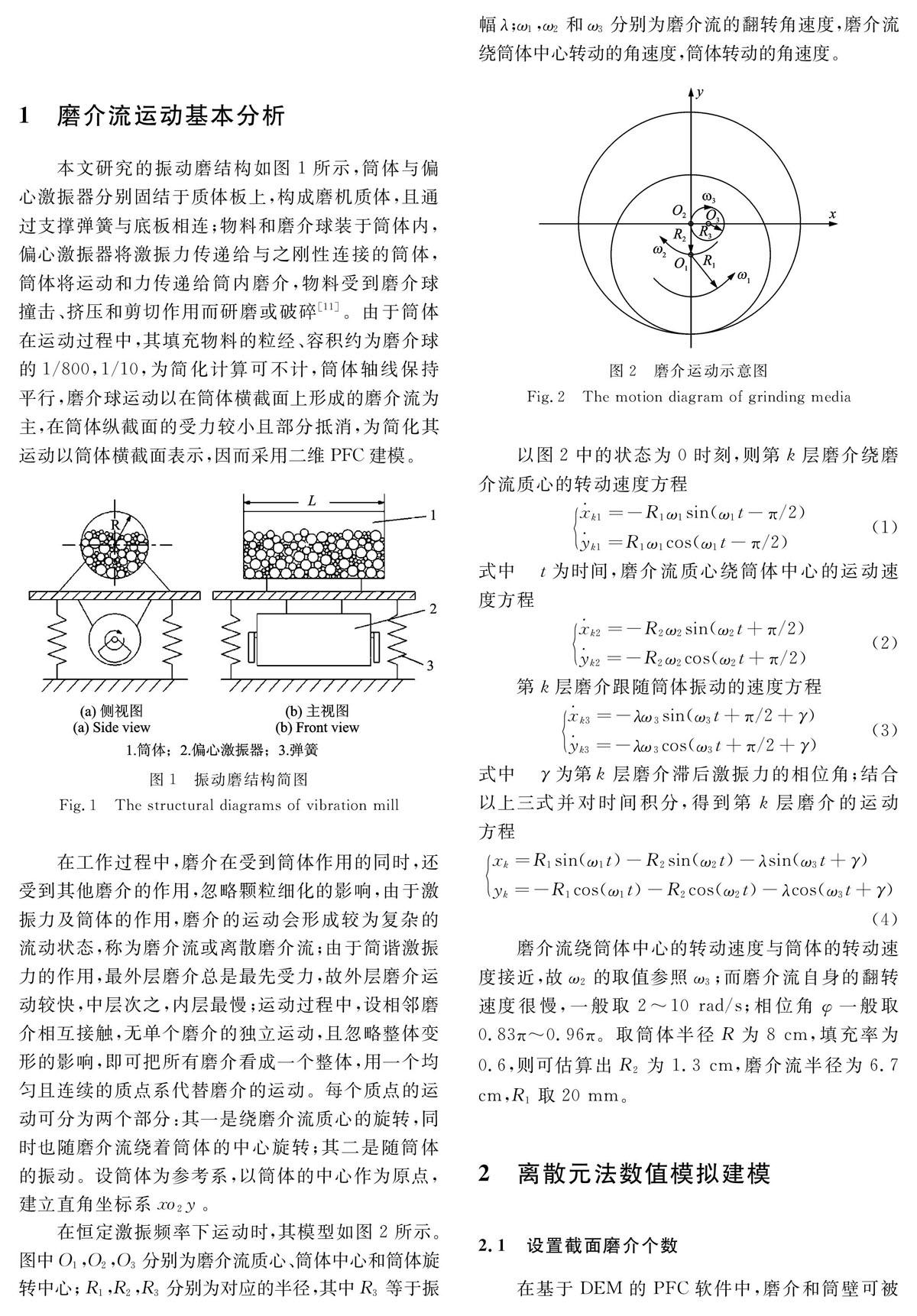
作為一種較為理想的細磨與超細粉磨設備,振動磨的結構有多種形式[12],以單筒下置式振動磨為例,物料和磨介裝在彈簧支撐的筒體內,偏心激振器將激振力傳遞給與之剛性連接的筒體,筒體將運動和力傳遞給筒內磨介,使物料在磨介撞擊等力能作用下被研磨或粉碎。磨介的運動形式直接影響著振動磨的粉磨效果,故分析磨介細觀運動過程是研究振動磨的關鍵問題之一[3]。
為研究磨介的細觀運動特性,近年來諸多學者不斷進行探索。蘇乾益等利用高速攝像機對磨介運動進行拍攝,獲得磨介的分布圖像,建立了振幅和能量的數學模型[4];尹忠俊等人通過攝像技術記錄磨介的運動過程,建立磨介間的沖量與能量傳遞的數學模型[5];唐果寧等通過高速攝像建立磨介的運動模型[6]。由于磨介運動的復雜性,高速攝像雖能觀察磨介分布隨時間變化的情況,卻不能具體到每個磨介的運動方向與速度;數學模型通常是基于圖像信息和一定假設建立的,能夠描述磨介整體的宏觀運動,對于磨介群體內部以及單顆磨介的細觀運動很難涉及。
離散元法(Distinct Element Method,DEM)是研究不連續離散體力學行為的一種數值方法[7],該方法在粉體的流動、分叉或成流等過程的模擬中獲得了成功應用;PFC是基于離散元法來模擬圓形顆粒運動和相互作用的軟件,在水利地質、巖土力學等領域,分析離散顆粒工程問題中已有應用。
V Murariu用PFC模擬不同密度、不同粒徑圓形粒子在FHS中的運動及碰撞[8];B P BHoomans利用PFC模擬在顆粒與墻體是完全彈性與完全光滑情況下,相同密度但不同粒徑的顆粒的分離情況[9];R D Morrison用PFC對粉碎機進行模擬取得一定進展[10];在振動磨中應用PFC模擬振動磨磨介群及磨介形成的磨介流細觀力學的情況,尚未見報道。
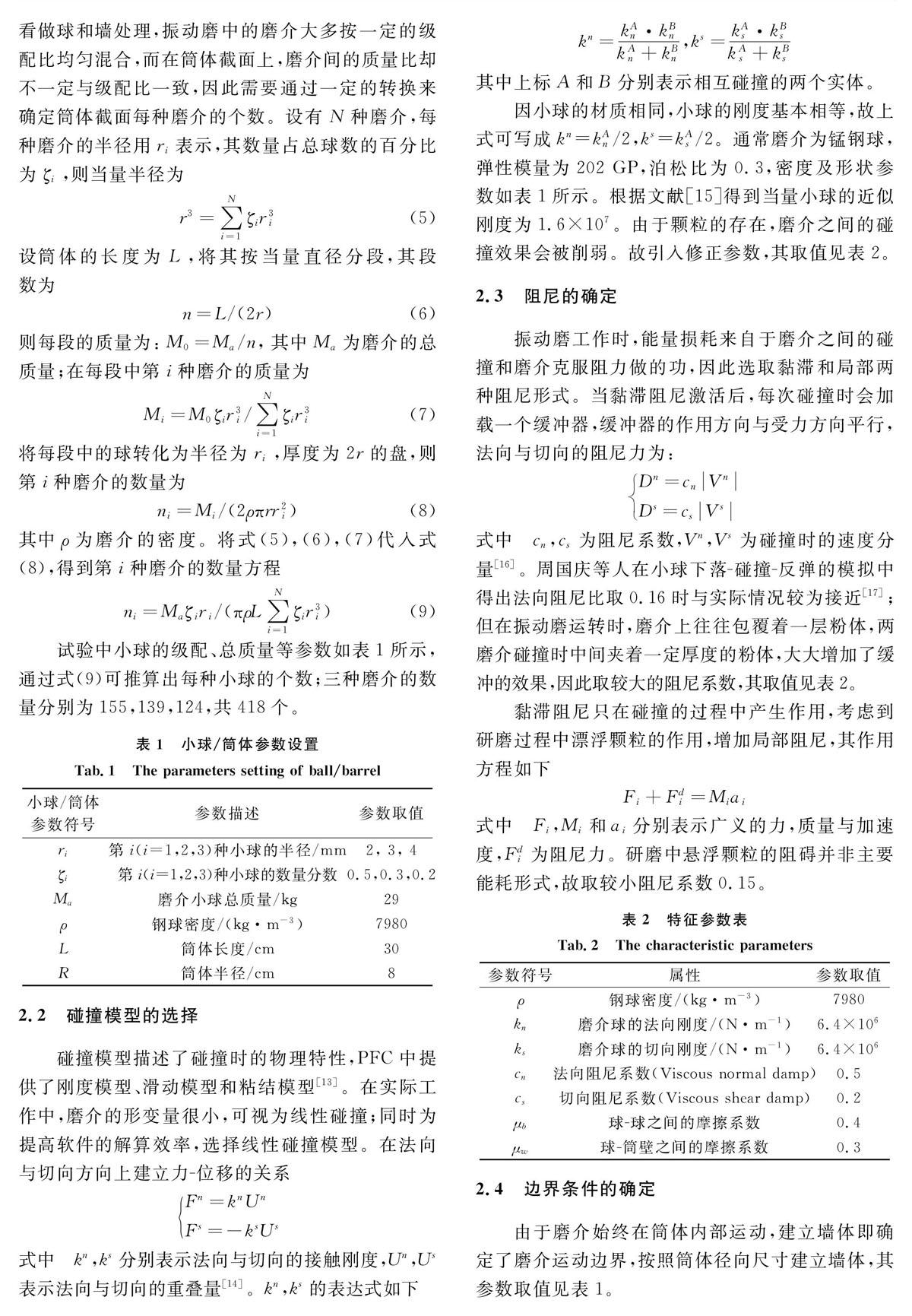
參照作者超微顆粒細化樣機的試驗數據,建立筒體截面的PFC模型,旨在模擬不同頻幅組合下磨介流的真實運動,可獲得筒體形心軌跡,磨介流速度矢場圖像,再現磨介流運動過程,獲得高速攝像試驗中無法得到的磨介流內部流動信息,即不同參數組合下磨介的響應程度,為單個磨介的運動軌跡和速度分析,以及筒內磨介流的動能應變能變化、力鏈分布、力矢場、溫度場等動力學分析作鋪墊,為破解超微顆粒的聚團瓶頸[1112],獲取超微顆粒細化試驗所需的參數選擇調整,提供有價值的參考,為深入了解磨介流的動力學特性及能量分布打下基礎。
5結論
1) 進行4種頻幅組合模式的PFC振動磨運動學數值模擬,獲得筒體中心運動軌跡、磨介流的速矢場等運動圖像,通過比對分析可知,高幅情況下磨介速度場的梯度分布明顯,磨介可形成單股磨介流;高頻組合下則磨介為多股磨介流,在磨介流分岔與匯合處形成低速區;兩種高振強組合的粉磨效果要明顯優于一般振強的組合:在高頻中幅的D模式中,磨介運動速度是B模式的約2倍,磨介流形成的規模大,碰撞效果顯著,但兩者的磨介平均速度都不大;與A,B,D模式相比,中頻高幅的C模式磨介流成流曲率大、速度大,能量傳輸快,能量利用率高,高速磨介多,磨介間的沖擊碰撞效果強,有利于實現超微顆粒細化。
2) 在普通和新型振動磨上,同時進行兩磨機基本技術參數相同的金剛石超微粉磨試驗,以便驗證數值模擬結果,經MS 2000型馬爾文激光粒度儀檢測數值、Mikrotron Gmbh高速攝影機記錄圖像,表明中頻高幅的C模式與其它模式相比,在磨介流形成的速矢及平均速度相對較大,速矢無明顯分叉,成股性好,試驗及檢測記錄顯示出C模式的新型磨機粉體細化及窄化帶寬的明顯效果,成為超硬顆粒振動粉碎細化方面的技術進步實證。
參考文獻:
[1]蓋國勝,陶珍東. 粉體工程[M].北京:清華大學出版社.2009.
Gai Guosheng, Tao Zhendong. Powder Engineering[M]. Beijing: Tsinghua University Press, 2009.
[2]Yang Xiaolan, Liu Jifeng, Jia Minping. Preparation of superhard and ultrafine particles by highintensity chaotic hibration[J]. JOURNAL OF VIBRATION ENGINEERING & TECHNOLOGIES, 2014, 2(3):265—277.
[3]Hoon Lee, Heechan Cho, Jihoe Kwon. Using the discrete element method to analyze the breakage rate in a centrifugal/vibration mill[J]. Powder Technology, 2010, 198(3):364—372.
[4]蘇乾益,劉政.振動磨機磨介運動規律及參數設計[J].南方冶金學院學報,2002,23(1):13—18.
Su Qianyi, Liu Zheng. The regularity of medium motion in a vibration and design of parameters[J]. Journal of Southern Institute of Metallurgy, 2002, 23(1):13—18.
[5]Wang M H, Yang R Y, Yu A B.DEM investigation of energy distribution and particle breakage in tumbling ball mills[J]. Powder Technology, 2012, 223(6):83—91.
[6]唐果寧,彭猛.振動磨機離散磨介動力學模型研究[J].中國機械工程,2008,19(11):1347—1350.
Tang Guoning, Peng Meng. Research on dynamics model of disperse mill medium group for vibration mill[J]. China Mechanical Engineering, 2008,19(11):1347—1350.
[7]An Xizhong, Yang Runyu, Dong Kejun, et al. DEM study of crystallization of monosized spheres under mechanical vibrations[J]. Computer Physics Communications, 2011, 182(9): 1989—1994.
[8]Murariu V, Svoboda J, Sergeant P. The modeling of the separation process in a Ferrohydrostatic separator[J]. Minerals Engineering, 2005,18:449—457.
[9]Hoomans B P B, Kuipers J A M, Van swaaij W P M. Ganular dunamics simulation of segregation phenomena in bubbling gasfluidized beds [J]. Powder Technology, 2000,109:41—48.
[10]Morrison R D, Cleary P W. Towards a virtual comminution machine[J]. Minerals Engineering, 2008,21:770—781.
[11]Hua Min, Xu Dayong, Zhou Ru, et al. Simulation Research of superfine powder extinguishing agent movement[J]. Procedia Engineering, 2012, 45: 1031—1038.
[12]馮銳.我國超細粉碎機械的研究進展[J]. 硫磷設計與粉體工程,2008,(5):13—17.
Feng Rui. Progress of research for super fine crushers in China[J]. SP & BMH RELATED ENGNEERING, 2008,(5):13—17.
[13]Zhao X L, Evans T M.Discrete simulations of laboratory loading conditions[J]. Int.J.Geomech.,2009, 9(4):169—178.
[14]Itasca Consulting Group Inc. PFC Particle Flow Code in 2 Dimensions[M]. Theory and Background. Minneapolis, Minnesota, 1999.
[15]孫其誠,王光謙. 顆粒流動力學及其離散模型評述[J]. 力學進展,2008,38(1):87—100.
Sun Qicheng, Wang Guangqian. Review on granular flow dynamics and its discrete element method[J]. Advances in Mechanics, 2008,38(1):87-100.
[16]Itasca Consulting Group Inc. PFC Particle Flow Code in 2 Dimensions[M]. Fish in PFC. Minneapolis, 2002.
[17]周國慶,周杰,陸勇,等.顆粒流程序(PFC)中阻尼參數的適用性研究[J].中國礦業大學學報, 2011,40(5):667—672.
Zhou Guoqing, Zhou Jie, Lu Yong, et al. Selection of damping parameters used in a particle flow code (PFC2D)[J]. Journal of China University of Mining & Technology, 2011,40(5):667—672.
[18]Zhang Chunlin. Discussion on selection and application of vibration grinding machine working parameters in magnetic powder aspects[J].Technological Development of Enterprise, 2011,30(13):13—14.
[19]DrIng JJ Jeng, Prof Dr-Ing E Gock. Sizing of tube vibration mills with the aid of simulation model based on machine dynamics[J]. AnfbdreitungsTecknik 1992,33(7):108—115.
[20]Zheng Yongjiang, Xie Zhaohui, Li Yigeng, et al. Spatial vibration of rolling mills[J]. Journal of Materials Processing Technology,2013, 213(4): 581—588.
[21]Yang Xiaolan, Liu Jifeng, Zou Jingchao. Research on new techniques of superfine grinding for superhard powder by high vibration intensity[J]. Chinese Mechanical Engineering, 2009, 20(42):2917—2921.
Discrete element on the numerical simulation and experiment of
vibration grinding medium flowYANG Xiaolan1,2, LIU Jifeng2,1, ZHOU Yajun2, WANG Zhijin1(1.College of Mechanical Engineering,Nanjing Institute of Technology, Nanjing 211167, China;
2.College of Engineering,Huanghe S & T University, Zhengzhou 450015, China)Abstract: In order to research the mesoscopic movement process and the mechanism of smashing, a numerical simulation model of the vibration grinding medium flow is built based on discrete element theory. According to various amplitude and frequency combinations, the vibration intensity is divided into two levels in four models, and the equation of the motion is derived. Consequently, the motion trajectory of the barrel center, the vector field of the grinding medium flow and the cloud picture of speed are all obtained. The results show that in mode C(midfrequency with highamplitude) the energy lacking area is reduced to at least 8%. The kinetic energy of the medium flow in the front part inside the barrel is equivalent to 1.26 to 22.31times of other modes.The increase of the kinetic energy makes the impact among the media more effective, and hence provides a valuable reference to the study of test parameter optimization in superfine grain refinement process. Experiments are conducted on both the regular and the newly developed grinding millsand the results recorded by laser particle size analyzer and high speed camera show that the refinement of particles is from d (50) = 1.6 m down to 0.2 mand the band width is narrowed from 4.8 m to 0.3 m. This can serve as evidence on superhard superfine powder refining technology advancement.Key words: grinding medium flow; discrete element; numerical simulation; grade of vibration intensity; experiment comparison作者簡介: 楊小蘭(1964—),女,教授。電話:(025)86118255;Email:yxhh001@163.com