
英國村莊波特米洛恩—這里不走尋常路
2016-11-12 07:30:00byAdrianMourby
瘋狂英語·初中天地
2016年10期
by Adrian Mourby
翻譯:寒星
英國村莊波特米洛恩—這里不走尋常路
by Adrian Mourby
翻譯:寒星
Track 7
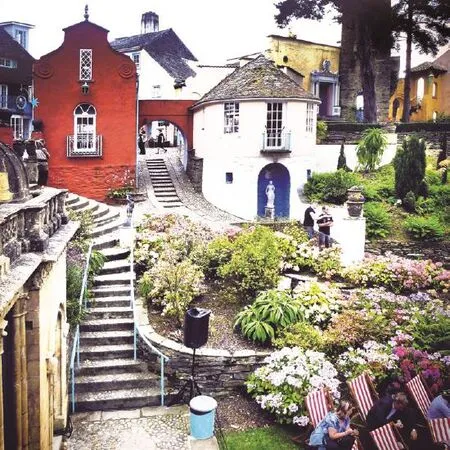
在英國的北威爾士,有那么一個小村莊。那里的建筑風格獨特,那里的房屋色彩繽紛,那里的夜格外寧靜……這是個不走尋常路的村莊,只等你去細細探尋。
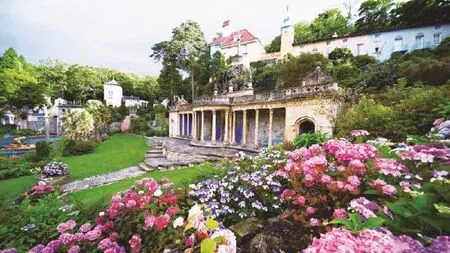

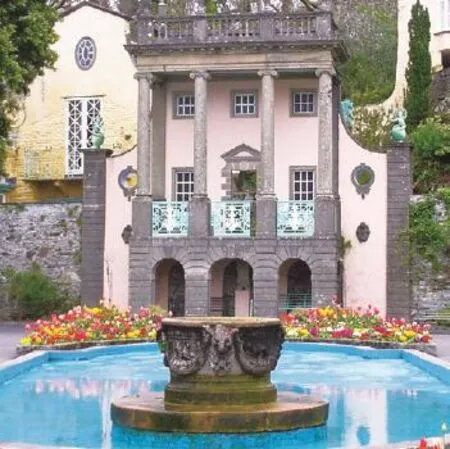
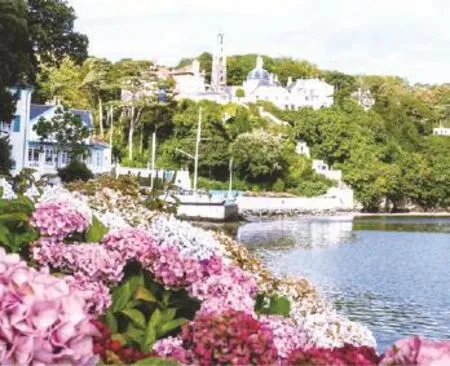
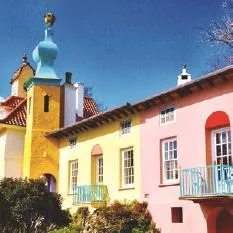
Built in the 1920s on the sandy1)estuary of northern Wales, beneath Snowdonia's注1majestic peaks, Portmeirion's注2buildings have many diferent styles. They are pink and red, green and2)ochre. Each3)roofine difers from the next.
4)Eccentric Portmeirion is one of the most recognizable attractions in Wales. The lifelong project of an architect with a passion for beauty, it would have been easy for the village to be frozen in time. Instead, it has continued to change and5)evolve. If there's anything constant about Portmeirion—other than its beauty—it is its ability for reinvention.
I first came to the village as a schoolboy in 1968. At that time, all I knew was it was6)featured in the7)bizarre British8)secret agent television series The Prisoner. I fell in love with Portmeirion that day.
A Welshman called Clough Williams-Ellis,born in 1883, was a successful but9)virtually self-taught architect. He wanted to show, as he once wrote, “that buildings properly situated within a landscape could actually10)enhance the scenery.” In 1925, Williams-Ellis bought a small11)estate on the edge of Snowdonia and started proving his point, building on pretty,wooded12)slopes that ran down to the estuary. There was already a gentleman's house on the estate, which Williams-Ellis immediately turned into a hotel.
1) estuary [?estj??rI] n. 河口三角灣,港灣
2) ochre [???k?] adj. 赭色的
3) roofine [?ru?flaIn] n. 屋頂輪廓線
4) eccentric [Ik?sentrIk] adj. 古怪的
5) evolve [I?v?lv] v. 發展
6) feature [?fi?t??] v. 以……為特色
7) bizarre [bI?zα?] adj. 奇異的,古怪的
8) secret agent 間諜,特務
9) virtually [?vз?t???lI] adv. 實際上
10) enhance [In?hα?ns] v. 提高
11) estate [I?steIt] n. 莊園
12) slope [sl??p] n. 斜坡
注1:斯諾登山,位于英國威爾士北部的一座山,是英格蘭和威爾士的最高點。在格溫內思郡(Gwynedd)境內,斯諾登尼亞(Snowdonia)是山脈的主峰。
注2:波特米洛恩(Portmeirion),一個位于威爾士北部的充滿意大利風情的小村,上世紀六十年代的大熱電視劇《囚犯》(The Prisoner)就是在此地拍攝的。
There were a few other buildings, which Williams-Ellis13)embellished in a colorful manner. His approach was just as14)irreverent as his style: he would draw his concept, and then let his builders work out how to achieve it.
But most of the village was new—in the sense that new uses were found for old pieces of architecture. In the years after World War I and World War II, modern architects were15)demolishing a lot of Britain's old buildings. Williams-Ellis got these buildings, or their parts, to reuse—so much so that he16)declared Portmeirion “a home for fallen buildings.”
On a visit this spring, when I arrived at my pink “17)cottage,”I was surprised to find that it took far fewer steps than I'd expected to get from the road outside to the front door.
Williams-Ellis and his writer wife Amabel hoped that their village would inspire painters. But artists never arrived—perhaps because Portmeirion was already a work of art. Still, thanks to Amabel's contacts with the London18)literati,many19)celebrities were soon accepting invitations. By World War II, Portmeirion had become a20)visual and social phenomenon.
Walking down from the cottage early in the morning, I passed a row of shops with21)faux Dutch22)gable where a café was opening for the day visitors. Outside the hall, the empty bottles were being taken quietly out from last night's reception.
It seemed surprising that such a famous23)anomaly could survive into the 21stcentury—let alone become more popular than ever before.
“The village has always24)muddled along,” William-Ellis' grandson and Portmeirion's25)managing director, the writer Robin Llywelyn, told me over cofee. “Various members of the family have often pursued their own interests. But somehow,this has worked to the long-term beneft of Portmeirion.”
Llywelyn himself pursued the arts while running Portmeirion,26)launching a music and arts festival in the village in 2012. He hopes to soon start a literary festival.
The village certainly continues to make me happy and I find it difficult to imagine life without the occasional visit. The reason why it has such an27)impact is based, I think,in the fact that Williams-Ellis fought for beauty all his life,considering it a “strange necessity.” And it is because his family has28)held on to this idea of beauty—in whatever form it comes—that Portmeirion continues to reinvent itself and29)go from strength to strength.

13) embellish [Im?belI?] v. 美化,裝飾
14) irreverent [I?rev?r?nt] adj.無禮的,傲慢的
15) demolish [dI?m?lI?] v. 毀壞,拆除
16) declare [dI?kle?] v. 宣布,聲稱
17) cottage [?k?tId?] n. 村舍,小屋
18) literati [?lIt??rα?tI] n. 文人學士
19) celebrity [sI?lebrItI] n. 名人
20) visual [?vI?j??l] adj. 視覺上的
21) faux [f??] adj. 人造的
22) gable [?geIbl] n.尖頂屋兩端的山形墻,三角形飾物
23) anomaly [??n?m?lI] n. 異常物
24) muddle along 得過且過
25) managing director 總經理
26) launch [l??nt?] v. 開辦,創辦
27) impact [?Imp?kt] n. 影響力
28) hold on to 堅持
29) go from strength to strength 不斷壯大
參考譯文
位于北威爾士沙河口三角灣的波特米洛恩村莊始建于20世紀20年代。在斯諾登尼亞山雄偉的峰巒之下,波特米洛恩的建筑風格迥異—有粉色、紅色、綠色和赭色。每個屋頂都各不相同,相映成趣。
不走尋常路的波特米洛恩是威爾士最受認可的旅游景點之一。這個村莊是一位熱愛美的建筑家的畢生杰作,它原本應該很容易就呈現出一副時光在此停駐的景象。可相反地,它一直處于變化和發展之中。如果說除了美以外,還有什么是波特米洛恩村莊亙古不變的,那便是它不斷創新的能力。
登錄APP查看全文
