P120-連環蛋白介導鈣黏蛋白轉換促進口腔鱗狀細胞癌細胞遷移和侵襲的實驗研究
2017-05-04 00:36:00陳鐘張美徐勇
華西口腔醫學雜志 2017年2期
關鍵詞:實驗
陳鐘 張美 徐勇
1.廈門醫學院口腔醫學系,廈門 361008;2.山東省高青縣人民醫院口腔科,高青 256300
·口腔腫瘤學專欄·
P120-連環蛋白介導鈣黏蛋白轉換促進口腔鱗狀細胞癌細胞遷移和侵襲的實驗研究
陳鐘1張美2徐勇1
1.廈門醫學院口腔醫學系,廈門 361008;2.山東省高青縣人民醫院口腔科,高青 256300
目的 探索P120-連環蛋白(P120ctn)在口腔鱗狀細胞癌(OSCC)細胞鈣黏蛋白轉換中的作用及其對腫瘤細胞遷移和侵襲的影響。方法采用質粒pGFP-V-RS-P120ctnshRNA轉染OSCC細胞株TSCCA,采用實時熒光定量聚合酶鏈反應、Western blot檢測細胞中P120ctn、E-鈣黏蛋白(E-cad)和N-鈣黏蛋白(N-cad)的mRNA和蛋白表達的變化,通過Transwell細胞侵襲及細胞遷移實驗檢測轉染前后細胞遷移和侵襲能力的變化。結果質粒pGFP-V-RSP120ctnshRNA轉染TSCCA細胞后,P120ctn表達明顯降低,E-cad的mRNA和蛋白表達水平也明顯降低,而N-cad的mRNA和蛋白表達水平明顯提高,細胞遷移和侵襲能力也明顯提高,差異均有統計學意義(P<0.05)。結論在OSCC中P120ctn可能通過介導鈣黏蛋白轉換來調節腫瘤的浸潤和轉移過程。
P120-連環蛋白; 鈣黏蛋白轉換; 口腔鱗狀細胞癌
腫瘤的侵襲轉移包含多個信號轉導通路,過程復雜,步驟繁多,其中細胞黏附能力下降是一個重要環節。鈣黏蛋白是一種鈣離子依賴型細胞黏附分子。口腔鱗狀細胞癌(oral squamous cell cancer, OSCC)發生發展過程中有鈣黏蛋白轉換現象,并且與腫瘤侵襲和轉移相關[1]。鈣黏蛋白轉換,是指上皮細胞E-鈣黏蛋白(E-cadherin,E-cad)表達的喪失和N-鈣黏蛋白(N-cadherin,N-cad)等間質鈣黏蛋白表達的上調,是上皮-間質轉化(epithelialmesenchymal transition,EMT)的重要步驟。研究[2]表明,P120-連環蛋白(P120-catenin,P120ctn)和E-cad可能通過調節細胞黏附調控OSCC浸潤和轉移,但與鈣黏蛋白轉化的關系尚未闡明。本研究通過基因轉染方法,探討P120ctn在OSCC細胞株TSCCA鈣黏蛋白轉換中的作用及其對細胞遷移和侵襲的影響。
1 材料和方法
1.1 主要試劑和儀器
鼠抗人P120ctn單克隆抗體、鼠抗人E-cad單克隆抗體(Abcam公司,美國),兔抗人N-cad多克隆抗體(Santa Cruz公司,美國)。pGFP-V-RS-P120ctnshRNA(Origene公司,加拿大),X-treme Gene HP DNA轉染試劑(Roche公司,瑞士)。DMEM培養基、胎牛血清(fetal bovine serum,FBS)(Gibco公司,美國),TRIzol試劑(Invitrogen公司,加拿大),逆轉錄試劑盒(TaKaRa公司,日本)。CO2培養箱(Thermal公司,美國),倒置相差顯微鏡(Olympus公司,日本),熒光定量聚合酶鏈反應(polymerase chain reaction,PCR)儀(Corbett公司,美國),Transwell小室(Corning公司,美國)。
1.2 基因轉染及篩選
細胞培養皿中接種約3×10⁵個TSCCA細胞,常規培養24 h。100 μL DMEM無血清培養基溶解1 μg pGFP-V-RS-P120ctnshRNA質粒和3 μL轉染試劑,然后將混合物加入TSCCA細胞中,輕柔混勻,15~25 ℃孵育30 min。37 ℃孵育24 h后施加篩選壓力,改用含0.8 μg·mL-1嘌呤霉素的培養基培養。反復篩選2~3周后,收集具有嘌呤霉素抗性的細胞克隆增殖,命名為TSCCA/shP120ctn細胞,對照組為未做任何處理的TSCCA細胞。
1.3 實時熒光定量PCR
引物合成委托上海生工生物工程公司完成。采用指數生長期細胞抽提總RNA,定量逆轉錄為cDNA。反應體系為Oligo dT primer(50 μmol·L-1)1 μL,dNTP Mixture 1 μL,Total RNA 5 μg,加入不含RNA酶dH2O補至10 μL,在PCR儀上進行逆轉錄PCR反應,反應條件如下:42 ℃ 15 min,70 ℃ 30~60 min,-20 ℃保存。PCR擴增反應條件為94 ℃ 5 min,93 ℃預變性30 s,59 ℃變性45 s,72 ℃退火60 s,71 ℃延伸7 min,35個循環。
1.4 Western blot
收獲指數生長期細胞的蛋白質,提取蛋白上樣,加入瓊脂糖凝膠,10 mA電泳2 h,根據相對分子質量Marker截取目的條帶,100 V衡壓1 h,濕轉到聚偏二氟乙烯(polyvinylidene fluoride,PVDF)膜上,5%脫脂奶粉封閉2 h,加入一抗4 ℃搖動孵育過夜,洗去一抗,辣根過氧化物酶(horseradish peroxidase, HRP)標記IgG與濾膜一同溫育洗膜曝光。
1.5 Transwell細胞侵襲及細胞遷移實驗
遷移實驗采用培養基和Transwell小室,置于37 ℃條件下溫育。消化對數生長期的TSCCA和TSCCA/ shP120ctn細胞,加入無血清培養基,調整細胞密度為每毫升2×10⁵個,上室加入200 μL細胞懸液,下室加入800 μL含20%FBS的培養基,48 h后進行固定、染色,計算并統計結果。侵襲試驗在Transwell上室底部中央垂直加入100 μL稀釋后的Matrigel,37 ℃溫育4 h使其干成膠狀,后續步驟同遷移試驗。
1.6 統計學方法
數據處理采用SPSS 19.0統計軟件,組間比較采用方差分析法,檢驗水準為雙側α=0.05。
2 結果
2.1 P120ctnshRNA轉染對TSCCA細胞鈣黏蛋白轉換的影響
用質粒pGFP-V-RS-P120ctnshRNA轉染TSCCA細胞后發現,隨著P120ctn表達的顯著降低,E-cad的mRNA和蛋白表達水平明顯降低,N-cad的mRNA和蛋白水平則明顯升高,差異均具有統計學意義(P<0.05)(圖1、2)。

圖1 P120ctnmRNA、E-cad mRNA和N-cad mRNA在TSCCA和TSCCA/shP120ctn細胞中的表達Fig1 Expression of P120ctnmRNA, E-cad mRNA and N-cad mRNA in TSCCA and TSCCA/shP120ctn
2.2 P120ctnshRNA轉染對TSCCA細胞遷移和侵襲能力的影響
利用無基質膠以及有基質膠Transwell實驗檢測TSCCA細胞轉染P120ctnshRNA前后遷移和侵襲能力的變化,結果見圖3。轉染前,遷移實驗穿過Transwell小室微孔的細胞數量為每視野59個,侵襲實驗為52個;轉染后,遷移實驗為每視野119個,侵襲實驗為102個,可見TSCCA細胞轉染P120ctnshRNA后遷移和侵襲能力顯著提高,差異有統計學意義(P<0.05)。
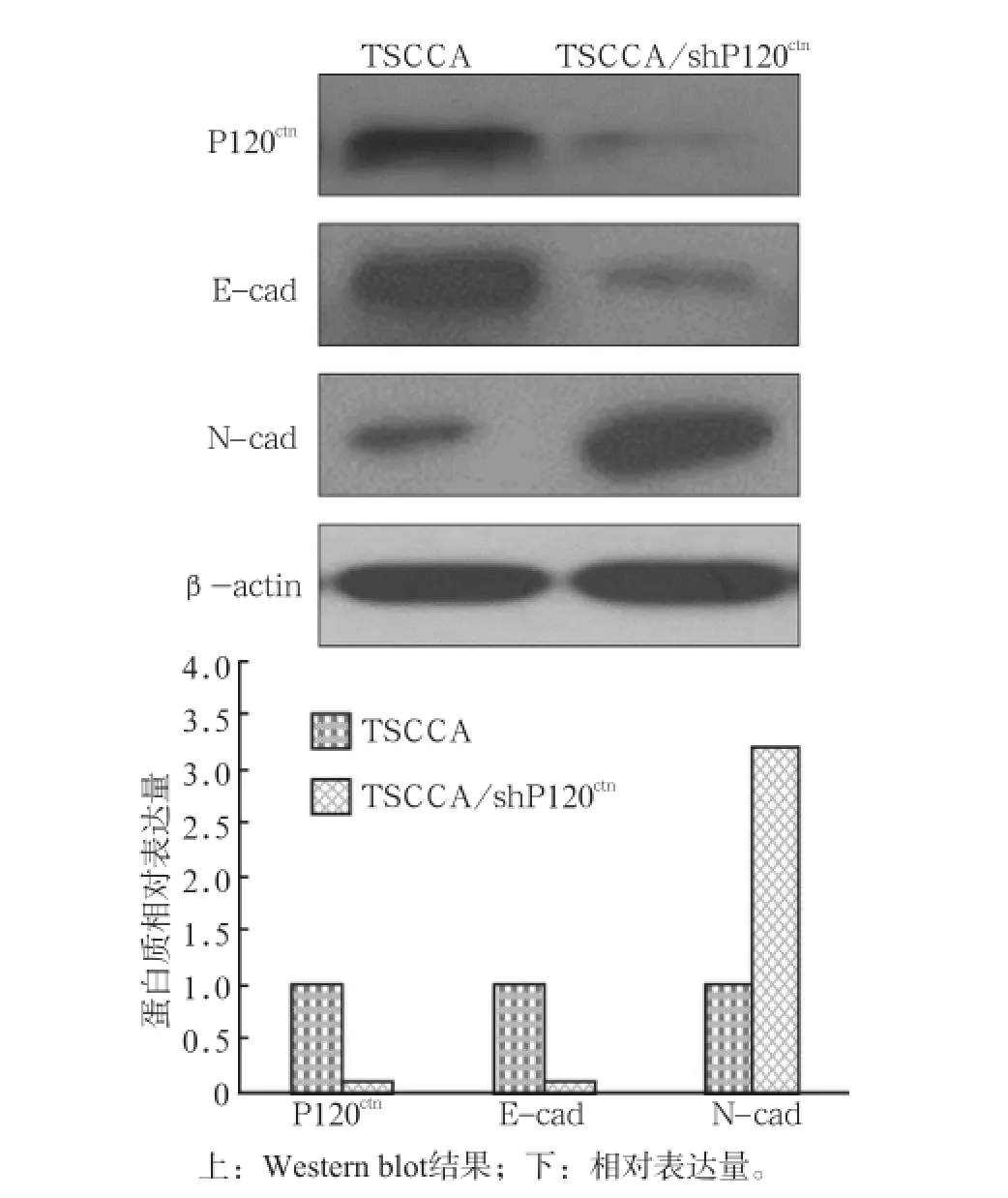
圖2 P120ctn、E-cad和N-cad蛋白在TSCCA和TSCCA/shP120ctn細胞中的表達Fig2 Expression of P120ctn, E-cad and N-cad protein in TSCCA and TSCCA/shP120ctn
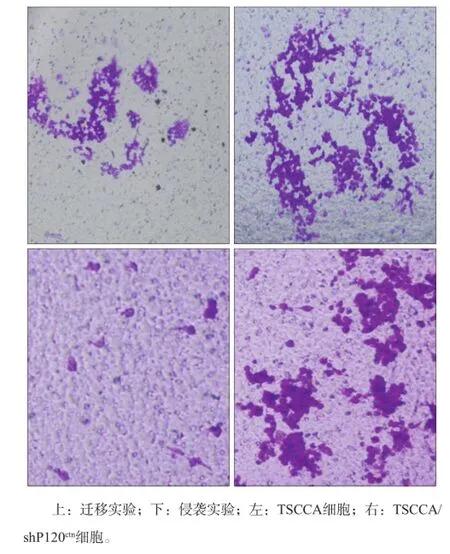
圖3 TSCCA細胞和TSCCA/shP120ctn細胞的遷移和侵襲能力對比Fig3 Contrast of migration and invasion capacity of TSCCA and TSCCA/shP120ctn
3 討論
鈣黏蛋白是鈣依賴的細胞與細胞之間粘連作用關鍵的細胞黏附調節分子,目前已發現30多種鈣黏蛋白,分布于不同的組織細胞上,如上皮細胞的E-cad、神經細胞的N-cad和胎盤滋養層細胞的P-鈣黏蛋白(P-cadherin,P-cad)以及心肌細胞上的N-cad等。腫瘤細胞之間通過鈣黏蛋白的作用而發生黏附,聚集成團,不易脫落進入周圍組織。腫瘤的轉移首先是腫瘤細胞從原發灶的脫落,因此與鈣黏蛋白的作用密切相關。如果鈣黏蛋白的表達異常,就會使這種黏附作用削弱,容易發生轉移。
P120ctn是連環蛋白家族的新成員,參與細胞黏附和信號傳導,通過與經典鈣黏蛋白,包括E-cad、N-cad和P-cad的胞內肽段近膜端(juxtamembrane domain,JMD)結合形成連環蛋白-鈣黏蛋白復合體(cadherin catenin complex,CCC)。P120ctn不同于其他幾種連環蛋白,它與經典鈣黏蛋白之間的連接并不緊密,因此P120ctn的主要作用在于調節而非物理性連接[3]。
本實驗結果發現,E-cad的mRNA和蛋白表達水平在P120ctnshRNA轉染舌癌原發灶細胞TSCCA后明顯降低。P120ctn蛋白水平的降低或P120ctn與E-cad結合的喪失使之從CCC脫離,導致鈣黏蛋白的內吞,內吞的鈣黏蛋白或者被溶酶體降解,或者通過與P120ctn結合和RAS小GTP結合蛋白1(a small GTP-binding protein of the RAS,Rap1 GTPase)被回收到細胞膜,因此P120ctn對于E-cad這種動靜結合的調節是非常重要的。P120ctn與E-cad結合的關鍵部位同時也是磷酸化位點,P120ctn上Y228位點的磷酸化與OSCC的發生密切相關[4],幾個酪氨酸和絲氨酸位點的磷酸化都與鈣黏蛋白的活化和黏附能力相關[5],P120ctn可能就是通過磷酸化調節了E-cad的結合和穩定性,從而影響CCC的穩定性,使細胞黏附能力發生異常。
此外,本研究還發現,P120ctnshRNA轉染TSCCA后,隨著E-cad表達水平的降低,N-cad的表達水平顯著增高,且TSCCA細胞遷移和侵襲的能力顯著增高,提示N-cad的表達和鈣黏蛋白轉換可能與OSCC的浸潤和轉移有關。這與前人的研究結果一致。Byrd等[1]應用免疫組織化學法觀察了93例OSCC病理切片,發現鈣黏蛋白轉換的發生與OSCC患者的預后不良有相關性。在許多實體腫瘤中,腫瘤細胞都發生了鈣黏蛋白轉換,并且被認為是腫瘤侵襲的起始步驟[6-8],并且,E-cad表達下調而N-cad表達上調的“鈣黏蛋白轉換”促進了腫瘤細胞的遷移和侵襲,并與不良預后有關[9-10]。
在鈣黏蛋白轉換機制的研究[11]中發現,如果在上皮細胞中強制表達N-cad,則內生性E-cad加速降解,表達水平下調。在A431細胞中,強制表達R-鈣黏蛋白(R-cadherin,R-cad)導致了內生性E-cad和P-cad的降解,這種降解是因為鈣黏蛋白競爭性結合于P120ctn所致[12]。鈣黏蛋白轉換可能發生在某一個鈣黏蛋白轉錄調節之后,生長因子諸如轉化生長因子β導致了E-cad的轉錄抑制,也通過釋放P120ctn,使之結合于N-cad,間接提高了N-cad的表達,并將其穩定于細胞表面[13]。
鈣黏蛋白轉化過程中腫瘤細胞的惡性行為可能與N-cad/血小板衍生生長因子受體的相互作用或N-cad/成纖維細胞生長因子受體(fibroblast growth factor receptor,FGFR)的相互作用有關。前者可能誘導了EMT過程中的一些重要事件,包括肌動蛋白重組、增殖和遷移;后者可能通過與成纖維細胞生長因子結合抑制了FGFR的內化,活化了絲裂原活化蛋白激酶,提高了細胞運動能力,促進了基質金屬蛋白酶的分泌和腫瘤細胞的侵襲。
綜上所述,由本研究結果可以推測,在OSCC中P120ctn可能通過介導鈣黏蛋白轉換參與調節OSCC的浸潤和轉移。
[1] Byrd KM, Aljadeff L, Bellile EL, et al. Cadherin switching, Twist, and Bmi-1 expression at the invasive front correlate with aggressive disease in oral squamous cell carcinoma patients: molecular biology and therapeutics[J]. Int J Radiat Oncol, 2014, 88(2):514.
[2] 陳鐘, 董孟華, 鄧鋒. P120ctn在口腔鱗癌中的表達及其與細胞黏附的關系[J]. 口腔醫學研究, 2013, 29(11):1051-1053.
Chen Z, Dong MH, Deng F. Correlation between the expression of P120ctnand the cell adhesion in the oral squamous carcinoma[J]. J Oral Sci Res, 2013, 29(11):1051-1053.
[3] Ozaki C, Yoshioka M, Tominaga S, et al. p120-Catenin is essential for N-cadherin-mediated formation of proper junctional structure, thereby establishing cell polarity in epithelial cells[J]. Cell Struct Funct, 2010, 35(2):81-94.
[4] Petrova YI, Spano MM, Gumbiner BM. Conformational epitopes at cadherin calcium-binding sites and p120-catenin phosphorylation regulate cell adhesion[J]. Mol Biol Cell, 2012, 23(11):2092-2108.
[5] Ma LW, Zhou ZT, He QB, et al. Phosphorylated p120-catenin expression has predictive value for oral cancer progression [J]. J Clin Pathol, 2012, 65(4):315-319.
[6] Gravdal K, Halvorsen OJ, Haukaas SA, et al. A switch from E-cadherin to N-cadherin expression indicates epithelial to mesenchymal transition and is of strong and independent importance for the progress of prostate cancer[J]. Clin Cancer Res, 2007, 13(23):7003-7011.
[7] ElMoneim HM, Zaghloul NM. Expression of E-cadherin, N-cadherin and snail and their correlation with clinicopathological variants: an immunohistochemical study of 132 invasive ductal breast carcinomas in Egypt[J]. Clinics, 2011, 66 (10):1765-1771.
[8] Hazan RB, Qiao R, Keren R, et al. Cadherin switch in tumor progression[J]. Ann N Y Acad Sci, 2004, 1014:155-163.
[9] Fan M, Liu Y, Xia F, et al. Increased expression of EphA2 and E-N cadherin switch in primary hepatocellular carcinoma[J]. Tumori, 2013, 99(6):689-696.
[10] Lade-Keller J, Riber-Hansen R, Guldberg P, et al. E- to N-cadherin switch in melanoma is associated with decreased expression of phosphatase and tensin homolog and cancer progression[J]. Br J Dermatol, 2013, 169(3):618-628.
[11] Nieman MT, Prudoff RS, Johnson KR, et al. N-cadherin promotes motility in human breast cancer cells regardless of their E-cadherin expression[J]. J Cell Biol, 1999, 147(3): 631-644.
[12] Maeda M, Johnson E, Mandal SH, et al. Expression of inappropriate cadherins by epithelial tumor cells promotes endocytosis and degradation of E-cadherin via competition for p120ctn[J]. Oncogene, 2006, 25(33):4595-4604.
[13] Wheelock MJ, Shintani Y, Maeda M, et al. Cadherin switching[J]. J Cell Sci, 2008, 121(Pt 6):727-735.
(本文編輯 吳愛華)
Cadherin switching induced by P120-catenin can promote the migration and invasion of oral squamous cell cancer cells
Chen Zhong1, Zhang Mei2, Xu Yong1. (1. Dept. of Stomatology, Xiamen Medical College, Xiamen 361008, China; 2. Dept. of Stomatology, Gaoqing People’s Hospital in Shandong Province, Gaoqing 256300, China)
Objective The main goal is to investigate the role of P120-catenin (P120ctn) in cadherin switching, as well as migration and invasion, of oral squamous cell cancer (OSCC) cells.MethodsThe plasmid pGFP-V-RS-P120ctnshRNA was used to transfect TSCCA cells and significantly reduce the expression of P120ctnin these cells. Real-time fluorescent quantitative polymerase chain reaction and Western blot were conducted to determine the mRNA and protein expression levels of P120ctn, E-cadherin (E-cad), and N-cadherin (N-cad). By contrast, the Transwell cell invasion and cell migration assay was used to determine the invasion and migration capacities before and after the transfection.ResultsAfter the plasmid pGFPV-RS-P120ctnshRNA was transfected into the TSCCA cells, we found that as the P120ctnexpression significantly decreased, E-cad mRNA and protein expression decreased significantly. Moreover, N-cad mRNA and protein expression increased significantly (P<0.05). Lastly, the cell migration and invasion capacities were augmented significantly (P<0.05). Conclusion In OSCC cells, P120ctnmay be involved in cadherin switching and promote metastasis and invasion.
P120-catenin; cadherin switching; oral squamous cell cancer
R 739.8
A
10.7518/hxkq.2017.02.014
Supported by: Project Supported by Natural Science Foundation of Xiamen Medical College (2013-02). Correspondence: Chen Zhong, E-mail: 310571932@qq.com.
2016-10-15;
2016-12-22
廈門醫學院自然科學基金(Z2013-02)
陳鐘,副教授,博士,E-mail:310571932@qq.com
陳鐘,副教授,博士,E-mail:310571932@qq.com
猜你喜歡
作文·小學低年級(2025年2期)2025-02-13 00:00:00
小雪花·小學生快樂作文(2024年11期)2024-12-31 00:00:00
作文·小學低年級(2024年2期)2024-04-29 00:00:00
作文·小學低年級(2023年3期)2023-04-29 00:00:00
小獼猴智力畫刊(2022年9期)2022-11-04 02:31:42
小主人報(2022年4期)2022-08-09 08:52:06
中學生數理化·中考版(2022年11期)2022-02-16 07:01:20
小哥白尼(趣味科學)(2019年6期)2019-10-10 01:01:50
發明與創新(2016年38期)2016-08-22 03:02:52
太空探索(2016年5期)2016-07-12 15:17:55