學(xué)制改革與地方紛爭:1920年代安徽實(shí)施“新學(xué)制”研究
2017-05-20 16:59:48周寧
安徽師范大學(xué)學(xué)報
2017年3期
周寧
關(guān)鍵詞: 安徽;教育界;新學(xué)制;地方主義
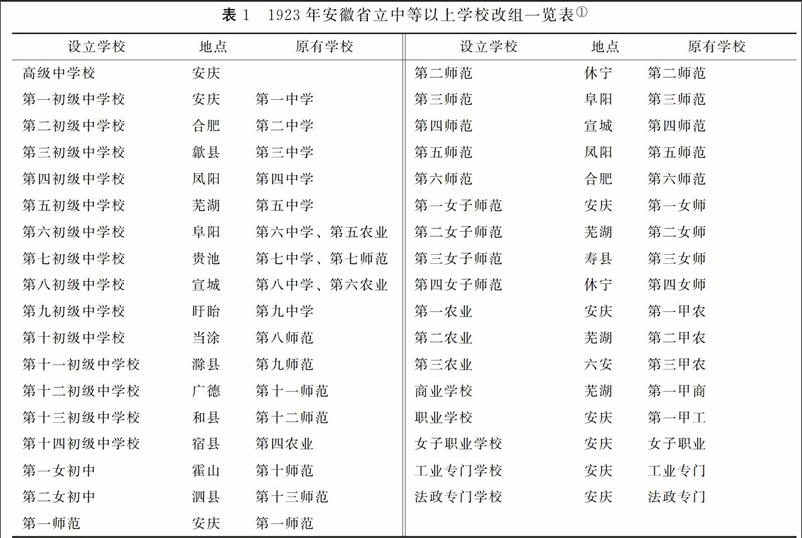
摘要: 1923年,安徽教育廳長江暐召開實(shí)施新學(xué)制討論會,在安徽推行新學(xué)制。然而,根深蒂固的地方主義讓安徽的新學(xué)制改革大打折扣。在安徽的新學(xué)制改革中,由于經(jīng)費(fèi)短缺,高級中學(xué)發(fā)展明顯滯后,這直接導(dǎo)致三年后初中生升學(xué)的困難。而此時,籌辦安徽大學(xué),將高中改辦預(yù)科的動議,又引發(fā)了中學(xué)“三三制”與“四二制”的爭議。新學(xué)制改革的困難與阻力,以及自由與彈性,在安徽均得到了淋漓盡致的體現(xiàn)。
中圖分類號: G4009文獻(xiàn)標(biāo)志碼: A文章編號: 10012435(2017)03037307
Key words: Anhui; educational circles; new educational system; localism
Abstract: In 1923,the Anhui education minister,Jiang Wei held discussion of the implementation of the new educational system,advocating the new educational system in Anhui.However,deeprooted local protectionism made the effectiveness of Anhui new educational system greatly reduced.In the new educational system reform,because of the shortage of funds,and high school development lagging behind obviously,triggered the dispute of “three three” and “four two” systems.The difficulties and resistance of the new educational system,as well as the freedom and flexibility,have been fully reflected in Anhui.
1922年“新學(xué)制”改革奠定了近代中國“六三三”的基本學(xué)制架構(gòu)。學(xué)界對此已經(jīng)進(jìn)行了比較深入的研究。但就研究成果而言,多集中于學(xué)制實(shí)施前的醞釀與爭論,較少實(shí)施過程的深入探討;①就研究視野而言,多側(cè)重于國家制度層面的宏觀勾勒,缺少實(shí)施狀況的個案分析。②有鑒于此,筆者以安徽為例,分析地方社會實(shí)施新學(xué)制引發(fā)的各種反應(yīng)及其調(diào)適過程,以期增進(jìn)對1922年“新學(xué)制”如何“落地”的動態(tài)了解,在此基礎(chǔ)上加深對近代中國地方教育發(fā)展的認(rèn)知。
一、安徽實(shí)施“新學(xué)制”
清末民初,中國主要借鑒模仿日本學(xué)制。這種學(xué)制時間偏長且過于僵化,實(shí)施之后弊端逐步顯現(xiàn)。迨至五四時期,教育界要求改革學(xué)制的呼聲日趨高漲。
1915年4月,全國教育聯(lián)合會第一屆大會在天津召開,湖南省教育會就提出改革學(xué)校系統(tǒng)案。時隔五年之后,學(xué)制改革再次成為教育界關(guān)注的焦點(diǎn)。1920年,全國教育聯(lián)合會第六次大會召開,“提出學(xué)制議案者有安徽二案,奉天、云南、福建各一案”。……
登錄APP查看全文
猜你喜歡
華人時刊(2022年13期)2022-10-27 08:55:52
當(dāng)代陜西(2022年4期)2022-04-19 12:08:52
金橋(2019年10期)2019-08-13 07:15:20
福建基礎(chǔ)教育研究(2019年9期)2019-05-28 01:34:27
領(lǐng)導(dǎo)決策信息(2017年9期)2017-05-04 04:04:50
留學(xué)生(2016年6期)2016-07-25 17:55:29
小朋友·聰明學(xué)堂(2014年7期)2015-01-15 12:07:06
傳記文學(xué)(2014年8期)2014-03-11 20:16:48
中學(xué)生英語·外語教學(xué)與研究(2008年2期)2008-02-18 01:52:44