
黃瓜硝酸還原酶基因(CsNR)序列分析及正反義表達載體的構建
2017-07-25 15:40:58潘玲玲王秀峰李強楊鳳娟魏珉史慶
天津農業科學
2017年7期
潘玲玲+王秀峰+李強+楊鳳娟+魏珉+史慶華
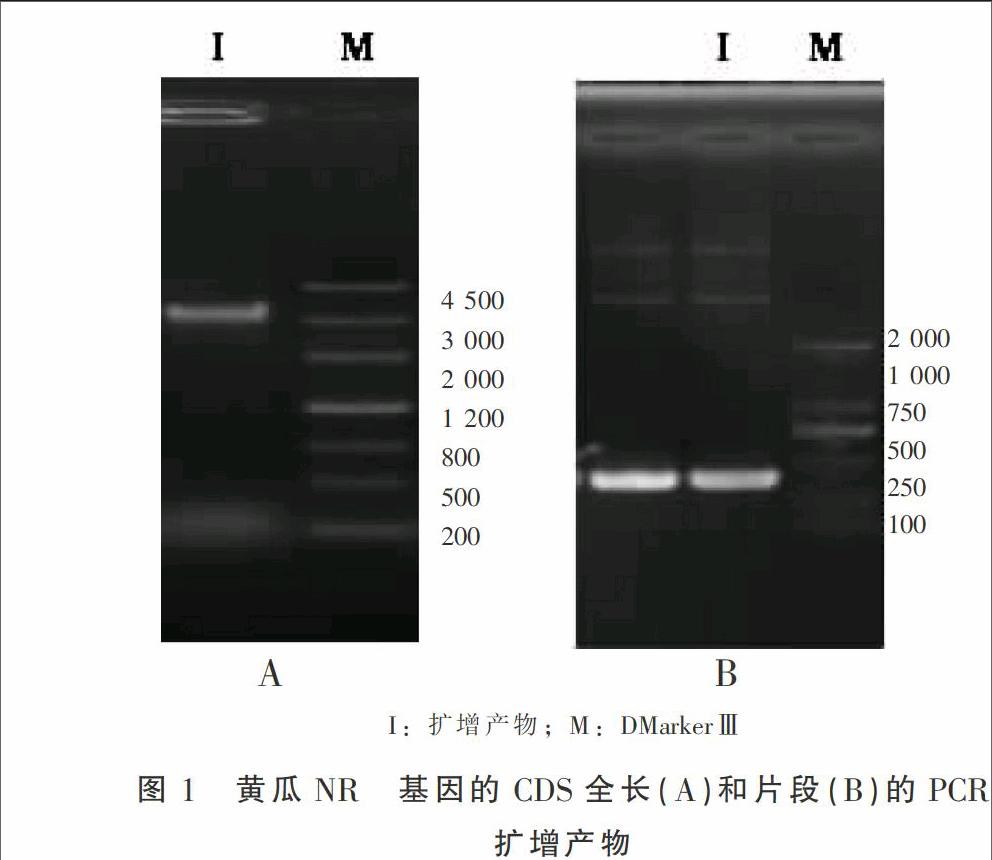
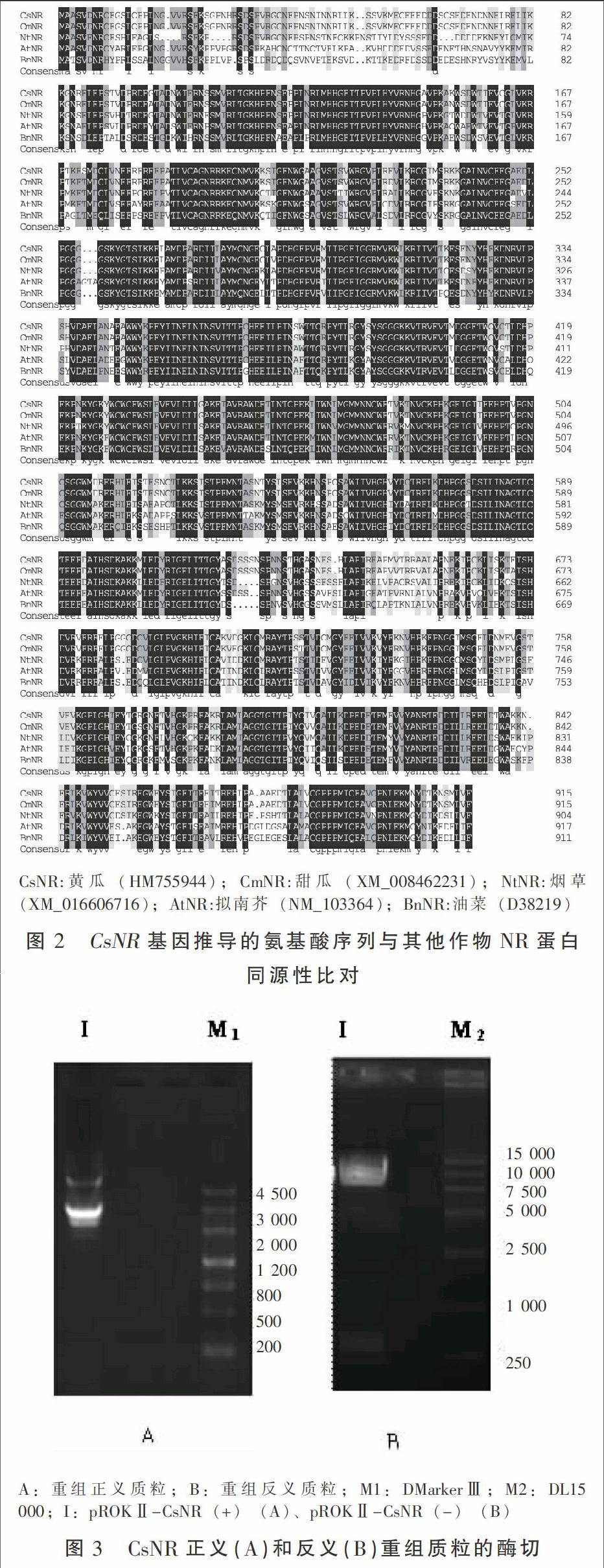
摘 要:為進一步研究CsNR的作用機制,從黃瓜幼葉中克隆獲得硝酸還原酶基因編碼區序列(CDS)全長和片段(CsNR; EC 1.6.6.1),并運用生物學軟件對該基因進行序列分析。其中CDS全長2 748 bp,編碼915個氨基酸;CDS片段360 bp。CDS全長和pROKⅡ經KpnI單酶切和連接,構建了CsNR正義表達載體;CDS片段和pROKⅡ經KpnI和SacI雙酶切,構建了CsNR反義表達載體。通過與其他高等植物NR蛋白進行同源性比對分析,結果發現,CsNR基因的氨基酸序列與甜瓜、煙草、擬南芥、油菜NR基因編碼的氨基酸序列高度同源,其中與甜瓜NR蛋白之間同源性最高,為98.25%。
關鍵詞:黃瓜;硝酸還原酶;生物信息學;正義表達載體;反義表達載體
中圖分類號:S642.2 文獻標識碼:A DOI 編碼:10.3969/j.issn.1006-6500.2017.07.001
Sequence Analysis and Construction of Sense and Antisense Expressing Vector of Cucumber Nitrate Reductase(CsNR)
PAN Lingling1, WANG Xiufeng1,2, LI Qiang1, YANG Fengjuan1,2,WEI Min1,3, SHI Qinghua1,2
(1.College of Horticulture Science and Engineering, Shandong Agricultural University, Tai'an, Shandong 271018, China; 2.State Key Laboratory of Crop Science, Tai'an, Shandong 271018, China;3. Scientific Observing and Experimental Station of Environment Controlled Agricultural Engineering in Huang-Huai-Hai Region, Ministry of Agriculture, Tai'an, Shandong 271018, China)
Abstract: To further study the mechanism of CsNR, a fragment and full length CDS of cucumber nitrate reductase (CsNR; EC 1.6.6.1) was isolated from cucumber (Cucumis sativus L.) young leaves, respectively. Meanwhile, the gene sequence was analyzed by the biology software. The fragment and full-length CDS was 2 952 and 360 bp, respectively. The full-length CDS and pROKII were digested to construct sense expressing vector. The fragment CDS and pROKII were digested to construct sense expressing vector. The homology alignment analysis indicated that the protein encoded by CsNR was in high similarity with NR-encoding protein in Cucumis melo, Nicotiana tabacum, Arabidopsis thaliana and Brassica campestris. The homology with amino acid sequences of CsNR compared with Cucumis melo was the highest by 98.25%.
Key words: Cucumis satinus L.; nitrate reduatase; bioinformatics; sense expressing vector; antisense expression vector
植物硝酸還原酶(Nitrate reductase,NR)是氮同化代謝的關鍵酶和限速酶,它以還原型輔酶(NAD(P)H)為電子供體催化硝酸鹽的還原,生成亞硝酸鹽。硝酸鹽通過谷氨酸合成循環轉變為銨,分別由胞質中的NR以及葉片葉綠體中的亞硝酸還原酶催化[1]。NR催化硝酸鹽還原成亞硝酸鹽是植物整個硝酸鹽同化過程中的限速和關鍵作用步驟[2-4],故NR被認為是硝酸鹽同化過程中的限速酶和誘導酶[5-8],那么植物中的硝酸還原酶活性和NO3- 含量之間就應該存在著密切聯系[9]。對高等植物而言,研究發現硝酸鹽是調節硝酸還原酶活性[5]以及NR表達[6]的主要因子。現已從大麥[10]、筍瓜[11]、煙草[12-13]、擬南芥[14-15]、番茄[16]、玉米[17]、蘿卜[18]、生菜[19]和大白菜[20]等多種植物種類中克隆出了多種NR基因。目前,人們在植物的鹽脅迫信號轉導機制方面研究已取得了大量成就[21],但均以NaCl作為鹽脅迫處理手段。……
登錄APP查看全文
