建筑學與對尺度、精準性和可預測性的吸納
2017-09-29 11:58:42弗朗西斯卡弗拉索達提FrancescaFrassoldati
世界建筑 2017年9期
弗朗西斯卡·弗拉索達提/Francesca Frassoldati
徐知蘭 譯/Translated by XU Zhilan
建筑學與對尺度、精準性和可預測性的吸納
弗朗西斯卡·弗拉索達提/Francesca Frassoldati
徐知蘭 譯/Translated by XU Zhilan
“在中世紀后期和文藝復興時期,歐洲出現新的現實世界模型。定量模型剛剛開始取代古代的定性模型。哥白尼和伽利略、許多相繼自學成才通曉如何建造優質大炮的工匠、那些在地圖上繪制出新發現大陸的海岸線的制圖者,還有管理著新興帝國的官僚、運營東西印度公司的企業家,以及部署和控制著新興財富流向的銀行家等等——這些人都在以定量的方式理解現實世界。”[1]
盡管克羅斯比1)的著作既沒有針對建設活動,也沒有就建筑學進行具體討論,然而作為14世紀和15世紀歐洲重要特征的文化與技術革新,也是建筑設計作為獨立專業之肇始的標識。各種建筑史和藝術史的研究已經探討了若干問題,包括在空間的表達中常規性地采用尺寸標注方法,紙張相對便宜的價格使它成為可隨身攜帶的輕便選擇,從而推動了用草圖來表達空間概念的方式,以及為信息共享的目的將圖像固定印制在媒介上所產生的影響。同樣與之相關的是,技術創新在思想和理論傳播方式中所扮演的角色,例如機械印刷,還包括與文字編輯成果的特定結構的關聯。一場就古典主義和諧形式的理想原則進行的爭論——配以視覺信息的輔助——得到了廣泛傳播,它迅速地取代了只有為數不多的幾份謄寫稿的古代手卷,這些手卷幾乎沒有任何配圖,并因此發展出了以定性描述和比較方法為基礎的敘事方式。
實際上,認知世界的定性概念和定量概念之間的沖突甚至延續至今天建筑學進行描述、溝通和討論的方式中。中世紀時期的智者先賢與旅行家們的著作和信件表達了以固有性質思考和描述世界的方式。在當時,建筑學包含了不證自明的信息——盡管在我們看來,閱讀那些著作猶如參與一場沒有指明規則的游戲。不同的是,從復雜現實世界的建成形式中抽象出規則和規律并進行思考,或將各種思想組織為因果關系或關聯關系,則是迄今為止建筑學司空見慣的手法。我們應該牢記,形成這些“自然而然”的推理方法所必須的一系列前提在15世紀之前的歐洲還尚未出現。它們產生自學術共同體的出現和由受過教育的被資助者所構成的組織,這些人更容易在腦海中對建成空間的圖紙進行解讀和視覺化——或甚至從世俗的建筑物中進行抽象。這兩個概念——即專業共同體的出現和建立在視覺形象基礎上的簡化抽象能力,其實相輔相成——由此可以得出結論,在建筑學中,我們不僅有可能抽象地探討無法直接檢驗的經驗(無論這些假設是否可被證明是正確的,唯一最重要的是:古代古典主義的建筑廢墟作為整體在圖紙上進行推敲而無需被重建的經驗),也可以對其具有的現實程度足以被模擬、計算和批評的假設事件進行抽象的探討,這是值得深思的。
西方世界建筑學專業的標準化過程就建立在這一前提下。如果說今天影像制作的技術似乎正在質疑我們觀察世界的方式,并改變了我們的視覺環境,那么科技革新則對形成于文藝復興時期的建筑觀察原則和建筑學訓練方法所仰賴的社會文化框架提出了挑戰[2]。
有3個具體的理念值得我們進一步進行關注:(1)認為建成作品脫離了采用符號系統圖紙預先布置的概念;(2)在腦海中以具有尺度的清晰圖像進行設計的行為本身,表達現實世界的哲學完美,并以描述性的再創造為特征; (3)以建立在視覺基礎上的推理過程的傳播作為社會技術的創新。
象征性語言vs視覺化表達
“通常,中世紀時期的文稿對兩座建筑進行比較時,現代讀者可能會疑惑作者如何能看出兩者之間有任何相似之處。”[3]2“中世紀時期奇怪地缺乏準確度的描述不僅出現在對建筑圖案的描述上,也出現在對所有幾何形式的描述中……看起來似乎對某些形狀的模仿并不是為其本身的目的,而是為了它所暗示的其他事物[3]7-8。”
在以采用符號標注的設計和透視圖表達方案之前,人們利用其他方式表現建筑。今天的這種方式以其對各種相對的和相關的對比概念或現場試錯檢驗的依賴代表了頗為有趣的文化前沿。盡管商業協議中通常會非常精確地指定某些建筑材料,但對建筑形式與結構卻不會這樣深入探討;在那些比較性的描述中——至少在克勞泰默爾2)的作品所提到的例子里——在根據中世紀的文獻認為具有類似性質的現存建筑中之間,我們沒能找到任何精確的幾何對應關系。這些中世紀的語言描述把一系列單一要素從建筑中孤立出來,如為了把一些建筑與某些偉大的先例定義為“相似的”或是受其啟發,建筑物內部某些位置上的柱子或柱墩數量就比完整的建筑布局更重要(如在克勞泰默爾研究的圣墓教堂3)一例中)。籠統地說,在中世紀的建筑學中,圖紙是邊緣事務,并且在圖紙和建筑之間也缺乏我們所謂的“精確”(也就是可測量的)對應關系。
"During the late Middle Ages and Renaissance a new model of reality emerged in Europe. A quantitative model was just beginning to displace the ancient qualitative model. Copernicus and Galileo, the artisans who taught themselves to make good cannon after another, the cartographers who mapped the coasts of newly contacted lands, the bureaucrats and entrepreneurs who managed the new empires and East and West India companies,the bankers who marshaled and controlled the streams of new wealth – these people were thinking of reality in quantitative terms"[1].
Despite neither construction activities nor architecture fnd specifc attentions in Crosby's work,the cultural and technical shift that characterised 14th and 15th century Europe also marked the very origin of architectural design as an independent profession. Diferent research works in architectural and art history have dealt with the naturalization of measurement in spatial representation, the expression of spatial ideas by means of sketches,which developed thanks to the availability of paper as a relatively cheap portable support, and the impact of fixing images on media for the purpose of sharing. Also relevant is the role of technical innovation, such as mechanical printing, in the way in which ideas and theories were circulated,including in relation to the very structure of editorial products. A widespread debate on the ideal principles of classic harmony, accompanied by visual messages, rapidly replaced ancient manuscripts in unique copies that rarely included pictures and had developed for that reason a narrative based on descriptive qualities and comparisons.
Indeed, the tension between qualitative and quantifiable perceptions of the world is inherent in the way in which architecture is described,communicated and discussed even today. Thinking and describing the world in terms of intrinsic qualities was what the Middle Ages transferred to us through volumes and letters compiled by wise sages and travellers. At that time, architecture embodied self-evident messages, even if reading them was, to us, like a game with no instructions.Instead, the thinking and abstracting of rules and laws out of the complex reality of built forms, or arranging thoughts as chains of causations and concatenations, are hitherto common operations in the architectural discipline. We should remember that these "natural" ways of reasoning had required a number of conditions that were manifested no earlier than 15th century Europe.They emerged from the presence of a technical community and a panel of educated recipients who were able to read and visualize drawings of the built space more easily in their minds – or even separately from – mundane architectural matters. These two notions, the presence of a professional community and the power of simplified abstraction based on visualization, are indeed relevant: from there, it follows that, in architecture, not only is it possible to abstractly discuss experiences that cannot be directly tested (one and foremost: the experience of the ancient classic ruins that are studied as a whole in drawings without being rebuilt, whether or not such hypotheses proved to be correct), but also,hypothetical occurrences that are sufficiently realistic to be simulated, calculated, criticised, etc.are worthy of consideration.
The Western standardization of the profession has been grounded on this mind-set. If nowadays image-making technologies seem to question our way of seeing the world and modify our visual environment, technological change challenges the socio-cultural framework on which the principles of seeing architecture, and its training, were established during the Renaissance[2].
Three specific threads of thoughts deserve further attention: (1) the notion of construction work as separate from the predisposition of drawings that adopt a notational system; (2) the very act of designing with a measurable idea in mind as the expression of the metaphysical perfection of reality in a clear image to be distinguished by its descriptive reproduction; (3) the circulation of a visual-based reasoning as a socio-technical innovation.
The language of symbolic vs. visual representation
"Often when two buildings are compared with one another in mediaeval writings the modern reader may wonder how the author came to see any resemblance between the two"[3]2. "The peculiar lack of precision in mediaeval descriptions not only of architectural patterns but of all geometrical forms… would seem as though a given shape were imitated not so much for its own sake as for something else it implied"[3]7-8.
Before the codification of notated design and perspective, alternative models of discourse around architecture were utilised. Today, these represent an interesting cultural frontier in their reliance on relative and relational concepts of comparison or on-site trial and error verification. Although there are very precise references to building materials as part of commercial agreements,forms and structures are not discussed as such,and in comparative descriptions – at least in the cases presented in Krautheimer's work – we found no precise geometrical correspondence among existing buildings that are grouped on the basis of similar qualities according to medieval sources of information. These mediaeval verbal depictions isolate a selection of single elements from the whole building, such as the number of columns or piers in particular positions within the building,which matter more than the complete layout, in order to define buildings as "similar" or inspired by significant references (e.g. the Holy Sepulchre in the case studied by Krautheimer). Generally speaking, drawings were marginal items in medieval architecture, and there was a lack of what we call a"precise" (i.e. measurable) correspondence between drawings and buildings.
其實,中世紀時期人工制品的美感與其對神圣性的展現直接相關,卻排除了復雜的分析手段:永生的建筑——如天主教堂——必須在與眾生對話的同時,也與實用主義的建造者和受過教育的神職人員對話——初見之物即為上帝的顯現,就其本身而言,并不需要更進一步的校驗。然而真正通過藝術作品變得可見的“對象”卻遠非事物的物質屬性[4],如建筑的物質屬性。不如說,圖紙強調了事物固有的原則和規律,正如維拉爾·德·奧內庫爾4)在最早的建筑草圖中所繪制的圖案。草圖中出現了許多幾何形狀,但我們并不很清楚它們的用途;而且,在許多情況下,由幾何形狀疊加形成的建筑形式只說明了圖紙是一種表達普遍規律、說明不同要素和抽象特征之間相互關系的復雜技巧,而不具有描述性的特征。
如果比較維拉爾·德·奧內庫爾和喬托(圖1、2)分別繪制的兩幅宗教建筑圖紙和繪畫,會發現拉昂大教堂含糊不清的空間體積感與斯科洛文尼教堂寫實主義的重量感截然不同,這是令人震驚的差異。前者的體積感能從描繪細致、卻又不具有物質性的裝飾要素中辨認出來。后一幅繪畫則存在著強烈的空間感,一整個三維模型被繪制在平整的墻面上,許多單一的建筑要素之間存在著內在聯系,由此形成了這種空間感。盡管許多拱券窗的細節在透視圖中并不可見,但我們的眼睛卻已被訓練得能補充完整畫面。我們確實是根據設計、透視和投影關系來觀看世界的,而對其客觀性的信任讓我們相信,這些表達方式足以讓我們通過觀察畫面來認識真實的建筑。
圖像在建筑學的思維方式中必不可少。通過具有誘惑力的幻象,我們能在二維的紙面上操縱三維的現實,而這些幻象仰賴于有節制的幾何簡化過程和在此之前對空間物體的精確量化過程。經由視覺化的過程,未來可被預見,過去也能復活至細致入微的程度,只要具備所有必要的軸向,使之能夠變成真實的物件即可。然而,文藝復興時期采用符號標注和透視方法制圖的過程則不僅考慮如何將作者的指令傳達給建造者,在許多情況下,它們更追求15世紀哲學家馬爾西利奧·費奇諾5)所謂的“一種‘意識之眼的視角’,力求近似一座建筑存在于建筑師意識中的柏拉圖理念”[5]335。也就是說,這意味著當時的人們并不認為設計是將“物體的質量”變為現實的操作指令[5]338;而認為它應該試圖通過去除偶然事件來提煉出事物精確的核心概念。
圖像的可預見性和簡化
“約15世紀中期,阿爾伯蒂作為文藝復興早期的罕世通才最早宣告建筑學首先是一種思想——它在創作者的頭腦中孕育,在圖紙上以符號表示,之后由手工匠人嚴格按照(圖紙和模型傳達的)指令建造,并不得進行絲毫改變。在阿爾伯蒂的設計理論中,建筑師的圖紙就是最初的創作行為;可能隨之而來的有形建筑只是其復制品,全無任何新增的知識價值。……這就是……為什么是圖紙,而不是磚石和砂漿,成為建筑師實踐的主要工具,而這一傳統延續至今。”[6]128
在這一概念模型中,設計師并未建造建筑,卻是建筑的創造者。他們繪制出能夠表現建筑的圖紙,他們的理想則是通過其他繪圖工作說明設計理念并使之視覺化(設計理念在建筑師頭腦中以理想幾何形狀的方式表達出來)。15世紀時探討過這一問題的包括從阿爾伯蒂到馬西里奧·費奇諾,他們將建筑學尊為許多哲學和科學爭論的視覺化過程,哲學和科學這兩者在當時密不可分。視覺化過程具有將在時間或空間上相距甚遠的不同對象立刻組合在一起的優勢。自然法則可用數學方程來書寫;音樂形象也可躍然紙上;哲學可被編制為一卷卷著作;世界地理也可用地球儀和經過數學計算的地圖來表現,用來在同一頁紙上表達直線距離和角度。所有這些視覺化的過程都擁有類似的簡化原則,采用了有所節制的復雜度刪減法。它們也都在孜孜不倦地追求著隱藏在變化無常又易于腐敗的日常經驗背后的穩定性和可預測性。
由于這一工作方法建立在有能力認識和使用數學工具的基礎上,建筑師必須接受教育和訓練。各種理論可從留存的文獻中學到,或通過研習古代經典作品獲得;然而,由于各種草圖本和建筑方案的收集與歸類,人們有可能獲得更為平易近人的信息傳播方式。它們并不是維拉爾·德·奧內庫爾繪制的那種草圖。歸功于建筑設計的方法論概念,作為阿爾伯蒂的晚輩,賽里奧提供了一套具有標準化特點的分類目錄,它來源于經過挑選的古典主義紀念建筑和一些當代建筑,并且可以根據簡單而不可能出錯的原則進行復制和重新組合。
盡管事實上賽里奧的訓練課程看似只是對龐大的知識系統化過程進行了不重要的刪減,其價值卻在于對設計過程和建筑學專業采用了具有可復制性的方法。可被設計對象和設計工作所承認的各種規則和規律早已俱備。建筑學變成更少隨機發生事物的結果,而更多成為社會和技術教育的產物,不再被秘密的典籍和必須牢記的建筑師行業規則所控制(可以認為,維拉爾·德·奧內庫爾的草圖已經繪制出了這些規則中的一部分)。

1 對真實建筑的想象/Fantasising on real architectureVillard de Honnecourt, Ms. fr. 19093, Biblioteque Nationale,Paris (13th cent.). Towers of the Laon Cathedral, Sketchbook of Villard de Honnecourt. In: Carpo, M. (1998). L'architettura dell'età della stampa. Oralità, scrittura, libro stampato e riproduzione meccanica dell' immagine nella storia delle teorie architettoniche. Milano: Jaca Book, p.36.

2 物質化的建筑思想/Materialising architectural ideasGiotto di Bondone (1305): Detail of the Last Judgement – Cross and donor portrait. Padova, Scrovegni Chapel.
Indeed, the beauty of artefacts in the Middle Ages was directly associated with divine manifestations, excluding sophisticated analytical tools: prominent buildings, such as cathedrals, had to speak to the crowds as well as to pragmatic builders and educated clergymen:what is visible at first sight as a manifestation of god that, as such, was not in need of further verification. Yet the "what" is made visible by works of art that is far from being the materiality of things[4], for instance, the materiality of buildings. Rather, drawings emphasise intrinsic rules and regularities, such as those drafted in the earliest architectural sketchbook of Villard de Honnecourt. Geometrical shapes appear in the sketchbook, but their use is rather obscure to us, and in most cases, the superimposition of geometrical shapes to built forms simply conveys the idea that drawings are a tricky means of expressing general rules, relationships among elements and abstract features instead of possessing descriptive characteristics.
When comparing the two religious buildings drafted by Villard de Honnecourt and painted by Giotto (Fig.1, 2), the striking diference is the vague idea of the spatial solidity of the Laon Cathedral,which is recognisable precisely by its detailed yet immaterial decorative elements as opposed to the realistic gravity of the Scrovegni Chapel. In the latter, spatiality is self-assertive and results from the interconnection among single architectural elements in a whole tridimensional model painted on a fat wall. Although some details of the arched windows are not visible in the perspective, our eye is trained to complete the picture. We do see the world according to design, perspective and projections,and our trust in their objectivity makes us confdent that these representations suffice to recognize the real building by sight from its picture.
Images are substantial in the way in which we practice architectural thinking. The seductive fiction through which tri-dimensional reality can be manipulated on bi-dimensional sheets relies on controlled geometrical simplifications and,before that, the precise quantification of spatial matters. Through visualization, the future can be anticipated and the past revived in detail, with all the necessary directions to make it into a real object.Yet, the Renaissance codification of notational and perspective drawings concerned not only the transposition of instructions from authors to builders, but also pursued in many cases what the 15th century philosopher Marsilio Ficino called "a"mind's-eye view", in seeking to approximate the original Platonic Idea of a building as it existed in the architect's mind"[5]335. This means, in other words, that designing was not intended as the operational indication to make real "the mass of the matter"[5]338; rather, it was an attempt at subtracting contingent matter to extract essential ideas.
The image of predictability and simplifcation
"Around the mid-15th century, Leon Battista Alberti, the universal man of the early Renaissance,was the first to claim that architecture is first and foremost an idea: conceived in the mind of its author, notated in drawings, then built by manual workers who must comply with the instructions they receive (through drawings and models), and follow them without change. In Alberti's theory of design, the architect's drawing is the original act of creation; the physical building that may follow is only a copy, devoid of any intellectual added value…This is how… drawings, rather than bricks and mortar, became, and remain to this day, the main tool of the architect's trade"[6]128.
In this conceptualization, designers are the authors of buildings that they do not build. They make drawings that represent buildings, and their ambition is to convey and visualize ideas (i.e. the one in the architect's mind that is expressed by ideal geometries) through their drawing work.Considering the personalities who elaborated on the matter in the 15th century, from Leon Battista Alberti to Marsilio Ficino, the architectural discipline is dignifed as the visualization of philosophical and scientific debates that were strictly connected at the time. Visualization had the merit of combining,at frst sight, objects that were far from each other in time or space. The law of nature can be written in terms of mathematical formula; music can be visualized on a page; philosophy can be organised into volumes; the world geography can be illustrated in globes and mathematically calculated maps,useful for transferring, on the same sheet, linear distances and angles. All these visualizations share similar principles of simplification by means of a controlled reduction of complexity. They also share the continuous search for stability and predictability hidden in the impermanent and corruptible routinary experience.

3 編篡建筑要素/Codifying architectural elementsSebastiano Serlio (about 1540). Details of the Coliseum; from the Third Book "On antiquities". In: Carpo, M. (1998). Ibid. p.55.
Since this work method is based on the capacity to recognise and use mathematical tools,architects had to be educated and trained. Theories could be learned in the existing treatises or by studying the ancient classics; however, a more approachable transmission was available, thanks to the collections and catalogues of sketchbooks and building solutions. These were not sketchbooks such as the one by Villard de Honnecourt. Thanks to the notion of a methodological approach to architectural design, a generation after Leon Battista Alberti, Sebastiano Serlio provided a catalogue of standardised features that were extracted from selected classic monuments and a few contemporary buildings and could be replicated and recombined according to simple and unmistakable rules.
Despite the fact that Serlio's training programme seems to be a minor reduction of a great systematization of knowledge, its value is the method of duplicability applied to the design process and the profession. Rules and regularities were ready to be acknowledged in the designed object as well as in the designing work. Architectural work was less the result of casual occurrences and more the product of socio-technical education, no longer controlled by the secretive codes and sets of norms that guilds of construction chiefs had to memorize(arguably, such rules are, in part, illustrated in Villard de Honnecourt's sketches).
建筑學教育所取得的這一里程碑直接導致的結果是,以一幅已經確定且描繪細致的圖像作為參考存在著一定風險,可能產生與某個模型相符的、造型正確卻相當粗糙的建筑。賽里奧的課程暗含遵守規則和強制方式的不同程度之間存在沖突——其本意并不是要教育出一班有創造力的設計師,而更傾向于教育出經過恰當訓練的專業人員,他們擁有同一種思維方式和同一種實踐表現。
以視覺化為基礎進行推理的力量
“既然藝術家應該‘再造’自然事物‘原本的樣子’,他就必須首先了解其本然;其次還需知曉如何對其進行再造。文藝復興時期的藝術理論在當時面對兩大主要問題,一是物質性的,另一則是形式的或具象的[7]244。”
以視覺化為基礎進行的推理建立在定量思維的基礎上,產生了通過統一的度量對世界進行有節制的簡化的方式。通過墨守成規可以取得精確的結果,甚至假設的基礎謬誤之時也同樣如此。透視圖已開始成為回應文藝復興時期一般哲學原則的理想方式,以特點顯著的單點透視開始,可與被放置在 “宇宙中心”的人相匹配——正如另一位人文主義哲學家皮科·德拉·米蘭多拉在其名著6)中所述。與平面投影圖相比較,透視圖具有明顯的優勢——它所呈現的內容提供了令人信服的錯覺;然而,從技術角度看,透視圖的幾何學并不是人類視力的復制品。透視圖只有一個視點,而我們的視力卻源自雙眼的同時觀看,研究各種角度就能產生視錯覺等。文藝復興時期的寫實主義因此只是虛構的渴望,希望能用一只眼睛觀察世界——即經過篩選的、如神一般的精確幾何綜合體——因此不該希冀它會遵循物質的屬性。大部分15世紀的理論文獻所收錄的建筑平面與剖面圖,以及后來出現在帕拉第奧著作中的圖紙,實際上更好地滿足了在同一頁紙上對一整套備選方案進行同時同等分析的需要。
透視圖和投影圖都滿足了對部分與整體相和諧的追求,并且基于這個原因,它們所取得的精確性和可預測性不僅是幾何學的正確,也具有構圖價值。這些透視結構不僅用于描述已建成的現存景觀,也是對新建環境進行想象的工具,它們與任何敘事性的意圖毫無關聯,后者只在某些情況下具有相關的影響,如理想城市的插圖(圖4)。相反,一幅精心構成的透視圖油畫,如皮耶羅·德拉·弗朗西斯卡在《基督受鞭圖》中描繪的虛構建筑,可以通過平面投影的方式進行再研究,來確定比例的協調和許多扭曲的建筑要素之間的相互關系。
然而,另一個值得我們關注的方面是,在文藝復興時期,圖紙變成了建立在簡化模式基礎上的原調查分析手段。建筑設計者把他們的工藝轉化為視覺形象,從而掌握了操縱視覺效果的特殊能力,讓其他人觀看這一視覺效果并最終用以形成一個觀念或作出一個決定。也就是說,設計者在準備其作品的表現框架時,有主觀行動、并插手干預了他們的設計任務。□
譯注
1)艾爾弗雷德·克羅斯比(1931-),美國歷史學家,美國奧斯汀德州大學歷史、地理和美國研究專業的榮譽退休教授。
2)理查德·克勞泰默爾(Richard Krautheimer,1897-1994),圖像學藝術史學家,曾師從沃爾夫林;將圖像學的方法運用于建筑研究,是基督教與拜占庭建筑權威。先后在漢堡大學、紐約大學等美國多所大學任教,對美國藝術史學的形成具有重要影響。
3)圣墓大教堂位于以色列東耶路撒冷舊城,又稱“復活教堂”,許多基督徒認為教堂的基址即是《新約圣經》中描述的耶穌基督死去、安葬和復活的地方;教堂從公元4世紀開始成為重要的朝圣目的地。4)維拉爾·德·奧內庫爾是13實際法國北部的藝術家,僅僅通過留存于世的一本作品集或“草圖本”為人們所知,其中繪制了大約250幅各種不同主題的圖紙和設計。
5)馬爾西利奧. 費奇諾(1433—1499),意大利學者和天主教教士,是意大利文藝復興早期最有影響力的人文主義哲學家之一。佛羅倫薩柏拉圖學院派最著名的代表人物,該學派影響了意大利文藝復興的方向和進程及歐洲哲學的發展。
6)皮科·德拉·米蘭多拉(1463-1494)是意大利文藝復興時期的著名思想家,其著作《論人的尊嚴》是他在23歲(1486年)寫就的一篇長篇講演稿,在其中肯定了人在宇宙的中心地位以及現世人生的美好和意義,被稱為“人文主義宣言”。
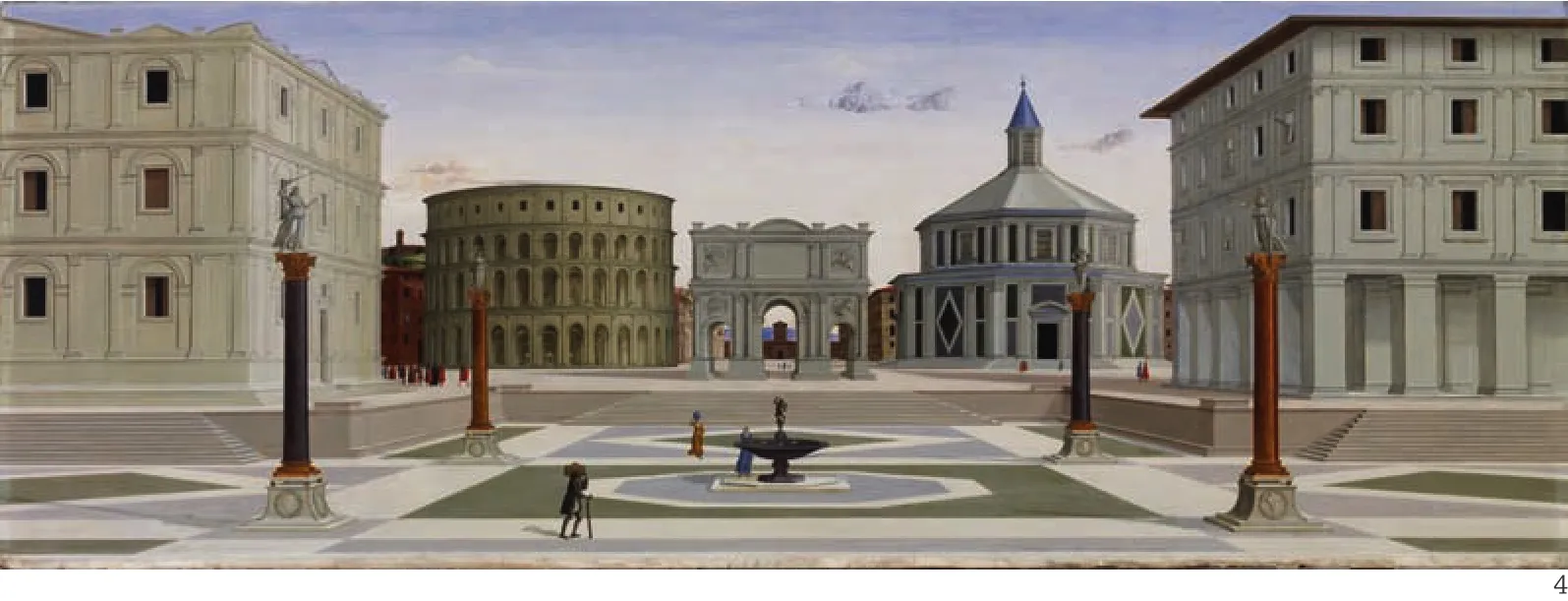
4 可以信賴的抽象事物/Abstractions made reliableFra Carnevale (about 1480-1484). The Ideal City. Courtesy ofThe Walters Art Museum, Baltimore.

5 虛構的建筑可以作為真實的對象進行研究/Fictionalarchitecture can be studied as a real object Wittkower, R. and Carter, B.A.R. (1953). Reconstruction of Plan and Elevation of Piero della Francesca's Flagellation of Christ.Journal of Warburg and Courtauld Institutes, 16 (3-4), plate 44.
The immediate result of this milestone in architectural education was that having as a reference a fixed and detailed image was at risk of generating correct yet rather rigid buildings that conform to a given model. A tension between degrees of conformation and coercion was implicit in Serlio's programme: his intent was not to educate a creative class of designers, but more properlytrained professionals who shared a methodology of thinking and an operative performativity.
The power of visual-based reasoning
"Since the artist was supposed to 'reproduce'the things in nature 'as they are' he had to be informed, frst, as to how they are; and, second, as to how they can be reproduced. The art theory of the Renaissance, then, was faced with two main problems, one material and the other formal or representational."[7]244.
Visual-based reasoning, which is built on quantitative thinking, resulted in the implementation of a controlled simplification of the world by means of uniform quanta. By employing conventions, it proved to be precise in its results, even when based on wrong assumptions.Perspective has been the ideal response to the general principles of Renaissance philosophy,starting with the prominence of a single point of vision comparable to the man placed "in the centre of the universe" as another humanist philosopher,Pico della Mirandola, stated in a famous motto.Perspective had the advantage of obviousness when compared to projections: what is represented provides an illusion of trustfulness; however,from a technical point of view, the geometry of perspective is not the replica of human vision.The perspectival point of vision is one, while our sight is made of two eyes working simultaneously,and the study of angles can result in visual distortions, etc. The realism of the Renaissance is thus a fictional aspiration to get a one-eye sight of the world, a filtered god-like synthesis of accurate geometry that should not be thought of as adherent to materiality. Plans and sections of buildings included in most of the theoretical treatises of the 15th century, and later in those of Palladio, better responded to the need to illustrate on one page a whole range of alternatives to be equally and simultaneously analysed.
Perspective as well as projections pleased the search for the harmony of the parts in relation to the whole, and for this reason, their exact and predictable results were not only geometrically correct but also compositionally valuable.Perspective constructions were not only a way of describing existing built landscapes, but also a tool for imagining new ones, disconnected from any particular narrative intent, which in some cases had a relevant influence, such as the illustrations of ideal cities (Fig. 4). Conversely, a carefully built perspectival painting, such as fctional architecture in The Flagellation by Piero della Francesca, could be re-studied in the form of plan projection to confrm proportional harmony and mutual relations among distorted architectural elements.
Yet another consideration deserves our attention inasmuch as drawings became, during the Renaissance, the analytical means of metainvestigations of the mechanisms of simplification on which they were based. Visualizing their crafts,architectural designers operate the special power of manipulating the visual effect that others will see and eventually use to form an opinion or make a decision. In other words, designers do things and step into the scene of their design task when they are preparing the framework for their work to be.□
[1] Crosby, A.W. (1997). The Measure of Reality.Quantification and Western Society, 1250-1600.Cambridge University Press.
[2] Carpo, M. & Lemerle, F. (eds) (2008). Perspective,Projections and Design. Technologies of Architectural Representation. Abingdon: Routledge.
[3] Krautheimer, R. 1942. Iconography of Mediaeval Architecture, Journal of the Warburg and Courtauld Institutes, Vol. 5: 1–33.
[4] Eco, U. 1987. Art and Beauty in the Middle Ages.New Haven-London: Yale University Press.
[5] Blair Moore, K. 2009. Ficino's Idea of architecture:the "mind's-eye view" in Quattrocento architectural drawings, Renaissance Studies 24(3): 332–352.
[6] Carpo, M. 2013. The Art of Drawing, Architectural Design 83(5): 128 – 133.
[7] Panofski, E. 1955. The Life and Art of Albrecht Dürer. Princeton: Princeton University Press.
[8] Choay, F. and Bratton, D. (1997). The Rule and the Model: On the Theory of Architecture and Urbanism.Cambridge: MIT Press.
[9] Wittkover R. and Carter, B.A.R. (1953). The perspective of Piero della Francesca's Flagellation of Christ. Journal of Warburg and Courtauld Institutes,16 (3-4): 292–302.
Architecture and the Naturalization of Measurement, Exactness and Predictability
文化與技術的革新是14世紀和15世紀歐洲的重要特征,其轉變與建筑設計作為獨立專業的肇始有深刻的淵源。建筑史和藝術史的許多研究已對其中一些方面進行了探討,包括在空間表達時采用尺寸標注,因紙張可相對便宜地購得讓人們能通過草圖表達空間概念,以及機械印刷的手段如何影響配有插圖、描述思想和理論稿件的編輯和傳播方式。本文在諸多認知世界的定性概念和定量概念之間存在矛盾的領域中,探討了透視畫和通過符號表達的設計如何不僅象征著人們在描述、溝通和探討建筑學方式上的激進轉變,也成為此后幾個世紀諸多專業爭論的基礎。
The cultural and technical shift that characterised 14th and 15th century Europe is deeply intertwined with the origin of architectural design as an independent profession.Research works in architectural and art history have dealt with the naturalization of measurement in the representation of space, the expression of spatial ideas through sketches,which was made possible by the availability of relatively cheap paper, and the infuence of mechanical printing on the way in which ideas and theories were edited and circulated along with illustrations. The essay explores how the codification of perspective drawings and notated design, among the many fields in which the tension between qualitative and quantifiable perceptions of the world unfolds, represented not only a radical shift in the way architecture was described,communicated and debated, but also the ground for professional debates in centuries to come.
空間測量,建筑表現,符號表達設計,透視畫
spatial measurement, architectural representation,notated design, perspective drawing

6 新建筑師的初次亮相/The new architect's debutGiovanni da Sangiovanni (about 1635), Detail of the Celebration of Lorenzo il Magnifco: Giuliano da Sangallo holding in his hands the project of the Villa in Poggio a Caiano.Florence, Pitti Palace. In: Jestaz, B. (1995). Il Rinascimento dell' architettura da Brunelleschi a Palladio. Milan: Electa/Gallimard, p.98.
都靈理工大學
2017-08-21
猜你喜歡
北方建筑(2021年6期)2021-12-31 03:03:54
文苑(2020年10期)2020-11-07 03:15:36
汽車實用技術(2020年16期)2020-09-06 13:28:22
現代裝飾(2020年6期)2020-06-22 08:43:12
現代裝飾(2020年4期)2020-05-20 08:55:08
當代工人(2019年20期)2019-12-13 08:26:11
制造技術與機床(2017年9期)2017-11-27 02:14:26
福建農業科技(2016年10期)2016-03-07 09:46:49
少兒科學周刊·兒童版(2015年6期)2015-11-24 03:49:38
河南科技(2014年12期)2014-02-27 14:10:44