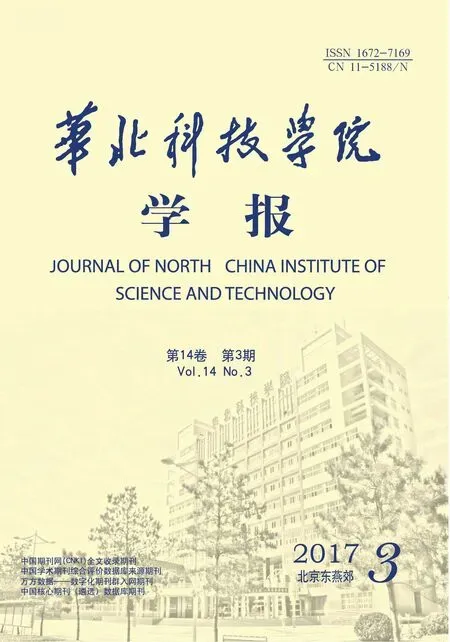
基于QRA的安全規(guī)劃方法在某油庫的應(yīng)用
2017-10-10 08:31:25胡燕康康榮學(xué)宋占兵于立見
淮南師范學(xué)院學(xué)報(bào)
2017年4期
關(guān)鍵詞:規(guī)劃標(biāo)準(zhǔn)
胡燕康,康榮學(xué),宋占兵,于立見
(1.華北科技學(xué)院,北京 東燕郊 065201;2.中國安全生產(chǎn)科學(xué)研究院,北京 100012)
基于QRA的安全規(guī)劃方法在某油庫的應(yīng)用
胡燕康1,康榮學(xué)2,宋占兵2,于立見2
(1.華北科技學(xué)院,北京 東燕郊 065201;2.中國安全生產(chǎn)科學(xué)研究院,北京 100012)
本文通過敘述了定量風(fēng)險(xiǎn)分析的程序、內(nèi)容、指標(biāo)和評價(jià)標(biāo)準(zhǔn),并采用此方法的QRA軟件對某油庫計(jì)算了個(gè)人和社會(huì)的風(fēng)險(xiǎn)水平。油罐區(qū)的個(gè)人風(fēng)險(xiǎn)結(jié)果表明,該油罐區(qū)的風(fēng)險(xiǎn)線沒有超出廠區(qū)的范圍,說明該油庫內(nèi)外防護(hù)目標(biāo)的個(gè)人風(fēng)險(xiǎn)是可接受的。社會(huì)風(fēng)險(xiǎn)結(jié)果表明,該油庫沒有產(chǎn)生社會(huì)風(fēng)險(xiǎn)曲線,處于可接受區(qū),滿足社會(huì)風(fēng)險(xiǎn)標(biāo)準(zhǔn)。出現(xiàn)此現(xiàn)象的原因既與庫區(qū)自身的儲(chǔ)量、圍堰大小有關(guān),也與周圍人口分布情況有關(guān)。該方法的應(yīng)用和國家法規(guī)規(guī)定的風(fēng)險(xiǎn)可接受標(biāo)準(zhǔn)的結(jié)合,不僅對油庫周邊防護(hù)目標(biāo)安全規(guī)劃具有指導(dǎo)意義,對重大危險(xiǎn)源的新建選址,其他重大危險(xiǎn)源的改、擴(kuò)建以及周邊土地開發(fā)利用均有重要參考價(jià)值。
重大危險(xiǎn)源;安全規(guī)劃;定量風(fēng)險(xiǎn)分析;風(fēng)險(xiǎn)
Abstract:In this paper,we describe the procedures,contents,indexes and evaluation criteria of quantitative risk analysis,and use this method to calculate the personal and social risk level of an oil depot by the QRA software.The personal risk of the tank area indicates that the risk line of the tank area does not exceed the scope of the plant,indicating that the individual risk of the protection target inside and outside the depot is acceptable.Social risk results show that the oil depot does not produce a social risk curve,in an acceptable area,to meet social risk standards.The reason for this phenomenon is related to the reserves of the reservoir area,the size of the cofferdam,and the distribution of the surrounding population.The combination of the application of this method and the risk acceptable standard stipulated in the national laws and regulations not only has the guiding significance to the safety planning of the protection target of the oil depot,the new site of the major hazard source,the alteration and expansion of other major hazard sources and the surrounding land development and utilization Have important reference value.
Key words:Major hazard installations;Safety planning;Quantitative Risk Analysis;Risk
0 引言
1978年以來,隨著工業(yè)化進(jìn)程加速,我國城鎮(zhèn)化發(fā)展呈現(xiàn)“起點(diǎn)低、速度快”的特點(diǎn)。2013年,城鎮(zhèn)常住人口為 7.3 億,城鎮(zhèn)化率達(dá)到 53.7%[1]。京津冀、長三角、珠三角等區(qū)域城市群也開始逐步發(fā)力。快速推進(jìn)的工業(yè)化和城鎮(zhèn)化,使得人口大量匯集,城市重大危險(xiǎn)源的數(shù)量顯著增加,城市固有風(fēng)險(xiǎn)不斷加大,引發(fā)嚴(yán)重的安全問題[2-3]。

表1 典型事故案例
重大危險(xiǎn)源規(guī)劃不合理、安全距離不足等致使事故后果嚴(yán)重。……
登錄APP查看全文
猜你喜歡
城市道橋與防洪(2022年4期)2022-07-01 06:04:12
公民與法治(2020年11期)2020-07-25 02:02:06
當(dāng)代陜西(2019年8期)2019-05-09 02:22:48
動(dòng)漫星空(興趣百科)(2019年3期)2019-03-07 07:23:10
家庭影院技術(shù)(2018年4期)2018-05-09 07:07:52
領(lǐng)導(dǎo)決策信息(2018年50期)2018-02-22 06:17:16
商周刊(2017年5期)2017-08-22 03:35:26
中國衛(wèi)生(2016年2期)2016-11-12 13:22:16
華東科技(2016年10期)2016-11-11 06:17:41
專用汽車(2016年4期)2016-03-01 04:13:43