草木灰對四種松屬種子發芽和幼苗生長的影響
2017-10-13 12:32:35劉發林
生態學報 2017年17期
關鍵詞:物種
劉發林
中南林業科技大學, 長沙 410004
草木灰對四種松屬種子發芽和幼苗生長的影響
劉發林*
中南林業科技大學, 長沙 410004
火干擾不僅影響森林生態系統的結構與功能,而且影響群落更新與演替。為了研究草木灰對4種松屬種子萌芽和幼苗生長的影響,在湖南省株洲市黃豐橋林場采集馬尾松、云南松、濕地松和火炬松種子,以馬尾松次生林火燒跡地的草木灰為基質,設置對照和3個草木灰處理,進行播種試驗及生長觀測。結果表明:(1)草木灰處理下4個物種的種子發芽率比對照試驗低,并呈現隨草木灰含量的增加而降低的趨勢,低草木灰含量處理馬尾松種子發芽率不及對照一半,中、高草木灰含量處理發芽率更低;云南松、濕地松和火炬松種子發芽率規律類似于馬尾松,而高草木灰含量處理發芽率為0。(2)培養皿播種平均發芽時間比花盆播種長,無論草木灰處理還是培養條件(培養皿或花盆),馬尾松和云南松種子平均發芽時間比濕地松和火炬松短。(3)4個物種種子播種14周后,對照試驗中馬尾松和云南松幼苗死亡率最低,而火炬松和濕地松幼苗死亡率相對增加。(4)播種14周后不同試驗處理4個物種幼苗生長差異不明顯。火炬松、濕地松、云南松和馬尾松幼苗的單株平均干重分別達0.038、0.031、0.027、0.024 g。各物種葉干重按降序排列依次是火炬松(0.026 g)>濕地松(0.019 g)>云南松(0.017 g)>馬尾松(0.016 g),根和莖的干重比重相當,約占對應物種幼苗葉干重的三分之一。研究表明以草木灰為培養基質,馬尾松和云南松種子的發芽率較高,平均發芽時間較短,更適合作為火燒跡地植被恢復先鋒樹種,為火干擾后選擇人工促進天然更新樹種提供參考。
松屬;發芽;幼苗生長;草木灰
Abstract: Fire disturbance not only alters the structure and function of forest ecosystems but also affects community regeneration and succession of forest ecosystems. In the present study, we investigated the effects of plant ash on germination and seedling growth of four pine species(Pinusmassoniana,Pinusyunnanensis,Pinuselliottii,andPinustaeda) grown from seeds collected from the Huangfengqiao State Forest Farm, Zhuzhou, Hunan Province, China. We used plant ash collected locally from a forest fire site of aP.massonianasecondary forest. Four ash treatments consisting of low (4 kg/hm2), medium (8 kg/hm2), high (16 kg/hm2), and control were used. The seeds were sown with plant ash in Petri dishes and plant pots measuring 20 cm×20 cm×20 cm. There were three replicates of 30 seeds for each species in each treatment used in a completely randomized design. The experimental data were then analyzed using analysis of variance (ANOVA). The results of our experiments show that: 1) germination of all four studied species was more negatively affected in the plant ash treatments than in the control group, and the germination rates for all four species decreased with increasing in the quantities of plant ash. Germination ofP.massonianadecreased by 60.16%, 91.63%, and 99.15% with low, medium, and high plant ash treatments, respectively.P.yunnanensis,P.elliottii, andP.taedashowed similar trends, but no germination was observed in high plant ash treatment. 2) On average, germination time was higher for medium ash treatment than for low ash treatment. In addition, the average germination time forP.elliottiiandP.taedawas higher than that forP.massonianaandP.yunnanensisregardless of the quantities of plant ash or incubation conditions(in Petri dishes or in plant pots). 3) Seedling mortality differed between the four species at 14 weeks after sowing.P.massonianaandP.yunnanensishad lower seedling mortality rate than didP.elliottiiandP.taedain the control experiments. The mortality rate increased as the quantities of plant ash increased. 4) No significant differences of seedling growth were detected among the plant ash treatments of four species.P.taedahad the highest total dry weights of seedlings(0.038 g) at 14 weeks after sowing followed successively byP.elliottii(0.031 g),P.yunnanensis(0.027 g), andP.massoniana(0.024 g). The average dry weight of leaves was 0.026 g forP.taeda, 0.019 g forP.elliottii,0.017 g forP.yunnanensis, and 0.016 g forP.massoniana. However, the average dry weights of roots and stems were similar and were approximately three times lesser than that of leaves. Our experiments did not show obvious promoting effects on germination and seedling growth of plant ash. Nonetheless, higher germination rates and shorter mean germination time were observed for the two native pine species,P.massonianaandP.yunnanensis, than for the other two species,P.taedaandP.elliottii, suggesting that the selection of the right tree species is important in order to aid in vegetation restoration in burned areas and natural regeneration after fire disturbance.
KeyWords:Pinus; germination; seedling growth; plant ash
森林火災不僅影響生態系統的結構與功能,而且影響群落更新[1]。火干擾后森林地表覆蓋一層灰燼,即植物(草本和木本植物)燃燒后的殘余物,俗稱草木灰,其質輕且呈弱堿性[2- 3]。草木灰是一種良好的無機肥料,具有消毒、增強植物抗逆性、促進植物發芽和生根及傷口愈合等作用。Raison[4]調查發現稀樹草原、森林燃燒后留下的草木灰達100—12000 kg/hm2,Carreira和Niell[5]研究地中海灌木林火燒后草木灰約486 kg/hm2,Soto[6]等研究大西洋灌叢火燒后草木灰約87 kg/hm2。北半球松屬植物生態系統經常遭受火災[7],有學者對廣泛分布于北半球的歐洲黑松(Pinusnigra)、歐洲紅松(Pinussylvestris)、海岸松(Pinuspinaster)的更新進行了研究,大多數松屬植物不能萌芽更新,主要通過種子更新[8- 12],Agee研究了英國部分松屬植物種子萌發和生長對火干擾的響應[13];國內有學者就水分脅迫、NaCl脅迫、鈣浸種和不同基質對馬尾松(Pinusmassoniana)或華山松(Pinusarmandii)種子發芽及生長的影響進行過研究[14- 17],但關于草木灰對火炬松(Pinustaeda)、濕地松(Pinuselliottii)、云南松(Pinusyunnanensis)等松屬種子萌芽和幼苗生長的研究未見報道。為了比較草木灰對馬尾松、云南松、濕地松、火炬松種子萌發及幼苗生長的影響,在湖南省株洲市黃豐橋林場采集種子,收集該場馬尾松次生林火燒跡地草木灰作為基質,設置1個對照與3個不同草木灰含量處理,觀測4個物種種子萌發及幼苗生長,為火干擾后火燒跡地天然更新或人工促進天然更新提供參考。
1 材料與方法
1.1 試驗區概況
黃豐橋林場呈帶狀橫跨于湖南省攸縣東西部,以中低山貌為主,海拔介于1270—115 m,坡度在20°—35°之間。主要成土母巖為板頁巖,土壤以板頁巖發育而成的山地黃壤為主,土壤肥沃。林場屬亞熱帶季風濕潤氣候區,年平均氣溫為17.8℃,年降水量為1410.8 mm,無霜期292 d。境內森林茂盛,物種豐富,據考察有木本植物430余種,其中國家保護的珍稀瀕危樹種有南方紅豆杉(Taxusmairei)、銀杏(Ginkgobiloba)、鳳凰樹(Delonixregia)等10余種,主要林分類型為杉木(Cunninghamialanceolata)、馬尾松、濕地松、火炬松和云南松等人工林,其次有馬尾松次生林、針闊(如馬尾松-檵木(Loropetalumchinensis)針闊混交林)和闊葉混交林,林場培養了主要樹種的母樹林。受南方冰雪災害的影響,2008年以來林場發生森林火災(含火警)14次,受害面積共8.4hm2。
1.2 試驗設計
2013年12月中旬在黃豐橋林場馬尾松、濕地松、火炬松和云南松母樹林采集成熟種子,將干燥種子用塑料袋密封。種子純度為95%時,馬尾松、濕地松、火炬松和云南松種子千粒重分別為10.95、29.45、20.12 g和16.99 g,0—5℃低溫下貯藏。2015年3月10日進行播種前處理,采用水洗法選出飽滿籽粒,用45℃溫水浸種24 h,濾干后用0.15%的福爾馬林溶液消毒30 min,再用蒸餾水沖洗3次,備播種試驗。試驗均在實驗室條件下進行,并測定不同草木灰使用量處理的發芽率。基質為馬尾松次生林地表火后的草木灰,火燒后收集地表草木灰并充分混合。
試驗1:在直徑9 cm雙層濾紙上進行試驗,濾紙置于培養皿上,以不用草木灰試驗為對照(CK),3種不同草木灰含量的試驗處理為:Low(低4 kg/hm2)、Medium(中8 kg/hm2)和High(高:16 kg/hm2),按試驗處理量將草木灰均勻的鋪在濾紙上,植物種子放置在草木灰上,每個處理播種30粒,重復3次。用10 mL蒸餾水滴于培養皿,培養期間根據需要噴灑蒸餾水以保持種子濕潤。2015年3月13日開始播種,以45 d為1周期,每兩天觀測發芽數(以胚根超出皮外1 mm以上為準)[18],45 d后每周觀測1次。根據觀測數據計算發芽率、平均發芽時間和發芽時間分布,平均發芽時間計算公式:

式中,N1為時間T1的發芽數,N2為時間T1與T2之間的發芽數,依次類推[18]。
試驗2:試驗置于20 cm×20 cm×20 cm花盆,草木灰鋪放在花盆內土壤(黃心土48%、菌根土20%、火燒土30%、過磷酸鈣2%)表面,花盆底部鋪一層珍珠巖避免種子霉變。草木灰試驗處理、播種時間、重復次數和觀測方法等與試驗1相同;此外,試驗2中每周觀測幼苗高1次,直到播種后第14周,根據存活苗數計算死亡率,而后幼苗被連根拔起,去泥土后放置于60℃干燥箱直至恒重,測量幼苗的根、莖和葉的重量與長度。
1.3 統計分析
觀測數據輸入Excel存儲,通過平方根的反余弦對發芽率觀測數據進行轉換,通過以常用對數對幼苗高度數據進行對數轉換,采用SAS軟件進行統計分析[19],以物種和處理為獨立變量,對各試驗數據進行多元方差分析。因此,對物種之間及物種與處理之間相互作用進行差異性分析,對培養皿及花盆中的發芽率、發芽時間、死亡率、各物種的幼苗高度、幼苗總重量及各器官的重量進行單變量方差分析,當試驗處理之間存在顯著差異,再進行LSD檢驗。
2 結果與分析
2.1 種子發芽率
試驗1,培養皿播種4個物種種子發芽率隨草木灰含量增加而減少(圖1),低草木灰含量處理馬尾松發芽率不及對照一半,中、高草木灰含量處理發芽率更低;云南松種子發芽率規律類似于馬尾松,而高草木灰含量處理發芽率為0;濕地松種子對草木灰更敏感,低、中、高草木灰含量處理下發芽率分別為13%、2%和0;火炬松種子低草木灰含量處理發芽率僅4%,而中、高草木灰含量處理發芽率均為0。方差分析結果表明,物種(P<0.05)之間和處理(P<0.05)之間均存在顯著差異,物種與處理之間的相互作用非常顯著(P<0.01),表明種子發芽率對草木灰處理的響應取決于物種。
試驗2,花盆播種4個物種種子發芽率在19.13%—76.14%之間變動(圖2)。除濕地松對照試驗播種比培養皿播種種子發芽率低外,草木灰處理下種子發芽率呈現隨草木灰含量增加而降低的趨勢。方差分析表明,物種之間和草木灰處理之間種子發芽率存在極顯著差異(P<0.01),物種與處理之間差異顯著(P<0.01);單變量方差分析表明各物種種子發芽率差異較小。高草木灰含量處理云南松種子發芽率最高,與其他處理之間存在顯著差異(P<0.05)。馬尾松和火炬松種子發芽率在高草木灰處理與對照試驗之間存在顯著差異,但高、中、低草木灰含量處理之間差異不顯著。
2.2 平均發芽時間
試驗1,4種松屬物種種子的平均發芽時間不同,馬尾松和云南松種子比濕地松和火炬松種子發芽快(圖1),經方差分析表明,物種之間差異顯著(P<0.01),而草木灰處理之間差異不顯著。
試驗2,花盆播種平均發芽時間比培養皿長(圖2)。馬尾松和云南松種子平均發芽時間介于20—38 d,而濕地松和火炬松介于48—57 d,物種之間存在極顯著差異(P<0.01),草木灰處理之間存在顯著差異(P<0.05),物種與處理之間的交互作用不顯著。處理之間濕地松和火炬松種子發芽時間沒有顯著差異,而高草木灰處理與其他3種處理之間云南松種子發芽時間差異顯著,對照試驗中馬尾松種子發芽時間與其他3種草木灰處理之間存在差異。
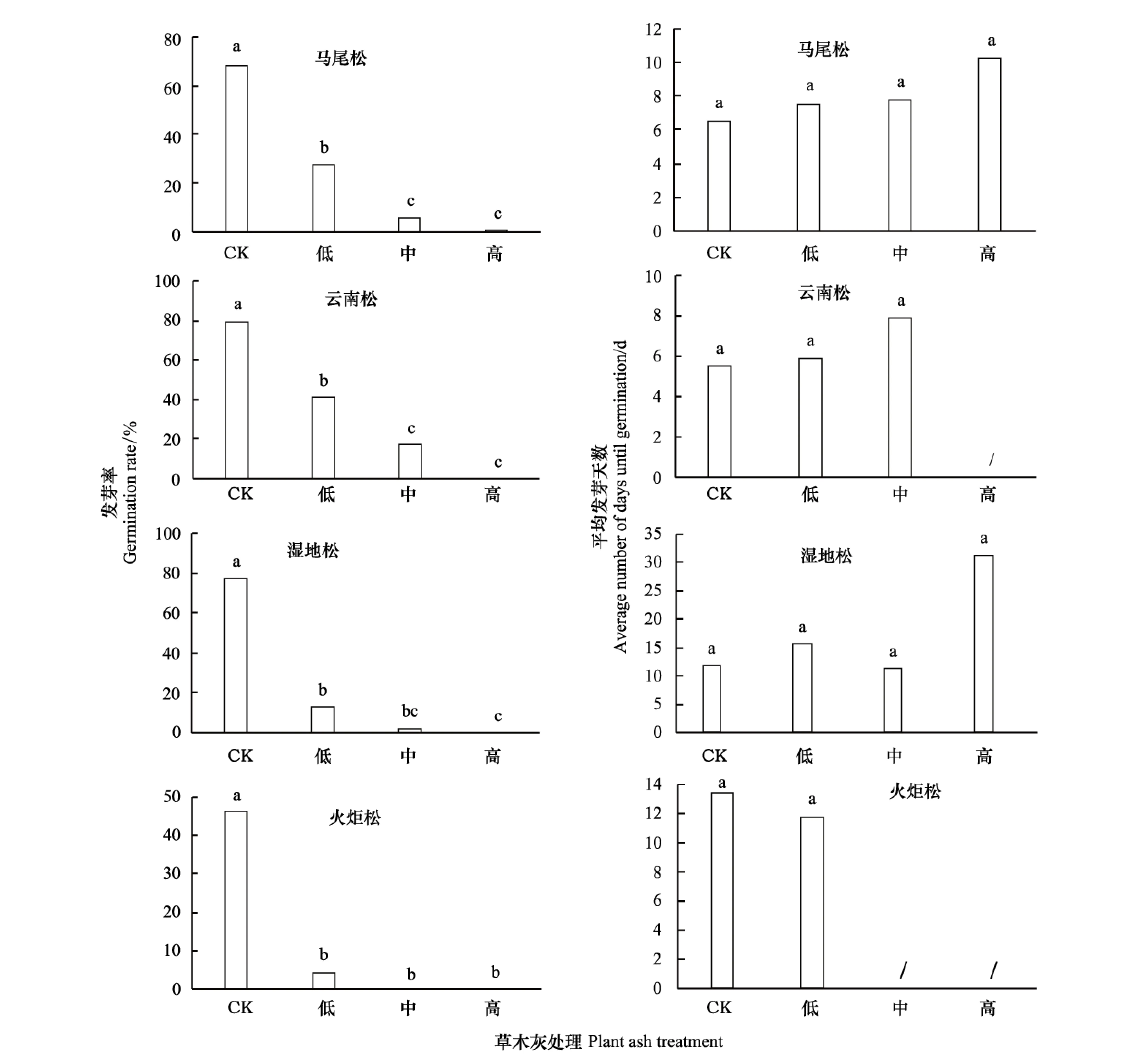
圖1 培養皿播種后4種松屬物種種子發芽率和平均發芽天數Fig.1 Germination rate and average number of days until germination for four Pinus species sown in Petri dishes
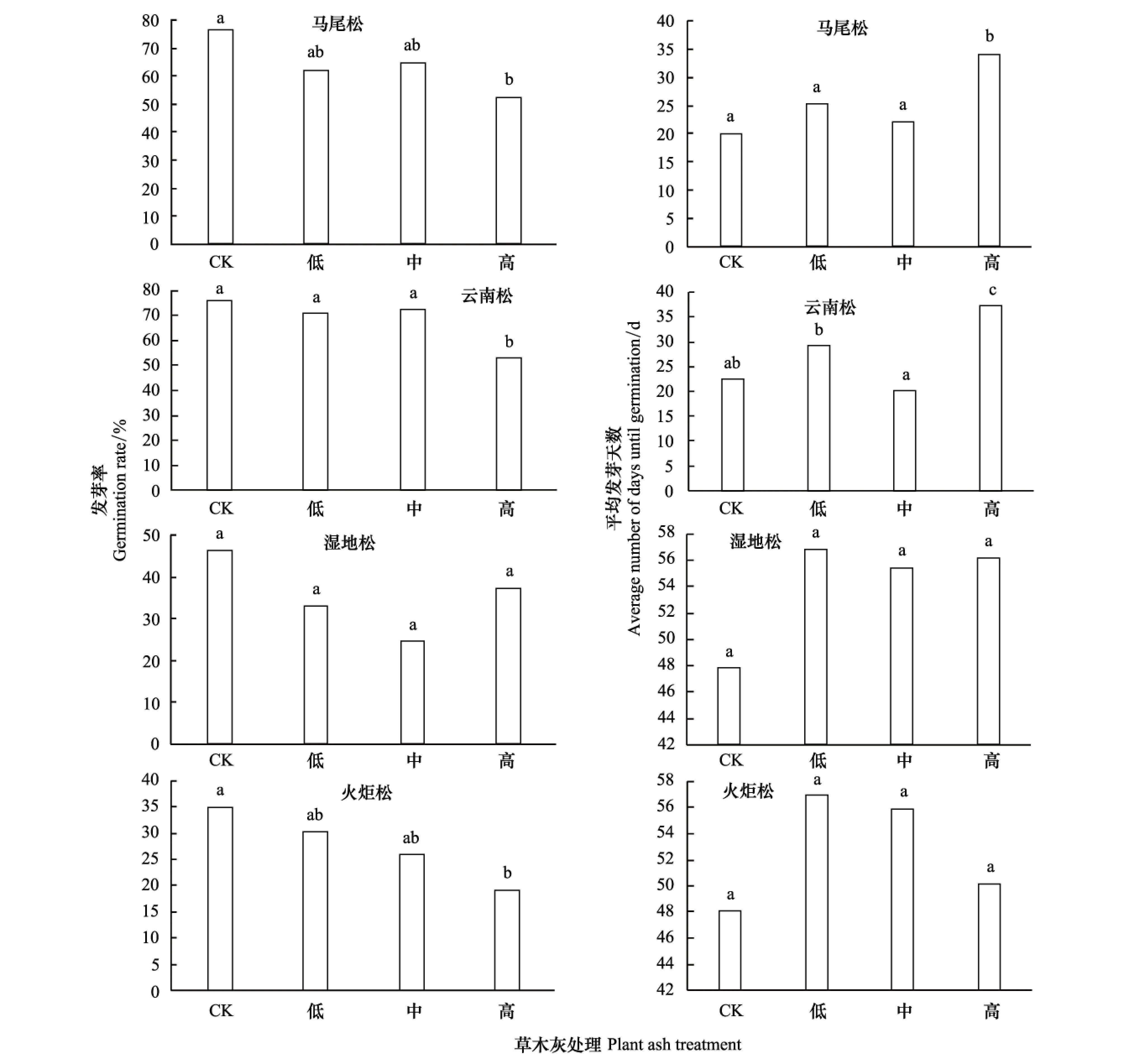
圖2 花盆播種后4種松屬物種種子發芽率和平均發芽天數Fig.2 Germination rate and average number of days until germination for four Pinus species sown in plant pots
2.3 幼苗死亡率
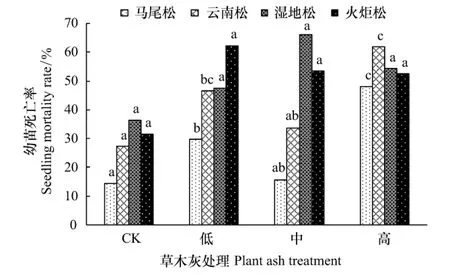
圖3 花盆播種后4種松屬物種幼苗死亡率 Fig.3 Seedling mortality rate of four Pinus species sown in plant pots
4個物種種子播種14周后幼苗死亡率存在差異(圖3),不同處理之間云南松幼苗死亡率介于27.06%—61.58%、馬尾松幼苗死亡率介于14.35%—47.91%;而濕地松幼苗死亡率介于36.28%—65.81%、火炬松幼苗死亡率介于31.46%—62.15%。方差分析表明,物種之間和處理之間均存在極顯著差異(P<0.01),但物種與處理之間的交互作用不顯著。馬尾松幼苗死亡率明顯比其他3個物種低。低、高草木灰含量處理存在顯著差異,而中草木灰含量處理與對照和低草木灰含量處理相似。處理之間濕地松和火炬松幼苗死亡率不存在顯著差異。
2.4 幼苗重量
播種14周后,火炬松、濕地松、云南松和馬尾松幼苗的單株平均干重分別達0.038、0.031、0.027、0.024 g(表1),濕地松和火炬松幼苗比馬尾松和云南松重,馬尾松和云南松幼苗與濕地松和火炬松間的差異沒有發芽率、平均發芽時間和死亡率顯著。物種間存在顯著差異(P=0.0024),但試驗處理間的差異不顯著。
4個物種樹葉干重占幼苗總干重比例最大,葉干重按降序排列依次為:火炬松(0.026 g)>濕地松(0.019 g)>云南松(0.017 g)>馬尾松(0.016 g),根和莖的干重相當,約占對應物種幼苗葉干重的三分之一。多元方差分析表明物種和處理間不存在顯著交互差異,而物種之間存在極顯著差異(P<0.01)。馬尾松幼苗干重與其他3個物種有顯著差異。分別對各物種進行分析發現,莖和地上部分干重沒有顯著差異,而根的干重差異顯著。高草木灰含量處理馬尾松幼苗根干重明顯低于其他處理。
2.5 幼苗長
播種14周后,4個物種的幼苗長幾乎沒有差異(表1),平均長按降序依次為:濕地松(15.75 cm)>火炬松(15.25 cm)>云南松(13.72 cm)>馬尾松(12.33 cm),方差分析顯示不同處理、不同物種整株幼苗長的差異不顯著,物種與處理之間的交互作用沒有顯著差異。平均根長度按降序排列分別為:濕地松(9.86 cm)>火炬松(8.18 cm)>云南松(8.01 cm)>馬尾松(6.78 cm);莖長度按降序排列分別為:火炬松(4.23 cm)>云南松(3.95 cm)>濕地松(3.87 cm)>馬尾松(3.59 cm);幼苗葉長度按降序排列分別為:火炬松(2.75 cm)>濕地松(2.01 cm)>馬尾松(1.96 cm)>云南松(1.70 cm)。
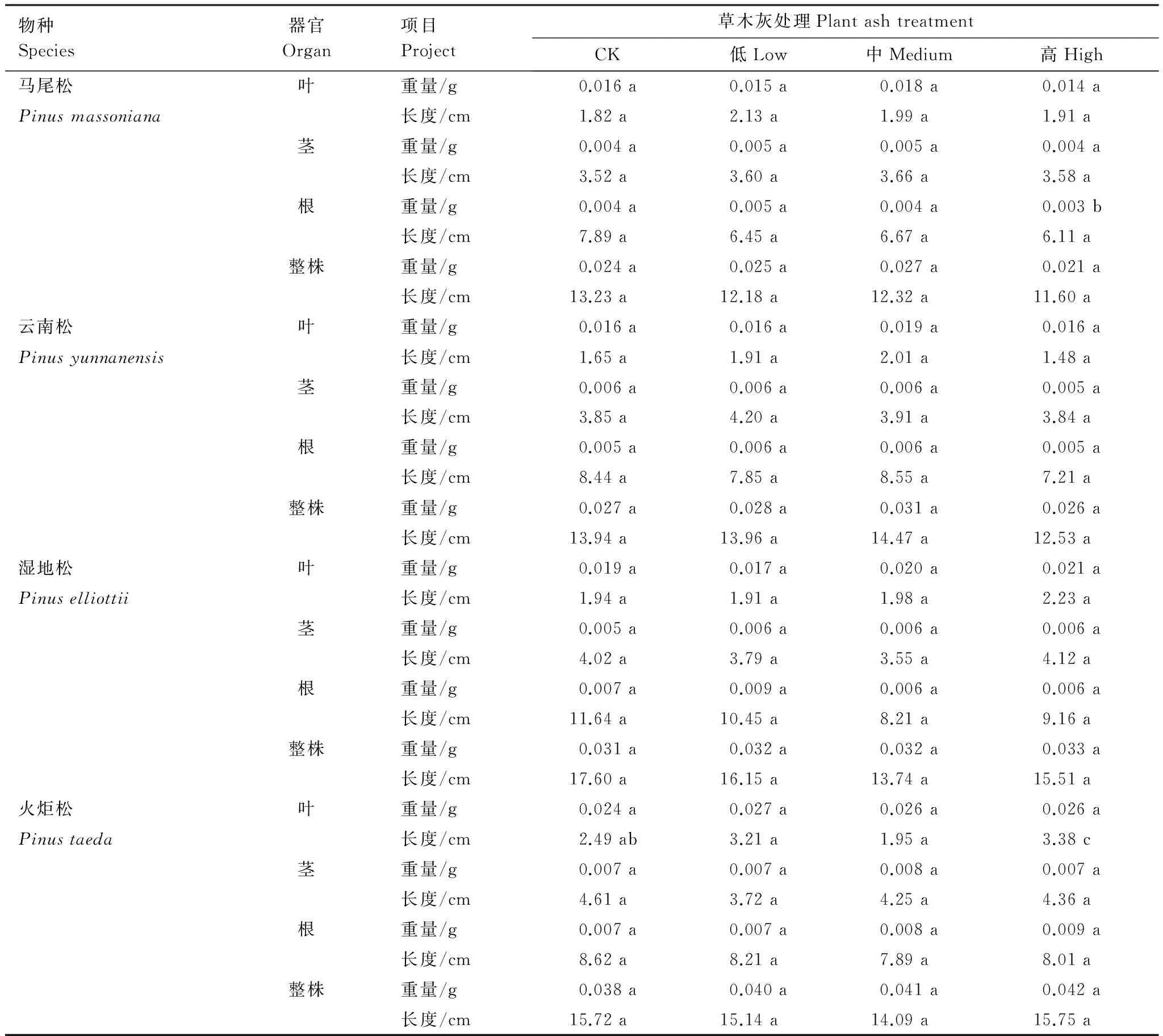
表1 花盆播種后4種松屬物種幼苗平均長和平均重
對各物種幼苗各器官長度進行統計分析,發現僅樹葉長度在物種間差異顯著(P<0.01)、物種與處理間的交互作用差異顯著(P<0.014)。火炬松幼苗樹葉比其他3個物種的長,高草木灰含量試驗處理下火炬松幼苗樹葉比對照和中草木灰含量試驗處理顯著增長(P<0.05),其他3個物種幼苗長度在草木灰試驗處理間沒有顯著差異,幼苗的根和莖長在物種間、試驗處理間差異不顯著,在物種與試驗處理間的交互作用也不顯著。
3 結論與討論
以馬尾松次生林火燒跡地草木灰進行試驗,對4種松屬物種的種子發芽及幼苗生長進行觀測,發現火炬松和濕地松種子在高草木灰含量試驗處理下發芽率最低,除對照處理外,花盆試驗處理種子發芽率比培養皿中的高,估計與花盆中土壤可以稀釋草木灰和降低抑制發芽的堿性物質濃度有關,因為低濃度堿性物質有利于植物種子發芽,而高濃度堿性物質對種子發芽起抑制作用[20]。無論草木灰處理還是培養條件(培養皿或花盆),馬尾松和云南松種子平均發芽時間比濕地松和火炬松短。
對照試驗中馬尾松和云南松幼苗死亡率最低,而火炬松和濕地松幼苗死亡率相對增加,但增加不顯著,死亡率隨草木灰含量的增加而明顯上升,表明火炬松和濕地松幼苗生長比馬尾松和云南松對草木灰更敏感。
播種14周后4種松屬物種幼苗的生長差異不明顯,因為4個物種的胚胎可以供給幼苗生長所需的營養,幼苗的生長并不需要從草木灰或土壤中獲取營養成分。有學者對其他物種進行試驗研究,發現2.5 a后高草木灰含量火燒跡地更新植物高是對照樣地的2倍[21- 22]。火炬松和濕地松在中、高草木灰含量試驗中能生長良好,說明有些物種能適應非酸性土壤,這也正好說明了地中海松為何能在地中海堿性土壤下發芽和生長[23- 24]。研究顯示馬尾松和云南松在草木灰處理試驗中發芽率比濕地松和火炬松高,這與濕地松和火炬松屬國外引種松屬有關,因馬尾松和云南松屬本地物種,更適合在研究區更新,也是火燒跡地天然更新中的先鋒樹種之一。
曾經松樹被認為是防火物種[25],而如今學者認為松樹不是防火樹種[12, 26- 27],因為松屬植物含有大量的松脂且松針屬細小可燃物,有利于林火的發生和蔓延。森林火災高溫對松屬種子的發芽促進作用不明顯[12, 28- 29]。總體來看,馬尾松和云南松比濕地松和火炬松的適應性更強,主要還是因為前者的種子體積小和重量輕,便于種子傳播。
研究結果發現,低草木灰含量試驗處理的4個松屬種子的發芽率均比對照低,因此今后對0—4 kg/hm2之間的濃度梯度進行試驗,篩選更適宜的草木灰濃度。
[1] 蔡文華, 楊健, 劉志華, 胡遠滿, 柳生吉, 荊國志, 趙增福. 黑龍江省大興安嶺林區火燒跡地森林更新及其影響因子. 生態學報, 2012, 32(11): 3303- 3312.
[2] 呂愛鋒, 田漢勤, 劉永強. 火干擾與生態系統的碳循環. 生態學報, 2005, 25(10): 2734- 2743.
[3] 韓春蘭, 邵帥, 王秋兵, 李甄, 孫仲秀, 毛偉偉. 興安落葉松林火干擾后土壤有機碳含量變化. 生態學報, 2015, 35(9): 3023- 3033.
[4] Raison R J. Modification of the soil environment by vegetation fires, with particular reference to nitrogen transformations: a review. Plant and Soil, 1979, 51(1): 73- 108.
[5] Carreira J A, Niell F X. Mobilization of nutrients by fire in a semiarid gorse-scrubland ecosystem of Southern Spain. Arid Soil Research and Rehabilitation, 1995, 9(1): 73- 89.
[6] Soto B, Basanta R, Diaz-Fierros F. Effects of burning on nutrient balance in an area of gorse (UlexeuropaeusL.) scrub. Science of the Total Environment, 1997, 204(3): 271- 281.
[7] Richardson D M, Rundel P W. Ecology and Biogeography ofPinus: an introduction //Richardson DM,ed. Ecology and Biogeography ofPinus. Cambridge, UK: Cambridge University Press,1998: 3- 46.
[8] Naveh Z. The evolutionary significance of fire in the Mediterranean region.Vegetation, 1975, 29(3):199- 208.
[9] Purdie R W, Slatyer R O. Vegetation succession after fire insclerophyllwoodland communities in South-Eastern Australia. Austral Ecology, 1976, 1(4): 223- 236.
[10] Trabaud L. Fire adaptation strategies of plants in the French Mediterranean area // Margaris NS, Arianoutsou-Faraggitaki M,Oechel WC,eds. Being alive on land. Proceedings of the International Symposium on Adaptations to the Terrestrial Environment. The Hague, The Netherlands: Dr W Junk Publishers,1984: 63- 69.
[11] Keeley J E, Zedler P H. Evolution of life histories inPinus//Richardson DM,ed. Ecology and Biogeography ofPinus.Cambridge, UK: Cambridge University Press,1998: 219- 250.
[12] Martínez-Sánchez J J, Marín A, Herranz J M, Ferrandis P,Heras J D. Effects of high temperatures on germination ofPinushalepensisMill. AndP.pinasterAiton subsp.Pinasterseeds in southeast Spain. Vegetation, 1995, 116(1): 69- 72.
[13] Agee J K. Fire and pine ecosystems // Richarrdson DM, ed. Ecology and Biogeography ofPinus. Cambridge, UK: Cambridge University Press, 2000: 193- 218.
[14] 施積炎, 丁貴杰. 水分脅迫對不同種源馬尾松種子發芽的影響. 山地農業生物學報, 2000, 19(5): 332- 337.
[15] 王瑞苓, 汪元超, 劉建祥, 汪夢婷. NaCl脅迫對華山松種子發芽和幼苗生長的影響. 湖北農業科學, 2013, 52(8): 1859- 1863.
[16] 韋小麗, 廖明. 鈣浸種對馬尾松種子發芽的影響. 種子, 2005, 24(4): 34- 36.
[17] 黃桂華, 梁坤南, 周再知, 馬華明, 林明平. 不同基質對柚木種子發芽與幼苗生長的影響. 種子, 2009, 28(10): 86- 87, 90- 90.
[19] SAS Institute. SAS user′s guide. 6thed. Cary, NC:SAS Institute,1995.
[20] 潘多鋒, 申忠寶, 王建麗, 高超, 李道明, 張瑞博. 堿性鹽脅迫對白三葉種子萌發及幼苗生長的影響. 北方園藝, 2015, (14): 67- 70.
[21] Kutiel P, Kutiel H. Effects of a wildfire on soil nutrients and vegetation in Aleppo pine, on Mount Carmel, Israel. Pirineos, 1989, 134: 59- 74.
[22] Neéman G, Meir I, Neéman R. The effect of ash on the germination and early growth of shoots and roots ofPinus,Cistusand annuals. Seed Science and Technology, 1993, 21(2): 339- 349.
[23] Thanos C A, Skordilis A. The effects of light, temperature and osmotic stress on the germination ofPinushalepensisandP.brutiaseeds. Seed Science and Technology, 1987, 15: 163- 174.
[24] Shiller G, Waisel Y. Among-provenance variation inPinushalepensisin Israel. Forest Ecology and Management, 1989, 28(2): 141- 151.
[25] Naveh Z. Effects of fire in the Mediterranean region // Kozlowski TT, Ahlgren CE,eds.Fire and Ecosystems.New York, USA: Academic Press, 1974: 401- 434.
[26] Trabaud L. Survie de jeunes plantules de pin d′alep apparues après incendie. Stvdia Oecologica, 1988, 5: 161- 170.
[27] Reyes O, Casal M. Germination ofPinuspinaster,P.radiateandEucalyptusglobulusin relation to the amount of ash produced in forest fires. Annales des Sciences Forestières, 1998, 55: 837- 845.
[28] Reyes O, Casal M. Germination behaviour of 3 species of the genusPinusin relation to high temperatures suffered during forest fires. Annales des Sciences Forestières, 1995, 52(4): 385- 392.
[29] Escudero A, Barrero S, Pita J M. Effects of high temperatures and ash on seed germination of two Iberian pines (Pinusnigrasspsalzmannii,P.sylvestrisvariberica). Annales des Sciences Forestieres, 1997, 54(6): 553- 562.
Responseoffourpinespeciestoplantashduringgerminationandseedlinggrowth
LIU Falin*
CentralSouthUniversityofForestry&Technology,Changsha410004,China
國家自然科學基金(31470659)
2016- 05- 31; < class="emphasis_bold">網絡出版日期
日期:2017- 04- 24
10.5846/stxb201605311043
*通訊作者Corresponding author.E-mail: liufl680@126.com
劉發林.草木灰對四種松屬種子發芽和幼苗生長的影響.生態學報,2017,37(17):5673- 5680.
Liu F L.Response of four pine species to plant ash during germination and seedling growth.Acta Ecologica Sinica,2017,37(17):5673- 5680.
猜你喜歡
課堂內外·初中版(科學少年)(2025年1期)2025-02-28 00:00:00
課堂內外·初中版(科學少年)(2025年2期)2025-02-28 00:00:00
課堂內外·初中版(科學少年)(2024年12期)2024-12-02 00:00:00
英語世界(2023年10期)2023-11-17 09:18:18
中學生博覽(2022年7期)2022-06-21 21:48:14
大科技·百科新說(2021年8期)2021-11-03 10:55:16
學苑創造·A版(2021年5期)2021-06-28 19:51:42
少兒美術(快樂歷史地理)(2020年9期)2020-03-19 05:10:56
科學大眾(中學)(2019年3期)2019-05-17 10:04:30
汽車觀察(2018年10期)2018-11-06 07:05:26