
插管型喉罩聯合氣管插管在俯臥位手術患者中療效觀察
2017-11-29 15:25:13胡豐登朱軼徐巧丹王偉徐象威
中國現代醫生 2017年29期
胡豐登++朱軼++徐巧丹++王偉++徐象威

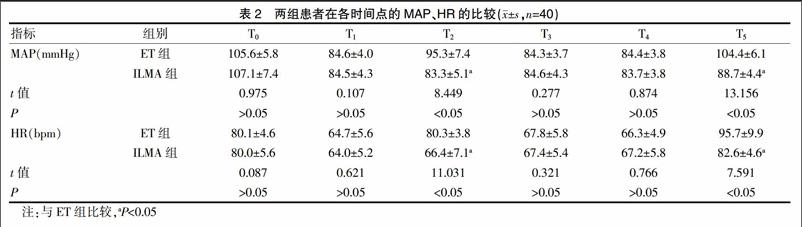
[摘要] 目的 探討插管型喉罩(ILMA)聯合氣管插管在俯臥位手術患者中應用臨床效果及安全性。 方法 80例擇期需俯臥位手術的患者通過隨機數字表法分成兩組,氣管導管組(ET組)和插管型喉罩組(ILMA組),各40例。ET組患者誘導麻醉后行氣管插管,術后各項拔管指征恢復后拔除氣管導管。ILMA組患者誘導麻醉后先插入配套喉罩,5 min后氣管導管經插管型喉罩置入,術后平臥位后深麻醉下拔除氣管導管,留置喉罩,待各項拔管指征恢復后拔除喉罩。記錄兩組T0(麻醉誘導前),T1(誘導用藥后插入喉罩或氣管導管前),T2(氣管導管插入時),T3(切皮時),T4(術中),T5(拔除氣管導管或喉罩時)5個時段的心率(HR)、平均動脈壓(MAP)。且觀察蘇醒期間的蘇醒時間(T6)、自主呼吸恢復時間(T7),以及評估蘇醒期間的并發癥如躁動、惡心嘔吐等發生情況。 結果 ILMA組T2、T5時段HR、MAP顯著低于ET組(P<0.05);術后蘇醒質量方面,ILMA組T6、T7顯著短于ET組(P<0.05),術后嗆咳、躁動發生率也顯著低于ET組(P<0.05)。 結論 俯臥位手術的患者麻醉時采用插管型喉罩全麻的血流動力學更穩定,術后麻醉蘇醒質量更高,安全性及可控性好。
[關鍵詞] 插管型喉罩;氣管導管;俯臥位;全身麻醉
[中圖分類號] R614 [文獻標識碼] B [文章編號] 1673-9701(2017)29-0098-04
Observation on curative effect of intubation laryngeal mask combined with tracheal intubation in patients with the prone position surgery
HU Fengdeng1 ZHU Yi1 XU Qiaodan1 WANG Wei2 XU Xiangwei3
1.Department of Anesthesiology, the First People's Hospital of Yongkang Cityin Zhejiang Province, Yongkang 321300, China; 2.Department of Neurosurgery, the First People's Hospital of Yongkang City in Zhejiang Province, Yongkang 321300, China; 3.Department of Clinical Pharmacy, the First People's Hospital of Yongkang City in Zhejiang Province, Yongkang 321300, China
[Abstract] Objective To investigate the clinical effect and safety of intubation laryngeal mask(ILMA) combined with tracheal intubation in patients with prone position surgery. Methods 80 patients needing elective prone position surgery were divided into two groups by random number table method, including tracheal tube group(ET group) with 40 cases and intubation laryngeal mask(ILMA group) with 40 cases. The patients in ET group underwent tracheal intubation after induction of anesthesia. And their tracheal tube was removed after the recovery of postoperative extubation indications. The matched laryngeal mask was inserted into the patients of ILMA group, and 5min later the tracheal catheter was inserted through the intubation laryngeal mask. The tracheal tube was removed and the laryngeal mask was indwelled under deep anesthesia in the postoperative supine position. And the laryngeal mask was removed after the recovery of extubation indications. The heart rate (HR) and mean arterial pressure (MAP) of the two groups at T0(before anesthesia induction), T1(after induction of medication and before inserting the laryngeal mask or tracheal tube), T2 (the time when the tracheal tube was inserted), T3 (when cutting the skin), T4 (intraoperation), T5 (the time when tracheal tube and laryngeal mask were removed) were recorded. The awakening time(T6) and spontaneous breathing recovery time (T7) during waking were observed. The occurrence of complications such as restlessness, nausea and vomiting during the awakening period was assessed. Results The levels of HR and MAP in the ILMA group at T2 and T5 were significantly lower than those in ET group(P<0.05). The quality of waking in ILMA group at T6 and T7 was significantly lower than that in the ET group(P<0.05). The incidence of cough and restlessness in the ILMA group was significantly lower than that of ET group(P<0.05). Conclusion The hemodynamics of general anesthesia with intubation laryngeal mask is more stable during anesthesia in patients with prone position, and the quality of anesthesia is higher, and the safety and controllability are better.endprint
