基于分布式空時干擾對齊的MIMO干擾信道自由度研究
2018-03-14 09:22:40應騰達馮文江蔣衛(wèi)恒劉國嶺姚楚楠包濤濤
通信學報 2018年1期
應騰達,馮文江,蔣衛(wèi)恒,劉國嶺,姚楚楠,包濤濤
?
基于分布式空時干擾對齊的MIMO干擾信道自由度研究
應騰達,馮文江,蔣衛(wèi)恒,劉國嶺,姚楚楠,包濤濤
(重慶大學通信工程學院,重慶 400044)
針對個用戶MIMO干擾信道(IC),研究基于分布式空時干擾對齊(DSTIA)的信道可達自由度。利用分布式當前和過期發(fā)射端信道狀態(tài)信息(CSIT)設計預編碼,分別給出MISO系統(tǒng)可達自由度關于CSI反饋時延和反饋頻率的折中域;分析發(fā)射端天線數對MISO系統(tǒng)可達自由度的影響,導出逼近系統(tǒng)自由度外界的條件。進一步研究MIMO系統(tǒng)接收端天線數對系統(tǒng)自由度的影響,給出保持系統(tǒng)可達自由度的CSI反饋時延范圍。理論和數值分析表明,所提DSTIA方案能充分消除用戶間干擾,獲得更高的自由度增益,縮小可達界與外界的差距,提高系統(tǒng)的可達速率。
自由度;分布式空時干擾對齊;MIMO干擾信道;CSI有限反饋
1 引言

2 系統(tǒng)模型
2.1 K個用戶MIMO IC模型
個用戶MIMO IC可看成是多小區(qū)蜂窩鏈路間干擾的抽象。例如,個用戶MISO IC是個鄰近小區(qū)下行鏈路用戶間干擾的抽象。如圖1所示,個用戶MIMO IC由對發(fā)射—接收節(jié)點組成。發(fā)射端配置根天線,接收端配置根天線,。每個發(fā)射端僅向相應的接收端發(fā)送單一信息。其信號模型為
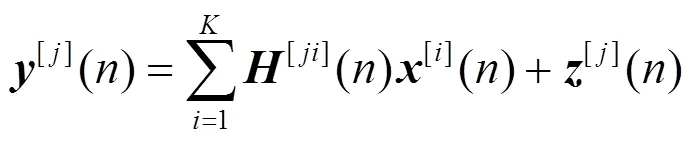

圖1 K個用戶MIMO IC模型
2.2 CSI反饋模型
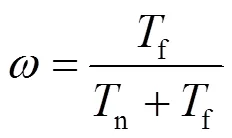
假設接收端(用戶)執(zhí)行預定的周期性反饋協(xié)議將CSI反饋給發(fā)射端。周期性反饋協(xié)議可以通過控制信號實現(xiàn),適用于當前主流的蜂窩移動通信標準,如3GPP LTE[22]。分別考慮2個導致CSIT時延的因素——反饋時延和反饋頻率[1]。

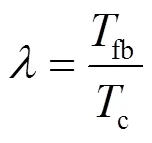
其中,為瞬時(instantaneous)CSIT;為適當延時(temperately-delayed)CSIT;為完全延時(completely-delayed)CSIT。發(fā)射端在時隙可用的本地CSI記為,這里,。因此,發(fā)射端的發(fā)送信號向量可看作是發(fā)送信息與本地延時CSIT的函數,即,為發(fā)射端的預編碼函數。

2.3 自由度


相應地,個用戶MIMO IC在本地CSIT下的總自由度定義為

3 K個用戶MISOIC的自由度折中域
3.1 分布式空時干擾對齊

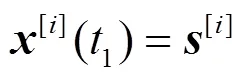

此時,各接收端觀測到一個期望信號與干擾信號疊加的線性方程。


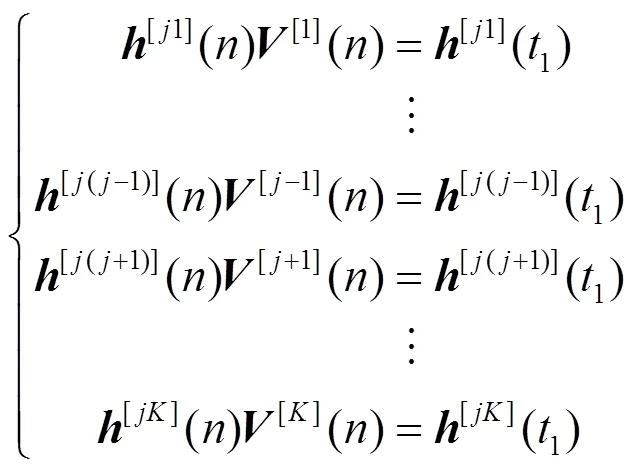

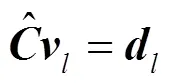

其中,表示從中選取對應中剩余個未知數的列組成的方陣,表示去除零元素后剩余未知元素按相對位置排序的矢量。由于信道系數的獨立同分布特性,此時,每列求解出的未知元素以概率1不為0。


3.2 自由度折中域
3.2.1 反饋時延受限自由度折中域


圖5 K個用戶MISO()IC關于反饋時延的自由度折中域
3.2.2 反饋頻率受限自由度折中域
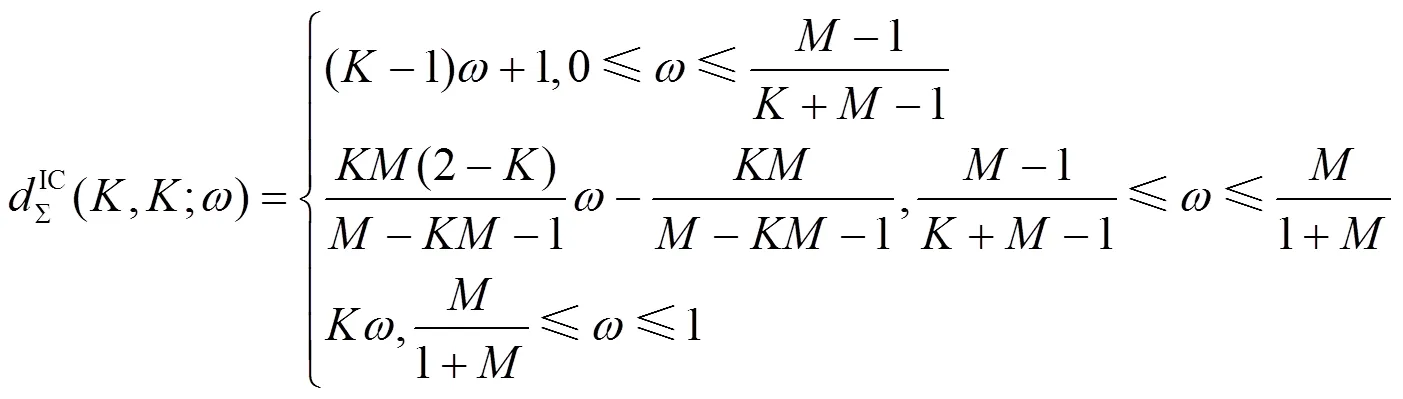


圖6 個用戶MISO()IC關于反饋頻率的自由度折中域
4 K個用戶MIMO IC的可達自由度
4.1 可達自由度

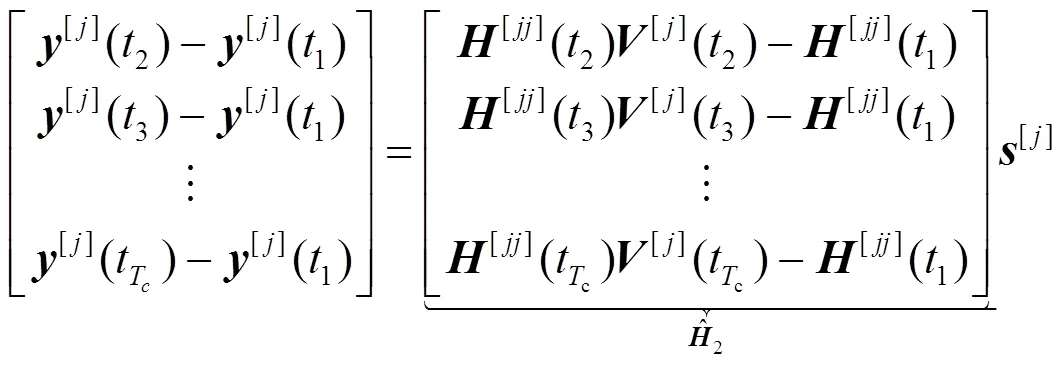
證明類似定理1,采用DSTIA方案獲取定理2的可達自由度。此時,式(12)可表示為

4.2 CSI有限反饋條件
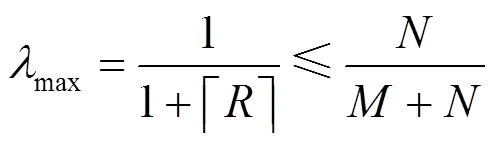
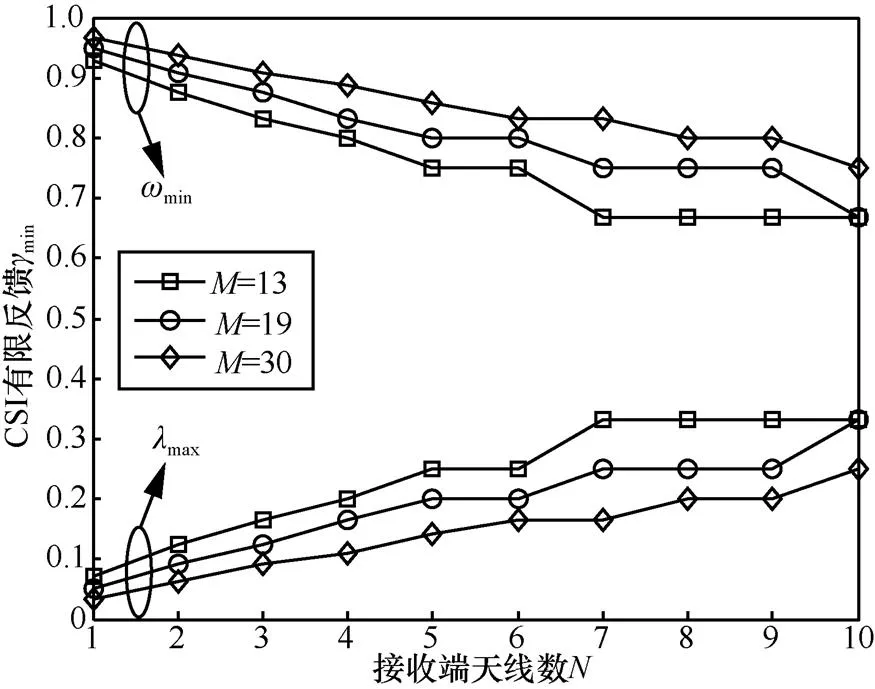
圖7 最大(小)歸一化CSI反饋時延(頻率)隨接收端天線數N的變化
5 數值分析
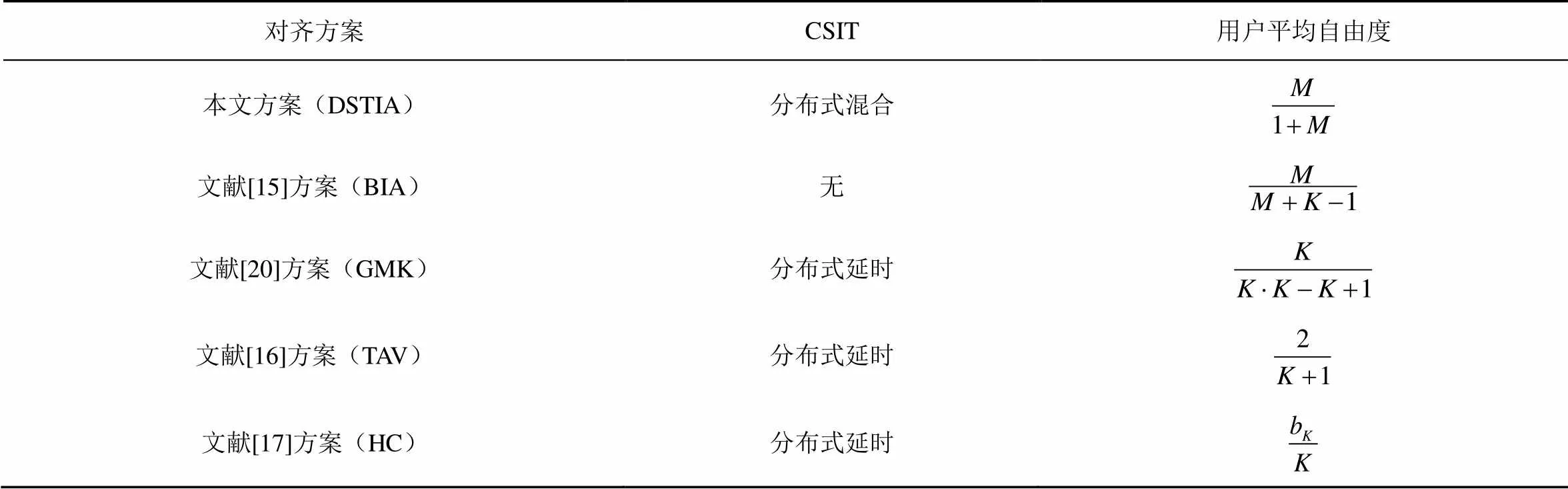
表1 K個用戶M×1(M≥1) MISO IC不同方案下的總自由度


圖8 用戶平均可達自由度隨總體用戶數K的變化情況
2) 信道和速率

圖9 3個用戶MIMO IC天線數與平均吞吐率的關系

3) CSI有限反饋條件


圖10 3個用戶MIMO IC可達自由度折中域
6 結束語
[1] LEE N, HEATH R. Space-time interference alignment and degree-of-freedom regions for the MISO broadcast channel with periodic CSI feedback[J]. IEEE Transactions on Information Theory, 2014, 60(1): 515-528.
[2] LEE N, TANDON R, HEATH R W. Distributed space-time interference alignment with moderately delayed CSIT[J]. IEEE Transactions on Wireless Communications, 2015, 14(2): 1048-1059.
[3] YING T, FENG W, SU W, et al. On the degrees of freedom of MIMO X networks with non-cooperation transmitters[J]. IEEE Transactions on Wireless Communications, 2017, 16(4): 2490-2504.
[4] YING T, FENG W, LIU G. Space-time interference alignment: DoF of two-user MIMO X channel with alternating CSIT[J]. IEEE Communications Letters, 2017, 21(5): 1167-1170.
[5] 孫獻, 趙曉暉. 認知無線電系統(tǒng)中干擾對齊的自由度分析[J]. 通信學報, 2016, 37(2): 179-189.
SUN X, ZHAO X H. Analysis on the degree of freedom of interference alignment in cognitive radio[J]. Journal on Communications, 2016, 37(2): 179-189.
[6] 朱世磊, 鄭娜娥, 王盛, 等. 基于用戶協(xié)作的認知MIMO干擾網絡自由度上界研究[J]. 通信學報, 2015, 36(8): 153-160.
ZHU S L, ZHENG N E, WANG S, et al. Upper bound of degrees of freedom in cognitive MIMO interference network with user cooperation[J]. Journal on Communications, 2015, 36(8):153-160.
[7] CADAMBE V R, JAFAR S A. Interference alignment and degrees of freedom of the-user interference channel[J]. IEEE Transactions on Information Theory, 2008, 54(8): 3425-3441.
[8] JAFAR S A, FAKHEREDDIN M J. Degrees of freedom for the MIMO interference channel[J]. IEEE Transactions on Information Theory, 2007, 53(7): 2637-2642.
[9] GOU T, JAFAR S A. Degrees of freedom of the-user×MIMO interference channel[J]. IEEE Transactions on Information Theory, 2010, 56(12): 6040-6057.
[10] WANG C, SUN H, JAFAR S A. Genie chains and the degrees of freedom of the-user MIMO interference channel[C]//The 2012 IEEE International Symposium on Information Theory. 2012: 2476-2480.
[11] SOMEKH O, SIMEONE O, BAR-NESS Y, et al. Cooperative multi-cell zero-forcing beamforming in cellular downlink channels[J]. IEEE Transactions on Information Theory, 2009, 55(7): 3206-3219.
[12] HUANG C, JAFAR S A, SHAMAI S, VISHWANATH S. On degrees of freedom region of MIMO networks without channel state information at transmitters[J]. IEEE Transactions on Information Theory, 2012, 58(2): 849-857.
[13] ZHU Y, GUO D. The degrees of freedom of isotropic MIMO interference channels without state information at the transmitters[J]. IEEE Transactions on Information Theory, 2012, 58(1): 341-352.
[14] VAZE C S, VARANASI M K. The degree-of-freedom regions of MIMO broadcast, interference, and cognitive radio channel with no CSIT[J]. IEEE Transactions on Information Theory, 2012, 58(8): 5354-5374.
[15] LU Y, ZHANG W. Blind interference alignment in the-user MISO interference channel[C]//IEEE GLOBECOM. 2013: 3464-3469.
[16] TORRELLAS M, AGUSTIN A, VIDAL J. On the degrees of freedom of the-user MISO interference channel with imperfect delayed CSIT[C]//The 2014 IEEE International Conference on Acoustic, Speech and Signal Processing. 2014: 1155-1159.
[17] HAO C, CLERCKX B. Degrees-of-freedom of the-user MISO interference channel with delayed local CSIT[C]//IEEE International Conference on Communications. 2015: 4217-4222.
[18] ABDOLI M J, GHASEMI A, KHANDANI A K. On the degrees of freedom of-user SISO interference andchannels with delayed CSIT[J]. IEEE Transactions on Information Theory, 2013, 59(10): 6542-6561.
[19] VAZE C S, VARANASI M K. The degrees of freedom region and interference alignment for the MIMO interference channel with delayed CSIT[J]. IEEE Transactions on Information Theory, 2012, 58(7): 4396-4417.
[20] GHASEMI A, MOTAHARI A S, KHANDANI A K. Interference alignment for the MIMO interference channel with delayed local CSIT, 2011 [J]. arXiv: arXiv 1102.5673.
[21] LEE N, HEATH R W. CSI feedback delay and degrees of freedom gain trade-off for the MISO interference channel[C]//The 46th Asilomar Conference on Signals, Systems and Computers. 2012: 1851-1854.
[22] GHOSH A, ZHANG J, ANDREWS J G, et al. Fundamentals of LTE[M]. Englewood Cliffs, USA: Prentice-Hall, 2010.
Degrees of freedom of MIMO interference channel with distributed space-time interference alignment
YING Tengda, FENG Wenjiang, JIANG Weiheng, LIU Guoling, YAO Chunan, BAO Taotao
College of Communication Engineering, Chongqing University, Chongqing 400044, China
In the context of-user MIMO interference channel (IC), achievable degrees of freedom (DoF) were investigated with distributed space-time interference alignment (DSTIA). By precoding with distributed current and outdated channel state information at the transmitters (CSIT), new tradeoff regions between achievable DoF and CSI feedback delay/frequency were achieved for MISO system. The impact of the number of transmit antennas on achievable DoF in the MISO system was analyzed, revealing that DoF results approach to the outer bound as the number of transmit antennas increases. Further, the impact of the number of receive antennas on achievable DoF was characterized, deriving the range of CSI feedback delay that preserves achievable DoF in the MIMO system. Theoretical and numerical analyses show that, the proposed DSTIA scheme can achieve better sum-DoFs by eliminating inter-user interference perfectly, tighten the gap between achievable DoF and outer bound, as well as improve the achievable rate of the system.
degree of freedom, distributed space-time interference alignment, MIMO interference channel, limited CSI feedback
TN919.1
A
2017-05-24;
2017-10-30
應騰達,tengdaying@cqu.edu.cn
中央高校基本科研業(yè)務費基金資助項目(No.106112016CDJXY500002);重慶市基礎科學與前沿技術研究重點基金資助項目(No.cstc2017jcyjBX0047, No.cstc2015jcyjA40021)
10.11959/j.issn.1000-436x.2018017
應騰達(1991-),男,浙江永康人,重慶大學博士生,主要研究方向為MIMO無線通信、信息論等。

馮文江(1963-),男,四川西充人,重慶大學教授、博士生導師,主要研究方向為寬帶無線接入技術、認知無線電、通信信號處理等。
蔣衛(wèi)恒(1985-),男,湖北枝江人,重慶大學講師,主要研究方向為無線通信與網絡、移動云計算等。
劉國嶺(1989-),男,遼寧北票人,重慶大學碩士生,主要研究方向為MIMO無線通信、全雙工等。
姚楚楠(1994-),男,湖南婁底人,重慶大學碩士生,主要研究方向為MIMO無線通信、移動邊緣計算等。
包濤濤(1993-),男,湖北孝感人,重慶大學碩士生,主要研究方向為MIMO無線通信、圖像處理等。
: The Fundamental Research Funds for the Central Universities (No.106112016CDJXY500002), The Key Project of Chongqing Basic Science and Advanced Technology Research (No.cstc2017jcyjBX0047, No.cstc2015jcyjA40021)
猜你喜歡
工業(yè)設計(2022年8期)2022-09-09 07:43:20
體育科技文獻通報(2022年3期)2022-05-23 13:46:54
遼金歷史與考古(2021年0期)2021-07-29 01:06:54
軍民兩用技術與產品(2021年10期)2021-03-16 06:05:30
北京測繪(2020年12期)2020-12-29 01:33:58
科技傳播(2019年22期)2020-01-14 03:06:54
民用飛機設計與研究(2019年4期)2019-05-21 07:21:24
家庭影院技術(2017年9期)2017-09-26 03:41:45
商用汽車(2016年11期)2016-12-19 01:20:16
商用汽車(2016年6期)2016-06-29 09:18:54