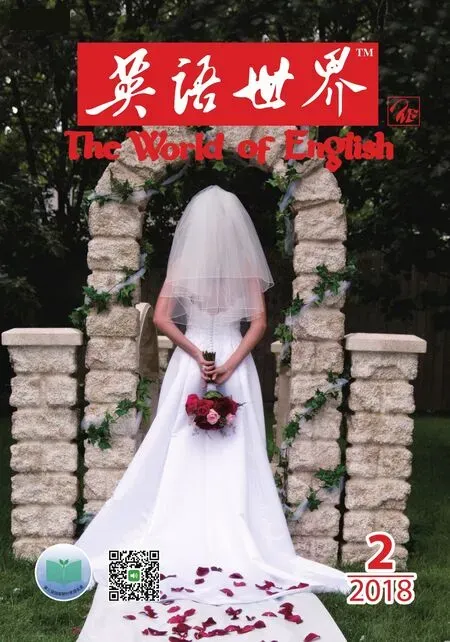
18 National Tying-the-Knot1 Traditions from Countries Across the Globe
2018-03-29 06:45:27ByCoreyWhelan
英語(yǔ)世界 2018年2期
關(guān)鍵詞:儀式
By Corey Whelan
From the customary father-daughter dance to wearing something old, something new, something borrowed, and something blue2起源于西方的婚禮習(xí)俗,新娘在結(jié)婚當(dāng)天需要穿戴“有舊、有新、有借和有藍(lán)”的四件服飾,四件東西各有含義,傳說(shuō)能帶來(lái)吉祥和財(cái)富。, weddings are filled with tradition. Whether the tradition is a long-standing family ritual or merely for a little good luck, it’s comforting to know that you are carrying on something of familial or cultural significance.從新娘和父親共舞,到穿戴“有舊、有新、有借和有藍(lán)”的服飾,婚禮中的傳統(tǒng)無(wú)處不在。無(wú)論這些傳統(tǒng)是累世家傳的儀式,還是只為求得些許好運(yùn),可感欣慰的是,家族傳統(tǒng)和文化價(jià)值由此得以延續(xù)。

Dancing feet
Origin: Ireland
During traditional Irish weddings, the bride had to keep at least one foot on the ground at all times while dancing. If both feet left the floor at the same time,legend had it that fairies would swoop3swoop飛降;俯沖。under the bride and carry her away.
跳舞時(shí)雙腳不能同時(shí)離地
起源地:愛(ài)爾蘭
在愛(ài)爾蘭人的傳統(tǒng)婚禮上,新娘在跳舞的時(shí)候,至少得有一只腳落在地面。如果雙腳同時(shí)離開(kāi)地面,傳說(shuō)會(huì)有妖精沖到新娘腳下,將其擄走。
Lovespoons
Origin: Wales
Originally these were hand carved by young men in order to court women.The spoons were given to a man’s lady of interest to court her and express his desire to feed and support her. Now lovespoons are often exchanged on a couple’s wedding day to commemorate their love.
Blackening of the bride and groom
Origin: Scotland
This originated as a practice to ward off evil spirits and bring good luck before marriage. The bride and/or groom is captured by friends and family the day before the wedding and covered in soot4soot煤煙灰。, mud, flour, feathers, and other sticky substances, and loudly paraded around town. Sometimes the victim ends up tied to a tree or post, or thrown in a body of water.
Baumstamm s?gen (sawing the log)
Origin: Germany
The idea of a kidnapped bride may be terrifying for a groom-to-be, but this German tradition is all fun and games.The night before the wedding, the bride is taken away by family and friends and hidden at a local pub. The groom must visit various bars to find his bride (buying drinks along the way) and once he finds her, he must pay her ransom by buying a round of drinks or performing romantic gestures.
愛(ài)情匙
起源地:威爾士
愛(ài)情匙最初是年輕男子自己手工雕刻而成的木制羹匙,用來(lái)向女性求愛(ài)。男子把愛(ài)情匙送給心儀的女性,表達(dá)自己愿意養(yǎng)活和照顧她的心意。現(xiàn)在,新郎新娘通常在婚禮當(dāng)天交換愛(ài)情匙,作為對(duì)他們愛(ài)情的紀(jì)念。
涂黑新郎和新娘
起源地:蘇格蘭
這種習(xí)俗最初是為了在結(jié)婚前替新郎新娘祛邪祈福。在婚禮前一天,親友們抓住新郎和/或新娘,在他們身上涂滿煤灰、泥巴、面粉、羽毛以及其他黏黏的東西,再大張旗鼓地帶著他們滿城游行。新郎新娘最后可能被綁在樹(shù)上或柱子上,也可能被扔進(jìn)水池里。
鋸圓木
起源地:德國(guó)
對(duì)新郎來(lái)說(shuō),新娘被綁架可能是個(gè)恐怖的想法,但德國(guó)人的這個(gè)傳統(tǒng)卻充滿游戲之樂(lè)。婚禮前一天晚上,親友們會(huì)把新娘帶走藏在當(dāng)?shù)啬抽g酒吧。新郎需要到各個(gè)酒吧找他的新娘(一路都要請(qǐng)酒吧里的人喝酒)。找到新娘后,新郎還需要有所表示才能贖回新娘,要么請(qǐng)酒吧里所有人喝酒,要么當(dāng)眾做出一些浪漫的舉動(dòng)。
After the ceremony, the bride and groom have to use a two-person crosscut handsaw to cut a large log in half—while still in their bridal clothes! This symbolizes the ways in which they must work together in the future (although, to make it a bit quicker,the log has sometimes already been partially sawed through by the fathers of the bride and groom).

Dancing till dawn
Origin: France
Joyful, weekend-long French weddings bring new meaning to the phrase,“dancing the night away.” French weddings feature non-stop dancing all night long, which doesn’t stop until the guests fall down, or it’s time to go to work. French marriages must have a civil ceremony, in order to be legal,so French brides and grooms often opt for two events over a long weekend—one civil service, and one religious ceremony. Either or both may be followed by a fabulous, champagne-filled fete,complete with a disc jockey5又稱(chēng)“唱片騎師”,是指選擇并且播放事先錄好的音樂(lè)來(lái)為他人帶來(lái)娛樂(lè)的人。, band, and foot-tapping rhythms that keep guests on their feet for seven hours, or more.
婚禮儀式結(jié)束后,新郎新娘還得用一把雙人橫鋸,把一根大圓木鋸成兩半——那會(huì)兒他們還穿著禮服呢!鋸圓木的習(xí)俗象征著新郎新娘在未來(lái)的生活中必須同心協(xié)力。當(dāng)然,為了節(jié)省時(shí)間,新郎的父親和新娘的父親有時(shí)會(huì)事先把圓木鋸開(kāi)一截。
跳舞到天明
起源地:法國(guó)
法國(guó)人通常選在周末兩天舉行婚禮,歡樂(lè)的法國(guó)婚禮給“跳到夜色消散”這句話帶來(lái)了新的注解。法國(guó)婚禮的一大特色就是徹夜不停地跳舞,一直跳到客人精疲力竭,或跳到第二天該去上班為止。在法國(guó),結(jié)婚必須要在政府登記注冊(cè)才算合法。所以法國(guó)新郎新娘通常選在長(zhǎng)周末舉辦兩場(chǎng)婚禮儀式——一場(chǎng)注冊(cè)登記,一場(chǎng)宗教儀式。每場(chǎng)儀式后,都可能舉行盛大的香檳宴會(huì)。宴會(huì)上會(huì)有調(diào)音師、樂(lè)隊(duì)和節(jié)奏感強(qiáng)的音樂(lè),客人們跳舞往往能跳上七個(gè)小時(shí),有時(shí)還會(huì)跳得更久。
Kissing the newlyweds
Origin: Sweden
Newlyweds in Sweden may be kissing more than each other on their wedding night. If the bride leaves the room for any reason, other women are allowed to kiss the groom. Same goes if the groom leaves the room for any reason.
Unity bowl
Origin: Australia
Guests are given stones or marbles to hold throughout the wedding. At the end of the ceremony the stones are placed in the unity bowl, which the couple will take home as a reminder of their friends’and families’ support. Sometimes different colored stones are given to each generation, and stones are placed in the bowl from oldest to youngest to build a strong foundation for the couple.
Kransekake (a special kind of cake)
Origin: Norway
Norwegians don’t have the threetiered wedding cake. Instead, they make Kransekake6挪威的傳統(tǒng)節(jié)日蛋糕甜點(diǎn),用冰凍的杏仁奶油蛋糕圈裝飾起來(lái)的錐形蛋糕塔,通常做成超過(guò)葡萄酒瓶高度的寶塔狀,以便賓客分食。, a steep-sided cake cone made by sticking rings of cake on top of one another with icing (often 18 rings or more). At the wedding, the bridal couple tries to break off the top layer—the number of cake rings that stick to it represent the number of children the couple will have!

親吻新婚夫婦
起源地:瑞典
在瑞典,新婚夫婦在婚禮當(dāng)晚可能會(huì)被對(duì)方以外的人親吻。不管出于什么原因,只要新娘離開(kāi)房間,其他女性都可以親吻新郎。新郎走開(kāi)后也是一樣,其他男性都可以親吻新娘。
同心碗
起源地:澳大利亞
參加婚禮的客人們每人會(huì)領(lǐng)到一小塊石頭,在整個(gè)婚禮儀式上都要拿著它。儀式結(jié)束時(shí),這些石塊被放進(jìn)同心碗中。新婚夫婦把裝滿石塊的同心碗帶回家中保存,留作對(duì)親友支持的紀(jì)念。有時(shí)候,不同輩分的客人領(lǐng)到的石塊的顏色也不同。客人們依照從長(zhǎng)到幼的次序,把石塊放進(jìn)同心碗中,有給新婚夫婦的生活打下堅(jiān)實(shí)基礎(chǔ)的寓意。
圈塔蛋糕
起源地:挪威
挪威人的婚禮上沒(méi)有三層婚禮蛋糕。他們會(huì)做“圈塔蛋糕”。這是一種用餅圈從大到小層層粘連、堆疊而成的錐形蛋糕塔(通常至少有18層餅圈),外表再輔以糖霜點(diǎn)綴。婚禮上,新婚夫婦要取下最頂層的餅圈,有多少層餅圈被粘在一起取下來(lái),就代表這對(duì)新人未來(lái)會(huì)生多少個(gè)孩子。
Shouting ‘Gorka!’
Origin: Russia
After a toast of bitter Champagne or vodka, guests will shout “gorka!” at the couple—meaning “bitter”—to make them kiss for as long as the chants last. The kiss is meant to get rid of the bitter taste of the alcohol.
Tea ceremony
Origin: China
Though Chinese weddings have become Westernized in many ways,the tea ceremony still plays an important role. The bride and groom will gather their parents, grandparents,and other honored relatives and serve them tea as a sign of respect. Though traditionally the bride’s and groom’s families were served separately, today there is commonly only one tea ceremony and the event is seen as a joining of the two families.
大聲叫“苦”
起源地:俄羅斯
客人們?cè)诨槎Y上祝酒并飲下苦澀的香檳酒或伏特加后,會(huì)對(duì)著新郎新娘大喊“戈?duì)柨ā保ǘ碚Z(yǔ)“苦澀”的意思),讓新郎新娘開(kāi)始接吻。客人們的喊聲不停,新郎新娘就得一直吻下去。讓新婚夫婦親吻是為了消除酒精的苦澀味道。
敬茶禮
發(fā)源地:中國(guó)
雖然中國(guó)人的婚禮在很多方面已經(jīng)西化,但敬茶禮仍是中國(guó)人婚禮中的重要環(huán)節(jié)。新郎新娘的父母、祖父母等尊長(zhǎng)們齊坐一堂,由新郎新娘向他們敬茶以示尊重。傳統(tǒng)上新郎和新娘要為對(duì)方家人分別舉行敬茶禮,但現(xiàn)在通常只舉辦一次敬茶禮,代表著兩個(gè)家庭結(jié)為親家。
Sake sharing ceremony
Origin: Japan
The number three is considered sacred in Japan, where the bride, groom,and both sets of parents take three sips of sake from each of the three cups of sake, or rice wine(nine means triple happiness). The first cup represents the three couples partaking in the ceremony, the second represents the three human flaws (hatred,passion, and ignorance), and the third represents deliverance from these flaws.
Getting a goose
Origin: Korea
The wild goose is an important sym- symbol because it keeps the same partner for life. Before the ceremony the groom presents a wooden goose to the bride’s mother as a promise of lifelong fidelity.In the past, grooms used to present live wild geese.
Foot whipping
Origin: South Korea
Before a traditional South Korean wedding the groom can look forward to something of a beating from his party.Foot whipping—also known as bastinado7bastinado笞跖刑,俗稱(chēng)打腳掌刑。or falaka8falaka打腳掌刑在中東地區(qū)的說(shuō)法。—involves the beating of a groom’s bare feet with a cane by his groomsman and is said to be a test of the groom’s strength and character.

共飲清酒儀式
發(fā)源地:日本
在日本人眼中,數(shù)字三是神圣的。日本人在婚禮上備有三杯清酒(或米酒),新娘、新郎和雙方父母每杯都要喝三小口(九意味著三倍的幸福)。第一杯酒代表參加儀式的三對(duì)夫妻,第二杯酒代表人性的三種弱點(diǎn)(貪、嗔、癡),第三杯酒代表從這三種弱點(diǎn)中解脫。
送木雁
起源地:朝鮮
野雁一生只有一個(gè)伴侶,因此是婚姻忠貞的重要象征。新郎在婚禮前送給新娘母親一只木雁,寓意為承諾對(duì)新娘終身保持忠貞。在過(guò)去,新郎送的通常是活野雁。新郎在婚禮前會(huì)被男方親友團(tuán)“揍一頓”,這就是打腳掌(也被稱(chēng)為笞跖刑或falaka)。伴郎用藤杖抽打新郎的光腳掌,據(jù)說(shuō)這是為了考驗(yàn)新郎的體力和品性。
打腳掌
起源地:韓國(guó)
按照韓國(guó)傳統(tǒng)婚禮習(xí)俗,
The art of henna
Origin: India
These ornate temporary designs are applied to the hands and feet of the bride, as well as her female friends and family members. And they’re not just decorative: The mahogany-hued dye has been used since ancient times to increase the flow of blessings to the couple. The stain is typically applied as a sacred ritual that begins two days before the wedding. Traditional henna9henna一種使用純天然植物指甲花的葉或幼苗磨成的糊狀顏料在手掌、手背等部位繪制的短時(shí)間保存的人體繪畫(huà)。tattoos include dedications to Hindu gods and goddesses and depictions of sacred symbols; today, brides and grooms often meld10meld結(jié)合。the name of their beloved into the intricate artwork.
彩繪藝術(shù)
起源地:印度
新娘以及新娘的女性朋友和女性家庭成員的雙手雙腳都要涂上這種臨時(shí)的裝飾圖案。這些彩繪不只是裝飾,紅褐色的指甲花染料自古就用來(lái)為新婚夫婦祈福。這種彩繪紋身是非常神圣的儀式,通常在婚禮前兩天就開(kāi)始進(jìn)行了。傳統(tǒng)的指甲花染料紋身包括向印度教男女眾神表達(dá)敬意的圖案和神圣符號(hào)。今天,新娘新郎通常把對(duì)方的名字融進(jìn)繁復(fù)的彩繪圖案里。

Ransom for the shoes
Origin: Pakistan
After a Pakistani wedding, the couple returns home for a ceremony called the “showing of the face.” Family and friends hold a green shawl over the couple’s heads and a mirror as the bride removes the veil she wears throughout the wedding ceremony. While the newlyweds are busy gazing at one another,the bride’s female relatives make off with the groom’s shoes and demand money for their safe return.
Royalty for a day
Origin: Malaysia
All brides hope to be treated like royalty on their big day, but Malaysian brides actual are. During Malay weddings, traditions of the royal court are observed11observe慶祝;慶賀。with Malay court music played during the ceremony. Wait staff dressed as court attendants serve the newlyweds and those impersonating12impersonate扮演。royal guards perform traditional martial arts.
Connecting with all five senses in the Andes Mountains
Origin: Peru
The Andean wedding is illustrative of local customs. The bride and groom enter a garden from opposite sides, to represent the coming together of people from different villages. A shaman1313 shaman薩滿(據(jù)信能和善惡神靈溝通,能治病的人)。awaits their arrival, while chanting a blessing. There is also intense, rhythmic music playing. There is a scent of burning herbs, and the shaman poured oil down the backs of their necks, to elicit physical sensation. Everything is designed to overwhelm the senses—sight, hearing, touch and scent. The bride and groom give offerings to each other, and bury a joint offering to Pachamama14大地之母:安第斯地區(qū)印加人信仰中的生育女神,掌管種植和收獲。, which is meant to be there waiting for her, underground, until the end of time.
贖鞋
起源地:巴基斯坦
巴基斯坦人的婚禮結(jié)束后,新婚夫婦會(huì)回到家中,舉行被稱(chēng)為“揭面紗”的儀式。在新娘揭開(kāi)婚禮全程所戴的面紗時(shí),親友們?cè)谛禄榉驄D頭頂上方撐起一塊綠色披巾并用一面鏡子照著。當(dāng)新郎新娘互相深情凝望時(shí),新娘的女性親屬就會(huì)拿走新郎的鞋子,新郎得交付贖金才能要回鞋子。
做一天皇族
起源地:馬來(lái)西亞
所有的新娘都希望自己在大喜之日能得到像皇族一樣的待遇,只有馬來(lái)西亞的新娘能如愿以償。馬來(lái)西亞人的婚禮遵循皇室傳統(tǒng),儀式從始至終播放馬來(lái)西亞皇室音樂(lè)。婚禮上服務(wù)人員穿戴成皇室侍從的樣子,供新婚夫婦差遣,還有人模仿皇室衛(wèi)隊(duì)表演傳統(tǒng)武術(shù)。
在安第斯山脈連通五感
起源地:秘魯
安第斯地區(qū)的婚禮極具地方特色。新郎和新娘分別從正對(duì)的兩邊走進(jìn)花園,代表來(lái)自不同村落的兩個(gè)人結(jié)合在一起。薩滿在花園里一邊等著新郎新娘到來(lái),一邊為他們吟唱祈福。婚禮上還會(huì)有熱烈歡快的音樂(lè)、燃燒藥草的香味。薩滿把一種油澆倒在新郎新娘頸后,觸發(fā)他們身體的感覺(jué)。做這一切是為了喚醒視覺(jué)、聽(tīng)覺(jué)、觸覺(jué)和嗅覺(jué)等感官。新婚夫婦會(huì)互贈(zèng)祭品,并把共同獻(xiàn)給“大地之母”的祭品埋入地下,這樣,直至地老天荒,“大地之母”都可享用祭品。
12 symbols of life
Origin: South Africa
South African weddings are steeped in15be steeped in深深浸淫;飽含(某品質(zhì))。ancient tradition. Twelve symbols,meant to represent the couple’s life together, must be present at every ceremony. These include wine, wheat, a broom, honey, bitter herbs, salt, pepper,a spoon, spear, a cooking pot, and a shield, plus a holy book, such as a Bible or Koran. In addition to the 12 symbols of life, the bride and groom ceremoniously have their wrists tied together with grass, to symbolize their coming together as a couple. ■
12件象征生活方方面面的物品
起源地:南非
南非人的婚禮充溢著古老的傳統(tǒng)元素。每個(gè)儀式上必須有12件物品,代表新婚夫婦未來(lái)共同的生活。這些物品包括酒、小麥、一把掃帚、蜂蜜、苦藥草、鹽、胡椒、一把勺、矛、一口鍋、一面盾,以及經(jīng)書(shū),比如《圣經(jīng)》或《古蘭經(jīng)》。除12件生活物品外,新郎新娘還會(huì)進(jìn)行一種儀式,用草結(jié)環(huán)把兩人手腕纏在一起,象征他們正式結(jié)為夫婦。 □
tie the knot〈習(xí)語(yǔ)〉結(jié)婚。
猜你喜歡
水上消防(2022年1期)2022-06-16 08:07:26
快樂(lè)語(yǔ)文(2021年34期)2022-01-18 06:04:10
少先隊(duì)活動(dòng)(2020年8期)2020-12-18 02:32:07
小資CHIC!ELEGANCE(2020年31期)2020-10-27 09:40:31
少先隊(duì)活動(dòng)(2020年7期)2020-08-14 01:18:12
海峽姐妹(2019年12期)2020-01-14 03:25:08
現(xiàn)代裝飾(2018年4期)2018-05-22 02:57:07
好日子(2018年9期)2018-01-28 10:49:06
華人時(shí)刊(2017年21期)2017-11-23 01:26:39
海峽姐妹(2017年6期)2017-06-24 09:37:41