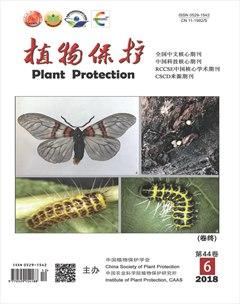
警惕危險性害蟲草地貪夜蛾入侵中國
2018-05-14 12:17:24郭井菲趙建周何康來
植物保護 2018年6期
關鍵詞:防治
郭井菲 趙建周 何康來
摘要 草地貪夜蛾Spodoptera frugiperda (Smith)是一種原產于美洲的重要的毀滅性農業害蟲,目前已經入侵到撒哈拉以南非洲地區及亞洲的印度,對我國構成入侵威脅。本文綜述了草地貪夜蛾的生物學特征、為害、分布區域及入侵性、形態及分子鑒定方法,以及防治措施,并對其入侵中國的風險進行了預測分析,同時提出應對策略。
關鍵詞 草地貪夜蛾; 生物學特征; 分布; 鑒定; 防治
中圖分類號: S 435.132
文獻標識碼: A
DOI: 10.16688/j.zwbh.2018452
Abstract Fall armyworm,Spodoptera frugiperda (Smith), is a major and destructive crop insect pest native to the Americas. It has invaded subSaharan Africa and India in recent years. It is a potential invasive insect pest to China. In this review, we summarized the biological characteristics and damage, distribution and invasion, morphological and molecular identification of S. frugiperda, as well as the control measures. We also made predictions for its potential invasion risk to China and proposed strategies to combat the potential invasion.
Key words Spodoptera frugiperda; biological characteristics; distribution; identification; control
草地貪夜蛾Spodoptera frugiperda(Smith),也稱秋黏蟲,隸屬于鱗翅目Lepidoptera,夜蛾科Noctuidae,是一種原產于美洲熱帶和亞熱帶地區的雜食性害蟲[1],廣泛分布于美洲大陸[2],為害多種作物,是重要的農業害蟲[3]。近年來, 隨著國際貿易活動的日趨頻繁,草地貪夜蛾傳播擴散的幾率越來越大,現已入侵到撒哈拉以南的44個非洲國家以及亞洲的印度[4],并有進一步向以東南亞和中國南部為主的亞洲其他地區入侵蔓延的態勢[5]。我國毗鄰印度,同時云南、廣西和廣東、海南等省區地處熱帶或亞熱帶地區,氣候溫暖、植物種類豐富,是草地貪夜蛾的適生區。一旦草地貪夜蛾入侵我國,可在這些地區周年繁殖。由于其具有巨大的繁殖力、暴發為害及遷飛能力,草地貪夜蛾將嚴重威脅我國的農業生產和糧食安全。本文綜述了草地貪夜蛾的生物學特征及為害特點、分布區域及擴散特點、鑒定方法及防治措施等,希望有助于防范該害蟲入侵為害。
1 生物學特性及為害
草地貪夜蛾是雜食性害蟲,其寄主植物廣泛,包括玉米、苜蓿、大麥、蕎麥、棉花、燕麥、粟、水稻、花生、黑麥草、高粱、甜菜、蘇丹草、大豆、煙草、番茄、馬鈴薯、洋蔥、小麥等80余種植物[6]。草地貪夜蛾分為玉米品系(corn strain, C strain)和水稻品系(rice strain, R strain)兩種單倍型(haplotypes),前者主要取食為害玉米、棉花和高粱,后者主要取食為害水稻和各種牧草[7-9]。這兩種單倍型外部形態基本一致,但在性信息素成分、交配行為以及寄主植物范圍等方面具有明顯差異[10-11]。草地貪夜蛾完成一個世代要經歷卵、幼蟲、蛹和成蟲4個蟲態[6],其世代長短與所處的環境溫度及寄主植物有關。草地貪夜蛾的適宜發育溫度為11~30℃,在28℃條件下,30 d左右即可完成一個世代,而在低溫條件下,需要60~90 d才能完成一個世代。由于沒有滯育現象,在美國,草地貪夜蛾只能在氣候溫和的南佛羅里達州和德克薩斯州越冬存活[2],而在氣候、寄主條件適合的中、南美洲以及新入侵的非洲大部分地區,可周年繁殖[12]。草地貪夜蛾成蟲可在幾百米的高空中借助風力進行遠距離定向遷飛[13],
每晚可飛行100 km[12]。成蟲通常在產卵前可遷飛500 km[14],如果風向風速適宜,遷飛距離會更長,有報道稱草地貪夜蛾成蟲在30 h內可以從美國的密西西比州遷飛到加拿大南部,長達1 600 km距離[15]。成蟲具有趨光性,一般在夜間進行遷飛、交配和產卵,卵塊通常產在葉片背面。成蟲壽命可達兩至三周,在這段時間內,雌成蟲可以多次交配產卵,一生可產卵900~1 000粒[14]。在適合溫度下,卵在2~4 d內即可孵化成幼蟲。幼蟲有6個齡期,高齡幼蟲具有自相殘殺的習性[16]。
草地貪夜蛾在幼蟲期取食為害,取食部位及為害程度與作物的種類、生育期以及幼蟲的齡期密切相關,6齡幼蟲為害最為嚴重[12]。在玉米上,1~3齡幼蟲通常隱藏在葉片背面取食,取食后形成半透明薄膜“窗孔”。低齡幼蟲還會吐絲,借助風擴散轉移到周邊的植株上繼續為害。4~6齡幼蟲對玉米的為害更為嚴重,取食葉片后形成不規則的長形孔洞,可將整株玉米的葉片取食光,嚴重時可造成玉米生長點死亡,影響葉片和果穗的正常發育。此外,高齡幼蟲還會取食玉米雄穗和果穗[17]。
草地貪夜蛾為害嚴重威脅玉米生產。據統計,在美國佛羅里達州,草地貪夜蛾為害可造成玉米減產20%[18]。在一些經濟條件落后的地區,其為害造成的玉米產量損失更為嚴重,比如在中美洲的洪都拉斯,其為害可造成玉米減產達到40%[19],在南美的阿根廷和巴西,其為害可分別造成72%[20]和34%[21]的產量損失。2017年9月,國際農業和生物科學中心(CABI)報道,僅在已被入侵的非洲12個玉米種植國家中,草地貪夜蛾為害可造成玉米年減產830萬到2 060萬t,經濟損失高達24.8億到61.9億美元[12]。
2 分布區域與入侵性
草地貪夜蛾原產于美洲熱帶和亞熱帶地區[18],2016年1月在非洲首次被發現[22]。由于從撒哈拉沙漠帶到非洲南部的大多數非洲國家都是草地貪夜蛾的適生區[18],因此從2016年1月在尼日利亞、多哥、貝寧以及圣多美和普林西比等非洲國家發現草地貪夜蛾后[22],草地貪夜蛾在撒哈拉沙漠以南地區迅速入侵蔓延[18]。到2017年4月28日,有12個非洲國家官方報道了草地貪夜蛾的侵入,到2017年9月28日,已經有28個撒哈拉以南的非洲國家證實草地貪夜蛾的侵入,尚有9個國家需要進一步確認[12]。到2018年1月,僅僅兩年的時間,草地貪夜蛾就已經入侵到撒哈拉以南非洲幾乎所有44個國家。
草地貪夜蛾主要是通過國際頻繁的人員流動和貿易往來傳入非洲的[23-24]。雖然草地貪夜蛾能借助風力進行遠距離遷飛,但因為美洲和非洲間的季風是從非洲吹向美洲,且在2016年前從沒有發生過草地貪夜蛾侵入非洲的事件,因此草地貪夜蛾的遠距離遷飛并不是其侵入非洲的主要途徑[12],但卻和其在非洲范圍內的快速蔓延密切相關[18]。草地貪夜蛾可以跨海遷飛數百千米[13],這就意味著草地貪夜蛾可以從撒哈拉以南非洲國家遷飛到非洲北部[18]。雖然目前摩洛哥等北非國家還沒有發現草地貪夜蛾的入侵,但是草地貪夜蛾可以在一些農作物豐富的北非地區定殖。一旦入侵到北非并定殖,其季節性遷飛到歐洲的可能性就非常高,目前歐洲已經將其作為檢疫害蟲[25]。隨著尼日利亞、加納等非洲國家與世界各國貿易和交通運輸的日益頻繁[24],草地貪夜蛾很可能“搭乘”非洲到歐洲、東亞、東南亞等國家的貿易“便車”,“偷渡”入侵到中國、印度尼西亞、泰國、馬來西亞、菲律賓和澳大利亞等適合草地貪夜蛾定殖的國家[18]。2018年5月,Sharanabasappa和Kalleshwara等人在印度的卡納塔克邦州的希莫加地區首次發現了草地貪夜蛾[26],表明草地貪夜蛾已經侵入印度[27]。Shylesha等在2018年也通過形態鑒定及DNA條形碼技術證實了草地貪夜蛾已經入侵到卡納塔克邦州的奇卡布拉普爾地區,并得到官方證實[28]。2018年10月9日,印度《經濟時報》報道,草地貪夜蛾已經蔓延至印度的6個邦,繼卡納塔克邦以后,在印度的泰米爾納德邦、特侖甘納邦、安得拉邦和西孟加拉邦相繼發現了草地貪夜蛾后,在馬哈拉施特拉邦的甘蔗上也發現了草地貪夜蛾的為害[29]。專家推測草地貪夜蛾很可能從印度向孟加拉、尼泊爾、巴基斯坦等毗鄰國家擴散[26],進而蔓延至以東南亞和中國南部為主的亞洲其他地區,嚴重威脅亞洲數百萬計玉米和水稻小農戶的糧食安全[5]。
3 草地貪夜蛾的外部形態及分子特征
準確、快速地識別草地貪夜蛾是研究其防控技術的第一步[30]。草地貪夜蛾的主要形態特征[30-33]:卵呈圓頂形,直徑0.4 mm,高為0.3 mm,通常100~200粒卵堆積成塊狀,初產時為淺綠或白色,孵化前逐漸變為棕色。幼蟲共6齡,體色和體長隨齡期而變化,低齡幼蟲體色呈綠色或黃色,體長6~9 mm,頭呈黑或橙色。高齡幼蟲多呈棕色,也有呈黑色或綠色的個體存在,體長30~36 mm,頭部呈黑、棕或者橙色,具白色或黃色倒“Y”型斑。幼蟲體表有許多縱行條紋,背中線黃色,背中線兩側各有一條黃色縱條紋,條紋外側依次是黑色、黃色縱條紋。草地貪夜蛾幼蟲最明顯的特征是其腹部末節有呈正方形排列的4個黑斑。老熟幼蟲常在2~8 cm的土壤中化蛹,蛹呈橢圓形,紅棕色,長14~18 mm,寬4.5 mm。成蟲,翅展32~40 mm,前翅深棕色,后翅灰白色。
草地貪夜蛾的分子鑒定方法包括限制性片段長度多態性聚合酶鏈反應(polymerase chain reaction, restriction fragment length polymorphism, PCRRFLPs)[34-37]、擴增片段長度多態性(amplified fragment length polymorphisms, AFLP)[38]、多態異型酶(allozyme polymorphisms)[39]、線粒體單倍型分析(mitochondrial haplotyping)[40]以及DNA條形碼(DNA barcoding)[23,41]。特別是基于線粒體DNA細胞色素C氧化酶亞基I基因(mitochondrial cytochrome C oxidase subunit I, mtDNA,COⅠ)的DNA條形碼已經逐漸成為檢測監測草地貪夜蛾入侵的一種有效手段。例如Goergen等基于COⅠ基因的DNA條形碼技術的檢測結果首次報道了草地貪夜蛾入侵到了非洲大陸[22],隨后Cock等利用DNA條形碼技術證明草地貪夜蛾已擴散到加納[23]。此外,基于mtDNACOⅠ基因的序列分析還能有效地鑒別草地貪夜蛾的不同單倍型,例如Jacobs等通過對從南非采集的19個草地貪夜蛾的COⅠ基因序列的分析發現草地貪夜蛾的玉米品系和水稻品系都已侵入非洲[42]。除COⅠ基因以外,位于Z染色體上磷酸甘油醛異構酶基因(triose phosphate isomerase,Tpi)也可以作為草地貪夜蛾分子鑒定的標記基因[43-45]。例如,Nagoshi等通過對草地貪夜蛾的COⅠ和Tpi基因序列分析,推測入侵多哥的草地貪夜蛾可能起源于美洲東部和大安的列斯群島,對草地貪夜蛾的入侵來源進行了解析[46]。
總之,傳統的形態學鑒定方法通常會受到蟲態、單倍型以及樣本受損情況的影響,同時鑒定時容易將草地貪夜蛾的幼蟲與其他形態與之類似的鱗翅目幼蟲混淆[33],因此僅依靠形態鑒定具有一定的局限性,而將分子鑒定方法與形態學鑒定方法有機結合,互為補充,可實現對草地貪夜蛾的快速、準確的鑒定。
4 防治措施
4.1 農業防治
農業防治就是綜合協調管理作物、害蟲和環境因素,創造一個不利于害蟲發生和繁殖的農田生態環境。健康的植株通常抗蟲性更好[47],因此生產中可通過加強田間管理、合理施肥澆水、促進作物健康生長等措施來提高作物本身的抗蟲、耐蟲性。也可以通過調整作物播期使作物易受草地貪夜蛾為害的敏感生育期與其主要發生期錯開以減輕為害。此外,將作物與驅避害蟲、吸引害蟲天敵的其他植物進行間作或輪作也是防治草地貪夜蛾的方法之一,目前試驗已經證明“推拉”伴生種植策略(“pushpull” companion cropping)在非洲地區可以有效地防治草地貪夜蛾。這種防治策略就是將作物與驅避草地貪夜蛾的植物進行間作,進而將草地貪夜蛾從作物上驅避(即“推”),同時在作物周圍種植誘集雜草將草地貪夜蛾誘集到周圍的雜草上(即“拉”)。此外,多種植物的種植也為草地貪夜蛾天敵昆蟲提供了庇護所,從而提高了天敵對草地貪夜蛾的自然控制作用。2017年,肯尼亞、烏干達和塔桑尼亞等國家的250個農戶采用了“推拉”伴生種植策略來防治草地貪夜蛾,試驗結果顯示能使單株玉米幼蟲數量降低82.7%,為害程度降低86.7%,產量增加2.7倍[48]。種植抗草地貪夜蛾的作物品種,也是防治草地貪夜蛾為害的一項經濟、安全、有效的措施。研究發現Mp707、Mp708等多個改良的熱帶/亞熱帶玉米自交系都對草地貪夜蛾具有一定的抗性[31]。總之,農業防治措施主要依靠人力,經濟投入相對較少,因此更適合缺少資金購買殺蟲劑和其他植保產品的小農戶使用,但是在生產中需要綜合考慮防治的效果,以及所消耗的人力和物力來選擇合適的農業防治方法。
4.2 化學防治
目前,化學防治仍然是在多種作物上控制草地貪夜蛾的主要方法[49-50]。多殺菌素、氟氯氰菊酯、順式氯氰菊酯、氟蟲雙酰胺、氯蟲苯甲酰胺、乙酰甲胺磷、丁硫克百威等多種殺蟲劑對草地貪夜蛾都有較好的防治效果[50-51]。例如,用氯蟲苯甲酰胺和溴氰蟲酰胺處理大豆種子能顯著降低草地貪夜蛾在大豆V7和R6時期的存活率[52]。與藥劑拌種相比,噴施殺蟲劑防治草地貪夜蛾效果更好,需要注意的是,噴施殺蟲劑時要充分考慮幼蟲的生物學特性,在合適的時期使用正確的方式進行噴施。由于高齡幼蟲會鉆蛀在植物組織內部為害,噴施藥劑往往對它不起作用,為了取得較好的防治效果,要在低齡幼蟲時期及時噴施藥劑,此外,低齡幼蟲通常在夜間才會出來取食為害,因此在清晨和黃昏時噴施藥劑防治效果更好[51]。用殺蟲劑防治草地貪夜蛾時要注意輪換和交替使用不同作用方式的殺蟲劑,根據田間種群監測及經濟為害水平來決定是否需要防治,避免頻繁用藥,還要根據農藥使用說明書推薦的濃度和劑量進行適量噴施,以延緩草地貪夜蛾抗藥性的產生[53]。據報道,在美洲的部分地區,草地貪夜蛾已經對氨基甲酸鹽類、有機磷酸酯類和擬除蟲菊酯-除蟲菊酯農藥產生了抗藥性[12,54]。一旦害蟲對一類殺蟲劑產生了抗藥性,就需要加大使用劑量,或者選擇可替代的殺蟲劑。一些殺蟲劑,如滅多威、甲基對硫磷、硫丹等雖能有效防治草地貪夜蛾,但它們的高毒性不僅給生態環境和人類健康帶來不利影響,還能殺死害蟲的捕食性或者寄生性天敵[54]。因此,應該根據國家立法和國際準則,選擇國際上已經注冊登記、允許使用的農藥來防治草地貪夜蛾[55]。
4.3 生物防治
害蟲的生物防治是指利用生物及其產物來防治害蟲。草地貪夜蛾的生物防治方法包括田間釋放天敵昆蟲、使用微生物農藥、植物源農藥、昆蟲致病線蟲以及利用昆蟲性信息素誘捕害蟲等。草地貪夜蛾的天敵資源豐富[56-57],包括短管赤眼蜂Trichogramma pretiosum Riley[58]、夜蛾黑卵蜂Telenomus remus Nixon[59-60]、黑唇姬蜂Campoletis sonorensis(Cameron)[61-63]、緣腹絨繭蜂Cotesia marginiventris(Cresson) 和小繭蜂Chelonus insularis Cresson[64]等寄生蜂,以及草蛉[65]、瓢蟲[63]、蠼螋[66]和捕食蝽[67]等捕食性天敵。真菌、細菌、病毒等昆蟲病原微生物也可用于草地貪夜蛾的防治,如白僵菌Beauveria bassiana、核型多角體病毒nucleopolyhedrovirus(SfMNPV)、蘇云金芽胞桿菌Bacillus thuringiensis(Bt)等[12]。目前,白僵菌、Bt、核型多角體病毒以及桿狀病毒等一些昆蟲病原微生物殺蟲劑已經在美國等國家登記用于草地貪夜蛾的防治[54]。昆蟲病原線蟲也是目前生物防治領域研究的熱點。Landazabal等在1973年就報道在哥倫比亞地區利用新線蟲Neoaplectana carpocapsae可以有效降低草地貪夜蛾的種群密度[68],但到目前為止還沒有有關昆蟲病原線蟲的商業化產品。一些植物提取物也對草地貪夜蛾具有殺蟲活性[56],例如棉葉膏桐和苦楝樹衰老葉片的乙醇提取物對草地貪夜蛾具有拒食作用,且與氯氰菊酯一起使用具有增效作用[69]。從平頂龍屬的一種植物Platypodium elegans種子中提取出來的庫尼(kunitz)型肽酶抑制劑會抑制草地貪夜蛾幼蟲的生長發育和體重,延長其發育歷期,降低其胰蛋白酶和糜蛋白酶的活性[70]。此外,類黃酮[71]、洋椿苦素[72]、檸檬苦素類似物[73]、水蓼二醛和補身醇衍生物[74]、雙稠哌啶類生物堿[75]以及其他一些植物提取物[76-79]對草地貪夜蛾都有明顯的毒殺、拒食或生長抑制作用。昆蟲性信息素也可以應用到草地貪夜蛾的防治中[80-83],生產上可以利用昆蟲性信息素制成誘芯來干擾草地貪夜蛾交配和大面積誘殺草地貪夜蛾[84],性信息素誘殺法在一些北美洲國家廣泛應用。
4.4 轉Bt基因抗蟲作物
在種植模式非常有利于草地貪夜蛾種群建立的熱帶或亞熱帶地區,種植轉Bt基因抗蟲玉米已被證明是一種控制草地貪夜蛾種群發展及為害的有效措施[85]。在巴西,種植轉Bt基因抗蟲玉米已經成為防治草地貪夜蛾的重要措施[86],如轉cry1F基因抗蟲玉米‘TC1507以及轉cry1A.105/cry2Ab2基因的二價抗蟲玉米‘MON89034對草地貪夜蛾都有較高抗性[85,87]。目前在南美洲的巴西、阿根廷或非洲的南非批準種植的轉基因抗蟲玉米有‘MON810、‘Bt11、‘MON89034、‘MON89034×TC1507、‘MIR162、‘Bt11×MIR162和‘MON810×TC1507×MIR162等,表達的蛋白有Cry1F、Cry1A.105、Cry1Ab、Cry2Ab2和Vip3Aa20(http:∥www.isaaa.org/gmapprovaldatabase/)。種植轉Bt基因抗蟲棉也能控制棉花上的草地貪夜蛾。研究發現轉cry1Ia12基因抗蟲棉對草地貪夜蛾幼蟲具有明顯毒性,可顯著延長幼蟲發育歷期,致死率可達40%[88]。轉cry1Ac和cry1F基因的雙價抗蟲棉能顯著降低草地貪夜蛾的田間為害率,同時草地貪夜蛾死亡率可達90%~100%[89]。雖然轉Bt基因抗蟲作物對草地貪夜蛾有很好的防治作用, 但由于Bt蛋白在作物的各個生育期、各個組織部位持續高劑量表達[90],草地貪夜蛾一直處于Bt殺蟲蛋白的選擇壓力下, 這就使草地貪夜蛾對轉Bt基因抗蟲作物產生了抗性[91]。特別是在巴西,每年可以連續種植兩季玉米,草地貪夜蛾一年會發生多代并發生世代重疊,更容易對Bt蛋白產生抗性[92]。如Farias等報道轉基因玉米‘TC1507在巴西商業化種植不到4年的時間,在田間就檢測到了草地貪夜蛾的抗性種群[93], 致使不能有效地控制草地貪夜蛾的為害[94]。此外,在波多黎各[95-96]和美國東南部[97-99]也檢測到抗Cry1F蛋白的草地貪夜蛾種群。草地貪夜蛾對Cry1Ab[92]和Cry2Ab2蛋白[100]也產生了抗性。盡管在巴西等地已經檢測到了對Bt蛋白產生抗性的草地貪夜蛾種群,在新傳入的地區需要采集當地田間種群并測定其對不同Bt蛋白的敏感性。近年來科學家就草地貪夜蛾對Bt抗性產生的機理進行了深入的研究[101-103],并制定了高劑量-庇護所策略、多基因策略等害蟲對Bt的抗性治理策略來延緩草地貪夜蛾對Bt抗蟲蛋白抗性的產生和發展[104]。使用新的殺蟲蛋白—營養期殺蟲蛋白(vegetative insecticidal proteins, Vips)也是害蟲對Bt抗性治理策略的重要內容[105]。Vips是Bt在對數生長中期分泌的一類不同于Cry類殺蟲晶體蛋白的新型殺蟲蛋白,與其他Cry蛋白無交互抗性[106],特別是對一些對Cry殺蟲蛋白不敏感的鱗翅目害蟲有特異殺蟲活性[86]。對草地貪夜蛾具有殺蟲活性的Vip蛋白有Vip3Aa16[107]、Vip3Ab1[108]、Vip3Ac1[109]、Vip3Ae1[110]、Vip3Af1[111]和Vip3Aa20等[86,112]。表達Vip3Aa20蛋白的轉基因玉米新品種‘MIR162于2009年已經在美國登記,這種玉米可有效控制對其他殺蟲蛋白產生抗性的草地貪夜蛾,目前已經在美國、阿根廷、巴西等地進行商業化種植[112-113]。雖然在巴西也能檢測到草地貪夜蛾對Vip3Aa20蛋白的抗性基因,但是其頻率很低[114],因此轉Vip3Aa20基因玉米仍然是目前控制草地貪夜蛾的有效措施[94],并且在高劑量+庇護所策略管理下必將會發揮更持久的抗蟲作用[114]。
5 傳入中國的風險預測及應對措施
草地貪夜蛾的快速擴散和嚴重危害引發了全球關注,2017年3月,英國《自然》雜志刊登了“外來入侵害蟲重創非洲”的文章[115];2017年5月在北京召開的第二十六屆國際玉米螟及其他玉米害蟲學術研討會通報了草地貪夜蛾入侵非洲的情況,并特邀CABI的Clottery博士做了“草地貪夜蛾在西非洲的傳播:需要應急對策預案”的報告;2017年10月,聯合國糧農組織(FAO)特別啟動了“非洲草地貪夜蛾可持續治理”項目,資助8 755萬美元,在非洲開展草地貪夜蛾的風險評估、監測、治理、農民培訓及相關政策的研究以應對入侵,遏制危害[116];美國USAID和CGIARCIMMYT 2017年9月在烏干達召開了非洲草地貪夜蛾田間防治研討會,以此為基礎并與其他機構合作,于2018年1月出版發行了“非洲草地貪夜蛾綜合治理(IPM)指南”[117],為相關項目提供技術支撐。2018年8月2日,CABI在印度官方網站[28]確認草地貪夜蛾已侵入后發出了“毀滅性害蟲草地貪夜蛾將在亞洲迅速傳播”的預警[118],入侵印度的草地貪夜蛾很可能會向孟加拉、尼泊爾、巴基斯坦等毗鄰國家擴散蔓延[26]。2018年10月在美國召開的“世界糧食獎”國際研討會也將草地貪夜蛾作為重要議題之一[119]。
中國毗鄰印度、孟加拉和尼泊爾,印度的西孟加拉邦已經確認草地貪夜蛾的侵入,該邦和孟加拉相鄰,草地貪夜蛾傳入孟加拉的可能性極大,草地貪夜蛾極有可能隨春季印度洋季風,或經孟加拉、緬甸入侵中國云南等南部地區,同時也可能通過與有草地貪夜蛾分布和發生國家的貿易往來和運輸工具傳入中國。草地貪夜蛾一旦傳入中國,如果不能及時采取有效措施加以剿滅就會快速擴散,鑒于其巨大的繁殖力、遷飛能力和為害力,必將成為威脅中國糧食作物安全生產的毀滅性害蟲,因此我們建議:
(1) 農業農村部相關部門和科研單位及早開展入侵風險評估、鑒定技術及預警技術研究, 在云南、廣西等地加強對草地貪夜蛾的早期檢測與監測,并制定應急處置預案,一旦發現草地貪夜蛾入侵中國,便可迅速采取應急防控和管理措施,撲滅入侵點草地貪夜蛾種群,遏制草地貪夜蛾定殖和擴散。
(2) 將草地貪夜蛾列入檢疫害蟲名錄,建立數據庫, 對來自美洲、非洲和印度等草地貪夜蛾發生區的飛機和貨物進行檢疫,杜絕其隨運輸工具進入中國。
(3) 密切跟蹤草地貪夜蛾在世界各地的發生與蔓延趨勢,加強和開展與國外相關國家和國際組織(FAO, CABI, CIMMYT, ICIPE, IITA等)的學術合作和信息交流,借鑒美洲和非洲在草地貪夜蛾防治方面成功的經驗和技術,根據草地貪夜蛾在中國的適生區域和該害蟲的發生特點,制定有效的預防措施和應急防控預案,防止其在中國的傳入、定殖和擴散。
參考文獻
[1] TODD E L, POOLE R W. Keys and illustrations for the armyworm moths of the noctuid genusSpodopteraGuenée from the Western Hemisphere [J]. Annals of the Entomological Society of America, 1980, 73(6): 722-738.
[2] SPARKS A N. A review of the biology of the fall armyworm[J]. Florida Entomologist, 1979, 62(2): 82-87.
[3] MARTINELLI S, BARATA R M, ZUCCHI M I, et al. Molecular variability ofSpodoptera frugiperda (Lepidoptera: Noctuidae) populations associated to maize and cotton crops in Brazil [J]. Journal of Economic Entomology, 2006, 99(2): 519-526.
[4] NAKWEYA G. Global actions needed to combat fall armyworm [EB/OL]. (2018-9-28)[2018-10-6].https:∥www.scidev.net/subsaharanafrica/farming/news/globalactionscombatfallarmyworm.html.
[5] FAO. Fall armyworm likely to spread from India to other parts of Asia with South East Asia and South China most at risk[R]. Rome: Food and Agriculture Organization of the United Nations, 2018.
[6] CABI.Spodoptera frugiperda (fall armyworm)[R]. Wallingford, UK: CAB International, 2016.
[7] DUMAS P, LEGEAI F, LEMAITRE C, et al.Spodoptera frugiperda (Lepidoptera: Noctuidae) hostplant variants: two host strains or two distinct species?[J]. Genetica, 2015, 143(3): 305-316.
[8] PASHLEY D P, JOHNSON S J, SPARKS A N. Genetic population structure of migratory moths: the fall armyworm (Lepidoptera: Noctuidae) [J]. Annals of the Entomological Society of America, 1985, 78(6): 756-762.
[9] PASHLEY D P. Quantitative genetics, development, and physiological adaptation in host strains of fall armyworm [J].Evolution, 1988, 42(1): 93-102.
[10]CRUZESTEBAN S, ROJAS J C, SNCHEZGUILLN D, et al. Geographic variation in pheromone component ratio and antennal responses, but not in attraction, to sex pheromones among fall armyworm populations infesting corn in Mexico [J]. Journal of Pest Science, 2018, 91(3): 973-983.
[11]PASHLEY D P, MARTIN J A. Reproductive incompatibility between host strains of the fall armyworm (Lepidoptera: Noctuidae) [J]. Annals of the Entomological Society of America, 1987, 80(6): 731-733.
[12]ABRAHAMS P, BATEMAN M, BEALE T, et al. Fall armyworm: Impacts and implications for Africa. Evidence note (2), september 2017. Report to DFID [R].Wallingford, UK: CAB International, 2017.
[13]WESTBROOK J, NAGOSHI R, MEAGHER R, et al. Modeling seasonal migration of fall armyworm moths [J]. International Journal of Biometeorology, 2016, 60(2): 255-267.
[14]JOHNSON S J. Migration and the life history strategy of the fall armyworm,Spodoptera frugiperda in the Western Hemisphere [J]. International Journal of Tropical Insect Science, 1987, 8(4-5-6): 543-549.
[15]ROSE A, SILVERSIDES R, LINDQUIST O. Migration flight by an aphid,Rhopalosiphum maidis (Hemiptera: Aphididae), and a noctuid,Spodoptera frugiperda (Lepidoptera: Noctuidae) [J].The Canadian Entomologist,1975,107(6):567-576.
[16]CHAPMAN J W, WILLIAMS T, MARTNEZ A M, et al. Does cannibalism inSpodoptera frugiperda (Lepidoptera: Noctuidae) reduce the risk of predation?[J]. Behavioral Ecology & Sociobiology, 2000, 48(4): 321-327.
[17]FAO. Integrated management of the fall armyworm on maize[R]. Rome: Food and Agriculture Organization of the United Nations, 2017.
[18]EARLY R, GONZALEZMORENO P, MURPHY S T, et al. Forecasting the global extent of invasion of the cereal pestSpodoptera frugiperda, the fall armyworm [J/OL].BioRxiv, 2018, doi: https:∥doi.org/10.1101/391847.
[19]WYCKHUYS K A G, ONEIL R J. Population dynamics ofSpodoptera frugiperda Smith (Lepidoptera: Noctuidae) and associated arthropod natural enemies in Honduran subsistence maize [J]. Crop Protection, 2006, 25(11): 1180-1190.
[20]MURA G, MOLINAOCHOA J, COVIELLA C. Population dynamics of the fall armyworm,Spodoptera frugiperda (Lepidoptera: Noctuidae) and its parasitoids in northwestern Argentina [J].Florida Entomologist, 2006, 89(2): 175-182.
[34]CANOCALLE D, ARANGOISAZA R E, SALDAMANDOBENJUMEA C I. Molecular identification ofSpodoptera frugiperda (Lepidoptera: Noctuidae) corn and rice strains in Colombia by using a PCRRFLP of the mitochondrial gene cytochrome oxydase I (COⅠ) and a PCR of the geneFR (for rice)[J]. Annals of the Entomological Society of America, 2015, 108(2): 172-180.
[35]LEVY H C, GARCIAMARUNIAK A, MARUNIAK J E. Strain identification ofSpodoptera frugiperda (Lepidoptera: Noctuidae) insects and cell line: PCRRFLP of cytochrome oxidase c subunit I gene [J].Florida Entomologist,2002,85(1): 186-190.
[36]LEWTER J A, AZALANSKI A L. Molecular identification of the fall armyworm,Spodoptera frugiperda (J.E. Smith) (Lepidoptera: Noctuidae) using PCRRFLP[J]. Journal of Agricultural and Urban Entomology, 2007, 24(2): 51-57.
[37]MEAGHER R L, CALLOMEAGHER M. Identifying host of fall armyworm (Lepidoptera: Noctuidae)in Florida using mitochondrial markers[J]. Florida Entomologist, 2003, 86(4): 450-455.
[38]MCMICHAEL M, PROWELL D P. Differences in amplified fragmentlength polymorphisms in fall armyworm (Lepidoptera: Noctuidae) host strains[J]. Annals of the Entomological Society of America, 1999, 92(2): 175-181.
[39]PASHLEY D P. Hostassociated genetic differentiation in fall armyworm (Lepidoptera: Noctuidae): a sibling species complex [J].Annals of the Entomological Society of America, 1986, 79(6): 898-904.
[40]LU Y, ADANG M J. Distinguishing fall armyworm (Lepidoptera: Noctuidae) strains using a diagnostic mitochondrial DNA marker [J]. Florida Entomologist, 1996, 79(1): 48-55.
[41]NAGOSHI R N, SILVIE P, MEAGHER R L, et al. Identification and comparison of fall armyworm (Lepidoptera: Noctuidae) host strains in Brazil, Texas, and Florida [J]. Annals of the Entomological Society of America,2007,100(3):394-402.
[42]JACOBS A, VAN VUUREN A, RONG I. Characterisation of the fall armyworm (Spodoptera frugiperda J. E. Smith)(Lepidoptera: Noctuidae) from South Africa [J]. Africa Entomology, 2018, 26(1): 45-49.
[43]MURUA M G, NAGOSHI R N, DOS SANTOS D A, et al. Demonstration using field collections that Argentina fall armyworm populations exhibit strainspecific host plant preferences[J].Journal of Economic Entomology,2015,108(5):2305-2315.
[44]NAGOSHI R N, MURUA M G, HAYROE M, et al. Genetic characterization of fall armyworm (Lepidoptera: Noctuidae) host strains in Argentina [J]. Journal of Economic Entomology, 2012, 105(2): 418-428.
[45]NAGOSHI R N, MEAGHER R L. Using intron sequence comparisons in the triosephosphate isomerase gene to study the divergence of the fall armyworm host strains [J].Insect Molecular Biology, 2016, 25(3): 324-337.
[46]NAGOSHI R N, KOFFI D, AGBOKA K, et al. Comparative molecular analyses of invasive fall armyworm in Togo reveal strong similarities to populations from the eastern United States and the Greater Antilles [J/OL]. PLoS ONE, 2017, 12(7): e0181982.
[47]CHAPIN F S. Integrated responses of plants to stress [J]. Bioscience, 1991, 41(1): 29-36.
[48]MIDEGA C A O, PITTCHAR J O, PICKETT J A, et al. A climateadapted pushpull system effectively controls fall armyworm,Spodoptera frugiperda (J. E. Smith), in maize in East Africa [J]. Crop Protection, 2018, 105: 10-15.
[49]TOGOLA A, MESEKA S, MENKIR A, et al. Measurement of pesticide residues from chemical control of the invasiveSpodoptera frugiperda (Lepidoptera: Noctuidae) in a maize experimental field in Mokwa, Nigeria [J]. International Journal of Environmental Research and Public Health,2018,15(5):849.
[50]OKUMA D M, BERNARDI D, HORIKOSHI R J, et al. Inheritance and fitness costs ofSpodoptera frugiperda (Lepidoptera:Noctuidae) resistance to spinosad in Brazil[J]. Pest Management Science,2018,74(6):1441-1448.
[51]MWANGI D K. Fall armyworm technical briefmaize crop in Kenya [R]. Nairobi: Ministry of Agriculture, Livestock and Fisheries, 2018.
[52]THRASH B, ADAMCZYK J J, LORENZ G, et al. Laboratory evaluations of lepidopteranactive soybean seed treatments on survivorship of fall armyworm(Lepidoptera: Noctuidae) larvae [J]. Florida Entomologist, 2013, 96(3): 724-728.
[53]DAY R, ABRAHAMS P, BATEMAN M, et al. Fall armyworm: impacts and implications for Africa[J]. Outlooks on Pest Management, 2017, 28(5): 196-201.
[54]YU S. Insecticide resistance in the fall armyworm,Spodoptera frugiperda (Smith, J.E.)[J]. Pesticide Biochemistry and Physiology, 1991, 39(1): 84-91.
[55]FAO. FAOs position on the use of pesticides to combat fall armyworm [R]. Rome: Food and Agriculture Organization of the United Nations, 2018.
[56]AYILGUTIRREZ B A, SNCHEZTEYER L F, VAZQUEZFLOTA F, et al. Biological effects of natural products againstSpodoptera spp. [J]. Crop Protection, 2018, 114: 195-207.
[57]SHYLESHA A N, JALALI S, GUPTA A, et al. Studies on new invasive pestSpodoptera frugiperda(J. E. Smith) (Lepidoptera: Noctuidae) and its natural enemies [J]. Journal of Biological Control, 2018, 32(3): 1-7.
[58]BUTLER J G D, LOPEZ J D.Trichogramma pretiosum: Development in two hosts in relation to constant and fluctuating temperatures [J]. Annals of the Entomological Society of America, 1980, 73(6): 671-673.
[59]BUENO R C O D F, CARNEIRO T R, BUENO A D F, et al. Parasitism capacity ofTelenomus remus Nixon (Hymenoptera: Scelionidae) onSpodoptera frugiperda (Smith) (Lepidoptera: Noctuidae) eggs[J]. Brazilian Archives of Biology and Technology, 2010, 53(1): 133-139.
[60]CAVE R D. Biology, ecology and use in pest management ofTelenomus remus[J]. Biocontrol News & Information, 2000, 21(1): 21-26.
[61]ISENHOUR D J.Campoletis sonorensis (Hym.: Ichneumonidae).as a parasitoid ofSpodoptera frugiperda (Lep.: Noctuidae): Host stage preference and functional response [J]. Entomophaga, 1985, 30(1): 31-36.
[62]JOURDIE V, ALVAREZ N, MOLINAOCHOA J, et al. Population genetic structure of two primary parasitoids ofSpodoptera frugiperda (Lepidoptera),Chelonus insularis andCampoletis sonorensis (Hymenoptera): to what extent is the host plant important?[J]. Molecular Ecology, 2010, 19(10): 2168-2179.
[63]WYCKHUYS K A G, ONEIL R J. Population dynamics ofSpodoptera frugiperda Smith (Lepidoptera: Noctuidae) and associated arthropod natural enemies in Honduran subsistence maize [J]. Crop Protection, 2006, 25(11): 1180-1190.
[64]MEAGHER R L, NUESSLY G S, NAGOSHI R N, et al. Parasitoids attacking fall armyworm (Lepidoptera: Noctuidae) in sweet corn habitats [J].Biological Control,2016,95:66-72.
[65]TAVARES W S, CRUZ I, SILVA R B, et al. Prey consumption and development ofChrysoperla externa(Neuroptera: Chrysopidae) onSpodoptera frugiperda (Lepidoptera: Noctuidae) eggs and larvae andAnagasta kuehniella (Lepidoptera: Pyralidae) eggs [J]. Maydica, 2011, 56(3): 283-289.
[66]SILVA A B D, BATISTA J D L, BRITO C H D. Capacidade predatória deEuborellia annulipes (Lucas, 1847) sobreSpodoptera frugiperda (Smith, 1797) [J]. Acta Scientiarum Agronomy, 2009, 31: 7-11.
[67]MALAQUIAS J B, RAMALHO F S, OMOTO C, et al. Imidacloprid affects the functional response of predatorPodisus nigrispinus (Dallas) (Heteroptera: Pentatomidae) to strains ofSpodoptera frugiperda (J. E. Smith) on Bt cotton [J]. Ecotoxicology, 2014, 23(2): 192-200.
[68]LANDAZABAL A J, FERNANDEZ A F. FIGUEROA P A. Biological control ofSpodoptera frugiperda (J. E. Smith), with the nematodeNeoaplectana carpocapsae in corn (Zea mays)[Colombia].[Spanish].[J]. Acta Agronomica, 1997.
[69]BULLANGPOTI V, WAJNBERG E, AUDANT P, et al. Antifeedant activity ofJatropha gossypifolia andMelia azedarach senescent leaf extracts onSpodoptera frugiperda (Lepidoptera: Noctuidae) and their potential use as synergists [J]. Pest Management Science, 2012, 68(9): 1255-1264.
[70]RAMALHO S R, BEZERRA C D S, LOUREN O DE OLIVEIRA D G, et al. Novel peptidase Kunitz inhibitor fromPlatypodium elegans seeds is active againstSpodoptera frugiperda larvae [J]. Journal of Agricultural and Food Chemistry, 2018, 66(6): 1349-1358.
[71]GALLO M B, ROCHA W C, DA CUNHA U S, et al. Bioactivity of extracts and isolated compounds fromVitex polygama (Verbenaceae) andSiphoneugena densiflora (Myrtaceae) againstSpodoptera frugiperda (Lepidoptera:Noctuidae) [J]. Pest Management Science, 2006, 62(11): 1072-1181.
[72]GIONGO A M, VENDRAMIM J D, FREITAS S D, et al. Toxicity of secondary metabolites from Meliaceae againstSpodoptera frugiperda (J. E. Smith) (Lepidoptera: Noctuidae)[J]. Neotropical Entomology, 2016, 45(6): 1-9.
[73]CSPEDES C L, CALDERN J S, LINA L, et al. Growth inhibitory effects on fall armywormSpodoptera frugiperda of some limonoids isolated fromCedrela spp. (Meliaceae)[J]. Journal of Agricultural and Food Chemistry, 2000, 48(5): 1903-1908.
[74]MONTENEGRO I J, DEL CORRAL S, DIAZ NAPAL G N, et al. Antifeedant effect of polygodial and drimenol derivatives againstSpodoptera frugiperda andEpilachna paenulata and quantitative structureactivity analysis[J]. Pest Management Science, 2018, 74(7): 1623-1629.
[75]BERMUDEZTORRES K, HERRERA J M, BRITO R F, et al. Activity of quinolizidine alkaloids from three MexicanLupinus against the lepidopteran crop pestSpodoptera frugiperda[J]. BioControl, 2009, 54(3): 459-466.
[76]ANSANTE T F, DO PRADO RIBEIRO L, BICALHO K U, et al. Secondary metabolites from neotropical Annonaceae: Screening, bioguided fractionation, and toxicity toSpodoptera frugiperda (J.E. Smith) (Lepidoptera: Noctuidae)[J]. Industrial Crops and Products, 2015, 74: 969-976.
[77]MARTNEZ A M, AGUADOPEDRAZA A J, VIUELA E, et al. Effects of ethanolic extracts ofArgemone ochroleuca (Papaveraceae) on the food consumption and development ofSpodoptera frugiperda (Lepidoptera: Noctuidae)[J]. Florida Entomologist, 2017, 100(2): 339-345.
[78]SMIA R R, DE OLIVEIRA R L, MOSCARDINI V F, et al. Effects of aqueous extracts ofCopaifera langsdorfii (Fabaceae) on the growth and reproduction ofSpodoptera frugiperda (J. E. Smith) (Lepidoptera: Noctuidae)[J]. Neotropical Entomology, 2016, 45(5): 580-587.
[79]SANTOS A D, ANDRADE C G, FERREIRA O D, et al. Screening of Brazilian plant extracts as candidates for the control ofSpodoptera frugiperda[J]. Revista Colombiana de Entomología, 2018, 44(1): 32-38.
[80]ANDRADE R, CARLOS R, OEHLSCHLAGER A C, et al. Optimization of a pheromone lure forSpodoptera frugiperda (Smith) in Central America [J]. Journal of the Brazilian Chemical Society, 2000, 11(6): 609-613.
[81]CRUZ I, FIGUEIREDO M D L C, SILVA R B D, et al. Using sex pheromone traps in the decisionmaking process for pesticide application against fall armyworm (Spodoptera frugiperda[Smith].[Lepidoptera: Noctuidae]) larvae in maize[J]. International Journal of Pest Management, 2012, 58(1): 83-90.
[82]CRUZ I, FIGUEIREDO M D L C, SILVA R B, et al. Efficiency of chemical pesticides to controlSpodoptera frugiperda and validation of pheromone trap as a pest management tool in maize crop[J]. Revista Brasileira De Milho E Sorgo, 2010, 9(2): 1-16.
[83]MEAGHER R L, NAGOSHI R N, ARMSTRONG J S, et al. Captures and host strains of fall armyworm (Lepidoptera: Noctuidae) males in traps baited with different commercial pheromone blends[J]. Florida Entomologist, 2013, 96(3): 729-740.
[84]GUERRERO A, MALO E A, COLL J, et al. Semiochemical and natural productbased approaches to controlSpodoptera spp. (Lepidoptera: Noctuidae)[J]. Journal of Pest Science, 2014, 87(2): 231-247.
[85]WAQUIL J M, DOURADO P M, CARVALHO R A D, et al. Manejo de lepidópterospraga na cultura do milho com o evento Bt piramidado Cry1A.105 e Cry2Ab2 [J]. Pesquisa Agropecuaria Brasileira, 2013, 48: 1529-1537.
[86]BERNARDI O, AMADO D, SOUSA R S, et al. Baseline susceptibility and monitoring of Brazilian populations ofSpodoptera frugiperda (Lepidoptera: Noctuidae) andDiatraea saccharalis (Lepidoptera: Crambidae) to Vip3Aa20 insecticidal protein [J]. Journal of Economic Entomology, 2014, 107(2): 781-790.
[87]MWILLRICH S, BABOCK J M, NOLTING S, et al. Efficacy of Cry1F insecticidal protein in maize and cotton for control of fall armyworm (Lepidoptera: Noctuidae)[J]. Florida Entomologist, 2008, 91(4): 555-565.
[88]OLIVEIRA R S D, OLIVEIRANETO O B, MOURA H F N, et al. Transgenic cotton plants expressing Cry1Ia12 toxin confer resistance to fall armyworm (Spodoptera frugiperda) and cotton boll weevil (Anthonomus grandis)[J]. Frontier Plant Science, 2016, 7(854): 165.
[89]TINDALL K V, SIEBERT M W, LEONARD B R, et al. Efficacy of Cry1Ac:Cry1F proteins in cotton leaf tissue against fall armyworm, beet armyworm, and soybean looper (Lepidoptera: Noctuidae)[J]. Journal of Economic Entomology, 2009, 102(4): 1497-1505.
[90]MARTINELLI S, DE CARVALHO R A, DOURADO P M, et al. Resistance ofSpodoptera frugiperda toBacillus thuringiensis proteins in the Western Hemisphere [M]∥FIUZA L M, POLANCZYK R A, CRICKMORE N.Bacillus thuringiensis andLysinibacillus sphaericus: Characterization and use in the field of biocontrol. Gewerbestrasse: Springer International Publishing, 2017: 273-288.
[91]CARRIRE Y C N, TABASHNIK B E. Optimizing pyramided transgenic Bt crops for sustainable pest management [J]. Nature Biotechnology, 2015, 33:161-168.
[92]OMOTO C, BERNARDI O, SALMERON E, et al. Fieldevolved resistance to Cry1Ab maize bySpodoptera frugiperda in Brazil [J].Pest Management Science,2016,72(9):1727-1736.
[93]FARIAS J R, ANDOW D A, HORIKOSHI R J, et al. Fieldevolved resistance to Cry1F maize bySpodoptera frugiperda (Lepidoptera: Noctuidae) in Brazil[J]. Crop Protection, 2014, 64(3): 150-158.
[94]BURTET L M, BERNARDI O, MELO A A, et al. Managing fall armyworm,Spodoptera frugiperda (Lepidoptera: Noctuidae), with Bt maize and insecticides in southern Brazil [J]. Pest Management Science, 2017, 73(12): 2569-2577.
[95]STORER N P, BABCOCK J M,SCHLENZ M, et al. Discovery and characterization of field resistance to Bt maize:Spodoptera frugiperda (Lepidoptera: Noctuidae) in Puerto Rico [J]. Journal of Economic Entomology,2010,103(4):1031-1038.
[96]STORER N P, THOMPSON G D, HEAD G P. Application of pyramided traits against Lepidoptera in insect resistance management for Bt crops [J].GM Crop Food,2012,3(3):154-162.
[97]LI Guoping, REISIG D, MIAO Jin, et al. Frequency ofcry1F nonrecessive resistance alleles in north Carolina field populations ofSpodoptera frugiperda (Lepidoptera: Noctuidae)[J/OL]. PLoS ONE, 2016, 11(4): e0154492.
[98]NIU Ying, MEAGHER R L, YANG Fei, et al. Susceptibility of field populations of the fall armyworm (Lepidoptera: Noctuidae) from Florida and Puerto Rico to purified Cry1F protein and corn leaf tissue containing single and pyramided Bt genes[J]. Florida Entomologist, 2013,96(3): 701-713.
[99]NIU Ying, YANG Fei, DANGAL V, et al. Larval survival and plant injury of Cry1Fsusceptible, resistant, andheterozygous fall armyworm (Lepidoptera: Noctuidae) on nonBt and Bt corn containing single or pyramided genes[J]. Crop Protection, 2014, 59: 22-28.
[100]NIU Ying, QURESHI J A, NI Xinzhi, et al. F2 screen for resistance toBacillus thuringiensisCry2Ab2maize in field populations ofSpodoptera frugiperda (Lepidoptera: Noctuidae) from the southern United States [J]. Journal of Invertebrate Pathology, 2016, 138: 66-72.
[101]BANERJEE R, HASLER J, MEAGHER R, et al. Mechanism and DNAbased detection of fieldevolved resistance to transgenic Bt corn in fall armyworm (Spodoptera frugiperda)[J]. Scientific Reports, 2017, 7(1): 10877.
[102]CAMARGO A M, CASTAERA P, FARINS G P, et al. Comparative analysis of the genetic basis of Cry1F resistance in two strains ofSpodoptera frugiperda originated from Puerto Rico and Florida [J]. Journal of Invertebrate Pathology, 2017, 146: 47-52.
[103]SANTOSAMAYA O F, TAVARES C S, MONTEIRO H M, et al. Genetic basis of Cry1F resistance in two Brazilian populations of fall armyworm,Spodoptera frugiperda[J]. Crop Protection, 2016, 81: 154-162.
[104]HORIKOSHI R J, BERNARDI D, BERNARDI O, et al. Effective dominance of resistance ofSpodoptera frugiperda to Bt maize and cotton varieties: implications for resistance management [J]. Scientific Reports, 2016, 6: 34864.
[105]LEE M K, WALTERS F S, HART H, et al. The mode of action of theBacillus thuringiensis vegetative insecticidal protein Vip3A differs from that of Cry1Ab deltaendotoxin [J]. Applied Environmental Microbiology,2003,69(8):4648-4657.
[106]GOUFFON C, VAN V A, VAN R J, et al. Binding sites forBacillus thuringiensisCry2Ae toxin on heliothine brush border membrane vesicles are not shared with Cry1A, Cry1F, or Vip3A toxin [J].Applied Environmental Microbiology, 2011, 77(10): 3182-3188.
[107]CHAKROUN M, BEL Y, CACCIA S, et al. Susceptibility ofSpodoptera frugiperda andS. exiguatoBacillus thuringiensis Vip3Aa insecticidal protein [J]. Journal of Invertebrate Pathology, 2012, 110(3): 334-339.
[108]ESCUDERO I R D, BANYULS N, BEL Y, et al. A screening of fiveBacillus thuringiensis Vip3A proteins for their activity against lepidopteran pests[J]. Journal of Invertebrate Pathology, 2014, 117(2): 51-55.
[109]FANG Jun, XU Xiaoli, WANG Ping, et al. Characterization of ChimericBacillus thuringiensis Vip3 toxins [J]. Applied Environmental Microbiology, 2007, 73(3): 956-961.
[110]HERNNDEZMARTNEZP, HERNNDEZRODRGUEZ C S, RIE J V, et al. Insecticidal activity of Vip3Aa, Vip3Ad, Vip3Ae, and Vip3Af fromBacillus thuringiensis against lepidopteran corn pests [J]. Journal of Invertebrate Pathology, 2013, 113(1): 78-81.
[111]SENA J A, HERN NDEZRODR GUEZ C S, FERR J. Interaction ofBacillus thuringiensisCry1 and Vip3A proteins withSpodoptera frugiperda midgut binding sites [J]. Applied & Environmental Microbiology, 2009, 75(7): 2236-2237.
[112]BERNARDI O, BERNARDI D, AMADO D, et al. Resistance risk assessment ofSpodoptera frugiperda (Lepidoptera: Noctuidae) andDiatraea saccharalis (Lepidoptera: Crambidae) to Vip3Aa20 insecticidal protein expressed in corn [J]. Journal of Economic Entomology,2015,108(6):2711-2719.
[113]嚴玉聽. 先正達公司獲準在阿根廷銷售Agrisure Viptera牌玉米新品種[J]. 農藥市場信息, 2011(15): 33.
[114]BERNARDI O, BERNARDI D, RIBEIRO R S, et al. Frequency of resistance to Vip3Aa20 toxin fromBacillus thuringiensis inSpodoptera frugiperda (Lepidoptera: Noctuidae) populations in Brazil [J]. Crop Protection, 2015, 76: 7-14.
[115]WILD S. African countries mobilize to battle invasive caterpillar [J]. Nature, 2017, 543:13-14.
[116]FAO. Sustainable management of the fall armyworm in Africa FAO programme for action [R]. Rome: Food and Agriculture Organization of the United Nations, 2017.
[117]PRASSANNA B M, HUESING J E, EDDY R, et al. Fall armyworm in Africa: A guide for integrated pest management[R]. Mexico, CDMX: CIMMYT,2018.
[118]CABI. CABI warns of rapid spread of cropdevastating fall armyworm across Asia[R]. Wallingford, UK: CAB International, 2018.
[119]WFP. The fall armyworm: advancing threat to global food security [R].Des Moines, Iowa: the World Food Prize,2018.
(責任編輯:田 喆)
猜你喜歡
中國科技博覽(2016年22期)2016-11-01 15:37:02
中國科技博覽(2016年22期)2016-11-01 15:36:18
中國科技博覽(2016年22期)2016-11-01 15:09:03
現代經濟信息(2016年19期)2016-10-20 21:17:37
中國科技博覽(2016年19期)2016-10-19 14:36:07
中國科技博覽(2016年19期)2016-10-19 13:22:33
中國科技博覽(2016年19期)2016-10-19 13:05:18
中國科技博覽(2016年19期)2016-10-19 11:56:15
中國科技博覽(2016年18期)2016-10-19 11:35:47
中國科技博覽(2016年18期)2016-10-19 11:32:09