暴力環(huán)境接觸對大學生網(wǎng)絡攻擊行為的影響:反芻思維與網(wǎng)絡道德的作用*
2018-08-30 02:07:10金童林陸桂芝烏云特娜金祥忠
心理學報 2018年9期
金童林 陸桂芝 張 璐,3 烏云特娜 金祥忠
?
暴力環(huán)境接觸對大學生網(wǎng)絡攻擊行為的影響:反芻思維與網(wǎng)絡道德的作用*
金童林1,2陸桂芝2張 璐2,3烏云特娜1金祥忠4
(1內(nèi)蒙古師范大學教育科學學院, 呼和浩特 010020) (2哈爾濱師范大學教育科學學院, 哈爾濱 150025) (3信陽學院社會科學學院, 河南 信陽 464000) (4國網(wǎng)吐魯番供電公司, 新疆 吐魯番 838000)
為探討暴力環(huán)境接觸、大學生網(wǎng)絡攻擊行為、反芻思維及網(wǎng)絡道德之間的關系, 選取1000名大學生為被試, 采用暴力環(huán)境接觸問卷、網(wǎng)絡攻擊行為量表、反芻思維問卷及網(wǎng)絡道德問卷進行測試。結果表明: (1)暴力環(huán)境接觸對大學生網(wǎng)絡攻擊行為有顯著的正向影響, 并間接地通過反芻思維對大學生網(wǎng)絡攻擊行為產(chǎn)生作用; (2)網(wǎng)絡道德在暴力環(huán)境接觸對大學生網(wǎng)絡攻擊行為的影響中起顯著的調(diào)節(jié)作用, 具體而言, 在低網(wǎng)絡道德水平下, 暴力環(huán)境接觸能顯著正向預測大學生網(wǎng)絡攻擊行為, 而在高網(wǎng)絡道德水平下, 暴力環(huán)境接觸對大學生網(wǎng)絡攻擊行為的預測作用不顯著。
大學生; 暴力環(huán)境接觸; 反芻思維; 網(wǎng)絡道德; 網(wǎng)絡攻擊行為
1 問題提出
隨著信息技術的迅猛發(fā)展, 互聯(lián)網(wǎng)在大學生群體中逐漸得到了普及。一方面, 借助于互聯(lián)網(wǎng)檢索的快速性特點, 大學生的學習和工作效率得到了顯著提升; 另一方面, 憑借互聯(lián)網(wǎng)的匿名性和便利性特點, 大學生在使用網(wǎng)絡時會表現(xiàn)出一些不良行為, 嚴重地影響身心健康, 其中, 大學生網(wǎng)絡攻擊行為(Online aggressive behavior)就是典型之一(李冬梅, 雷靂, 鄒泓, 2008; Kessel, Donnell, & Sminth, 2015)。網(wǎng)絡攻擊行為指大學生利用信息溝通技術對他人進行有目的性的傷害, 從而獲得某種利益, 并且這種傷害行為是他人極力想避免的, 實施網(wǎng)絡攻擊行為的工具包括手機、電腦、平板電腦等電子通信設備, 網(wǎng)絡攻擊行為是傳統(tǒng)攻擊行為的衍生形式, 也是基于互聯(lián)網(wǎng)的發(fā)展出現(xiàn)的新攻擊形式(金童林, 陸桂芝, 張璐, 金祥忠, 王曉雨, 2017; 趙鋒, 高文斌, 2012; Grigg, 2010; Wong, Bullock, & Gable, 2011)。研究表明, 約75%的青少年和58%的大學生在使用網(wǎng)絡的過程中出現(xiàn)過網(wǎng)絡攻擊行為(Chapin, 2016; Kokkinos, Antoniadou, & Markos, 2016)。遭受到網(wǎng)絡攻擊的個體會出現(xiàn)焦慮、憤怒、抑郁等不良情緒體驗, 甚至產(chǎn)生注意缺損、人際緊張、自殺等社會功能受損問題(Bonanno & Hymel, 2013; Litwiller & Brausch, 2013; Pabian & Vandebosch, 2016; 胡陽, 范翠英, 2013), 這嚴重地影響了大學生正常的學習和生活。因此, 研究者有必要對大學生網(wǎng)絡攻擊行為產(chǎn)生的內(nèi)在機制進行探討, 從而為大學生網(wǎng)絡攻擊行為的預防與干預提供理論支持。
1.1 暴力環(huán)境接觸與大學生網(wǎng)絡攻擊行為之間的關系
暴力環(huán)境接觸(Violent exposure)是指個體知覺到所處環(huán)境中與暴力有關的信息, 它能夠增強個體的敵意和憤怒體驗, 進而引發(fā)個體認知、情緒、行為及生理喚醒的改變, 從而誘發(fā)攻擊行為(Butcher, Galanek, Kretschmar, & Flannery, 2015; Finkelhor, Turner, Ormrod, & Hamby, 2009; Schwartz & Proctor, 2000; 吳曉燕, 2012; 張林, 劉燊, 徐強, 吳曉燕, 楊夢圓, 2017)。暴力環(huán)境接觸包括日常生活中真實的暴力環(huán)境接觸(如親身經(jīng)歷暴力事件、血腥場面等)和虛擬的媒體暴力環(huán)境接觸(如暴力視頻游戲接觸、暴力影視節(jié)目等)。然而, 以往的研究較多的關注了虛擬媒體的暴力環(huán)境接觸, 而對于現(xiàn)實生活中真實的暴力環(huán)境接觸關注相對較少, 因此, 本研究擬對這一問題進行探討(劉元, 周宗奎, 張從麗, 魏華, 陳武, 2011; 魏華, 張叢麗, 周宗奎, 金瓊, 田媛, 2010; 張林等, 2017)。
按照社會學習理論的觀點(Bandura, 1977), 個體主要通過觀察學習的方式獲得暴力攻擊行為的圖式。在日常生活中, 當個體直接暴露在暴力環(huán)境的刺激下, 就會內(nèi)隱性的習得攻擊行為的圖式, 這種圖式隨后會經(jīng)過認知系統(tǒng)的深層加工, 并逐漸內(nèi)化為個體穩(wěn)定的攻擊圖式。當這些個體在使用網(wǎng)絡時, 他們會憑借著網(wǎng)絡的匿名性和便利性特點(李冬梅等, 2008), 將這些內(nèi)隱學習來的攻擊圖式再現(xiàn), 從而產(chǎn)生網(wǎng)絡攻擊行為。研究表明, 暴力環(huán)境接觸不僅會導致個體產(chǎn)生焦慮、抑郁、睡眠障礙等不良的生理心理反應, 而且會導致個體出現(xiàn)更多的外化行為問題, 進而引發(fā)敵意認知偏向, 產(chǎn)生“暴力脫敏效應”, 誘發(fā)個體產(chǎn)生攻擊行為, 甚至暴力行為等(Burgers & Drabick, 2016; Bradshaw, Rodgers, Ghandour, & Garbarino, 2009; Howard, Kimonis, Mu?oz, & Frick, 2012; Kliewer & Lepore, 2015; 吳曉燕, 祝陽君, 方圣杰, 張林, 2012; 張林等, 2017)。因此, 基于以往的研究, 我們可以認為, 暴力環(huán)境接觸是個體攻擊行為產(chǎn)生的主要前因變量, 它對于個體攻擊行為的產(chǎn)生起著重要的解釋作用。然而, 網(wǎng)絡攻擊行為作為傳統(tǒng)攻擊行為的衍生形式(Wong, Bullock, & Gable, 2011; 金童林等, 2017), 暴力環(huán)境接觸能否對其產(chǎn)生顯著的解釋作用, 這在以往的研究中并沒有得到驗證。故本研究基于社會學習理論, 提出假設H1:暴力環(huán)境接觸對大學生網(wǎng)絡攻擊行為有顯著的預測作用。
1.2 反芻思維在暴力環(huán)境接觸與大學生網(wǎng)絡攻擊行為之間的中介作用
反芻思維(Ruminative responses)指個體反復地關注與自身有關的消極情緒、思想或者行為狀態(tài), 并對這一消極的狀態(tài)反復地思考前因后果, 但個體并不積極地去考慮如何解決現(xiàn)實問題, 反芻思維是一種適應不良的反應風格(Nolen-Hoeksema, 1991)。實證研究表明, 反芻思維不僅與暴力環(huán)境接觸呈顯著的正相關, 而且暴力環(huán)境接觸是反芻思維的主要預測變量之一。基于互聯(lián)網(wǎng)的研究發(fā)現(xiàn), 網(wǎng)絡暴力環(huán)境接觸的青少年會反復思考被欺負的場景, 出現(xiàn)反芻思維, 反芻思維是青少年網(wǎng)絡受欺負與抑郁之間的中介變量(Feinstein, Bhatia, & Davila, 2014; Ruddle, Pina, & Vasquez, 2017; Sotelo & Babcock, 2013)。基于護士群體的研究發(fā)現(xiàn), 工作場所的暴力環(huán)境接觸、暴力次數(shù)等對反芻思維均有顯著的預測作用(袁芬芬, 吳惠萍, 黃茜茜, 2016)。此外, 相關研究表明, 反芻思維不僅與青少年手機成癮、睡眠質(zhì)量有關, 而且會導致青少年出現(xiàn)自殺意念, 甚至攻擊行為、網(wǎng)絡欺負行為等, 反芻思維是誘發(fā)青少年網(wǎng)絡攻擊行為產(chǎn)生的主要原因之一(劉慶奇, 周宗奎, 牛更楓, 范翠英, 2017; 劉旺, 田麗麗, 陸紅, 2014; Eisenlohr-Moul, Peters, & Dewal, 2016; García-Sancho, Salguero, & Fernández-Berrocal, 2016; Peters, Smart, Eisenlohr- moul, Geiger, Smith, & Baer, 2015; Slavish & Graham-Engeland, 2015)。
此外, 按照一般攻擊模型理論的觀點(General Aggressive Model, GAM), 大學生網(wǎng)絡攻擊行為的產(chǎn)生與環(huán)境中的輸入變量(如暴力環(huán)境接觸、攻擊性環(huán)境等)及個體的信息加工過程(如反芻思維、敵意認知等)有關(DeWall, Anderson, & Bushman, 2011)。當大學生接觸暴力環(huán)境時, 他們會將知覺到的暴力信息以輸入變量的形式輸入到信息加工機制中, 這些暴力性信息會刺激大學生的信息加工機制, 促使大學生持續(xù)性地思考這些暴力事件帶給自己的各種危害和創(chuàng)傷, 也就導致大學生出現(xiàn)反芻思維, 反芻思維的出現(xiàn)就會導致他們執(zhí)行功能受損、心理生理出現(xiàn)障礙, 攻擊圖式被激活, 進而導致大學生的注意范圍縮小, 自我控制能力降低, 當他們在使用網(wǎng)絡時, 他們會按照激活的攻擊圖式的指引, 對他人實施網(wǎng)絡攻擊行為(Dickson, Ciesla, & Zelic, 2017; Whitmer & Gotlib, 2013; 陳驍, 馮正直, 2015)。因此, 基于文獻回顧, 我們可以推測, 暴力環(huán)境接觸會促使大學生產(chǎn)生反芻思維, 進而導致大學生的敵意認知水平升高, 自我控制能力降低, 最終誘發(fā)產(chǎn)生網(wǎng)絡攻擊行為, 即反芻思維是大學生暴力環(huán)境接觸與網(wǎng)絡攻擊行為之間的中介變量。于是, 提出本研究的假設H2:反芻思維在暴力環(huán)境接觸與大學生網(wǎng)絡攻擊行為之間起中介作用。
1.3 網(wǎng)絡道德在暴力環(huán)境接觸與大學生網(wǎng)絡攻擊行為之間的調(diào)節(jié)作用
特質(zhì)道德脫離理論認為, 當大學生處于暴力性刺激較強的環(huán)境時, 網(wǎng)絡道德水平較低的個體自我控制能力較弱, 沖動水平較高, 容易表現(xiàn)出網(wǎng)絡攻擊行為, 而網(wǎng)絡道德水平較高的個體能理性地分析攻擊行為帶來的不良后果, 進而控制認知沖動, 降低負性情緒體驗, 從而抑制攻擊行為的出現(xiàn)。因此, 當大學生暴露在暴力性刺激線索之下時, 其所出現(xiàn)的網(wǎng)絡攻擊行為與其網(wǎng)絡道德水平的高低性調(diào)節(jié)有關(Egan, Hughes, & Palmer, 2015; Ogunfowora & Bourdage, 2014; Wang, Lei, Yang, Gao, & Zhao, 2016; 金童林等, 2017)。網(wǎng)絡道德(Internet moral)指個體在使用網(wǎng)絡的過程中需要恪守的道德規(guī)范, 這種道德規(guī)范來自于社會輿論、傳統(tǒng)習慣等, 并最終內(nèi)化為內(nèi)心的道德標準, 它能調(diào)節(jié)個體在使用網(wǎng)絡過程中的言行(羅曉玲, 2007)。研究表明, 大學生網(wǎng)絡道德意識薄弱, 網(wǎng)絡道德水平相對較低, 網(wǎng)絡道德觀念不強, 在使用網(wǎng)絡的過程中表現(xiàn)出較多的網(wǎng)絡失范行為(朱琳, 2016)。此外, 大學生網(wǎng)絡道德可以顯著地預測網(wǎng)絡偏差行為, 也可以預測網(wǎng)絡欺負行為(馬曉輝, 雷靂, 2010; 葉寶娟, 鄭清, 姚媛梅, 趙磊, 2016)。因此, 基于特質(zhì)道德脫離理論, 我們可以認為, 暴力環(huán)境接觸對大學生網(wǎng)絡攻擊行為產(chǎn)生作用的同時, 還受到網(wǎng)絡道德的調(diào)節(jié)。由此提出本研究的假設H3:網(wǎng)絡道德在暴力環(huán)境接觸對大學生網(wǎng)絡攻擊行為的影響中起顯著的調(diào)節(jié)作用, 具體而言, 暴力環(huán)境接觸對大學生網(wǎng)絡攻擊行為的影響會隨著網(wǎng)絡道德水平的不同而不同, 在低網(wǎng)絡道德水平下, 暴力環(huán)境接觸能顯著正向預測大學生網(wǎng)絡攻擊行為。
綜上所述, 本研究基于社會學習理論、GAM理論、特質(zhì)道德脫離理論的觀點, 擬探討暴力環(huán)境接觸對大學生網(wǎng)絡攻擊行為的影響, 及反芻思維起到的中介作用和網(wǎng)絡道德起到的調(diào)節(jié)作用(假設模型見圖1), 以期為大學生網(wǎng)絡攻擊行為的長期干預提供理論指導。
2 研究方法
2.1 被試
采用整群取樣法, 選取數(shù)所高校的部分本科生作為被試。根據(jù)專業(yè)類別分別選取應用心理學專業(yè)、漢語言文學專業(yè)、軟件工程專業(yè)、水利水電工程等專業(yè), 分別從每個專業(yè)的大一、大二、大三、大四班級中各選取1個班級, 以班級為單位進行團體施測。主試詳細講解指導語后, 所有被試約在30 分鐘內(nèi)完成全部問卷, 超過30分鐘的問卷均為無效問卷。研究共發(fā)放問卷1000份, 收回有效問卷834份, 有效率為83.4%。其中男生326人, 女生508人; 理科292人, 文科332人, 工科36人, 醫(yī)學174人; 大一382人, 大二151人, 大三217人, 大四84人; 被試年齡在17~25之間, 平均年齡為20.74 ± 1.58歲, 其中22人年齡信息缺失。

圖1 暴力環(huán)境接觸對大學生網(wǎng)絡攻擊行為影響機制的假設模型
2.2 研究工具
2.2.1 暴力環(huán)境接觸問卷(Violence Exposure Questionnaire, VEQ)
采用Schwartz和Proctor (2000)編制的《暴力環(huán)境接觸問卷》, 中文版由吳曉燕(2012)修訂。該問卷主要測量個體在日常生活中知覺到的暴力刺激的程度, 被試得分越高, 說明其知覺到的暴力程度越高。問卷共25個條目, 采用1(從未)~5(總是)5點計分。在本研究中, 問卷整體的Cronbach α系數(shù)為0.98; 問卷效度指標擬合良好(c2/= 3.53, IFI = 0.94, NFI = 0.92, CFI = 0.92, TLI = 0.91, SRMR = 0.05, RMSEA = 0.06)。
2.2.2 網(wǎng)絡攻擊行為量表(Online Aggressive Behavior Scale, OABS)
采用趙鋒和高文斌(2012)編制的《少年網(wǎng)絡攻擊行為量表》。該量表主要測量個體在使用網(wǎng)絡的過程中對他人實施網(wǎng)絡攻擊行為的程度, 被試得分越高, 說明對他人實施的攻擊行為越嚴重。量表采用1(從不)~4(總是)4點計分, 包含了工具性攻擊和反應性攻擊2個維度。在本研究中, 量表整體的Cronbach α系數(shù)為0.93, 2個維度Cronbach α系數(shù)為0.85、0.91; 問卷的效度指標擬合良好(c2/= 2.73, NFI = 0.91, IFI = 0.92, CFI = 0.92, TLI = 0.90, SRMR = 0.05, RMSEA = 0.05)。
2.2.3 反芻思維問卷(Ruminative Responses Scale, RRS)
采用韓秀和楊宏飛(2009)修訂的《反芻思維量表》。該量表主要測量負性生活事件導致個體產(chǎn)生反芻思維的水平狀況, 被試得分越高, 說明反芻思維程度越嚴重。問卷共22個條目, 采用1(從不)~4(總是)4點計分, 包含了癥狀反芻、強迫思考和反省深思3個維度。在本研究中, 該問卷整體的Cronbach α系數(shù)為0.95, 3個維度的Cronbach α系數(shù)在0.85~0.92之間; 問卷的效度指標擬合良好(c2/= 3.20, NFI = 0.92, IFI = 0.91, CFI = 0.93, TLI = 0.92, SRMR = 0.05, RMSEA = 0.05)。
2.2.4 網(wǎng)絡道德問卷(Internet Moral Questionnaire, IMQ)
采用羅曉玲(2007)編制的《網(wǎng)絡道德問卷》。該問卷主要測量個體的網(wǎng)絡道德水平狀況, 被試得分越高, 說明其使用網(wǎng)絡時的道德水平就越高。問卷共9個條目, 采用1(完全不同意)~7(完全同意)7點計分。在本研究中, 問卷整體的Cronbach α系數(shù)為0.81; 問卷的效度指標擬合良好(c2/= 3.11, NFI = 0.94, IFI = 0.95, CFI = 0.97, TLI = 0.96, RMSEA = 0.05)。
2.3 數(shù)據(jù)處理及分析
采用SPSS 24.0、AMOS 21.0、Mplus 7.4統(tǒng)計軟件進行數(shù)據(jù)處理。采用驗證性因素分析驗證各問卷的區(qū)分效度及結構效度; 采用單因素法檢驗共同方法偏差; 采用積差相關探討各主要變量之間的關系; 采用偏差校正的非參數(shù)百分位Bootstrap方法進行中介和調(diào)節(jié)效應的檢驗。
3 結果
3.1 構念效度的驗證性因子分析
為檢驗本研究中各主要變量(暴力環(huán)境接觸、反芻思維、網(wǎng)絡道德及大學生網(wǎng)絡攻擊行為)的區(qū)分效度及聚斂效度, 采用Mplus 7.4軟件進行驗證性因素分析。分析結果如表1所示。從表1可以看出, 單因子模型擬合效果極差(c2/= 10.98, CFI = 0.44, TLI = 0.46, RMSEA = 0.11), 這說明本研究不存在嚴重的共同方法偏差問題(熊紅星, 張璟, 葉寶娟, 鄭雪, 孫配貞, 2012); 四因子模型與其他競爭模型相比, 其擬合效果最佳(c2/= 3.35, CFI = 0.91, TLI = 0.89, RMSEA = 0.05), 這說明本研究中的四個變量具有較好的區(qū)分效度。此外, 各因子的因子負荷及值均達到了顯著性水平(α = 0.05), 沒有出現(xiàn)共線性問題, 各因子的平均方差抽取量(AVE)均高于0.5 (吳明隆, 2013), 這說明本研究中的各主變量均具有較好的聚斂效度。
3.2 暴力環(huán)境接觸、大學生網(wǎng)絡攻擊行為、反芻思維及網(wǎng)絡道德間的相關分析
對各主變量進行描述統(tǒng)計和皮爾遜積差相關分析。結果表明, 暴力環(huán)境接觸與大學生網(wǎng)絡攻擊行為呈正相關(= 0.29,< 0.01); 暴力環(huán)境接觸與反芻思維呈正相關(= 0.22,< 0.01); 暴力環(huán)境接觸與網(wǎng)絡道德呈負相關(= ?0.14,< 0.01); 反芻思維與大學生網(wǎng)絡攻擊行為呈正相關(= 0.22,< 0.01); 反芻思維與網(wǎng)絡道德呈正相關(= 0.07,< 0.05); 網(wǎng)絡道德與大學生網(wǎng)絡攻擊行為呈負相關(= ?0.17,< 0.01)。其它各維度相關見表2。
3.3 暴力環(huán)境接觸對大學生網(wǎng)絡攻擊行為的影響機制分析
根據(jù)本研究的理論假設, 運用Mplus 7.4構建研究模型, 如圖2。采用偏差校正的非參數(shù)百分位Bootstrap方法進行中介和調(diào)節(jié)效應的檢驗, 研究共重復抽樣2000次(葉寶娟, 溫忠麟, 2013)。檢驗過程分為3個步驟。首先, 對本研究中所有的測量項目進行標準化處理; 然后, 構建中介效應及暴力環(huán)境接觸與網(wǎng)絡道德的乘積項(吳艷, 溫忠麟, 侯杰泰, Marsh, 2011); 最后, 構建研究模型并匹配數(shù)據(jù)進行估計。模型擬合顯示理論模型與數(shù)據(jù)吻合, 模型各指標均達到了臨界值(c2/= 2.45, CFI = 0.99, TLI = 0.98, SRMR = 0.03, RMSEA = 0.04)。
本研究數(shù)據(jù)運行結果顯示, 暴力環(huán)境接觸對大學生網(wǎng)絡攻擊行為預測作用顯著(暴力環(huán)境接觸→大學生網(wǎng)絡攻擊行為= 0.29,< 0.01), 其95%的置信區(qū)間為[0.176, 0.381]; 暴力環(huán)境接觸對反芻思維預測作用顯著 (暴力環(huán)境接觸→反芻思維= 0.23,< 0.01), 其95%的置信區(qū)間為[0.163, 0.303]; 反芻思維對大學生網(wǎng)絡攻擊行為預測作用顯著(反芻思維→大學生網(wǎng)絡攻擊行為= 0.17,< 0.01), 其95%的置信區(qū)間為[0.108, 0.227]; 暴力環(huán)境接觸通過反芻思維對大學生網(wǎng)絡攻擊行為的間接效應大小為0.04, 其95%的置信區(qū)間為[0.025, 0.061], 置信區(qū)間內(nèi)不包含0, 說明反芻思維在暴力環(huán)境接觸對大學生網(wǎng)絡攻擊行為的影響中起著部分中介作用。同時, 網(wǎng)絡道德對大學生網(wǎng)絡攻擊行為預測作用顯著(網(wǎng)絡道德→大學生網(wǎng)絡攻擊行為= ?0.17,< 0.01), 其95%的置信區(qū)間為[?0.283, ?0.065]; 暴力環(huán)境接觸與網(wǎng)絡道德的交互項對大學生網(wǎng)絡攻擊行為的預測作用顯著(暴力環(huán)境接觸×網(wǎng)絡道德→大學生網(wǎng)絡攻擊行為= ?0.17,< 0.05), 其95%的置信區(qū)間為[?0.311, ?0.025], 說明網(wǎng)絡道德顯著地調(diào)節(jié)了暴力環(huán)境接觸與大學生網(wǎng)絡攻擊行為之間的關系。綜上, 我們可以認為, 暴力環(huán)境接觸不僅通過反芻思維的中介影響大學生網(wǎng)絡攻擊行為, 而且網(wǎng)絡道德調(diào)節(jié)了暴力環(huán)境接觸與大學生網(wǎng)絡攻擊行為之間的關系。

表1 各主變量的驗證性因素分析結果(n = 834)
注:基準模型:包含暴力環(huán)境接觸、反芻思維、網(wǎng)絡道德及大學生網(wǎng)絡攻擊行為4個因子; 三因子模型一:在基準模型的基礎上, 將暴力環(huán)境接觸和反芻思維合并為1個因子; 三因子模型二:在基準模型的基礎上, 將暴力環(huán)境接觸和網(wǎng)絡道德合并為1個因子; 三因子模型三:在基準模型的基礎上, 將反芻思維和網(wǎng)絡道德合并為1個因子; 單因子模型:將4個變量合并為1個因子。
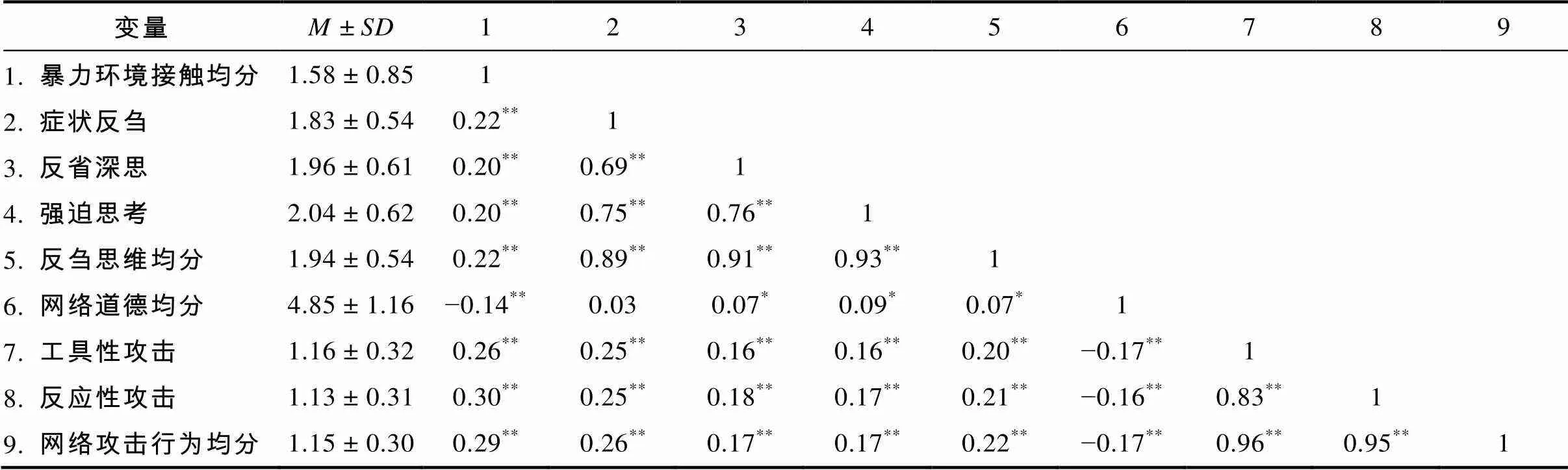
表2 各主要變量間的描述統(tǒng)計和相關矩陣(n = 834)
注:*< 0.05,**< 0.01。
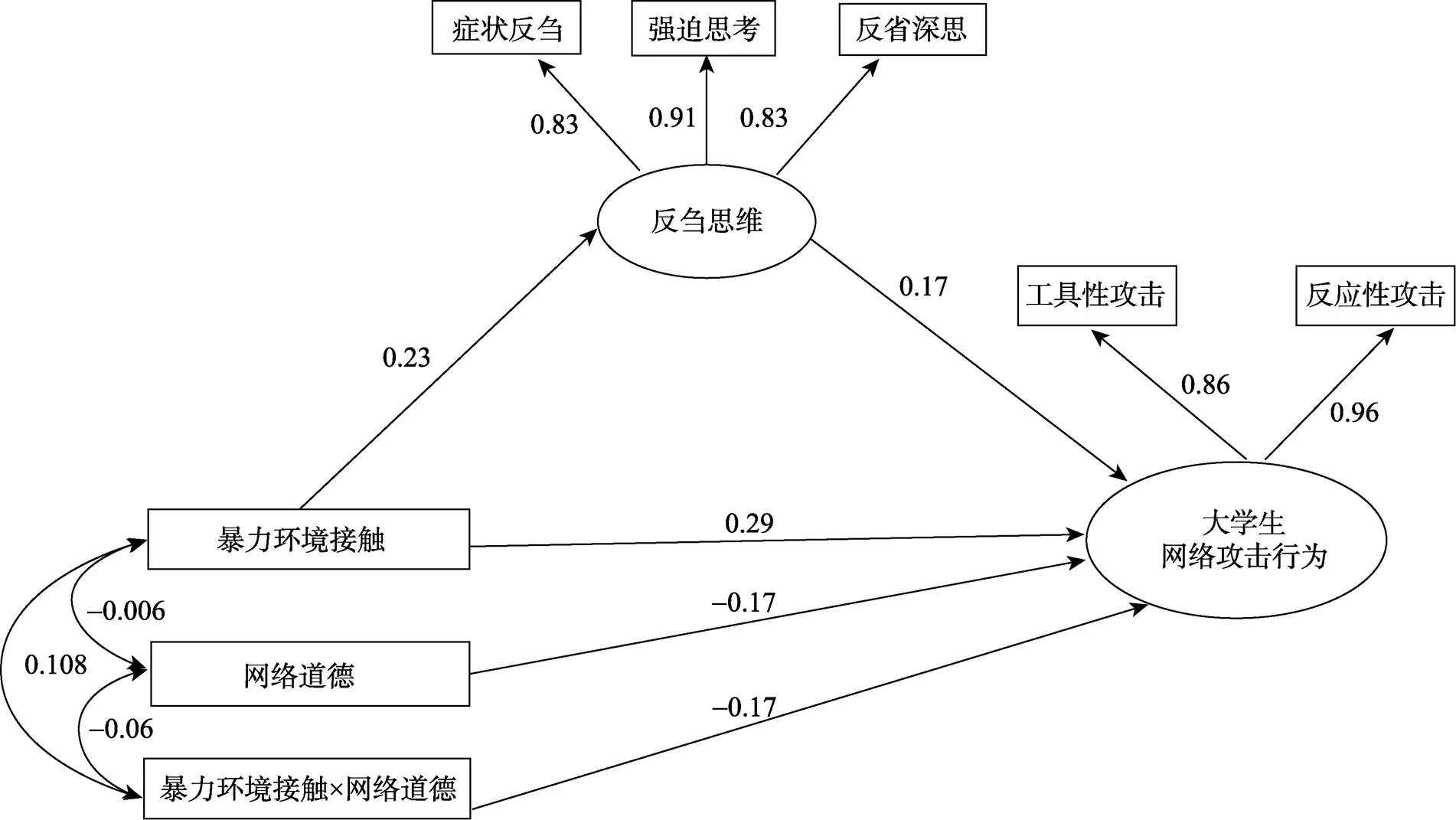
圖2 暴力環(huán)境接觸對大學生網(wǎng)絡攻擊行為影響的內(nèi)部機制模型圖(標準化)
為進一步分析網(wǎng)絡道德的調(diào)節(jié)效應, 本研究將網(wǎng)絡道德分為高分組(+ 1)和低分組(? 1)兩個組, 然后做出網(wǎng)絡道德在暴力環(huán)境接觸與大學生網(wǎng)絡攻擊行為間的簡單斜率檢驗圖(如圖3)。結果表明, 在低網(wǎng)絡道德水平下, 暴力環(huán)境接觸對大學生網(wǎng)絡攻擊行為有顯著的正向預測作用(Simple slope = 0.66,< 0.001), 其95%的置信區(qū)間為[0.402, 0.783]; 而在高網(wǎng)絡道德水平下, 暴力環(huán)境接觸對大學生網(wǎng)絡攻擊行為的預測作用不顯著(Simple slope = 0.25,> 0.05), 其95%的置信區(qū)間為[?0.148, 0.677]。

圖3 網(wǎng)絡道德作為調(diào)節(jié)效應的簡單斜率檢驗圖
4 討論
4.1 暴力環(huán)境接觸對大學生網(wǎng)絡攻擊行為直接效應討論
本研究發(fā)現(xiàn), 暴力環(huán)境接觸可以顯著地預測大學生網(wǎng)絡攻擊行為, 這驗證了本研究的假設H1, 這與以往的研究相對一致(張林等, 2017; Brady, Gormansmith, Henry, & Tolan, 2008; Bradshaw et al., 2009; Howard et al., 2012; Schwartz & Proctor, 2000)。這一結果也契合了一般學習模型理論的觀點(Buckley & Anderson, 2006; 張林等, 2017), 大學生暴露在具有暴力性刺激的線索下, 會自動化的習得攻擊行為知識結構, 并且這些暴力性刺激會不斷地改變大學生原有的認知結構, 這就導致大學生的認知出現(xiàn)沖突, 內(nèi)部心理機制的平衡被打破, 為了適應這種平衡被打破的狀態(tài), 大學生必須被動地學習新的認知觀念, 接受攻擊行為的圖式, 以緩解內(nèi)心的緊張和焦慮。當大學生自動化的習得了攻擊行為的圖式之后, 這就會導致大學生生理喚醒, 出現(xiàn)認知沖動, 對攻擊行為的后果估計不足, 出現(xiàn)“暴力脫敏”現(xiàn)象, 進而出現(xiàn)嚴重的攻擊行為或罪錯行為等, 攻擊行為的出現(xiàn)會增強個體攻擊圖式的練習效應, 形成攻擊行為的長時效應, 并最終儲存內(nèi)化成個體長時記憶信息中的一部分(Carnagey, Anderson, & Bushman, 2007; 吳曉燕等, 2012)。當然, 在目前的網(wǎng)絡社交環(huán)境下, 存在著諸多的暴力刺激信息, 大學生對這些信息的識別能力通常不高, 這些信息隨著網(wǎng)絡的匿名性特點隨意傳播, 形成了一種惡性的“暴力循環(huán)”。因而, 大學生很容易接觸到這些暴力信息, 也很容易暴露在網(wǎng)絡暴力的環(huán)境下, 這就導致大學生在潛移默化的過程中學習到更多關于網(wǎng)絡攻擊行為的認知圖式, 進一步降低對網(wǎng)絡攻擊行為的控制感, 出現(xiàn)道德推脫現(xiàn)象, 并最終對他人實施網(wǎng)絡攻擊行為(Mcmahon, Felix, Halpert, & Petropoulos, 2009; 金童林等, 2017)。這一整個網(wǎng)絡侵犯過程使大學生內(nèi)化的網(wǎng)絡攻擊行為圖式得到再現(xiàn), 他們在此過程中滿足了畸形的占有欲和控制欲, 強化了網(wǎng)絡攻擊行為的認知表征, 并進一步使大學生的網(wǎng)絡攻擊行為圖式更具體, 同時增強了網(wǎng)絡攻擊行為圖式在記憶中存在的長期性。
4.2 反芻思維的中介機制討論
本研究發(fā)現(xiàn), 在暴力環(huán)境接觸對大學生網(wǎng)絡攻擊行為的影響機制中, 反芻思維起著部分中介作用, 這驗證了本研究的假設H2。在日常生活中, 當大學生接觸了暴力事件時, 他們會在腦海里重復性地思考這些負性刺激, 重復性的思考就會導致大學生的注意范圍縮小, 認知能力減弱, 對于外界的各種刺激敏感度下降, 這反過來又會進一步加強大學生對于負性刺激的深度關注, 進而導致大學生出現(xiàn)反芻思維, 反芻思維的出現(xiàn)會導致大學生部分社會功能受損, 人際交往功能退化(Dickson, Ciesla, & Zelic, 2017; Whitmer & Gotlib, 2013; 陳驍, 馮正直, 2015), 因而他們不能進行正常的人際交流, 對他人容易產(chǎn)生敵意性的認知偏差, 促使敵意水平升高, 攻擊性增強, 當他們在使用網(wǎng)絡的時候, 憑借著網(wǎng)絡的匿名性和便利性, 他們將現(xiàn)實生活中無法排遣的消極情緒肆意地發(fā)泄給網(wǎng)絡環(huán)境中的其他個體, 對他人實施網(wǎng)絡攻擊行為(Eisenlohr-Moul et al., 2016; García-Sancho, Salguero, & Fernández- Berrocal, 2016; Guerra & White, 2017; Peters et al., 2015)。此外, 按照自我監(jiān)管執(zhí)行功能模型的觀點(Wells & Matthews, 1996), 大學生長期接觸暴力環(huán)境, 這會潛移默化地促使攻擊性人格的形成, 具有攻擊性人格傾向的大學生遇事不能冷靜, 容易產(chǎn)生暴力認知和暴力情緒, 導致個體自我監(jiān)管執(zhí)行功能的失效, 出現(xiàn)反芻思維, 認知水平下降, 沖動水平升高, 自我控制能力降低, 對行為產(chǎn)生的后果不能合理地預估判斷, 以及對行為的應對策略也不能正確合理地制定, 因而他們在使用網(wǎng)絡的時候極容易表現(xiàn)出網(wǎng)絡攻擊行為。
4.3 網(wǎng)絡道德的調(diào)節(jié)機制討論
本研究發(fā)現(xiàn), 網(wǎng)絡道德顯著的調(diào)節(jié)了暴力環(huán)境接觸與大學生網(wǎng)絡攻擊行為間的關系, 具體來講, 在低網(wǎng)絡道德水平下, 暴力環(huán)境接觸能顯著地正向預測大學生網(wǎng)絡攻擊行為, 而在高網(wǎng)絡道德水平下, 暴力環(huán)境接觸對大學生網(wǎng)絡攻擊行為的預測作用不顯著, 這驗證了本研究的假設H3。此外, 本研究也表明, 大學生網(wǎng)絡道德對于網(wǎng)絡攻擊行為的預測作用具有明顯的抑制作用。由此可以說明, 高網(wǎng)絡道德水平的大學生, 他們在使用網(wǎng)絡的時候, 十分注重維護自己的形象, 會用較高標準的道德規(guī)范要求自己, 因而他們在網(wǎng)絡中的言行都受道德監(jiān)控系統(tǒng)的監(jiān)督, 即使接觸暴力環(huán)境時, 他們的道德監(jiān)控系統(tǒng)并不允許他們對暴力性信息進行模仿, 也會讓認知加工系統(tǒng)對這些暴力信息進行排斥, 不對負性信息進行系統(tǒng)化的加工, 因而有效地減少了網(wǎng)絡攻擊行為; 相反, 低網(wǎng)絡道德水平的大學生, 他們在使用網(wǎng)絡的過程中只注重滿足內(nèi)心的私欲, 對網(wǎng)絡道德規(guī)范知之甚少, 對自身的道德約束能力不強, 因而他們的道德監(jiān)控系統(tǒng)比較薄弱(金童林, 陸桂芝, 張璐, 閆萌智, 劉艷麗, 2016), 當他們暴露在暴力線索下時, 會內(nèi)隱性地學習攻擊圖式, 再憑借網(wǎng)絡匿名性的有利特點, 輕易地對他人實施網(wǎng)絡攻擊, 也不會因為自己對他人造成的傷害而感到內(nèi)疚自責。
4.4 不足與展望
本研究主要存在兩方面不足, 有待于未來的研究補充。一方面, 由于本研究全部采用的是自評數(shù)據(jù), 同時也是一次性收集的, 且本研究中大部分的變量都屬于消極的心理行為特征, 被試在作答的時候會考慮到社會贊許而出現(xiàn)虛假偏差, 而由于方法學的限制, 這些虛假偏差不能有效地分離出來。因此, 未來的研究可以結合實驗設計或追蹤研究的方法, 降低這些偏差對研究帶來的影響。另一方面, 在暴力環(huán)境接觸對大學生網(wǎng)絡攻擊行為的影響機制中, 反芻思維和網(wǎng)絡道德是兩個不同的影響機制, 反芻思維是加速機制, 而網(wǎng)絡道德卻是抑制機制, 從某種程度上來說, 這兩種機制之間應當還存在著更深層的內(nèi)部機制來關聯(lián)它們之間的聯(lián)系, 局限于起初研究的思路, 本研究對此更深層的內(nèi)部機制無法繼續(xù)探討, 未來的研究可以從這方面入手, 進一步的深化大學生網(wǎng)絡攻擊行為的發(fā)生發(fā)展機制。
5 結論
本研究得出主要結論如下:
(1)暴力環(huán)境接觸對大學生網(wǎng)絡攻擊行為有著顯著的正向影響, 并間接地通過反芻思維對大學生網(wǎng)絡攻擊行為產(chǎn)生作用。
(2)網(wǎng)絡道德在暴力環(huán)境接觸對大學生網(wǎng)絡攻擊行為的影響中起顯著的調(diào)節(jié)作用, 具體而言, 在低網(wǎng)絡道德水平下, 暴力環(huán)境接觸能顯著正向預測大學生網(wǎng)絡攻擊行為, 而在高網(wǎng)絡道德水平下, 暴力環(huán)境接觸對大學生網(wǎng)絡攻擊行為的預測作用不顯著。
Bandura, A. (1977).. Englewood Cliffs, NJ: Prentice Hall.
Bonanno, R. A., & Hymel, S. (2013). Cyber bullying and internalizing difficulties: Above and beyond the impact of traditional forms of bullying.(5), 685–697.
Bradshaw, C. P., Rodgers, C. R. R., Ghandour, L. A., & Garbarino, J. (2009). Social-cognitive mediators of the association between community violence exposure and aggressive behavior.(3), 199–210.
Brady, S. S., Gorman-Smith, D., Henry, D. B., & Tolan, P. H. (2008). Adaptive coping reduces the impact of community violence exposure on violent behavior among African American and Latino male adolescents.(1), 105–115.
Buckley, K. E., & Anderson, C. A. (2006). A theoretical model of the effects and consequences of playing video games. In P. Vorderer & J. Bryant (Eds.),(pp.363–378). Mahwah, NJ: LEA.
Burgers, D. E., & Drabick, D. A. G. (2016). Community violence exposure and generalized anxiety symptoms: Does executive functioning serve a moderating role among low income, urban youth?.(8), 1543–1557.
Butcher, F., Galanek, J. D., Kretschmar, J. M., & Flannery, D. J. (2015). The impact of neighborhood disorganization on neighborhood exposure to violence, trauma symptoms, and social relationships among at-risk youth.300–306.
Carnagey, N. L., Anderson, C. A., & Bushman, B. J. (2007). The effect of video game violence on physiological desensitization to real-life violence.(3), 489–496.
Chapin, J. (2016). Adolescents and cyber bullying: The precaution adoption process model.,(4), 719–728.
Chen, X., & Feng, Z. Z. (2015). Trait rumination and deficits of executive functions.,(6), 1065–1069.
[陳驍, 馮正直. (2015). 特質(zhì)反芻思維與執(zhí)行控制功能缺陷.(6), 1065–1069.]
DeWall, C. N., Anderson, C. A., & Bushman, B. J. (2011). The general aggression model: Theoretical extensions to violence.,(3), 245–258.
Dickson, K. S., Ciesla, J A., & Zelic, K. (2017). The role of executive functioning in adolescent rumination and depression.(1), 62–72.
Egan, V., Hughes, N., & Palmer, E. J. (2015). Moral disengagement, the dark triad, and unethical consumer attitudes.,, 123–128.
Eisenlohr-Moul, T. A., Peters, J. R., Pond, P. S. Jr., & Dewall, C. N. (2016). Both trait and state mindfulness predict lower aggressiveness via anger rumination: A multilevel mediation analysis.(3), 713–726.
Feinstein, B. A., Bhatia, V., & Davila, J. (2014). Rumination mediates the association between cyber-victimization and depressive symptoms.(9), 1732–1746.
Finkelhor, D., Turner, H., Ormrod, R., & Hamby, S. L. (2009). Violence, abuse, and crime exposure in a national sample of children and youth.(5), 1411–1423.
García-Sancho, E., Salguero, J. M., & Fernández-Berrocal, P. (2016). Angry rumination as a mediator of the relationship between ability emotional intelligence and various types of aggression.143–147.
Grigg, D. W. (2010). Cyber aggression: Definition and concept of cyberbullying.,(2), 143–156.
Guerra, R. C., & White, B. A. (2017). Psychopathy and functions of aggression in emerging adulthood: Moderation by anger rumination and gender.,(1), 35–45.
Han, X., & Yang, H. F. (2009). Chinese Version of Nolen-Hoeksema Ruminative Responses Scale (RRS) used in 912 college students: Reliability and validity.,(5), 550–551.
[韓秀, 楊宏飛. (2009). Nolen-hoeksema反芻思維量表在中國的試用. 中(5), 550–551.]
Howard, A. L., Kimonis, E. R., Mu?oz, L. C., & Frick, P. J. (2012). Violence exposure mediates the relation between callous-unemotional traits and offending patterns in adolescents.(8), 1237–1247.
Hu, Y., & Fan, C. Y. (2013). A Review of Researches into Adolescents' Cyberbullying Behavior., 5, 72–84.
[胡陽, 范翠英. (2013). 青少年網(wǎng)絡欺負行為研究述評與展望.72–84.]
Jin, T. L., Lu, G. Z., Zhang, L., Jin, X. Z., & Wang, X, Y. (2017). The effect of trait anger on online aggressive behavior of college students: The role of moral disengagement.,(5), 605–613.
[金童林, 陸桂芝, 張璐, 金祥忠, 王曉雨. (2017). 特質(zhì)憤怒對大學生網(wǎng)絡攻擊行為的影響:道德推脫的作用.(5), 605–613.]
Jin, T. L., Lu, G. Z., Zhang, L., Yan, M. Z., & Liu, Y, L. (2016). The effect of college students’ interpersonal needs on their online deviant behavior: The mediating effect of social anxiety.,, 84–89.
[金童林, 陸桂芝, 張璐, 閆萌智, 劉艷麗. (2016). 人際需求對大學生網(wǎng)絡偏差行為的影響:社交焦慮的中介作用., 84–89.]
Kessel, S. S., O'Donnell, L., & Smith, E. (2015). Trends in cyberbullying and school bullying victimization in a regional census of high school students, 2006-2012.,(9), 611–620.
Kliewer, W., & Lepore, S. J. (2015). Exposure to violence, social cognitive processing, and sleep problems in urban adolescents.(2), 507–517.
Kokkinos, C. M., Voulgaridou, I., & Markos, A. (2016). Personality and relational aggression: Moral disengagement and friendship quality as mediators.,, 74–79.
Li, D. M., Lei, L., & Zou, H. (2008). Characteristics and prospects of the adolescents’ deviant behaviors on internet.,(1), 95–97.
[李冬梅, 雷靂, 鄒泓. (2008). 青少年網(wǎng)上偏差行為的特點與研究展望.,(1), 95–97.]
Litwiller, B. J., & Brausch, A. M. (2013). Cyber bullying and physical bullying in adolescent suicide: The role of violent behavior and substance use.(5), 675–684.
Liu, Q. Q., Zhou, Z. K., Niu, G. F., &Fan, C. Y. (2017). Mobile phone addiction and sleep quality in adolescents: Mediation and moderation analyses.(12), 1524–1536.
[劉慶奇, 周宗奎, 牛更楓, 范翠英. (2017). 手機成癮與青少年睡眠質(zhì)量: 中介與調(diào)節(jié)作用分析.(12), 1524–1536.]
Liu, W., Tian, L. L., & Lu, H. (2014). Rumination and suicide ideation among Chinese working women: Moderating role of hope.,(1), 119–122.
[劉旺, 田麗麗, 陸紅. (2014). 職業(yè)女性反芻思維與自殺意念的關系:希望的調(diào)節(jié)作用.(1), 119–122.]
Liu, Y., Zhou, Z. K., Zhang, C. L., Wei, H., & Chen, W. (2011). Short-term effects of violent video games on implicit aggression in different aged female students.,(2), 157–159.
[劉元, 周宗奎, 張從麗, 魏華, 陳武. (2011). 暴力視頻游戲對不同年齡女性內(nèi)隱攻擊性的短時效應.(2), 157–159.]
Luo, X. L. (2007).(Unpublished master’s thesis). Central China Normal University, Wuhan.
[羅曉玲. (2007).(碩士學位論文)華中師范大學, 武漢.]
Ma, X. H., & Lei, L. (2010). Adolescents’ internet morality and deviant behavior online.(10), 988–997.
[馬曉輝, 雷靂. (2010). 青少年網(wǎng)絡道德與其網(wǎng)絡偏差行為的關系.(10), 988–997.]
Mcmahon, S. D., Felix, E. D., Halpert, J. A., & Petropoulos, L. A. N. (2009). Community violence exposure and aggression among urban adolescents: Testing a cognitive mediator model.(7), 895–910.
Nolen-Hoeksema, S. (1991). Responses to depression and their effects on the duration of depressive episodes.(4), 569–582.
Ogunfowora, B., & Bourdage, J. S. (2014). Does honesty- humility influence evaluations of leadership emergence? The mediating role of moral disengagement.,(1), 95–99.
Pabian, S., & Vandebosch, H. (2016). An investigation of short-term longitudinal associations between social anxiety and victimization and perpetration of traditional bullying and cyberbullying.(2), 328–339.
Peters, J. R., Smart, L. M., Eisenlohr-Moul, T. A., Geiger, P. J., Smith, G. T., & Baer, R. A. (2015). Anger rumination as a mediator of the relationship between mindfulness and aggression: The utility of a multidimensional mindfulness model.(9), 871–884.
Ruddle, A., Pina, A., & Vasquez, E. (2017). Domestic violence offending behaviors: A review of the literature examining childhood exposure, implicit theories, trait aggression and anger rumination as predictive factors.154–165.
Schwartz, D., & Proctor, L. J. (2000). Community violence exposure and children's social adjustment in the school peer group: The mediating roles of emotion regulation and social cognition.(4), 670–683.
Slavish, D. C., & Graham-Engeland, J. E. (2015). Rumination mediates the relationships between depressed mood and both sleep quality and self-reported health in young adults. J(2), 204–213.
Sotelo, J. M., & Babcock, J. C. (2013). Bis/bas variables as moderators of the rumination-intimate partner violence link.(3), 233–242.
Wang, X. C, Lei, L., Yang, J. P., Gao, L., & Zhao, F. Q. (2016). Moral disengagement as mediator and moderator of the relation between empathy and aggression among Chinese male juvenile delinquents.,(2), 316–326.
Wei, H., Zhang, C. L., Zhou, Z. K., Jin, Q., & Tian, Y. (2010). Long-term and short-term effects of violent media on aggression of undergraduates.,(5), 489–494.
[魏華, 張叢麗, 周宗奎, 金瓊, 田媛. (2010). 媒體暴力對大學生攻擊性的長時效應和短時效應.(5), 489–494.]
Wells, A., & Matthews, G. (1996). Modelling cognition in emotional disorder: The S-Ref model.(11-12), 881–885.
Whitmer, A. J., & Gotlib, I. H. (2013). An attentional scope model of rumination.(5), 1036–1061.
Wong, L. M., Bullock, L. M., & Gable, R. A. (2011). Cyberbullying: Practices to face digital aggression., 16(3), 317–325.
Wu, M. L. (2013).. Chongqing: Chongqing university press.
[吳明隆. (2013).. 重慶:重慶大學出版社.]
Wu, X. Y. (2012).(Unpublished master’s thesis). Ningbo University.
[吳曉燕. (2012).(碩士學位論文). 寧波大學.]
Wu, X. Y., Zhu, Y. J., Fang, S. J., & Zhang, L. (2012). The new progresses in research on aggression behavior.(1), 56–59.
[吳曉燕, 祝陽君, 方圣杰, 張林. (2012). 關于攻擊行為研究的新進展.(1), 56–59.]
Wu, Y., Wen, Z. L., Hou, J. T., & Marsh, H. W. (2011). Appropriate standardized estimates of latent interaction model without the mean structure.(10), 1219–1228.
[吳艷, 溫忠麟, 侯杰泰, Marsh, H. W. (2011). 無均值結構的潛變量交互效應模型的標準化估計.,(10), 1219–1228.]
Xiong, H. X., Zhang, J., Ye, B. J., Zheng, X., & Sun, P. Z. (2012). Common method variance effects and the models of statistical approaches for controlling it.(5), 757–769.
[熊紅星, 張璟, 葉寶娟, 鄭雪, 孫配貞. (2012). 共同方法變異的影響及其統(tǒng)計控制途徑的模型分析.(5), 757–769.]
Ye, B. J., & Wen, Z. L. (2013). A discussion on testing methods for mediated moderation models: Discrimination and integration.(9), 1050–1060.
[葉寶娟, 溫忠麟. (2013). 有中介的調(diào)節(jié)模型檢驗方法:甄別和整合.(9), 1050–1060.]
Ye, B. J., Zheng, Q., Yao, Y. M., & Zhao, L. (2016). Moral disengagement on cyber-bullying: Mediating of internet morality and moderation of moral identity.,(6), 1105–1107.
[葉寶娟, 鄭清, 姚媛梅, 趙磊. (2016). 道德推脫對大學生網(wǎng)絡欺負的影響:網(wǎng)絡道德的中介作用與道德認同的調(diào)節(jié)作用.(6), 1105–1107.]
Yuan, F. F., Wu, H. P, & Huang, Q. Q. (2016). Current situation and influencing factors of rumination of nurses suffered from workplace violence.(5), 610–613.
[袁芬芬, 吳惠萍, 黃茜茜. (2016). 遭受工作場所暴力護士反芻性沉思水平及其影響因素分析.,(5), 610–613.]
Zhang, L., Liu, S., Xu, Q., Wu, X. Y., & Yang, M. Y. (2017). Long-term effect of violence exposure in real-life on aggressive behaviors: A moderated mediation model.(1), 50–59.
[張林, 劉燊, 徐強, 吳曉燕, 楊夢圓. (2017). 日常環(huán)境中的暴力暴露對攻擊行為的長期影響:一個有調(diào)節(jié)的中介模型.(1), 50–59.]
Zhao, F., & Gao, W. B. (2012). Reliability and validity of the Adolescent Online Aggressive Behavior Scale.,(6), 439–444.
[趙鋒, 高文斌. (2012). 少年網(wǎng)絡攻擊行為評定量表編制及信效度檢驗.,(6), 439–444.]
Zhu, L. (2016). An investigation of the types and causes of college students’ online anomie behavior.(2), 88–95.
[朱琳. (2016). 大學生網(wǎng)絡行為失范的類型、成因與對策.(2), 88–95.]
The effect of violent exposure on online aggressive behavior of college students: The role of ruminative responses and internet moral
JIN Tonglin1,2; LU Guizhi2; ZHANG Lu2,3; WU Yuntena1; JIN Xiangzhong4
(1College of Education and Science, Inner Mongolia Normal University, Hohhot 010022, China) (2School of Education, Harbin Normal University, Harbin 150025, China) (3School of Social Sciences, Xinyang College, Xinyang 464000, China) (4Tulufan Electric Power Supply Company, State Grid, Tulufan 838000, China)
With the development of science, the internet has become an indispensable tool in college students' study and daily life. However, online aggressive behavior has become a much more serious problem for college students in recent few years. It is necessary to find out which factors have significant effects on online aggressive behavior of college students. According to the previous researches, the violent exposure was found to be able to predict aggressive behavior significantly. In addition, some theorists also have confirmed that ruminative responses and aggressive behavior are strongly related. However, as a special form of aggressive behavior, there was little research focused on online aggressive behavior and violent exposure. So the purposes of the present study is to explore the relationship between violent exposure, ruminative responses, internet moral and online aggressive behavior as well as the mechanism the effect of violent exposure on online aggressive behavior of college students.
A total sample of 1000 college students from some universities was selected, with 326 males and 508 females, the average age was 20.74-year-old. All subjects were gathered in the class and finished the questionnaires within about 30 minutes. The questionnaires included the Violent Exposure Questionnaire (VEQ), Online Aggressive Behavior Scale (OABS), Ruminative Responses Scale (RSS), and the Internet Moral Questionnaire (IMQ). Data was collected and analyzed with SPSS 24.0, Amos 21.0 and Mplus 7.4, and the bias-corrected percentile Bootstrap method was used to analyze the role of ruminative responses and internet moral between violent exposure and college students' online aggressive behavior. A single factor analysis was calculated to test the common method variance. Results showed that the study was in-existent common method variance.
The results show that: (1)The relationships between each pair of violent exposure, ruminative responses, internet moral and online aggressive behavior are correlated significantly and positively, the correlation coefficient ranges 0.07 from 0.96 (< 0.01); (2)The structural equation model (SEM) reveals that the data fits the theoretical model well (c2/= 2.45, CFI = 0.99, TLI = 0.98, SRMR = 0.03, RMSEA = 0.04). (3) Violent exposure has a significant direct effect on online aggressive behavior (= 0.29,< 0.01); Violent exposure has a significant direct effect on ruminative responses (= 0.23,< 0.01); Ruminative responses has a significant direct effect on online aggressive behavior (= 0.17,< 0.01); Internet moralhas a significant direct effect on online aggressive behavior (= ?0.17,< 0.01); Interaction has a significant direct effect on online aggressive behavior (= ?0.17,< 0.01). (4)Violent exposure has a significant indirect effect on online aggressive behavior through ruminative responses, and the confidence interval of 95% is [0.025, 0.061]; (5) Internet moral moderates the relation between violent exposure and online aggressive behavior of college students, that is, there is a significant positive relation between violent exposure and online aggressive behavior under the low internet moral level, however, there is a non-significant relation between violent exposure and online aggressive behavior under the high internet moral level.
It is concluded that in the structural equation model of violent exposure on online aggressive behavior of college students, ruminative responses plays a partial mediating role and internet moral moderates the direct effect. These findings suggest some measures of prevention and treatment for college students’ online aggressive behavior should be taken. Schools and families should set up a good core self-evaluation system in order to help them improve their moral level and eradicate online aggressive behavior.
college students; violent exposure; ruminative responses; internet moral; online aggressive behavior
B844; B849:C91
2017-10-20
* 國家社會科學基金資助項目(BMA170035); 黑龍江省哲學社會科學基金資助項目(17SHB050)。
烏云特娜, E-mail: wuyuntena@163.com
10.3724/SP.J.1041.2018.01051
猜你喜歡
小哥白尼(野生動物)(2022年6期)2022-08-17 08:05:28
小哥白尼(野生動物)(2022年4期)2022-07-16 03:37:32
小哥白尼(野生動物)(2022年2期)2022-06-01 06:21:20
小哥白尼(野生動物)(2022年1期)2022-04-26 14:01:18
中老年保健(2021年12期)2021-08-24 03:30:40
中國傳媒大學學報(自然科學版)(2021年1期)2021-06-09 08:43:00
中國生殖健康(2020年6期)2020-02-01 06:28:50
下一代英才(酷炫少年)(2019年3期)2019-03-25 02:34:18
中國生殖健康(2019年11期)2019-01-07 01:28:02
黃河之聲(2017年14期)2017-10-11 09:03:59