Study on the Relationship between Beliefs and Strategy Use of Translation in English learning
2018-09-08 10:08:38曹傳鋒
校園英語·中旬 2018年8期
【Abstract】Based on the research of China and abroad, this thesis carried on an empirical study on 272 English majors using the instrument of questionnaires and gained some important findings that English majors Beliefs about Translation and Their Use of Chinese Translation as a learning are closely related with each other which proved the findings of Posen Liao.
【Key words】Beliefs about Translation; Use of Chinese Translation as learning Strategy
【作者簡介】曹傳鋒,新疆醫科大學。
In addition to its usual definition in transferring meanings and conveying information, translation can also regarded as a method for learning foreign languages. The definition of translation in the present study means using one language as a basis for understanding, remembering, or producing another language, in either direction from the target or the source language into the second language.
1. Learners beliefs about translation
Few studies have been reported so far that specifically examined learners beliefs about using translation in their foreign language learning, but it can be expected that students may have highly varied views on this issue. In one such studies, Horwitz (1988) found that the majority of Germen and Spanish students (70% and 75%) endorsed the idea that learning a foreign language is mainly a matter of learning to translate from English, while a mere of 15% of the French students agreed or strongly agreed to the same statement.
2. The use of translation as a learning strategy
With the increase in research on language learning strategies in the past years and with the advent of various classifications of these strategies, many researchers have identified translation as one of the cognitive learning strategies (Chamot, 1987; Chamot et al., 1987; OMalley et al., 1985a; OMalley et al. 1985b; Oxford, 1990). At a general level, cognitive strategies involve interacting with the material to be learned, manipulating the material mentally or physically, or applying a specific technique to a learning task. Under the cognitive category of learning strategies, translation is referred to as the rendering of ideas from one language to another in a relatively verbatim manner (Chamot and Kupper, 1989).
3. Methodology
This part included five parts, participants, instruments, data collection and data analysis procedure. It involved a survey, comprised of three sets of questionnaires concerning beliefs, strategy use, and personal background information.
The participants in this study consisted of 238 juniors studying in the Foreign Language College of Xinjiang University, Xinjiang Normal University, Xinjiang Agricultural University and Xinjiang Finance and Economics University. All those subjects with Chinese as their mother tongue had formally studied English for at least six years in junior and senior high school and for two years at university. Those subjects ranged in age from 19 to 22. The reason that I chose juniors was that they have studied English as English majors for two years and finished the fundamental two years study of English.
The instruments adopted in this study include questionnaire, and SPSS15.0 soft ware.
The questionnaire was designed on the basis of Posen Liao (2002) for beliefs measurement, the Inventory for Beliefs about Translation (IBT) was used; for strategy use measurement, the Inventory for Translation as a Learning Strategy (ITLS) was used. The questionnaire was carried out in Chinese.
The students answered each statement on a 5-point Likert-type scale ranging from “strongly disagree” to “strongly agree” for the first part of concerning language learning beliefs and “Never or almost never true of me” to “always or almost true of me” for the second part about strategy use of translation respectively.
4. Results and Discussions
Relations between learning Belief and Strategy use of translation.
To examine the correlations between the learners beliefs about translation and their strategy use of translation, Pearson correlation was employed to meet them.
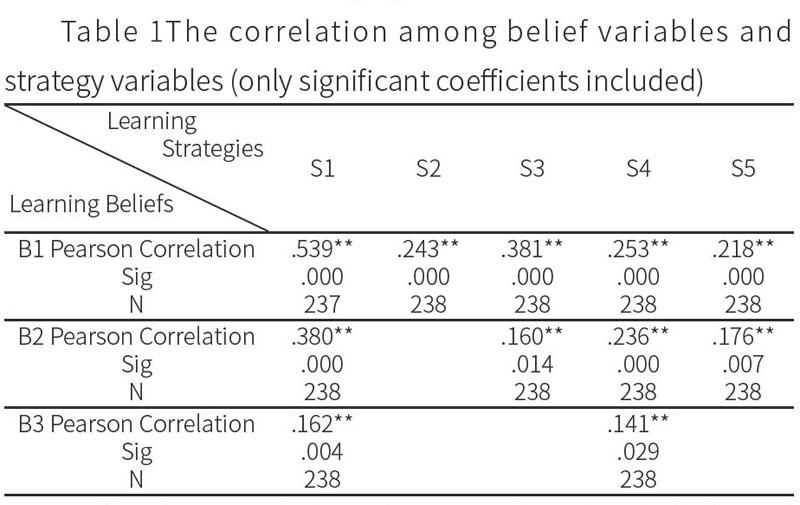
As for the correlations between learning beliefs and strategies of using translation, the results were presented in table 3.3.1, which indicated that B1 was correlated positively with all the strategy variables of using translation.B2 was positively with S1, S3, S4 and S5. B3 was only correlated with S1and S4. This result was a little different from Posen Liaos finding, which may be because of different educational settings he mentioned in his thesis, but still every belief was significantly correlated with one or more learning strategies which indicated that the beliefs about how translation could function in English learning had a very significant influence on learners strategy use of translation, further confirming what Wang Hongmei (2005) and Zou Min (2006), have claimed that learners beliefs about language learning may underlie their use of learning strategies.
The current study examined the relationship between learners beliefs about translation and their strategy use involving translation, and some empirical evidence of significant associations were found. Learners beliefs about how translation could function in their English learning apparently influence the kinds of translation strategies they chose to use, further confirming what Wenden (1987), Horwitz (1987,1988), Wang (2006)and Zhao (2006) have claimed about learners beliefs about language learning and how these may underlie their use of learning strategies.
Some limitations exist in the present research; firstly, the sample is still limited in size. Although the study investigated 238 English majors, only the junior English majors were selected as the subjects. Non-English-majors beliefs and strategies of using translation should also be investigated and be compared with English majors. Furthermore, although the present thesis studied the students beliefs and strategy use of Chinese translation; however, the teachers beliefs about using translation have not been touched.
References:
[1]Horwitz,E.K.(1988).The beliefs about language learning of beginning university foreign language students[J].Modern Language Journal.72,283-294.
[2]Kern,R.(1994).The Role of Mental Translation in Second Language Reading[J].Studies in Second Language Acquisition.16,441-61.
[3]Liao,P.-S.(2002).Taiwanese Students Beliefs about Translation and their Use of Translation as a Strategy to Learn English[D].(PhD thesis; Austin,USA:The University of Texas at Austin).
[4]Prince,P.(1996).Second Language Vocabulary Learning:The Role of Context versus Translation as a Function of Proficiency[J].The Modern Language Journal.180,478-93.