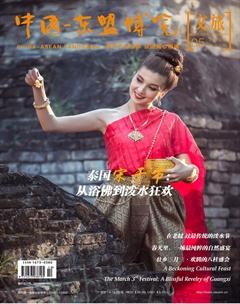
The March 3rd Festival: A Blissful Revelry of Guangxi
2019-06-11 11:32:50MoTingitng
中國(guó)-東盟博覽(旅游版) 2019年5期
Mo Tingitng
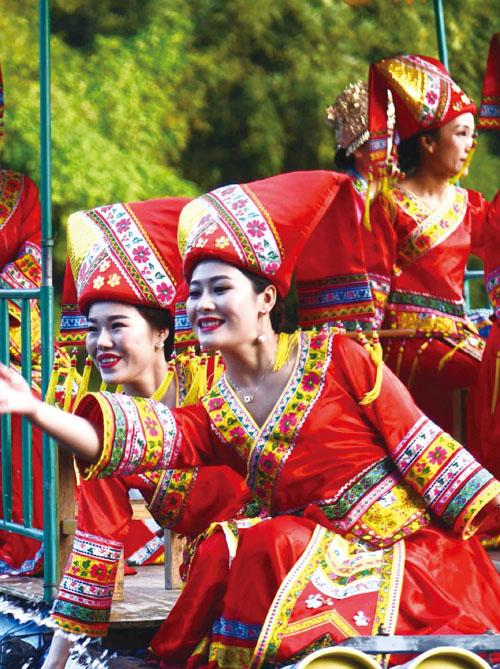

It is universally acknowledged that people from different cultures have their own unique perspective to think and behave. Just as some ethnic groups in Guangxi celebrate the March 3rd Festival (Sanyuesan Festival) on March 3rd of Chinese lunar calendar, with a belief that holding celebration activities could bring them good luck. In modern days, the March 3rd Festival has been more than a chance for numerous shutterbugs escape from the rooms to get a glimpse of the breathtaking moments of stunning flowers or a time for singing folk songs as in the past, but involved many colorful celebration activities of several Chinese nationalities.
The oldest Valentine's Day
The March 3rd Festival, collectively observed by many nationalities in Guangxi, including Han and ethnic minorities such as Zhuang, Dong, Miao, Yao, Li and She, is one of the most widely observed festivals in southwest China.
As for its origin, there are many tales or mythologies. Legend has it that the ancestor of the Chinese Yellow Emperor gave birth on March 3rd of lunar calendar. There was another story about this day. It was said that Fu Xi, one of the three emperors who was credited with introducing farming, fishing and animal husbandry, and his wife Nu Wa, a goddess in Chinese mythology with the body of a woman and the tail of a snake became pregnant on this day. Coincidentally, this explains exactly why there are still some places celebrating this day in honor of Fu Xi and Nu Wa.
The activities of the March 3rd Festival have changed with the times. In ancient time, the March 3rd Festival is a traditional festival for the Zhuang people during which people would go for an outing by the water, breathe fresh air, and sing to each other. More surprisingly, the March 3rd Festival is also honored by lovers as the oldest Valentine's Day. On this day, a primitive sacrificial ceremony by the riverside would be held to honor ancestors. After the ceremony, in order to cleanse and purify their bodies, they would bathe in a river with herbs. Following that, a spring outing would be carried out by young men and women — these scenes were vividly described in the ancient book Shijing (The Book of Poetry). After the Wei and Jin Dynasties (220-420), this day had been evolved into a spring outing, featuring lively activities involving listening to love songs, throwing embroidered balls, dancing, and eating glutinous rice. Overall, this festival can be associated with sacrifice, date between men and women, having an outing in spring, as well as praying for children.
In 2014, the Zhuangs March 3rd Festival was approved by the State Council to be listed as a National Intangible Cultural Heritage, which means that the festival has gained wide domestic and even international recognition. For local people, the March 3rd Festival is a great occasion for family reunion, ancestor worship and best wishes for the upcoming year. During the festival, grand festive activities such as song fair, bamboo-pole dance and making colorful glutinous rice and eggs will definitely offer people a visual feast, especially for those city dwellers that are always busy with their work. And for outsiders, there are many exotic items to enjoy or appreciate.
The ocean of folk songs
The Zhuang in Guangxi enjoys a rich tradition of folk songs which are parts of China's historical and cultural heritage. On some important occasions, for example, receiving distinguished guests, Zhuang people will put on their dresses to perform their amazing folk songs. Also, Guangxi is the homeland of Sister Liu Sanjie, a legendary Zhuang female singer who composed a lot of folk songs about labor, life and love.
It is said that Zhuang people are born with singing and dancing talents, and their traditional folk songs can hence be inherited from generation to generation. Usually the fathers teach the sons, and the daughters learn from the mothers, thus forming such a custom: Learning songs in childhood, singing in adulthood, and teaching in old age. In the countryside, people sing at any time and any place, whether laboring in the fields, cutting firewood in the mountains, or even courting, whether at the wedding, funeral or festival.
Throughout the year, there are several regular folk song fairs for the Zhuang people, such as the song fairs on January 15th, March 3rd, April 8th, and August 15th, among which the song fair (Gexu) on March 3rd is the most significant one.
According to historical records, song fair has a history of more than thousands of years. It is recorded in Universal Geography of the Taiping Era in the Northern Song Dynasty (960-1127) that “Around the time when crops grow ripe, Zhuang people will choose a day for a rite for gods, during which men and women will hold grand song fair”. This kind of song fair usually is followed by activities such as bronze drum striking and bamboo-pole dancing, all highlighting the folk traditions and customs and distinctive ethnic culture. After being dressed up, young boys and girls swarm to the singing stage, usually a vast open space in the village.
During the song fair, in addition to the chorus performance, another distinctive activity is antiphonal singing, which is a form of characteristic folk art where different performers sing in alternation. For young people, antiphonal singing is a perfect chance to seek or pursue potential lovers. Usually, young boys should take the first to raise songs to girls they are into, and if the girls share the same feelings, they will respond positively to the boys through singing. In this way, song fair acts as a medium of acquaintance with each other, where they communicate and express themselves through the sweet songs. No matter you are the locals or visitors, just let go of the worries during the normal days and immerse yourselves in the fabulous festival.
Dances of Guangxis ethnic groups display and carry forward its glamorous history and culture. Despite many hardships, they have still maintained their optimism, open-mindedness and courage, which are fully demonstrated in their dances.
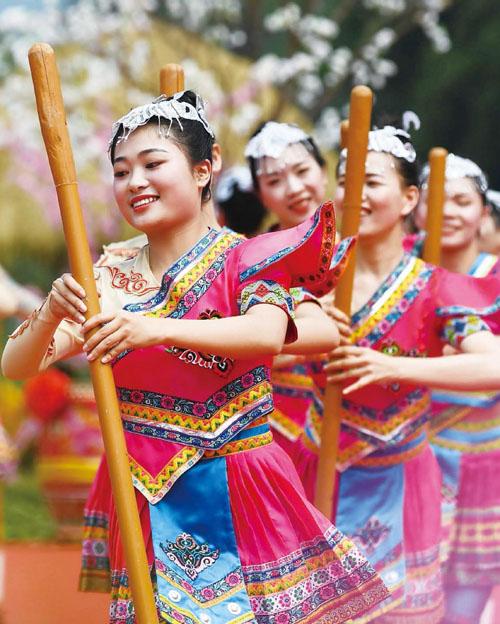
The most spectacular activity that you cannot miss in Wuming County is the “thousand-person bamboo-pole dance”. Bamboo-pole dance is a highlight for the Zhuang people on the March 3rd Festival and usually consists of four parts, namely "rice-transplanting", "water-lifting by using waterwheels", "reaping and thrashing" and "rice husking", depicting the main working scenes of the farmers. In accordance with the rhythm from the beating of gongs and drums, the dancers would dance and jump deftly along with the opening and closing of the bamboo-poles.
The Dalang Dance in Tiandeng County is typical of the various Zhuang dances. Boasting a time-honored history of more than 1,300 years, the Dalang Dance is a valuable cultural heritage created by the Zhuang ancestors in this place, and well carried forward to the present day. "Lang" (mortar) and "Chu" (pestle) are two commonly used tools in the Dalang Dance. "Lang" refers to a hard boatshaped object in which Zhuang people in the past could remove the husks from substances such as grain, seeds and nuts; and "Chu" is a small heavy tool about one-meter long with a round end used for that purpose. These two things may have suggested that the Dalang Dance was derived from the scene of agricultural work that involves the use of "Lang" and "Chu", and that it produces an archetypal display of traditional farming culture of Zhuang ethnic group.
Historically, drum is an integral part of Yao culture, with the meaning of praying for a good harvest, and offering sacrifice to ancestors. Therefore, it is natural that the Bronze Drum Dance is more than a traditional folk dance, and more importantly, a highlight in Yao people's celebration activities. Dressed in traditional costumes with distinctive ethnic features, dancers will dance to the rhythm of the bronze drums, which are led by a large wood one in the center of the dancing pool. During this kind of dance, young Yao men and women will dance in a circle, hand in hand, which symbolizes unity, solidarity and close bonds.
Undoubtedly, for the Miao people, Caitang Dance is popular on March 3rd by the lunar calendar and every Miao youth learns the Caitang Dance from childhood. Caitang Dance often takes place in empty space with a group of three people walking in front and three to nine people as guiders. Young men play Lusheng (a kind of reed-pipe instrument) when they sing songs and touch the ground with feet.
Universal rejoicing with rich
The March 3rd Festival is one of the biggest traditional festivals for Dong nationality. During the festival, people from different towns and villages take part in a wide range of activities. Being praised as "the Rugby in the East", grabbing firecrackers has been considered as the most popular and the most exciting game during the festival. Grabbing firecracker ball is a folk sport game with strong ethnic features, and has a firm and strong base in the masses of Dong nationality. The firecracker ball is made with bamboo strips or rattan, and outside the ball is a red piece of cloth tied up frmly with red and green silk threads. There are three firecracker balls in the game, "Facai (fortune) firecracker ball", "Tianding (birth of boys) firecracker ball" and "Ruyi (smooth going) firecracker ball", all representing auspiciousness.
On that occasion, seas of people gather in an open space, waiting for the arrival of young players. When a host declares the beginning of the game, the ball will be put on the gun muzzle and then be shot into the air. On hearing the gunshot, the athletes will vie for the ball, and all at once, the audience break into deafening cheers. Sometimes the firecracker ball may fall on to the ground, sometimes into the pond or onto the cliffs, the roofs or the branches, but wherever it falls, athletes will do their best to get it. As the grabber succeeds in sending the ball to the designated place, bells and drums will be played together immediately to announce the winner.
In addition, dragon and lion dance has injected great glamour to this festival. In a grand parade, the dragon-led procession joined by the enthusiastic people that stretches for several meters snakes its way through the well-decorated streets of the county. The lion dance is another highlight of the festival that attracts tens of hundreds of viewers. Amid the sound of gongs and drums, the dancers dressed in resplendent lion costumes constantly vary their dancing movements, and sometimes do some stunts like high jump in mid-air, presenting spectacular beauty of different images of the dragon.
But beyond that, bullfighting is another popular entertainments for the Guangxis people. The Bullfighting Festival includes much pageantry for the participants, attracting many local people, even tourists from all over the world.