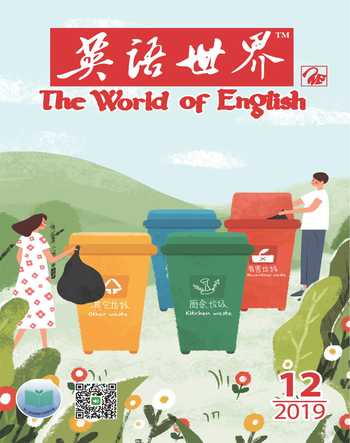
Japan’s Garbage Disposal System日本垃圾處理體系
2019-09-10 07:22:44維里蒂·萊恩
英語世界 2019年12期
關鍵詞:體系
維里蒂·萊恩
If you take a walk in a city in Japan, you might notice something. Where are all the rubbish bins!? Seriously, you’ve been carrying this empty onigiri wrapper around for an hour now and you just want, no need, to find a bin! If you do find one of these rare public trashcans, you’ll notice that it isn’t just one, but many different bins grouped together.
Let’ talk trash.
If you have ever lived in Japan, you’ve probably discovered that once you are responsible for your household’s garbage, things get a lot more complicated. Have you been faced with the challenge of sorting and cleaning your garbage meticulously, making sure to put it out on the right day in the right colored bag, or suffered the shame of having it returned to you?
After these experiences it might seem like Japan is an incredibly clean and eco-friendly country that is super keen on recycling. However, things are even more complex if we look a little deeper.
Sort it out!
If you have moved to Japan, one of the first things you’ll need to do is get hold of your town’s gomi guide. Gomi ごみ (sometimes written ゴミ) is the Japanese word for garbage. For example, the gomi guide from Niihama City is forty-two pages long, and that kind of length isn’t unusual.
There’s no simple way to describe Japan’s rubbish sorting system. Waste disposal is carried out at the municipal level. That means that each city, town, and district has a completely different system. Even Tokyo’s twenty-three wards have different systems.
So even if you’ve mastered one system, that doesn’t help you all that much if you move somewhere else. For example, my town’s garbage was sorted into burnable (red bags), non-burnable (blue bags), paper, plastic, PET bottles, cans, styrofoam, newspapers, cartons, unbroken glass, and batteries (white bags, with different collection days). That was a fairly relaxed system, comparatively. I knew people who had to sort out their namagomi 生ごみ (food waste) from their burnables and their envelopes from their paper.
Some types were collected every week, some every fortnight. Other types were collected anywhere from once a month to once a year. Over sized garbage was collected twice a year and you had to buy a special sticker to pay for disposal. You also had to buy specific garbage bags that were only usable in your town. You couldn’t just put your burnable garbage in any red bag; it had to be a special, approved red bag.
Why is sorting so strict?
You might think that you are being made to do all this trash sorting as some kind of punishment, but there are some pretty important reasons behind it. Japan has a set of specific challenges when it comes to dealing with its waste. The biggest of these is lack of land suitable for landfill. In the 1960s it became clear that, with it’s rising population, Japan would have to find a solution for its garbage or sink under the weight of its trash.
According to Waste Atlas1 each person in Japan produces an average of 356.2kg of waste per year and as a whole, Japan generates 45,360,000 tons of municipal waste per year, ranking 8th in the world. Unlike larger countries like the United States and China, there simply isn’t the space to bury it all. Japan had to find another solution.
Where does it all go?
You might think that you are sorting your waste so that it can be more easily recycled. But a happy, new recycled life is by no means the final destination for most of those papers you’ve torn into the correct sizes and plastic wrappers you’ve sorted. When it comes to its recycling rate, Japan (20.8%) lags behind other industrialized nations that also face problems with lack of space, such as the Netherlands (51%) and the UK (39%). No, your rubbish is probably going to be burned.
“Fluidized bed” is a very efficient way of burning materials that don’t normally burn easily. Your carefully sorted rubbish will be suspended in a hot, bubbling bed of ash and other particulates as jets of air are blown through it.
This thermal treatment of municipal solid waste does have some advantages over other forms of incineration. It is cheaper, takes up less space, and produces fewer nitrogen oxides and less sulphur dioxide. It can also be used as part of a Waste to Energy system, using the resultant heat to create power. Given Japan’s problems with producing electricity this is certainly a big advantage. Although this method might not have as clean an image as recycling, it does suit Japan.
Returning to recycling
What happens to that 20.8% that is recycled? One success story can be found with PET bottles. PET stands for polyethylene terephthalate and these are used to make the drink bottles you’ll find in vending machines and convenience stores all over Japan. After you’ve downed your delicious oolong cha or lychee and salt beverage, be sure to pop that bottle into a PET bottle bin. Japanese companies have increased the percentage of used PET bottle plastic that can be used to make new PET bottles. PET bottles can be dissolved and filtered at high temperatures, producing a pure resin that can be turned back into new PET bottles.
PET bottles that do not undergo this filtration process can also be turned into other things. A fiber can be spun from recycled PET bottles, which can then be made into clothes, bags, carpets, and doggy raincoats.
Use landfill to make more land!
Japan has one more solution for dealing with its trash. If there isn’t enough land to bury the trash, why not just make more land with the trash? You might be familiar with land reclamation (also called land fill, but not landfill, just to be confusing) from seeing pictures of the The Palm Islands, built off Dubai in the United Arab Emirates. Well Japan has also used this technology of filling in an area of water with heavy rock, cement, dirt, and garbage to make new land, though not in quite such fancy shapes. The Chūbu Centrair International Airport near Nagoya and Kansai International Airport are both built on artificial islands. In Tokyo, where land prices are astronomical, 249 square kilometres (96 square miles) of land has been reclaimed in Tokyo Bay through land fill.
Your old onigiri wrapper will probably be burned in a fluidized bed, but there’s a chance it will become a part of Japan’s newest island.
如果在一個日本城市逛一圈,可能會注意到一個現象:垃圾箱在哪里啊!?說真的,你已經拿著這個日式飯團的空包裝袋逛了一小時了,只不過想要,不,是需要,找個垃圾箱!如果你真能找到罕見的公共垃圾箱,便會發現,它們從不單個出現,而是許多不同的垃圾箱排在一起。
來聊聊垃圾吧。
如果曾經在日本生活過,很可能就會知道,一旦親自負責處理家庭垃圾,情況就會變得復雜得多。是否面臨過這樣的挑戰:一絲不茍地把垃圾分門別類,清理干凈,確保裝進顏色正確的垃圾袋里,在正確的日期送出去?或者因為沒做到上述這些而遭受垃圾被送還給你的恥辱?
經歷了這些之后,似乎會覺得日本是一個非常清潔環保的國家,非常熱衷于廢物回收再利用。然而,如果看得再深入些,其實更復雜。
分門別類!
如果已移居日本,首先要做的一件事就是找到你所在城市的ごみ指南。ごみ(有時也寫成ゴミ)就是日語“垃圾”。例如,新居濱市的ごみ指南長達42頁,且這種長度并不罕見。
日本的垃圾分類體系無法簡單描述。廢物處理由地方政府來執行。這意味著每個城市、鄉鎮和地區都有完全不同的體系。甚至東京市的23個區也各有各的體系。
因此,即使已經熟練掌握了一種體系,只要搬到別的地方,那就沒什么用了。例如,我住的小鎮垃圾被分為:可燃垃圾(裝紅色袋子),不可燃垃圾(裝藍色袋子),紙張、塑料、PET樹脂瓶、金屬罐、泡沫塑料、報紙、硬紙箱、未破碎的玻璃和電池(裝白色袋子,各有不同的垃圾收集日期)。相對而言,這是一個非常寬松的體系了。有些我認識的人,他們住的地方要求從可燃垃圾里把廚余垃圾單獨分出來,從紙張垃圾里把信封單獨分出來。
有些類型的垃圾每周收集一次,有些每兩周收集一次。其他類型的垃圾從每月收集一次到每年收集一次的都有。大尺寸垃圾每年收集兩次,必須買專用的貼紙來支付垃圾處理的費用。另外,還必須購買僅在所住城鎮中可用的特定垃圾袋。可燃垃圾也不是隨便什么紅色袋子都能裝的;必須用那種特殊的、經過批準的紅色垃圾袋。
為什么分類要求這么嚴格?
你可能會認為被迫做這些垃圾分類簡直就像受罰,但是這背后其實有非常重要的原因。在廢物處理方面,日本面臨著一系列具體挑戰。其中最嚴峻的挑戰就是缺乏適合填埋垃圾的土地。20世紀60年代,人們清楚意識到,隨著人口的增長,日本將不得不設法解決垃圾問題,否則就會被垃圾的重量壓得沉入大海。
根據“垃圾地圖”網站的數據,日本人均每年產生356.2公斤垃圾,日本全國每年產生4536萬噸城市垃圾,居世界第8位。與美國、中國等領土較大的國家不同,日本根本沒有掩埋這么多垃圾的空間。日本不得不找到另一種解決方案。
垃圾都去哪兒了?
你可能以為將垃圾仔細分類可以讓廢物更容易回收再利用。但是,對于大多數被撕成正確尺寸的紙片和分好類的塑料包裝袋來說,被回收后再次擁有快樂、全新的生命絕不是它們的歸宿。在回收率方面,日本(20.8%)落后于其他同樣面臨填埋空間不足問題的工業化國家,例如荷蘭(51%)和英國(39%)。跟你以為的不一樣,你的垃圾很可能會被焚燒掉。
要焚燒通常情況下不易燃的東西,有種非常有效的方法叫“流化床”。經過仔細分選后的垃圾將懸吊在充滿滾燙沸騰的灰燼和其他顆粒的爐膛中,高速氣流不停噴射穿透爐膛。
與其他焚化形式相比,對城市固體廢物的這種熱處理確實具有優勢。這種方法更便宜,占用空間更少,產生的氮氧化物和二氧化硫也更少。這還可以成為“廢物轉能源”系統的一部分,燃燒產生的熱量可以用來發電。考慮到日本發電方面的問題,這無疑是個巨大的優勢。盡管這種方法表面上看可能沒有回收再利用那么干凈,但確實適合日本。
再聊聊回收
那回收的20.8%垃圾會怎樣呢?PET瓶就是個成功的例子。PET即聚對苯二甲酸乙二醇酯,用于制造飲料瓶,在日本全國各地的自動售貨機和便利店中購買飲料時都能買到這種瓶裝的。喝完美味的烏龍茶或荔枝加鹽飲料后,請一定要將瓶子扔進PET瓶的專用垃圾箱。日本公司已經提高了制造PET瓶的原料中可回收用于生產新瓶的塑料所占的百分比。PET瓶可以在高溫下溶解、過濾,生成一種可以再次制成新PET瓶的純樹脂。
未經此過濾處理的PET瓶也可以用于制造其他東西。可以用回收的PET瓶制造一種纖維,然后制成衣服、袋子、地毯和狗狗雨衣等。
用垃圾堆填造陸!
日本還有另一種辦法來解決垃圾問題。如果沒有足夠的陸地來填埋垃圾,為什么不直接利用垃圾來增加陸地呢?如果看過阿聯酋在迪拜海岸建造的棕櫚島的照片,那對填海造陸可能并不陌生(這也叫陸地堆填[land fill],可不是垃圾填埋[landfill],千萬別搞混了)。其實日本也使用了這種技術,用沉重的巖石、水泥、泥土和垃圾填滿一片水域,形成新的陸地,不過形狀沒那么漂亮。名古屋附近的中部國際機場和關西國際機場都建在人工島上。在東京,地價是天文數字,東京灣已通過填海造陸開辟了249平方公里(96平方英里)的土地。
你的那個舊飯團包裝袋很可能會在流化床中焚化,但也有可能成為日本最新島嶼的一部分哦。
猜你喜歡
商品與質量(2021年43期)2022-01-18 05:31:22
杭州(2020年23期)2021-01-11 00:54:42
新世紀智能(數學備考)(2020年11期)2021-01-04 00:38:16
中國外匯(2019年17期)2019-11-16 09:31:14
中國衛生(2015年12期)2015-11-10 05:13:40
現代企業(2015年1期)2015-02-28 18:43:18
汽車零部件(2014年5期)2014-11-11 12:24:28
新高考·高一物理(2014年1期)2014-09-18 01:26:07
浙江人大(2014年1期)2014-03-20 16:19:53
終身教育研究(2012年4期)2012-03-25 10:41:11