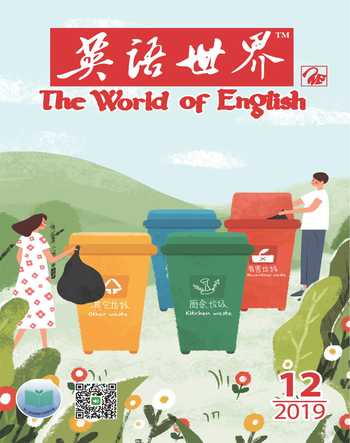
Shanghai Begins New Waste Sorting Era上海開啟垃圾分類新時代
2019-09-10 07:22:44左璇嚴婷
英語世界 2019年12期
左璇 嚴婷
Calls for garbage sorting have brought little progress in China in the past decade, but Shanghai is leading a fresh start for the world’s second-largest waste producer with its new municipal solid waste (MSW)1 regime2, observers have said.
“If we say China is now classifying its waste, then it’s Shanghai that is really doing it,” said Chen Liwen, a veteran environmentalist who has worked for non-governmental organisations devoted to waste classification for the past decade.
“It’s starting late, comparing with the US or Japan, but if it’s successful in such a megacity with such a huge population, it will mean a lot for the world,” she said.
Household waste in the city is now required to be sorted into four categories: wet garbage (household food), dry garbage (residual waste), recyclable waste and hazardous waste.
General rubbish bins that had previously taken all types of household waste were removed from buildings. Instead, residents were told to visit designated trash collection stations to dispose of different types of waste during designated periods of the day.
Companies and organisations flouting the new rules could be fined 50,000-500,000 yuan (US$7,000-70,000), while individual offenders risked a fine of 50-200 yuan. The city’s urban management officers will be mainly responsible for identifying those who breach the rules.
While the measures force a change of habits for most people, they bring opportunities for some.
Du Huanzheng, director of the Recycling Economy Institute at Tongji University, said waste sorting was crucial for China’s recycling industry.
“Without proper classification, a lot of garbage that can be recycled is burned, and that’s a pity,” he said. “After being classified, items suitable to be stored and transported can now be recycled.”
Shanghai’s refuse treatment plants deal with 19,300 tonnes of residual waste and 5,050 tonnes of kitchen waste every day, according to the municipal government. By contrast, only 3,300 tonnes of recyclables per day are collected at present.
Nationwide, the parcel delivery industry used more than 13 billion polypropylene woven bags, plastic bags and paper boxes as well as 330 million rolls of tape in 2016, but less than 20 per cent of this was recycled, according to a report by the State Post Bureau.
Prices of small sortable rubbish bins for home use have surged on e-commerce platforms, while bin makers are also developing smart models in response to new needs.
Some communities are deploying bins that people are required to sign in with their house number to use, and are equipped with a “big data analysis system”. The system records households have “actively participated” and which have not, so that neighbourhood management can publicise their addresses and make house visits, according to a report by Thepaper.cn.
According to Du, waste classification is not only about environmental impact or business opportunities.
“Garbage sorting is an important part of a country’s soft power,” he said.
For China, it was an opportunity to improve its international reputation, he said. “In the past, Chinese people were rich and travelled abroad, but they threw rubbish wilfully, making foreigners not admit we are a respected powerhouse.” He added: “It’s also related to 1.3 billion people’s health, since the current waste treatment methods—burying and burning—are not friendly to the environment.”
Shanghai’s part in tackling waste comes amid President Xi Jinping’s repeated calls for the country to sort waste better.
“For local officials, it is a political task,” said Chen, who heads a waste management programme in rural China called Zero Waste Villages.
Huang Rong, the municipal government’s deputy secretary general, said the president had asked Shanghai in particular to set a good example in waste classification.
In March 2017, the central government set out plans for a standardised system and regulations for rubbish sorting by 2020, with a target for 46 major cities, including Shanghai, to recycle 35 per cent of their waste by then.
However, it was a long process that required input from individuals, government and enterprises, Du said.
“Japan took one generation to move to doing its waste sorting effectively, so we shouldn’t have the expectation that our initiative will succeed in several years,” Du said.
“The lessons we can learn from Japan include carrying out campaigns again and again, and paying close attention to educating young pupils about rubbish classification.”
Chen echoed that Shanghai’s waste sorting frenzy now was only a beginning.
“What we can see now is that people are being pushed to sort waste by regulators, but what’s next? How shall we keep up the enthusiasm?” she asked.
She suggested that how well officials worked on garbage sorting should be included in their job appraisal, and that ultimately people should pay for waste disposal.
“The key to waste classification, going by international experience, is making polluters pay,” Chen said.
Shanghai officials admitted that there were plenty of challenges involved in sorting and transport.
Zhang Lixin, deputy chief of the municipal housing administration, said: “Many property management companies fear the difficulties brought by garbage sorting or are reluctant to implement the new rules.”
“We do find that some cleaners and rubbish trucks mix the waste, despite residents being asked to throw different types in different bins,” said Deng Jianping, head of the city’s landscaping and city appearance administration—the government department spearheading the initiative.
In the interests of curbing such practices, they could face fines of up to 50,000 yuan or even have their licences revoked, he said.
過去十年,中國時有要求垃圾分類的呼吁,但并未帶來多少進展,然而觀察者認為,上海出臺的全新城市生活垃圾管理政策,正在引領中國這一世界第二大垃圾制造國進入一個全新的時代。
“我們說中國現(xiàn)在開始實施垃圾分類了,其實真正這么做的是上海。”陳立雯如是說道。陳是位資深的環(huán)保人士,過去十年一直為致力于垃圾分類的非政府機構工作。
她說:“和美國或日本相比,上海的垃圾分類起步較晚,不過,作為一個人口眾多的超級城市,上海一旦成功,將對世界具有重要意義。”
現(xiàn)在上海的居民生活垃圾需按要求分成四大類:濕垃圾(廚余垃圾)、干垃圾(其余生活垃圾)、可回收物和有害垃圾。
以往裝各種生活垃圾的通用垃圾箱已經(jīng)從建筑物里拆除。居民們被要求在每天的規(guī)定時間段內(nèi)前往指定的垃圾回收站按照不同類別來投放垃圾。
無視新規(guī)的公司和單位將會面臨5萬以上50萬元以下的罰款(約合7000至7萬美元),違規(guī)的個人也會被處以50元以上200元以下的罰款。確認違規(guī)人員和單位的工作主要由上海的城市管理官員負責。
對于多數(shù)人而言,垃圾分類的新舉措意味著習慣的改變,但對有些人而言,它們則帶來了新機遇。
同濟大學循環(huán)經(jīng)濟研究所所長杜歡政稱,垃圾分類對于中國的循環(huán)利用產(chǎn)業(yè)至關重要。
“如果沒有妥當?shù)姆诸悾S多原本可以回收再利用的垃圾就會被燒掉,這是很可惜的事。”他說,“合理分類后,適宜儲存和運輸?shù)奈锲肪湍鼙换厥绽谩!?/p>
據(jù)上海市政府統(tǒng)計,上海的廢品處理廠每天可處理19300噸干垃圾和5050噸廚余垃圾。與之形成鮮明對比的是,目前每天收集的可回收物只有3300噸。
根據(jù)中國國家郵政局的一份報告,全國范圍內(nèi),2016年,快遞產(chǎn)業(yè)使用了130億只聚丙烯編織袋、塑料袋和紙盒子,以及3.3億卷膠帶,但其中回收利用的不超過20%。
電子交易平臺上,小型家用分類垃圾筒的價格已經(jīng)快速上漲,垃圾筒制造商還在積極研發(fā)一些時髦的樣式來迎合新的需求。
有些社區(qū)安裝的垃圾箱需要居民輸入門牌號碼方可使用,并配備了“大數(shù)據(jù)處理系統(tǒng)”。據(jù)澎湃新聞網(wǎng)的報道,該系統(tǒng)會記錄哪些家庭“積極參與”而哪些家庭沒有,社區(qū)居委會可據(jù)此公示相關家庭的地址并做家訪。
在杜歡政看來,垃圾分類并不僅僅會影響環(huán)境或者帶來新的生意機會。他說:“垃圾分類是一個國家軟實力的重要組成部分。”
他表示,對中國而言,這是提高國際聲譽的一個機會。“過去,中國人富起來了,很多人出國旅游,但他們隨意亂扔垃圾,讓外國人覺得我們不是個令人尊重的強國。”
他補充說:“垃圾分類還關乎13億人的健康,因為目前的垃圾處理方式——填埋和焚燒——對環(huán)境并不友好。”
上海在垃圾處理上的舉措響應了習近平主席多次強調(diào)的全國上下要摸索更好的方式來處理垃圾。
“對于地方官員而言,這是一項政治任務。”陳立雯說。她在中國農(nóng)村主持開展一個垃圾處理項目,稱為“零垃圾村莊”。
上海市政府副秘書長黃融稱,習主席曾特別要求上海在垃圾分類上給全國樹立一個好榜樣。
2017年3月,中央政府出臺政策,計劃到2020年年底基本建立垃圾分類相關法律法規(guī)和標準體系,包括上海在內(nèi)的46個重點城市屆時的垃圾回收利用率要達到35%。
然而,這是一個長期的過程,離不開個人、政府和企業(yè)的投入,杜歡政如是表示。
“日本用了一代人的時間才實現(xiàn)有效的垃圾分類,我們也不應該急于求成,期待短短幾年就取得成功。”
“日本的經(jīng)驗告訴我們,要反復開展垃圾分類活動,并高度重視對年輕學生的垃圾分類教育。”
陳立雯也認為,上海目前的垃圾分類熱情只是一個開始。
“我們可以看到,人們現(xiàn)在是被監(jiān)督著被迫實行垃圾分類,那么下一步呢?我們該如何保持這一熱情?”她問。
她建議,官員們在垃圾分類工作上的表現(xiàn)應該納入績效考核,并且最終居民要支付垃圾處理費。
“按照國際經(jīng)驗,垃圾分類成功的關鍵在于讓污染環(huán)境的人支付費用。”陳說。
上海市的官員承認,在垃圾分類和運輸?shù)倪^程中存在許多困難。
上海市房管局副局長張立新說:“很多物業(yè)公司擔心垃圾分類會帶來種種困難,不愿意執(zhí)行新的規(guī)定。”
“我們確實發(fā)現(xiàn)有些清潔工和垃圾清運車又把垃圾混在了一起,哪怕居民們已經(jīng)按要求把不同類型的垃圾分類投放。”上海市綠化和市容管理局局長鄧建平表示。該局是主要負責新規(guī)執(zhí)行的政府部門。
他說,為了扼制此類行為,那些人可能面臨5萬元以下的罰款,甚至還可能被吊銷執(zhí)照。
(譯者單位:北京外國語大學)
猜你喜歡
國家教育行政學院學報(2022年9期)2022-10-10 10:02:28
兒童時代·快樂苗苗(2022年4期)2022-06-05 07:17:08
少先隊活動(2021年5期)2021-07-22 09:00:02
環(huán)境衛(wèi)生工程(2021年2期)2021-06-09 09:11:16
數(shù)學小靈通(1-2年級)(2021年4期)2021-06-09 06:25:56
大眾健康(2021年6期)2021-06-08 19:30:06
家庭影院技術(2020年11期)2020-12-28 01:22:42
中學生數(shù)理化·七年級數(shù)學人教版(2019年4期)2019-05-20 10:06:32
中學生數(shù)理化·七年級數(shù)學人教版(2018年6期)2018-06-26 08:36:06
初中生世界·七年級(2017年9期)2017-10-13 22:27:46