
Approaches to Further Improve Upconversion Efficiency of Nanomaterials
2020-04-09 10:05:32ZHANGHong
應用技術學報 2020年1期
ZHANG Hong
(Faculty of Science, University of Amsterdam, Science Park 904, 1098 XH Amsterdam, The Netherlands)
Abstract: In this mini-review the progress of upconversion nanomaterials is briefly overviewed, as well as the challenges encountered.The role of luminescence dynamics tools in unravelling the upconversion processes is emphasized.Based on the upgraded comprehension, perspective on the route of developing more efficient upconversion is presented.
Key words: photon upconversion; nanomaterials; energy migration; rare earth; nonlinear spectroscopy
Based on the difference in photon conversions, luminescence can in principle be divided into two categories,i.e.linear and nonlinear.Linear luminescence is mostly studied and well known with quantum yield <100%.Nonlinear luminescence includes also upconversion luminescence(UCL)and down conversion luminescence.Down conversion refers to generation of several photons(≥2)upon the excitation of a higher energy photon, of which the intrinsic quantum yield is >200%.Upconversion luminescence is opposite, where absorption of several low energy photons results in emission of a higher energy photon with the intrinsic quantum yield <50%.Nonlinear luminescence is difficult to observe due to the fact that nonlinear coefficients are in principle orders of magnitude smaller than the linear counterparts.
Upconversion luminescencewas proposed by Bloembergen in 1959 and observed independently by Auzel, Ovsyakin&Feoflov,etal.in early 1960’s[1-3].Since then UCL had been intensively studiedin 1960’s to 1980’s mainly in ions doped glasses and crystalline materials.It was turned out that UC could occur in most lanthanide(Ln)ions and a few other ions with relatively high efficiency, where three mechanisms were identified to be the major responsible,i.e.(a)excited state absorption(ESA);(b)energy transfer upconversion(ETU); and(c)photon avalanche(PA).Among these ETU is proven to be in most cases the dominant one.
UCL of these ions in appropriate hosts can be observed under relatively low power excitation of continuous wave laser light.The UC luminescence intensity is usually described by formula(1)[4]
IUCL=kPn
(1)
whereIUCLis the UC luminescence intensity,ka material-related coefficient,Pthe power density of pump laser andnthe number of the photons required to induce one upconverted photon.In practice, the obtained “n” values are usually not integers which may be attributed to the saturation effect of the intermediate states and involvement of various UC processes.
Stepping into the new century, UCL study was reboosted with advance of nanotechnology.Nanomaterization has extended significantly the application of functional materials.Regarding UC, the effect was more on biology and biomedicine, where near infrared(NIR)light transduced in UC nanocrystals to ultraviolet or visible light is very attractive for administration of major diseases, like tumors.For example, UC nanomaterials allow the excitation wavelength to fall in the so-called “bio-window”(~650-1 300 nm),i.e., the optimal spectral range for minimal absorption of human tissue and negligible auto-fluorescence of the biological background, less light scattering, high signal-to-noise ratio in imaging.Optical imaging and photo-activated therapy can thus unprecedentedly reach lesions at deep tissue.They were thus expected to significantly improve the quality of bio-imaging, labelling, sensing and therapy[5-11].On top of that, UC nanomaterials were also applied in RGB printing, security, display and optical storage, photocatalysisetal[12-13].
Lanthanides have special electronic configurations.The electronic configurations of lanthanide atoms are given by:
1s22s22p63s23p63d104s24p64d104fn5s25p65dm6s2,n=0~14,m=0, 1
On the other hand, lanthanides are mostly stable in the trivalent form(Ln3+), whose relevant electronic configurations are given by:
1s22s22p63s23p63d104s24p64d104fn5s25p6,n=0~14.
It should be noted that for the electron filling 5s25p6states have priority over 4fnstates, which means that the 4fnelectrons are shielded by the outer 5s25p6electrons.This is the reason that the Ln3+are usually characterized by sharp absorption and emission peaks, relatively weak absorption and relatively long lifetimes of the excited states.Furthermore, because of the shielding of 5s25p6electrons, these spectral characteristics are only weakly affected by the environment, such as surrounding crystal field[14].
1 Upgraded comprehension of upconversion in nanostructure—the role of energy migration
Together with the exploration of utilization, more and more attention has also been paid on improving the optical properties of the UC nanomaterials addressed from the application.For example, to be a competent the ranostic nanoplatform, minimization of toxicity is a major issue, which is in close relationship with upconversion efficiency.Higher efficiency means lower dosage, and thus less toxicity and lower cost.In therapy of deep lesion, high UC efficiency is even more critical.Low efficiency calls for intensive irradiation taking the rick of normal cell/tissue damage.Till now, the most efficient UC materials based on NaYF4or analogues(cfFigure 1)have not really won the very competitive market, largely due to the unsatisfactory efficiency.
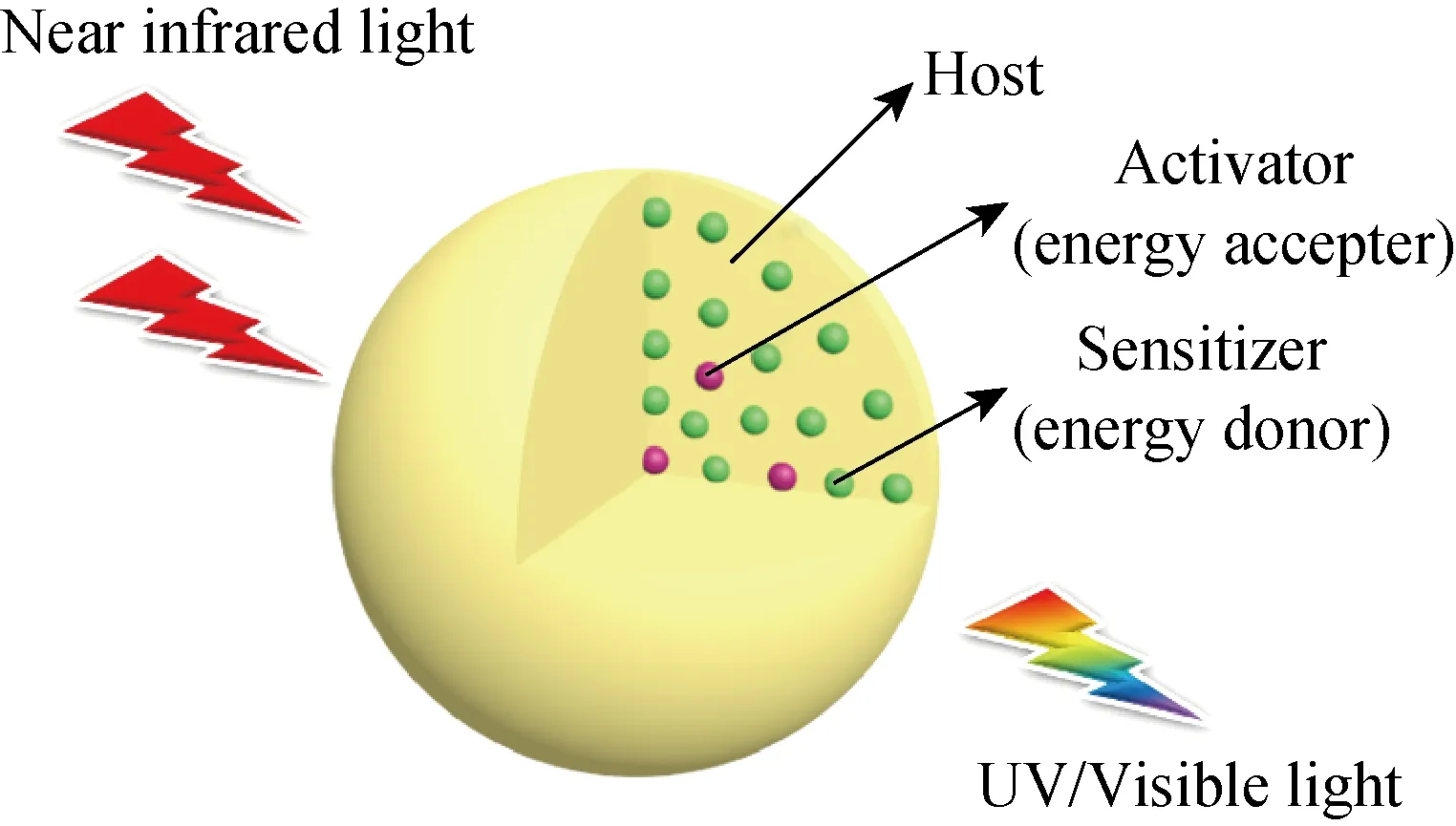
Fig.1 Typical structure of lanthanide-doped upconversion nanoparticles[15]
Another challenge we have been confronted with is the lack of a proper parameter to define the upconversion efficiency.Currently only luminescence quantum yield is employed to characterize the UC efficiency.However, UCL is a nonlinear process differing from linear emission, luminescence quantum yield(η)defined as
(2)
is not appropriate anymore in characterizing the upconversion luminescence efficiency since it is now becoming excitation power density dependent.The misuse has caused crisis of confidence on the reportedηof which the value are actually laser beam profile and emission collection profile dependent.A fair comparison between the quantum yield values from different laboratories is thus an extravagant hope.
Our group has been devoted to the UCL mechanism exploration and function design of UCL nanostructures since the beginning of this century.The unsatisfactory UC luminescence intensity under the low irradiation level of clinics continuously encourages us to update our comprehension of upconversion, especially in nanoscale, which we believe is still the bottleneck on the way towards application.In order to obtain the underlying physical picture of the rare earth ions based UC, we have designed various specific nanostructures, aided by linear and nonlinear spectroscopic techniques and theoretical modelling.Preliminary results have already sorted out some confusions[16-17].
Our first target was the role of excitation energy migration in upconversion luminescence.Inmacroscopic study it was discovered that the most efficient UCL comes from sensitizer/activator codoping system, represented typically by NaYF4∶Yb3+(20%), Er3+(2%).It was believed that the activator Er3+ions accept excitation dominantly from the sensitizer Yb3+in the closest vicinity.The sensitizers farther away contribute thus little on the UCL.This vision led to popular activator-sensitizer pair model in treating UCL[18-20].Although this vision was challenged from time to time, direct evidence was hard to acquire from macroscopic materials where separation of activators and sensitizers was difficult in practice to realize, if not impossible, until advance of nanotechnology enabled precise architecture of nanostructures.In our case “Dopant ions spatially separated” nanostructures were designed as model systems.We tailored the location of activators and sensitizers in different areas of a nanoparticle to control the distance between them.The energy migration path and corresponding cost time could thus be tuned.A Sandwich structure, NaYF4∶20% Yb, 2% Er @NaYF4∶20% Yb @NaYF4∶10% Nd, 20%Yb was taken as a model system.
To realize the migration time dependence UCL we developeda two color synergistic pulsed excitation UCL setup.The time difference between the two color(980 nm and 800 nm)pulse trains were tuned electronically.The UCL intensity of Er3+as sum of the green and red bandswas therefore originated from three parts, one from 980 nm excitation, another one from 800 nm excitation, and the third one from the joint excitation of 980 nm and 800 nm.The last depends on the time difference between the two color pulses interval, whereas the rest two are independent of the time difference.From the experiments it was found that the UCL intensity reached maximum when 980 nm pulse delayed 240 μs compared to the 808 nm pulse(cf.Figure 2).This observation confirmed that(1)migration UC is nonnegligible, and(2)3 nm radial distance costs much more time than one would expect to migrate 3 nm from the point to point cascade energy transfer calculation(~6 μs).Such a huge deviation and the corresponding UCL intensity variation exhibit unambiguously the non-negligible contribution of sensitizers in farther vicinities to the UCL of activators.To build up quantitative relationship between the UCL dynamics and migration time, time-correlated Monte Carlo simulation was adopted, where the parameters were determined either from experiments or from quantum mechanical calculations.The simulation indeed agreed well with the experimental observations.This was the first time that the migration and UCL dynamics are quantitatively correlated[17].It released also the long standing puzzle as if and how those sensitizers farther away from the activators affect the UCL.

Fig.2 (a)Upconversion emission detection setup with two color pulsed excitation,(b)typical sample UCNP for excitation migration study,(c)visible UCL integration vs.time delay of the two different color excitation pulses[17]
The UCL time behaviors demonstrated also the energy migration path dependence.Typically, the rise edge of the UCL decay curve was prolonged with the intermediate layer thickness, in line with the simulation.In order to decode further the nature of the time profile of UCL, a core/active shell system was developed.NaYF4∶20% Yb, 2% Er @NaYF4∶20% Yb was employed with NaYF4∶20% Yb shell of various thicknesses.Here the UCL decay distinctly exhibited an extension with the active shell thickness.All these results supported that the UCL decay is different from the single molecular model-it is not a single level population, but a profile of an assemble of UCL decays.This observationis important as it has validated the complex of the time behavior of UCL.
Deeper comprehension often will encourage new designs and functions.Our case here was simply another example.Based on this upgraded comprehension of UCL dynamics, fine control of upconversion emission time behavior(either rise or decay process)became possible by tuning the energy migration paths in various specifically designed nanostructures which shall facilitate greatly the application of UCL materials in super-resolution spectroscopy, high density data storage, anti-counterfeiting and biological imaging,etal.
At this end, we would like to point out that nonlinear(excitation)spectroscopy plays an essential and very important role in our study.The core of its application is it enables us to select activation channels via the time difference between different color pulses and/or hinder/promote specific reaction paths(cfFigure 3).
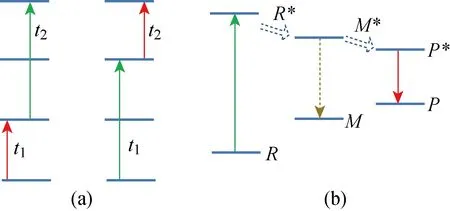
Fig.3 (a)Schematic diagram of upconversion path determined by the order of two color pulses, and(b)pump-dump-probe experiment
The synergistic excitation scheme enables us to selectively choose the excitation channel in one activator or involving both activator and sensitizer.Coexistence of various UC channels was one of the annoying troubles in UC mechanism study.Many electronic levels(>3)and various channels contributing synergistically to UC has confused in many cases our efforts in acquiring a distinct UC picture, which as aforementioned, is the prerequisite of function design in most cases.Nonlinear multicolor excitation is expected to be a very powerful approach in thoroughly unravelling the UC processes.
2 Possible road map towards more highly efficient upconversion nanosystems
After development of more than half century, especially with the nanomaterization, UCL has exhibited its unique advantages in some applications, typically in optical imaging, detection and therapy of deep lesion.However, the current status that it has not yet taken the market share as it deserved despite the explosive reports of last decade on proof-of-principle is really a little awkward, which reflects mainly the efficiency deficit as it does not match the market needs.
Therefore, further study should be focused on(1)deeper comprehension of the UC mechanism which is the base,(2)avoiding as many as possible the lost channels in UC processes,(3)exploring better structure or materials.
From our current comprehension, it is well established that most radiative and/or nonradiative processes other than UC directly involved states are in general negative.Bearing that in mind we might consider several scenarios.At first we might revisit the scheme of current UCL.Cross-relaxation and radiative transition of the intermediate levels are the main reason responsible for the excitation energy loss.To minimize cross-relaxation the electronic level differences of the activator itself, as well as sensitizers should not match well.This probably denies the monochromatic upconversion.However, our experiments have shown that two color upconversion,i.e.upconversion luminescence comes from synergistic excitation of two different energy photons, could be as effective as monochromatic one for Er3+(cf.Figure 2c).Another way of circumventing the population loss of intermediate levels would be to find a way that the intermediate electronic level of activator(A)can somehow effectively transfer the energy to an even longer lived state of another ion or entity(B), and when being populated to a higher state of B upon excitation of second photon, to transfer the energy back to the original activator A for UCL.Here B should have relatively strong absorption.The mentioned energy forwardtransfer and back transfer between A and B should be efficient also.Of course phonon assisted relaxation could be inhibited with external conditions.
Another approach to minimize the excitation energy deleterious loss is to construct defect-free tiny islands(~nm diameter)within a nanoparticle, in which a defect-free environment can be realized for these very limited doping areas.It could be helpful in minimizing the nonradiative loss.
3 Perspective
This brief review transfers the message that the major challenge we have encountered remains the unsatisfactory UC efficiency.Deeper comprehension of UC mechanism is important for planning the roadmap to design/discover new UC systems, where synergy of nonlinear spectroscopy, the oretical modelling, synthetic chemistry, and other disciplines may play a key role.With the clearing of the excitation energy loss channels more efficient upconversion luminescence materials/structures might be expected.
AcknowledgementThis work was financially supported by Netherlands Organization for Scientific Research in the framework of the Fund New Chemical Innovation under grant nr.731.015.206, EU H2020-MSCA-ITN-ETN Action program, ISPIC, under grant nr.675743, EU H2020-MSCA-RISE Action program, CANCER, under grant nr.777682, EU H2020-MSCA-RISE-2014, PRISAR, under grant nr.644373.
