大學(xué)生學(xué)業(yè)自我設(shè)限的影響因素研究
2020-05-09 10:24:36師朝軍嚴(yán)純順周雪陳越張婧璐
科教導(dǎo)刊
2020年5期
關(guān)鍵詞:大學(xué)生
師朝軍 嚴(yán)純順 周雪 陳越 張婧璐
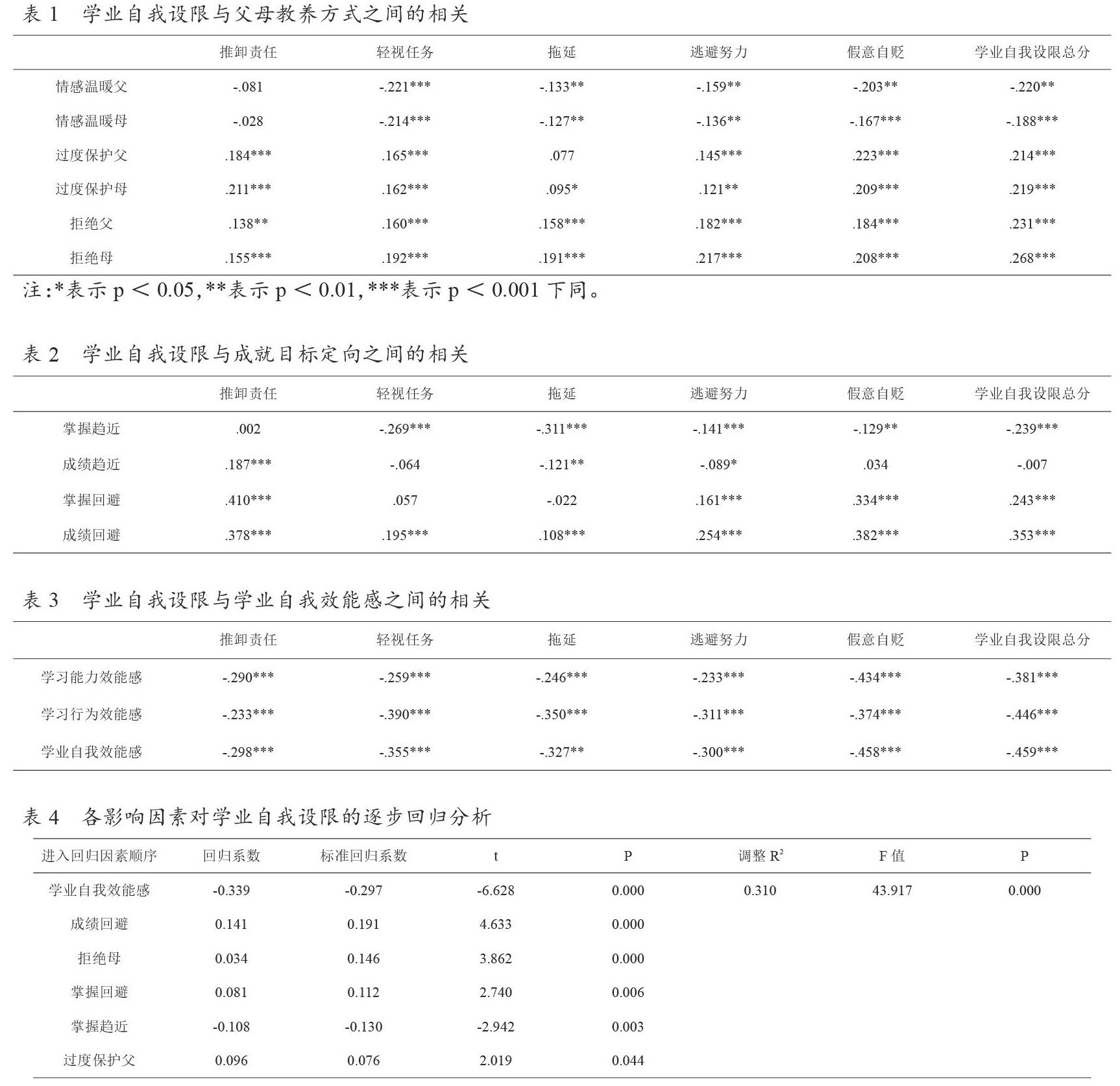
摘 要 為探討大學(xué)生學(xué)業(yè)自我設(shè)限的一些影響因素,使用問卷測(cè)量573名大學(xué)生的父母教養(yǎng)方式、學(xué)業(yè)自我效能感、成就目標(biāo)定和學(xué)業(yè)自我設(shè)限,結(jié)果表明:(1)學(xué)業(yè)自我設(shè)限與情感溫暖類型的父母教養(yǎng)方式呈顯著負(fù)相關(guān),與拒絕類型的父母教養(yǎng)方式和過度保護(hù)的父母教養(yǎng)方式呈顯著正相關(guān);(2)學(xué)業(yè)自我設(shè)限與成績(jī)趨近目標(biāo)相關(guān)不顯著,與掌握回避和成績(jī)回避目標(biāo)呈顯著正相關(guān),與掌握趨近目標(biāo)呈顯著負(fù)相關(guān);(3)學(xué)業(yè)自我效能感與學(xué)業(yè)自我設(shè)限呈顯著負(fù)相關(guān),對(duì)其的預(yù)測(cè)力也最強(qiáng)。
關(guān)鍵詞 學(xué)業(yè)自我設(shè)限 大學(xué)生 自我效能感 父母教養(yǎng)方式 成就目標(biāo)定向
中圖分類號(hào):G642? ? ? ? ? ? ? ? ? ? ? ? ? ? ? ? ?文獻(xiàn)標(biāo)識(shí)碼:A? DOI:10.16400/j.cnki.kjdkz.2020.02.086
Abstract To investigate some influence factors of college students' academic self-handicapping, using questionnaire to measure 573 college students of the parents' upbringing, academic self-efficacy, achievement goal, the results show that: (1) Academic self-handicapping and emotional warmth type parents upbringing, has negative correlation with the rejection of the type of parents upbringing and excessive protection of parents upbringing was significantly positively related; (2) There is no significant correlation between academic self-handicapping and achievement approaching goal, but there is a significant positive correlation between academic self-handicapping and achievement avoiding goal, and a significant negative correlation between academic self-handicapping and achievement approaching goal. (3) Academic self-efficacy is significantly negatively correlated with academic self-handicapping, and has the strongest predictive power.
Keywords academic self-handicapping; college students; self-efficacy; parenting style; achievement goal orientation
0 前言
學(xué)業(yè)自我設(shè)限是指學(xué)生為了避免或減少因?qū)W業(yè)失敗而引起的他人對(duì)自己能力低下的消極評(píng)價(jià),而采取一些將失敗原因外在化的行為,如故意拖延學(xué)習(xí)、減少努力程度等(Covington,1992)。已有研究表明,人們使用自我設(shè)限或是出于保護(hù)自身價(jià)值,或是維護(hù)自己的形象。在學(xué)校這樣典型的成就場(chǎng)景中,學(xué)生的能力和智力會(huì)通過他們作業(yè)完成情況、考試成績(jī)等反映出來(lái)。由于老師和眾多同學(xué)在場(chǎng),學(xué)生也傾向于使用自我設(shè)限來(lái)保護(hù)自身價(jià)值或維護(hù)自己的形象,所以在學(xué)校會(huì)有許多自我設(shè)限的情況發(fā)生。已有研究表明,某些自我設(shè)限的實(shí)際行為比如減少練習(xí)或服用藥物會(huì)真正損害學(xué)業(yè)成績(jī),使自我設(shè)限者成功的可能性降低。……
登錄APP查看全文
猜你喜歡
今日農(nóng)業(yè)(2021年15期)2021-10-14 08:20:06
青春期健康(2020年22期)2021-01-12 00:50:58
下一代英才(酷炫少年)(2019年3期)2019-03-25 02:34:18
黃河之聲(2017年14期)2017-10-11 09:03:59
北方音樂(2017年7期)2017-05-16 00:32:46
教育與職業(yè)(2014年7期)2014-04-17 18:46:57
教育與職業(yè)(2014年16期)2014-01-19 01:24:34
中國(guó)火炬(2013年7期)2013-07-24 14:19:23
中國(guó)火炬(2010年9期)2010-07-25 11:45:09
中國(guó)火炬(2009年2期)2009-07-24 14:31:30