管理模式對(duì)護(hù)理資源有效性整合的效果分析
2020-05-19 15:03:38宋紅張莉劉海棠張敏
中國(guó)衛(wèi)生產(chǎn)業(yè)
2020年4期
宋紅 張莉 劉海棠 張敏

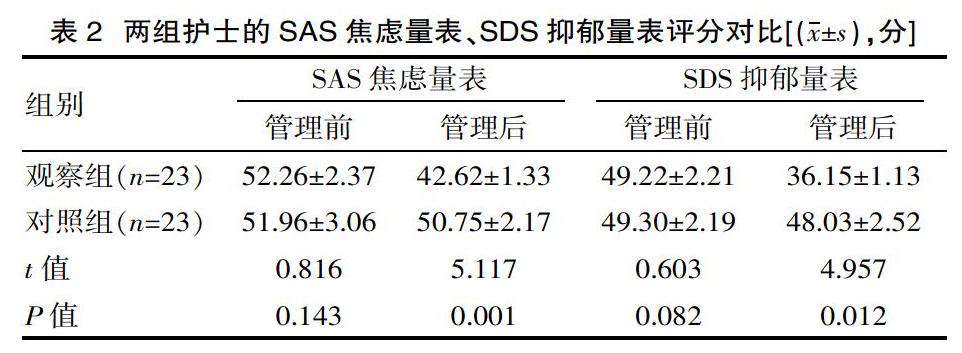
[摘要] 目的 分析通過開展分層級(jí)的護(hù)理管理模式對(duì)于提高護(hù)理資源有效性整合的臨床價(jià)值。方法 于2017年1月—2018年12月選取該院的46名護(hù)理人員為研究對(duì)象,隨機(jī)分為兩組。對(duì)照組采取常規(guī)的護(hù)理管理模式,觀察組則采取分層級(jí)護(hù)理管理模式。結(jié)果 觀察組護(hù)士在病房管理、護(hù)理文件、護(hù)理操作、健康教育、對(duì)患者病情的了解程度等方面護(hù)理質(zhì)量評(píng)分均高于對(duì)照組(P<0.05);觀察組患者的護(hù)理滿意度評(píng)分為(94.62±3.55)分,對(duì)照組為(87.43±2.26)分,差異有統(tǒng)計(jì)學(xué)意義(P<0.05);兩組護(hù)士在管理前SAS焦慮量表、SDS抑郁量表評(píng)分均較高(P>0.05),管理后觀察組護(hù)士的SAS、SDS量表評(píng)分低于該組管理前及同期對(duì)照組(P<0.05);觀察組護(hù)士的基礎(chǔ)護(hù)理知識(shí)、專業(yè)技術(shù)考核、文書書寫合格率高于對(duì)照組(P<0.05)。結(jié)論 通過開展分層級(jí)護(hù)理管理模式有助于為患者提供更為規(guī)范化和連續(xù)性的臨床護(hù)理服務(wù),有助于促進(jìn)護(hù)理質(zhì)量的持續(xù)性提升。
[關(guān)鍵詞] 護(hù)理資源;管理模式;有效性;整合
[中圖分類號(hào)] R47 [文獻(xiàn)標(biāo)識(shí)碼] A [文章編號(hào)] 1672-5654(2020)02(a)-0056-03
Effect Analysis of Management Mode on Effective Integration of Nursing Resources
SONG Hong , ZHANG Li , LIU Hai-tang , ZHANG Min
General Hospital of Xuzhou Mining Group, Jiangsu Province(Second Affiliated Hospital of Xuzhou Medical University), Xuzhou, Jiangsu Province, 221006 China
[Abstract] Objective To analyze the clinical value of improving the effective integration of nursing resources by developing a hierarchical nursing management model. Methods 46 Nurses were selected and randomly divided to two groups from January 2017 to December 2018. The control group adopted the conventional nursing management mode, and the observation group adopted the hierarchical nursing management mode. Results The nurses in the observation group had higher nursing quality scores in ward management, nursing documents, nursing operations, health education, and understanding of the patient's condition than the control group(P<0.05); the nursing satisfaction score of the observation group was(94.62±3.55)points, compared with (87.43±2.26)points in the control group, and the difference was statistically significant(P<0.05); the SAS anxiety scale and SDS depression scale scores were higher in the two groups of nurses before management(P>0.05), and the nurses in the observation group after management of the SAS and SDS scales were lower than those of the control group before and during the same period of the control group(P<0.05); the pass rate of the basic nursing knowledge and professional technical assessment literature of the observation group nurses was higher than that of the control group(P<0.05). Conclusion The development of a layered nursing management model helps to provide patients with more standardized and continuous clinical nursing services and promotes the continuous improvement of nursing quality.
[Key words] Nursing resources; Management mode; Effectiveness; Integration
隨著近年來人們生活水平的不斷提升,對(duì)于臨床護(hù)理工作質(zhì)量也提出了更高要求,許多歐美國(guó)家護(hù)理分級(jí)系統(tǒng)已進(jìn)入成熟階段,然而我國(guó)現(xiàn)階段還未形成統(tǒng)一的護(hù)理,人力資源分級(jí)管理體系。而臨床護(hù)理工作是一項(xiàng)任務(wù)繁重,且壓力較大的工作,伴隨著患者對(duì)護(hù)理質(zhì)量要求的不斷提升,如何開展護(hù)理人員的分層管理并提高其護(hù)理能力是廣大醫(yī)院共同關(guān)注的問題[1]。該文抽取院內(nèi)2017年1月—2018年12月工作的46名護(hù)理人員為研究對(duì)象,旨在分析通過在護(hù)理管理中開展分層護(hù)理管理模式的應(yīng)用價(jià)值。報(bào)道如下。
1? 資料與方法
1.1? 一般資料
抽取院內(nèi)工作的46名護(hù)理人員,根據(jù)管理模式差異分組。觀察組:23名,男女性別比為22/1;年齡區(qū)間處于22~42歲,均值(29.6±1.5)歲;工作年限1~19年,均值(5.3±1.2)年。對(duì)照組:23名,男女性別比為23/0;年齡區(qū)間處于21~45歲,均值(28.9±1.7)歲;工作年限1~18年,均值(5.5±0.9)年。……
登錄APP查看全文
猜你喜歡
甘肅教育(2020年6期)2020-09-11 07:45:28
大眾投資指南(2020年10期)2020-07-24 08:03:48
甘肅教育(2020年12期)2020-04-13 06:24:56
中國(guó)科技博覽(2016年19期)2016-10-19 12:31:29
電腦知識(shí)與技術(shù)(2016年21期)2016-10-18 21:32:32
科學(xué)與財(cái)富(2016年28期)2016-10-14 23:43:29
考試周刊(2016年76期)2016-10-09 08:23:04
考試周刊(2016年76期)2016-10-09 08:12:00
成才之路(2016年26期)2016-10-08 11:39:33
成才之路(2016年25期)2016-10-08 10:33:44