廣西扶桑綿粉蚧寄生蜂發(fā)生情況調(diào)查
2020-06-04 15:51:13李金峰鄧軍陳華燕楊朗周忠實(shí)姜建軍黃立飛桂富榮陳紅松
南方農(nóng)業(yè)學(xué)報(bào) 2020年4期
李金峰 鄧軍 陳華燕 楊朗 周忠實(shí) 姜建軍 黃立飛 桂富榮 陳紅松


摘要:【目的】調(diào)查廣西扶桑綿粉蚧寄生蜂種類(lèi)、種群動(dòng)態(tài)及其對(duì)扶桑綿粉蚧的控制作用,為廣西利用自然天敵防控扶桑綿粉蚧提供科學(xué)依據(jù)。【方法】2018年10月—2019年10月,每月中旬從廣西北海、欽州、崇左和防城港4個(gè)城市分別定點(diǎn)采集約450頭扶桑綿粉蚧帶回實(shí)驗(yàn)室。僵蚧單頭挑至2 mL離心管中等待羽化,其余粉蚧放至發(fā)芽土豆上繼續(xù)飼養(yǎng)、每天觀察,將新形成的僵蚧及時(shí)挑至2 mL離心管中等待羽化,連續(xù)觀察10 d,直至再無(wú)僵蚧出現(xiàn)。統(tǒng)計(jì)僵蚧數(shù)量及所占比例,鑒定寄生蜂種類(lèi),統(tǒng)計(jì)其數(shù)量,計(jì)算各種寄生蜂僵蚧所占比例。【結(jié)果】野外采集到9種寄生蜂,其中跳小蜂科5種:班氏跳小蜂[Aenasius arizonensis (Girault)]、刷盾跳小蜂Cheiloneurus sp.、康長(zhǎng)索跳小蜂(Anagyrus kamali Moursi)、松粉蚧抑虱跳小蜂(Acerophagus coccois Smith)和黑角原長(zhǎng)緣跳小蜂[Prochiloneurus nigricornis (Girault)];蚜小蜂科3種:豹紋花翅蚜小蜂[Marietta picta (André)]、康氏邁蚜小蜂(Myiocnema comperei Ashmead)和黃臉擬暗蚜小蜂(Promuscidea unfasciativentris Girault);廣腹細(xì)蜂科1種:粉蚧廣腹細(xì)蜂(Allotropa phenacocca Chen, Liu & Xu)。其中松粉蚧抑虱跳小蜂和刷盾跳小蜂Cheiloneurus sp.為群居寄生蜂,單頭僵蚧最多可羽化出14頭刷盾跳小蜂Cheiloneurus sp.成蜂。寄生蜂的總體寄生率較低(2.83%~29.56%),但僵蚧總體羽化率較高(92.15%)。北海寄生蜂資源最豐富、寄生蜂的寄生率最高,共采集到9種寄生蜂;欽州和防城港均采集到6種寄生蜂,崇左采集到5種寄生蜂。班氏跳小蜂和刷盾跳小蜂Cheiloneurus sp.為優(yōu)勢(shì)寄生蜂,二者個(gè)體數(shù)量約是其余7種寄生蜂數(shù)量的17倍,二者寄生的僵蚧合計(jì)比例多超過(guò)80.00%;在野外,5月班氏跳小蜂為絕對(duì)優(yōu)勢(shì)種,其他月份在不同城市二者交替占優(yōu)勢(shì)。【結(jié)論】廣西扶桑綿粉蚧寄生蜂資源豐富,目前發(fā)現(xiàn)9種,其中班氏跳小蜂和刷盾跳小蜂Cheiloneurus sp.為優(yōu)勢(shì)種,二者交替占優(yōu)勢(shì),但寄生蜂總體寄生率較低。
關(guān)鍵詞: 扶桑綿粉蚧;寄生蜂;種群動(dòng)態(tài);優(yōu)勢(shì)種;廣西
Abstract:【Objective】In order to provide scientific reference for the control of Phenacoccus solenopsis Tinsley by natural enemies in Guangxi, the species, population dynamics and control effects of parasitic wasps of P. solenopsis were studied. 【Method】From October, 2018 to October, 2019, about 450 P. solenopsis individuals were collected from designated locations in Beihai, Qinzhou, Chongzuo, and Fangchenggang separately in the middle of each month and were brought to the laboratory. The single P. solenopsis mummy was placed in a 2 mL centrifuge tube until the emergence of the parasitic wasp. The rest of P. solenopsis were placed on sprouted potatoes to allow continue feeding and were observed daily, the newly formed mummies were placed in a 2 mL centrifuge tube until the wasps emergence. The process lasted for 10 d until no more mummies appeared. The number and percentage of P. solenopsis mummies were counted, the species of parasitic wasps were identified, the number of each parasitic wasp was recorded, and thepercentage of P. solenopsis mummies formed by each parasitic wasp was calculated. 【Result】In total, nine species of parasitic wasps were collected from the four localities, five species of Encyrtidae:Aenasius arizonensis(Girault), Cheiloneurus sp., Anagyrus kamali Moursi, Acerophagus coccois Smith and Prochiloneurus nigricornis(Girault), three species of Aphididae: Marietta picta(André), Myiocnema comperei Ashmead and Promuscidea unfasciativentris Girault, one species of Platygastridae: Allotropa phenacocca Chen, Liu & Xu. A. coccois and Cheiloneurus sp. were gregarious species(more than one wasp individual emerged from one mummy), one mummy could emerge as many as 14 Cheiloneurus sp. adults. The overall parasitic rate of parasitic wasps was low (the rate ranged from 2.83% to 29.56%), but the emergence rate of P. solenopsis mummies was high (92.15%). Beihai was the richest in parasitic wasp resource, the highest parasitic rate and nine species of parasitic wasps were discovered there. Six species of parasitic wasps were collected both in Qinzhou and Fangchenggang, while five species of parasitic wasps were collected in Chongzuo. A. arizonensis and Cheiloneurus sp. were the dominant species, the number of the two species was about 17 times as that of the other seven species, the proportion of the P. solenopsis mummies formed by the two parasitic wasps was more than 80.00%. In the field, A. arizonensis was the absolute dominant species in May, while A. arizonensis and Cheiloneurus sp. predominated alternatively in different cities in other months.【Conclusion】The parasitic wasp resource of P. solenopsis in Guangxi is rich. At present, nine species have been disco-vered. A. arizonensis and Cheiloneurus sp. are the dominant species, the two species predominate alternatively. However, the overall parasitic rate of parasitic wasps is relatively low.
0 引言
【研究意義】扶桑綿粉蚧(Phenacoccus solenopsis Tinsley)最早發(fā)現(xiàn)于美國(guó)新墨西哥州,后快速傳播,現(xiàn)已分布至全球48個(gè)國(guó)家和地區(qū)(Nagrare et al.,2019)。2008年在廣州首次發(fā)現(xiàn)該害蟲(chóng)入侵我國(guó)(武三安和張潤(rùn)志,2009),在大陸現(xiàn)分布至包括廣西在內(nèi)的16個(gè)省、直轄市、自治區(qū)(張潤(rùn)志和王福祥,2010;孟醒等,2018,2019;Wang et al.,2020),該粉蚧為我國(guó)重要入境檢疫對(duì)象。扶桑綿粉蚧為雜食性害蟲(chóng),寄主范圍廣,可取食64屬267種植物(Nagrare et al.,2019),包括大田作物、蔬菜、觀賞植物、雜草、灌木和樹(shù)木等(張潤(rùn)志和王福祥,2010;Nagrare et al.,2018;Rezk et al.,2019)。扶桑綿粉蚧以若蟲(chóng)和雌成蟲(chóng)吸食植物的葉片、枝條、果實(shí)、主干和根部韌皮部汁液,分泌蜜露導(dǎo)致煙煤病發(fā)生而影響植物的光合作用,同時(shí)作為媒介昆蟲(chóng)傳播多種植物病毒,通過(guò)多種方式危害寄主植物(Saeed et al.,2007;陳紅松等,2019)。由于寄主范圍廣、繁殖力強(qiáng)、共生螞蟻的保護(hù)、環(huán)境適應(yīng)能力強(qiáng)、傳播途徑多(水、風(fēng)、動(dòng)物、鳥(niǎo)類(lèi)、農(nóng)機(jī)具、棉花種植及植物貿(mào)易等)、在新侵入地缺乏天敵,致使扶桑綿粉蚧在新入侵地快速建立種群,并對(duì)多種寄主植物造成巨大危害(Nagrare et al.,2018;Tong et al.,2019)。2005—2009年,巴基斯坦和印度部分棉區(qū)棉花因扶桑綿粉蚧造成的損失高達(dá)30%~60%(Fand and Suroshe,2015)。廣西屬熱帶、亞熱帶季風(fēng)氣候,為扶桑綿粉蚧的高度適生區(qū)(Wang et al.,2010),目前扶桑綿粉蚧在廣西已分布至除桂林外的13個(gè)地級(jí)市,入侵定殖率高達(dá)92.86%,以崇左、防城港、梧州和北海的朱槿(Hibiscus rosa-sinensis L.)受害較嚴(yán)重(孟醒等,2019);該蟲(chóng)在廣西大部分地區(qū)年發(fā)生8~10代,入侵地遭受?chē)?yán)重經(jīng)濟(jì)損失的風(fēng)險(xiǎn)極高(Chen et al.,2015)。因此,研究扶桑綿粉蚧的防控措施,對(duì)控制該害蟲(chóng)的擴(kuò)散蔓延、降低經(jīng)濟(jì)損失極為重要。目前扶桑綿粉蚧的防治方法主要為化學(xué)防治,但扶桑綿粉蚧體外有蠟脂保護(hù)、卵胎生和世代重疊,因而化學(xué)防治很難奏效(Kaur and Virk,2011);同時(shí),由于長(zhǎng)期和大量使用化學(xué)農(nóng)藥,導(dǎo)致扶桑綿粉蚧對(duì)多種殺蟲(chóng)劑產(chǎn)生了抗藥性或交互抗性,引起蟲(chóng)情反彈(Kaur and Virk,2011; Ejaz et al.,2019; Nagrare et al.,2019; Afzal et al.,2020);此外,殺蟲(chóng)劑會(huì)影響非靶標(biāo)生物、生態(tài)環(huán)境和人類(lèi)健康(Asogwa et al.,2010),其使用受到限制。因此,利用捕食性或寄生性天敵防治扶桑綿粉蚧的生物防治方法受到高度重視。【前人研究進(jìn)展】害蟲(chóng)生物防治具有持久、環(huán)境友好、自行擴(kuò)散及費(fèi)用低等優(yōu)點(diǎn)(Iqbal et al.,2016;羅麗林和李莉,2018),日益受到人們的重視。以色列、印度和巴基斯坦學(xué)者發(fā)現(xiàn)班氏跳小蜂[Aenasius arizonensis (Girault)(=A. bambawalei Hayat)]在部分農(nóng)田對(duì)扶桑綿粉蚧具有較好的控制作用,其寄生率介于79%~100%(Nagrare et al.,2011;Sahito et al.,2011; Spodek et al.,2018),防控效果優(yōu)于殺蟲(chóng)劑,故在扶桑綿粉蚧防治措施中,相對(duì)于殺蟲(chóng)劑,寄生蜂居優(yōu)先地位,利用寄生蜂防治粉蚧已成為一種趨勢(shì)(Vennila et al.,2010)。中國(guó)、伊朗、以色列和印度學(xué)者描述了扶桑綿粉蚧寄生蜂在各自國(guó)家的種類(lèi)、分布或寄主范圍,共26種寄生蜂:班氏跳小蜂、松粉蚧抑虱跳小蜂(Acerophagus coccois Smith)、長(zhǎng)崎原長(zhǎng)緣跳小蜂[Prochiloneurus nagasakiensis(Ishii)]、粉蚧廣腹細(xì)蜂(Allotropa phenacocca Chen,Liu & Xu)、黃臉擬暗蚜小蜂(Promuscidea unfasciativentris Girault)、康長(zhǎng)索跳小蜂(Anagyrus kamali Moursi)、A. aligarhensis Agarwal and Alam、A. californicus(Compere)、A. dactylopii(Howard)、A. mirzai Agarwal and Alam、Aprostocetus bangaloricus Narendran、Bothriothorax serratellus(Dalman)、Chartocerus kerrichi(Agarwal)、C. kurdjumovi(Nikolskaya)、Encyrtus aurantii(Geoffroy)、Homalotylus albiclavatus (Agarwal)、H. flaminius (Dalman)、Leptomastix algirica Trjapitzin、L. dactylopii Howard、L. mayri ?z-dikmen、Metaphycus sp.、Pachyneuron leucopiscida Mani、P. aegyptiacus(Mercet)、P. pulchellus Silvestri、P. rex(Girault)和Pseudleptomastix squammulata Girault(陳華燕等,2011;Chen et al.,2011;Nagrare et al.,2011;Spodek et al.,2018;Torfi et al.,2020)。關(guān)于班氏跳小蜂的研究最多,包括班氏跳小蜂對(duì)扶桑綿粉蚧的控制效果(Spodek et al.,2018)、不同寄主植物上扶桑綿粉蚧的寄生率及班氏跳小蜂的種群適合度(Khuhro et al.,2011;Badshah et al.,2018)、扶桑綿粉蚧蟲(chóng)齡對(duì)班氏跳小蜂生活史和形態(tài)特征的影響(Karmakar and Shera,2018)、溫度對(duì)班氏跳小蜂寄生率和生活史的影響(He et al.,2018;Joodaki et al.,2018)、殺蟲(chóng)劑對(duì)班氏跳小蜂的安全性(Badshah et al.,2017)等。【本研究切入點(diǎn)】明確天敵種類(lèi)和控制效果是發(fā)揮生防天敵作用的前提。在扶桑綿粉蚧的天敵調(diào)查方面,我國(guó)僅對(duì)海南和廣東進(jìn)行了簡(jiǎn)單的調(diào)查和描述(陳華燕等,2011),大部分地區(qū)扶桑綿粉蚧天敵資源尚待系統(tǒng)調(diào)查和全面研究。【擬解決的關(guān)鍵問(wèn)題】根據(jù)前期調(diào)查結(jié)果,在廣西選取扶桑綿粉蚧發(fā)生嚴(yán)重和采樣便利的4個(gè)城市,定時(shí)定點(diǎn)采集扶桑綿粉蚧樣本,鑒定寄生蜂種類(lèi),統(tǒng)計(jì)其數(shù)量和寄生率,明確廣西扶桑綿粉蚧寄生蜂種類(lèi)、動(dòng)態(tài)及其對(duì)扶桑綿粉蚧的野外控制效果,為廣西扶桑綿粉蚧的生物防治提供科學(xué)依據(jù)。
1 材料與方法
1. 1 寄生蜂采集
根據(jù)前期調(diào)查結(jié)果(孟醒等,2019),選取采樣方便、扶桑綿粉蚧為害較重的4個(gè)城市(廣西北海、欽州、崇左和防城港)為采樣地,每個(gè)城市選取3個(gè)50 m長(zhǎng)的朱槿綠化帶為調(diào)查點(diǎn),每點(diǎn)用等距法選取5個(gè)1 m×10 m的樣方,每個(gè)樣方隨機(jī)采集約30頭扶桑綿粉蚧3齡幼蟲(chóng)或雌成蟲(chóng)(3齡幼蟲(chóng)和雌成蟲(chóng)體型較大,適宜寄生蜂寄生)(Karmakar and Shera,2018),每個(gè)調(diào)查點(diǎn)采集約150頭扶桑綿粉蚧,每個(gè)城市共采集約450頭扶桑綿粉蚧。將采集的扶桑綿粉蚧帶回室內(nèi)[溫度(28±2)℃,光周期14L∶10D,相對(duì)濕度(70%±5%)],僵蚧單頭挑出,置于2 mL離心管中等待羽化。其余粉蚧放至發(fā)芽的土豆上繼續(xù)飼養(yǎng)、每天觀察,并將僵蚧及時(shí)挑出,單頭放至2 mL離心管中,等待其羽化,觀察10 d,直至再無(wú)僵蚧出現(xiàn)。寄生蜂羽化后及時(shí)收集并浸泡于75%乙醇中,根據(jù)采樣時(shí)間和樣方分開(kāi)存放。2018年10月—2019年10月,每月中旬定點(diǎn)采樣1次。
1. 2 寄生蜂鑒定
在尼康SMZ18立體顯微鏡下觀察、測(cè)量和拍照,參考相關(guān)寄生蜂分類(lèi)資料進(jìn)行種類(lèi)鑒定(時(shí)振亞和申效誠(chéng),1995;徐志宏和黃建,2004)。
1. 3 寄生率和各種寄生蜂僵蚧比例計(jì)算
統(tǒng)計(jì)僵蚧數(shù)量,根據(jù)采集樣本數(shù)量計(jì)算各地每個(gè)月的寄生率。羽化后統(tǒng)計(jì)各種寄生蜂的數(shù)量,計(jì)算不同地方各月份每種寄生蜂僵蚧所占比例。
2 結(jié)果與分析
2. 1 寄生蜂的種類(lèi)和數(shù)量調(diào)查結(jié)果
2018年10月—2019年10月,從廣西北海、欽州、崇左和防城港市共采集到僵蚧1236頭,平均寄生率為8.54%(2.83%~29.56%),羽化1139頭,總羽化率為92.15%(72.22%~97.47%),羽化后得到寄生蜂2548頭。共采集到9種寄生蜂,其中跳小蜂科5種:班氏跳小蜂、康長(zhǎng)索跳小蜂、松粉蚧抑虱跳小蜂、黑角原長(zhǎng)緣跳小蜂[P. nigricornis (Girault)]和刷盾跳小蜂Cheiloneurus sp.;蚜小蜂科3種:豹紋花翅蚜小蜂[Marietta picta (André)]、康氏邁蚜小蜂(Myiocnema comperei Ashmead)和黃臉擬暗蚜小蜂;廣腹細(xì)蜂科1種:粉蚧廣腹細(xì)蜂。松粉蚧抑虱跳小蜂和刷盾跳小蜂Cheiloneurus sp.為群居寄生蜂(同一寄主體內(nèi)可同時(shí)存活幾頭或多頭寄生蜂幼蟲(chóng)),單頭僵蚧最多可羽化出14頭刷盾跳小蜂Cheiloneurus sp.,最少羽化出1頭刷盾跳小蜂Cheiloneurus sp.。班氏跳小蜂和刷盾跳小蜂Cheiloneurus sp.為優(yōu)勢(shì)寄生蜂,班氏跳小蜂標(biāo)本共525頭,其中雌蟲(chóng)330頭、雄蟲(chóng)195頭;刷盾跳小蜂Cheiloneurus sp.標(biāo)本共1876頭,其中雌蟲(chóng)1219頭、雄蟲(chóng)657頭,二者的個(gè)體數(shù)量約是其余7種寄生蜂數(shù)量的17倍。班氏跳小蜂和刷盾跳小蜂Cheiloneurus sp.均偏雌性,其余7種寄生蜂數(shù)量均較少,其中黑角原長(zhǎng)緣跳小蜂數(shù)量最少,僅采集到5頭(表1)。
2. 2 寄生蜂僵蚧百分率
12月—翌年2月,野外很難發(fā)現(xiàn)扶桑綿粉蚧,3月扶桑綿粉蚧開(kāi)始出現(xiàn),4月數(shù)量增加,5月大暴發(fā),數(shù)量達(dá)最大值。采集到寄生蜂的時(shí)間為5—11月,因此只分析5—11月的數(shù)據(jù)(2.3同)。
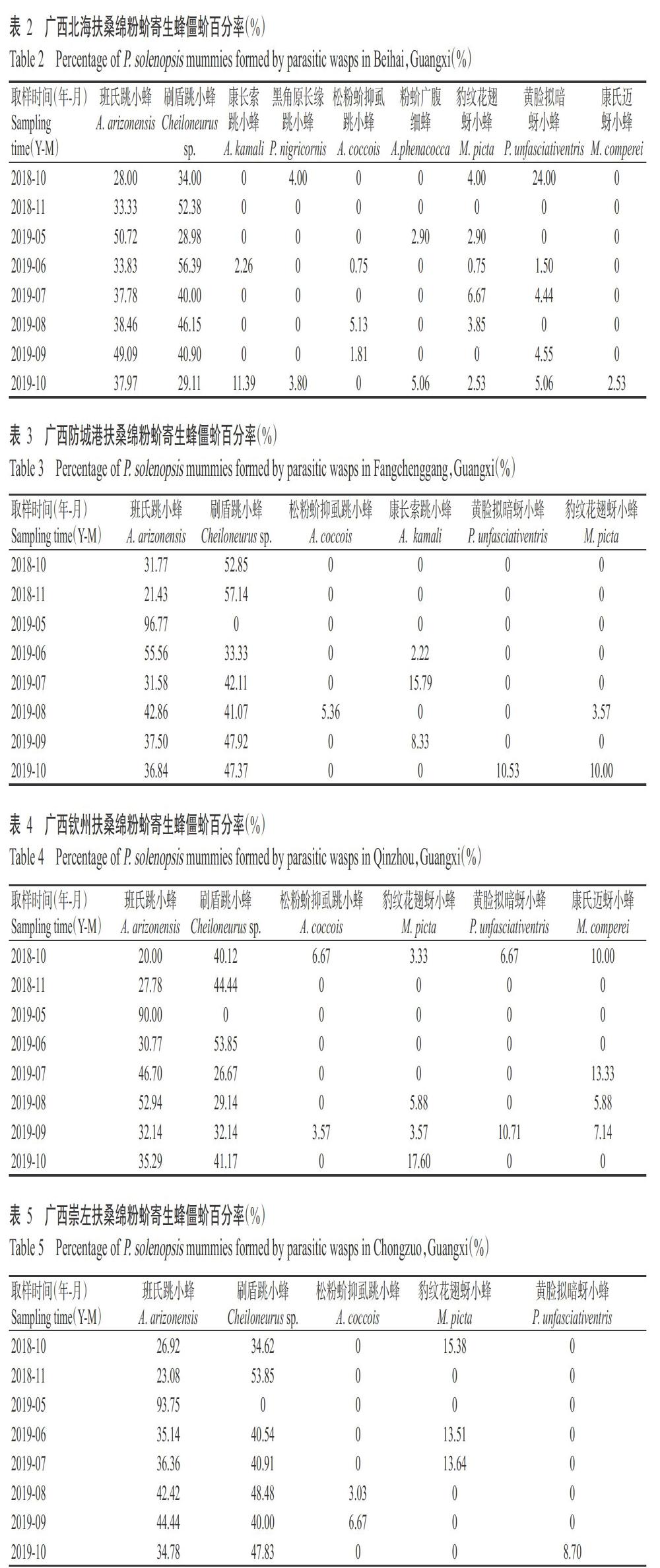
從表2可看出,廣西北海的寄生蜂資源最豐富,共采集到9種寄生蜂,其中跳小蜂科5種:班氏跳小蜂、康長(zhǎng)索跳小蜂、松粉蚧抑虱跳小蜂、黑角原長(zhǎng)緣跳小蜂和刷盾跳小蜂Cheiloneurus sp.;蚜小蜂科3種:豹紋花翅蚜小蜂、康氏邁蚜小蜂和黃臉擬暗蚜小蜂;廣腹細(xì)蜂科1種:粉蚧廣腹細(xì)蜂。班氏跳小蜂和刷盾跳小蜂Cheiloneurus sp.為優(yōu)勢(shì)種,二者寄生的僵蚧所占比例最高;除2019年5、9和10月外,其他調(diào)查月份刷盾跳小蜂Cheiloneurus sp.寄生的僵蚧比例均最高;其余7種寄生蜂比例較低,其中康氏邁蚜小蜂僅采集到1次。
從表3可看出,在廣西防城港采集到6種寄生蜂,其中跳小蜂4種:班氏跳小蜂、刷盾跳小蜂Cheiloneurus sp.、松粉蚧抑虱跳小蜂和康長(zhǎng)索跳小蜂;蚜小蜂2種:豹紋花翅蚜小蜂和黃臉擬暗蚜小蜂。班氏跳小蜂和刷盾跳小蜂Cheiloneurus sp.為優(yōu)勢(shì)種,二者寄生的僵蚧所占比例最高;除2019年5、6和8月外,其他調(diào)查月份刷盾跳小蜂Cheiloneurus sp.寄生的僵蚧比例均最高;其余4種寄生蜂比例較低,其中松粉蚧抑虱跳小蜂和黃臉擬暗蚜小蜂僅采集到1次。
從表4可知,在廣西欽州采集到6種寄生蜂,其中跳小蜂3種:班氏跳小蜂、刷盾跳小蜂Cheiloneurus sp.和松粉蚧抑虱跳小蜂;蚜小蜂3種:豹紋花翅蚜小蜂、黃臉擬暗蚜小蜂和康氏邁蚜小蜂。班氏跳小蜂和刷盾跳小蜂Cheiloneurus sp.為優(yōu)勢(shì)種,二者寄生的僵蚧所占比例最高,且二者交替占優(yōu)勢(shì),其余4種寄生蜂比例較低。
從表5可知,在廣西崇左采集到5種寄生蜂,其中跳小蜂3種:班氏跳小蜂、刷盾跳小蜂Cheiloneurus sp.和松粉蚧抑虱跳小蜂;蚜小蜂2種:豹紋花翅蚜小蜂和黃臉擬暗蚜小蜂。班氏跳小蜂和刷盾跳小蜂Cheiloneurus sp.為優(yōu)勢(shì)種,二者寄生的僵蚧所占比例最高;除2019年5和9月外,刷盾跳小蜂Cheiloneurus sp.寄生的僵蚧比例均最高;其余3種寄生蜂比例較低,只在部分月份采集到。
比較表2~表5可知,班氏跳小蜂、刷盾跳小蜂Cheiloneurus sp.、松粉蚧抑虱跳小蜂、豹紋花翅蚜小蜂和黃臉擬暗蚜小蜂分布較廣,在4個(gè)城市均有分布,其中班氏跳小蜂和刷盾跳小蜂Cheiloneurus sp.在各地均占優(yōu)勢(shì),調(diào)查期間二者寄生的僵蚧合計(jì)比例多超過(guò)80.00%,2019年5月班氏跳小蜂在各地均占絕對(duì)優(yōu)勢(shì),5和11月寄生蜂種類(lèi)相對(duì)較少。
2. 3 僵蚧數(shù)量和寄生蜂的寄生率
由圖1可看出,廣西北海扶桑綿粉蚧僵蚧數(shù)量和寄生蜂的寄生率在各次調(diào)查中均最高,除2018年11月外,其余時(shí)間寄生蜂的寄生率均不低于10.00%。其余3個(gè)城市扶桑綿粉蚧僵蚧數(shù)量和寄生蜂的寄生率在各次調(diào)查中較接近,崇左2019年9月、防城港2019年6、8和9月的寄生率分別為10.00%、10.00%、12.44%和10.67%,其他時(shí)間這3個(gè)城市的寄生率均低于10.00%。寄生蜂的寄生率總體不高,北海2019年6月的寄生率在4個(gè)城市各次調(diào)查中最高,也僅為29.56%。
3 討論
探明寄生蜂種類(lèi)、數(shù)量和控制效果是利用寄生蜂進(jìn)行生物防治的前提。本研究通過(guò)野外1周年系統(tǒng)調(diào)查,較全面地掌握了廣西朱槿上扶桑綿粉蚧寄生蜂的種類(lèi)、動(dòng)態(tài)、分布及寄生情況,為寄生蜂的應(yīng)用提供了基礎(chǔ)數(shù)據(jù)。本次野外調(diào)查共采集到9種寄生蜂,其中跳小蜂科5種:班氏跳小蜂、康長(zhǎng)索跳小蜂、松粉蚧抑虱跳小蜂、黑角原長(zhǎng)緣跳小蜂和刷盾跳小蜂Cheiloneurus sp.;蚜小蜂科3種:豹紋花翅蚜小蜂、康氏邁蚜小蜂和黃臉擬暗蚜小蜂;廣腹細(xì)蜂科1種:粉蚧廣腹細(xì)蜂。松粉蚧抑虱跳小蜂(火炬松短索跳小蜂)由廣東省森林病蟲(chóng)害防治與檢疫總站于1996年從美國(guó)引進(jìn)用以防治濕地松粉蚧,并在野外成功建立種群(方天松等,2014),認(rèn)為松粉蚧抑虱跳小蜂具有較強(qiáng)的適應(yīng)能力。陳華燕等(2011)對(duì)廣東和海南扶桑綿粉蚧的天敵進(jìn)行調(diào)查,共發(fā)現(xiàn)4種寄生蜂:松粉蚧抑虱跳小蜂、班氏跳小蜂、長(zhǎng)崎原長(zhǎng)緣跳小蜂和粉蚧廣腹細(xì)蜂;余海濱等(2015)對(duì)廣東9種園林植物上扶桑綿粉蚧的天敵進(jìn)行調(diào)查,共采集到3種寄生蜂:松粉蚧抑虱跳小蜂、班氏跳小蜂和粉蚧廣腹細(xì)蜂。其中松粉蚧抑虱跳小蜂、班氏跳小蜂和粉蚧廣腹細(xì)蜂在廣西也采集到樣本,說(shuō)明這3種寄生蜂分布范圍更廣,也證實(shí)了松粉蚧抑虱跳小蜂具有較強(qiáng)的環(huán)境適應(yīng)能力和擴(kuò)散能力。豹紋花翅蚜小蜂在遼寧省大豆蚜蟲(chóng)(Aphis glycines Matsumura)上有報(bào)道,數(shù)量較少,發(fā)生時(shí)間為7月中旬—8月上旬(席玉強(qiáng),2010)。康氏邁蚜小蜂在我國(guó)首次采集于福建的龜蠟蚧和扶桑綿粉蚧上(阮用穎等,2012),Viggiani和Ren(1993)首次報(bào)道中國(guó)新種黃臉擬暗蚜小蜂,并對(duì)其進(jìn)行簡(jiǎn)單描述,本研究是這2種寄生蜂在我國(guó)的第二次報(bào)道。康長(zhǎng)索跳小蜂和黑角原長(zhǎng)緣跳小蜂在我國(guó)目前尚無(wú)報(bào)道,屬于新紀(jì)錄種,可能是隨扶桑綿粉蚧入侵而定殖;刷盾跳小蜂Cheiloneurus sp.為未報(bào)道新種,有關(guān)描述另文報(bào)道。
在印度,已報(bào)道扶桑綿粉蚧寄生蜂12種,分別為班氏跳小蜂、康長(zhǎng)索跳小蜂、黃臉擬暗蚜小蜂、Metaphycus sp.、A. bangaloricus、E. aurantii、P. pulchellus、A. dactylopii、A. mirzai、H. albiclavatus、C. kerrichi和P. leucopiscida(Nagrare et al.,2011),其中班氏跳小蜂、康長(zhǎng)索跳小蜂和黃臉擬暗蚜小蜂為廣西共有種。在以色列,已報(bào)道扶桑綿粉蚧寄生蜂4種,分別為班氏跳小蜂、A. californicus、P. squammulata和L. algirica(Spodek et al.,2018),其中班氏跳小蜂為廣西共有種。在伊朗,已報(bào)道扶桑綿粉蚧寄生蜂11種,分別為豹紋花翅蚜小蜂、班氏跳小蜂、黃臉擬暗蚜小蜂、A. aligarhensis、B. serratellus、H. flaminius、L. dactylopii、L. mayri、P. aegyptiacus、P. rex和C. kurdjumovi(Torfi et al.,2020),其中豹紋花翅蚜小蜂、班氏跳小蜂和黃臉擬暗蚜小蜂為廣西共有種。從全球范圍看,扶桑綿粉蚧寄生蜂資源豐富,班氏跳小蜂、豹紋花翅蚜小蜂和黃臉擬暗蚜小蜂分布范圍廣,國(guó)外許多種目前我國(guó)尚無(wú)報(bào)道,因此,對(duì)于寄生率高的種,可考慮引入國(guó)內(nèi),在進(jìn)行安全性評(píng)價(jià)后用以防治扶桑綿粉蚧。
現(xiàn)有的大量文獻(xiàn)只報(bào)道了班氏跳小蜂為扶桑綿粉蚧的優(yōu)勢(shì)寄生蜂(Kumar et al.,2009;Nagrare et al.,2011;Prasad et al.,2011;余海濱等,2015;Spodek et al.,2018),本研究發(fā)現(xiàn)在廣西除班氏跳小蜂外,新種刷盾跳小蜂Cheiloneurus sp.寄生導(dǎo)致的僵蚧數(shù)量與班氏跳小蜂相近,且其為群居寄生蜂,個(gè)體數(shù)量遠(yuǎn)多于班氏跳小蜂,也是扶桑綿粉蚧的優(yōu)勢(shì)寄生蜂。在以色列,2017年夏季,野外班氏跳小蜂對(duì)扶桑綿粉蚧的寄生水平較高,多地寄生率達(dá)100%,由于班氏跳小蜂的寄生作用,使扶桑綿粉蚧的種群數(shù)量急劇降低(Spodek et al.,2018)。在巴基斯坦,多種植物上班氏跳小蜂對(duì)扶桑綿粉蚧的寄生率接近90%,不施用殺蟲(chóng)劑情況下,班氏跳小蜂可將扶桑綿粉蚧控制在危害水平之下(Khuhro et al.,2011)。在我國(guó)廣東,野外寄主密度高時(shí)班氏跳小蜂對(duì)扶桑綿粉蚧雌成蟲(chóng)的寄生率可達(dá)60%以上(余海濱等,2015)。在印度,田間班氏跳小蜂對(duì)扶桑綿粉蚧的平均寄生率為57.2%(Kumar et al.,2009),其余種類(lèi)寄生蜂的田間寄生率幾乎均低于10%(Nagrare et al.,2011);本研究發(fā)現(xiàn),除班氏跳小蜂和刷盾跳小蜂Cheiloneurus sp.的寄生率稍高外,其余7種寄生蜂的僵蚧比例大多低于10.00%,與印度的情況類(lèi)似。究其原因可能是氣候或寄主植物的差異所造成,本研究中,2019年6月廣西北海寄生蜂的寄生率最高,也只有29.56%,遠(yuǎn)低于文獻(xiàn)報(bào)道的班氏跳小蜂單一寄生蜂的寄生率。同樣的情況出現(xiàn)在印度安得拉邦瓦朗加爾市,Prasad等(2011)調(diào)查了不同時(shí)期班氏跳小蜂對(duì)不同寄主植物上扶桑綿粉蚧的寄生率,發(fā)現(xiàn)班氏跳小蜂的寄生率較低,大多在10.0%以下(其中在朱槿上的寄生率最高,僅11.1%),遠(yuǎn)低于印度其他地方的寄生率,也說(shuō)明寄生蜂的寄生率在不同地方存在差異。班氏跳小蜂具有溫度適應(yīng)范圍廣(2~45 ℃)、寄主專(zhuān)一性強(qiáng)、繁殖速度快于寄主、生活史短、雌性比率高、寄主搜索能力強(qiáng)、寄生率高、易人工飼養(yǎng)、擴(kuò)散能力強(qiáng)及與寄主生活史同步等特點(diǎn)(Nagrare et al.,2011),可能是其廣泛分布,成為優(yōu)勢(shì)寄生蜂并在多地成功控制扶桑綿粉蚧的主要原因。雨季后,氣溫25~29 ℃,相對(duì)濕度68%~73%,最適宜班氏跳小蜂生長(zhǎng)發(fā)育(Karmakar and Shera,2018)。廣西5~9月(7月雨水多,情況特殊)總體上僵蚧數(shù)量和寄生蜂寄生率較高,可能是氣候條件利于扶桑綿粉蚧寄生蜂種群擴(kuò)增。廣西寄生蜂羽化率較高,但寄生蜂總體寄生率較低,推測(cè)是春季寄生蜂繁殖基數(shù)較低所致。目前關(guān)于班氏跳小蜂的文獻(xiàn)相對(duì)較多,但如何實(shí)現(xiàn)其規(guī)模化繁殖、春季在野外大量釋放、提高起始蟲(chóng)源基數(shù)、提升防控效果,是下一步研究的重點(diǎn)。新發(fā)現(xiàn)種刷盾跳小蜂Cheiloneurus sp.作為扶桑綿粉蚧的優(yōu)勢(shì)寄生蜂,尚需加大研究力度,充分發(fā)揮其生防潛能。
4 結(jié)論
廣西扶桑綿粉蚧寄生蜂資源豐富,共采集到9種寄生蜂,其中跳小蜂科5種:班氏跳小蜂、康長(zhǎng)索跳小蜂、松粉蚧抑虱跳小蜂、黑角原長(zhǎng)緣跳小蜂和刷盾跳小蜂Cheiloneurus sp.;蚜小蜂科3種:豹紋花翅蚜小蜂、康氏邁蚜小蜂和黃臉擬暗蚜小蜂;廣腹細(xì)蜂科1種:粉蚧廣腹細(xì)蜂。康長(zhǎng)索跳小蜂和黑角原長(zhǎng)緣跳小蜂為我國(guó)新紀(jì)錄種,刷盾跳小蜂Cheiloneurus sp.為新發(fā)現(xiàn)種。班氏跳小蜂和刷盾跳小蜂Cheiloneurus sp.在個(gè)體數(shù)量和僵蚧比例方面均較高,為扶桑綿粉蚧優(yōu)勢(shì)寄生蜂。在廣西,5~9月為寄生蜂發(fā)生高峰期,寄生蜂的羽化率較高,但總體寄生率偏低,對(duì)扶桑綿粉蚧的控制能力有限,寄生蜂的生防潛力有待進(jìn)一步挖掘。
參考文獻(xiàn):
陳紅松,黃立飛,姜建軍,周忠實(shí),王偉蘭,孟醒,楊朗. 2019. 扶桑綿粉蚧寄主選擇行為及其與寄主葉片生化物質(zhì)含量的相關(guān)性[J]. 南方農(nóng)業(yè)學(xué)報(bào),50(4): 768-774. [Chen H S,Huang L F,Jiang J J,Zhou Z S,Wang W L,Meng X,Yang L. 2019. Host selection behavior of Phenacoccus solenopsis Tinsley and its correlation with the contents of biochemical substances in host leaves[J]. Journal of Southern Agriculture,50(4): 768-774.]
陳華燕,何嫏芬,鄭春紅,李盼,易晴輝,許再福. 2011. 廣東和海南扶桑綿粉蚧的天敵調(diào)查[J]. 環(huán)境昆蟲(chóng)學(xué)報(bào),33(2): 269-272. [Chen H Y,He L F,Zheng C H,Li P,Yi Q H,Xu Z F. 2011. Survey on the natural enemies of mealybug,Phenacoccus solenopsis Tinsley(Hemiptera:Pseudococcidae) from Guangdong and Hainan,China[J]. Journal of Environmental Entomology,33(2): 269-272.]
方天松,余海濱,潘志萍,徐家雄. 2014. 濕地松粉蚧引進(jìn)天敵在廣東林間定居情況的調(diào)查[J]. 環(huán)境昆蟲(chóng)學(xué)報(bào),36(2): 271-275. [Fang T S,Yu H B,Pan Z P,Xu J X. 2014. Investigation settlement of introduced enemies of Oracella acuta (Lobdell) in Guangdong forest[J]. Journal of Environmental Entomology,36(2): 271-275.]
羅麗林,李莉. 2018. 寄生蜂適應(yīng)性生殖行為策略的研究進(jìn)展[J]. 河南農(nóng)業(yè)科學(xué),47(6):7-12. [Luo L L,Li L. 2018. Research progress on adaptive reproductive behavior stra-tegies of parasitic wasps[J]. Journal of Henan Agricultural Sciences,47(6): 7-12.]
孟醒,桂富榮,陳斌. 2018. 云南扶桑綿粉蚧的發(fā)生及防治[J]. 生物安全學(xué)報(bào),27(4): 236-239. [Meng X,Gui F R,Chen B. 2018. The occurrence and control of the invasive scale insect,Phenacoccus solenopsis Tinsley in Yunnan Province[J]. Journal of Biosafety,27(4): 236-239.]
孟醒,李金峰,黃立飛,姜建軍,楊朗,周忠實(shí),桂富榮,陳斌,陳紅松. 2019. 扶桑綿粉蚧在廣西的發(fā)生為害情況調(diào)查[J]. 南方農(nóng)業(yè)學(xué)報(bào),50(5): 1021-1027. [Meng X,Li J F,Huang L F,Jiang J J,Yang L,Zhou Z S,Gui F R,Chen B,Chen H S. 2019. Occurrence and damage of co-tton mealybug Phenacoccus solenopsis Tinsley(Hemi-ptera: Pseudococcidae) in Guangxi[J]. Journal of Southern Agriculture,50(5): 1021-1027.]
阮用穎,王竹紅,黃建. 2012. 中國(guó)蚜小蜂科一新紀(jì)錄屬及一新紀(jì)錄種(膜翅目,小蜂總科)[J]. 動(dòng)物分類(lèi)學(xué)報(bào),37(2): 456-459. [Ruan Y Y,Wang Z H,Huang J. 2012. A new record genus and species of Aphelinidae(Hymenoptera,Chalcidoidea) from China[J]. Acta Zootaxonomica Sinica,37(2): 456-459.]
時(shí)振亞,申效誠(chéng). 1995. 寄生蜂鑒定[M]. 北京: 中國(guó)農(nóng)業(yè)科技出版社. [Shi Z Y,Shen X C. 1995. Identification of parasitic wasps[M]. Beijing: China Agricultural Science and Technology Press.]
武三安,張潤(rùn)志. 2009. 威脅棉花生產(chǎn)的外來(lái)入侵新害蟲(chóng)——扶桑綿粉蚧[J]. 昆蟲(chóng)知識(shí),46(1): 159-162. [Wu S A,Zhang R Z. 2009. A new invasive pest,Phenacoccus solenopsis threatening seriously to cotton production[J]. Chinese Bulletin of Entomology,46(1): 159-162.]
席玉強(qiáng). 2010. 豆柄瘤蚜繭蜂Lysiphlebus fabarum Marshall田間發(fā)生動(dòng)態(tài)及繁育技術(shù)研究[D]. 鄭州: 河南農(nóng)業(yè)大學(xué). [Xi Y Q. 2010. The occurrence of Lysiphlebus fabarum Marshall in soybean field and its feeding technology[D]. Zhengzhou: Henan Agricultural University.]
徐志宏,黃建. 2004. 中國(guó)介殼蟲(chóng)寄生蜂志[M]. 上海: 上海科學(xué)技術(shù)出版社. [Xu Z H,Huang J. 2004. Chinese fauna of parasitic wasps on scale insects[M]. Shanghai: Shanghai Scientific & Technical Publishers.]
余海濱,梁偉莎,方天松,潘志萍. 2015. 廣東省扶桑綿粉蚧對(duì)園林植物為害及其天敵的調(diào)查[J]. 環(huán)境昆蟲(chóng)學(xué)報(bào),37(5): 1109-1112. [Yu H B,Liang W S,F(xiàn)ang T S,Pan Z P. 2015. Investigation of damage and its natural enemies of Phenacoccus solenopsis Tinsley on garden plants in Guangdong Province[J]. Journal of Environmental Entomology,37(5): 1109-1112.]
張潤(rùn)志,王福祥. 2010. 扶桑綿粉蚧(棉花粉蚧)[M]. 北京: 中國(guó)農(nóng)業(yè)出版社. [Zhang R Z,Wang F X. 2010. Phenacoccus solenopsis Tinsley(cotton mealybug)[M]. Beijing: China Agriculture Press.]
Afzal M B,Shad S A,Ejaz M,Serrao J E. 2020. Laboratory selection,cross-resistance,and estimations of realized heri-tability of indoxacarb resistance in Phenacoccus solenopsis(Homoptera: Pseudococcidae)[J]. Pest Management Science,76(1): 161-168.
Asogwa E U,Ndubuaku T C N,Ugwu J A,Awe O O. 2010. Prospects of botanical pesticides from neem,Azadirachta indica for routine protection of cocoa farms against the brown cocoa mirid–Sahlbergella singularis in Nigeria[J]. Journal of Medicinal Plants Research,4(1): 1-6.
Badshah H,Ullah F,Calatayud P A,Ullah H,Ahmad B. 2017. Can toxicants used against cotton mealybug Phenacoccus solenopsis be compatible with an encyrtid parasitoid Aenasius bambawalei under laboratory conditions?[J]. Environmental Science and Pollution Research,24(6): 5857-5867.
Badshah H,Ullah F,Calatayud P A,Ullah H,Bashir A. 2018. Influence of the host plant on the encyrtid Aenasius bambawalei,a parasitoid used to control the cotton mealybug,Phenacoccus solenopsis,in Pakistan[J]. Pakistan Journal of Zoology,50(1): 207-216.
Chen H S,Yang L,Huang L F,Wang W L,Hu Y,Jiang J J,Zhou Z S. 2015. Temperature- and relative humidity-dependent life history traits of Phenacoccus solenopsis(Hemiptera: Pseudococcidae) on Hibiscus rosa-sinensis (Malvales:Malvaceae)[J]. Environmental Entomology,44(4): 1230-1239.
Chen H Y,Liu J X,Xu Z F. 2011. Description of a new platygastrid parasitoid Allotropa phenacocca(Hymenoptera) on Phenacoccus solenopsis Tinsley(Hemiptera: Pseudococcidae)[J]. Oriental Insects,45(2-3): 275-280.
Ejaz M,Ullah S,Shad S A,Abbas N,Binyameen M. 2019. Characterization of inheritance and preliminary biochemical mechanisms of spirotetramat resistance in Phenacoccus solenopsis Tinsley: An economic pest from Pakistan[J]. Pesticide Biochemistry and Physiology,156: 29-35.
Fand B B,Suroshe S S. 2015. The invasive mealybug Phenacoccus solenopsis Tinsley,a threat to tropical and subtropical agricultural and horticultural production systems–A review[J]. Crop Protection,69: 34-43.
He L F,Li P,Zhou Z S,Xu Z F. 2018. Temperature-dependent parasitism and development in Aenasius arizonensis Girault(Hymenoptera:Encyrtidae),a solitary endoparasi-toid of Phenacoccus solenopsis(Hemiptera: Pseudococcidae)[J]. International Journal of Pest Management,64(1): 45-50.
Iqbal M S,Abdin Z,Arshad M,Abbas S K,Tahir M,Jamil A,Manzoor A. 2016. The role of parasitoid age on the fecundity and sex ratio of the parasitoid,Aenasius bambawalei(Hayat)(Hymenoptera: Encyrtidae)[J]. Pakistan Journal of Zoology,48(1): 67-72.
Joodaki R,Zandi-Sohani N,Zarghami S,Yarahmadi F. 2018. Temperature-dependent functional response of Aenasius bambawalei(Hymenoptera: Encyrtidae) to different po-pulation densities of the cotton mealybug Phenacoccus solenopsis(Hemiptera: Pseudococcidae)[J]. European Journal of Entomology,115: 326-331.
Karmakar P,Shera P S. 2018. Seasonal and biological interactions between the parasitoid,Aenasius arizonensis(Girault) and its host,Phenacoccus solenopsis Tinsley on co-tton[J]. Phytoparasitica,46(5): 661-670.
Kaur H,Virk J S. 2011. Feeding potential of Cryptolaemus montrouzieri against the mealybug Phenacoccus solenopsis[J]. Phytoparasitica,40(2): 131-136.
Khuhro S N,Kalroo A M,Mahmood R. 2011. Present status of mealybug,Phenacoccus solenopsis(Tinsley) on cotton and other plants in Sindh(Pakistan)[J]. CABI,45: 268-271.
Kumar R,Kranthi K R,Monga D,Jat S L. 2009. Natural parasitization of Phenacoccus solenopsis Tinsley(Hemiptera: Pseudococcidae) on cotton by Aenasius bambawalei Hayat (Hymenoptera:Encyrtidae)[J]. Journal of Biological Control,23(4): 457-460.
Nagrare V S,F(xiàn)and B B,Naik V C B,Naikwadi B,Deshmukh V,Sinh D. 2019. Resistance development in cotton me-alybug,Phenacoccus solenopsis Tinsley(Hemiptera: Pseudococcidae) to insecticides from organophosphate,thiadia-zines and thiourea derivatives[J]. International Journal of Tropical Insect Science. doi: 10.1007/s42690-019-00068-9.
Nagrare V S,Kranthi S,Kumar R,Jothi B D,Amutha M,Deshmukh A J,Bisane K D,Kranthi K R. 2011. Compendium of cotton mealybugs[M]. Nagpur,India: Central Institute for Cotton Research.
Nagrare V S,Naikwadi B,Deshmukh V,Kranthi S. 2018. Bio-logy and population growth parameters of the cotton mealybug,Phenacoccus solenopsis Tinsley(Hemiptera: Pseudococcidae),on five host plant species[J]. Animal Biology,68(4): 333-352.
Prasad Y G,Prabhakar M,Sreedevi G,Thirupathi M. 2011. Spatio-temporal dynamics of the parasitoid,Aenasius bambawalei Hayat(Hymenoptera: Encyrtidae) on mealybug,Phenacoccus solenopsis Tinsley in cotton based cropping systems and associated weed flora[J]. Journal of Biological Control,25(3): 198-202.
Rezk M,Hassan A N T,El-Deeb M F,Shaarawy N,Dewer Y. 2019. The impact of insecticides on the cotton mealybug,Phenacoccus solenopsis(Tinsley): Efficacy on potato,a new record of host plant in Egypt[J]. Journal of Plant Protection Research,59(1): 1427-4345.
Saeed S,Ahmad M,Kwon Y J. 2007. Insecticidal control of the mealybug,Phenacoccus gossypiphilous(Hemiptera: Pseudococcidae) a new pest of cotton in Pakistan[J]. Entomological Research,37(2): 76-80.
Sahito H A,Abro G H,Mahmood R,Malik A Q. 2011. Survey of mealybug,Phenacoccus solenopsis(Tinsley) and effect of bio-ecological factors on its population in different ecological zones of Sindh[J]. Pakistan Journal of Agriculture Agricultural Engineering and Veterinary Sciences,27(1): 51-65.
Spodek M,Ben-Dov Y,Mondaca L,Protasov A,Erel E,Mendel Z. 2018. The cotton mealybug,Phenacoccus solenopsis Tinsley(Hemiptera: Pseudococcidae) in Israel:Pest status,host plants and natural enemies[J]. Phytoparasitica,46(1): 45-55.
Tong H J,Yan A,Li Z H,Wang Y,Jiang M X. 2019. Invasion biology of the cotton mealybug,Phenacoccus solenopsis Tinsley:Current knowledge and future directions[J]. Journal of Integrative Agriculture,18(4): 758-770.
Torfi E T,Rasekh A,Moravvej S A,Mossadegh M S,Rajabpoor A. 2020. Associated Chalcidoidea(Hymenoptera) with the cotton mealybug Phenacoccus solenopsis(Hemiptera: Pseudococcidae) in the southwestern Iran[J]. Journal of Crop Protection,9(1): 129-139.
Vennila S,Deshmukh A J,Pinjarkar D,Agarwal M,Ramamurthy V V,Joshi S,Kranthi K R,Bambawale O M. 2010. Biology of the mealybug,Phenacoccus solenopsis on co-tton in the laboratory[J]. Journal of Insect Science,10:1-10.
Viggiani G,Ren H. 1993. New species and records of Aphe-linidae(Hymenoptera:Chalcidoidea) from China[J]. Bo-llettino del Laboratorio di Entomologia Agraria“Filippo Silvestri”,Portici,48: 219-239.
Wang Y P,Watson G W,Zhang R Z. 2010. The potential distribution of an invasive mealybug Phenacoccus solenopsis and its threat to cotton in Asia[J]. Agricultural and Forest Entomology,12(4): 403-416.
Wang Y S,Dai T M,Tian H,Wan F H,Zhang G F. 2020. Range expansion of the invasive cotton mealybug,Phenacoccus solenopsis Tinsley: An increasing threat to agricultural and horticultural crops in China[J]. Journal of Integrative Agriculture,19(3): 881-885.
(責(zé)任編輯 麻小燕)