999精品在线视频,手机成人午夜在线视频,久久不卡国产精品无码,中日无码在线观看,成人av手机在线观看,日韩精品亚洲一区中文字幕,亚洲av无码人妻,四虎国产在线观看 ?

煙粉虱MEAM1隱種主要內共生菌的定位和分布

2020-06-08 09:41:12陳吉強張毅波張桂芬
植物保護 2020年2期

陳吉強 張毅波 張桂芬
摘要 煙粉虱MEAM 1隱種是一種重要的世界性入侵害蟲,共生菌在其種群入侵和擴張中起著不可忽視的作用。本研究采用熒光原位雜交技術(FISH),明確其攜帶的初生共生菌(Candidatus Portiera aleyrodidarum)和次生共生菌(Candidatus Hamiltonella defensa和Rickettsia sp.)在不同發育階段蟲體中的定位和分布。結果顯示,煙粉虱MEAM 1隱種卵、若蟲和成蟲3個階段均攜帶3種共生菌,Portiera和Hamiltonella菌集中分布于含菌細胞中,其中Hamiltonella呈環形包裹于含菌細胞周邊;Rickettsia既在菌胞中呈“集中”分布,也“隨機”分布于蟲體其他部位或器官。上述結果明確了這3種共生菌在MEAM 1煙粉虱各個發育階段的分布特征,同時證明3種共生菌均能通過煙粉虱雌蟲垂直傳播,為進一步揭示內共生菌在煙粉虱入侵過程中的作用打下基礎。

關鍵詞 煙粉虱; 共生菌; 熒光原位雜交; 垂直傳播

中圖分類號: S 433.3 ?文獻標識碼: A ?DOI: 10.16688/j.zwbh.2019072

Abstract Bemisia tabaci (Gennadius) MEAM 1 is one of the most devastating invasive pests worldwide and its endosymbionts play an important role in the invasion and expansion of this pest insect. In this study, the fluorescence in situ hybridization (FISH) was used to identify the localization and distribution of the primary endosymbiont (Candidatus Portiera aleyrodidarum) and the secondary endosymbionts (Candidatus Hamiltonella defensa and Rickettsia sp.) in different developmental stages of B.tabaci MEAM 1. Three symbiotic bacteria were found in the eggs,nymphs,and adults of B.tabaci MEAM 1. Among them, Portiera and Hamiltonella were located inside the bacteriocytes and Hamiltonella around the bacteriocyte. Rickettsia was located both inside the bacteriocyte and randomly distributed in other parts or organs. These results revealed the distribution characteristics of the three endosymbionts in different developmental stages of B.tabaci MEAM 1, and provided evidence that all the three endosymbionts are vertically transmitted through the female of B.tabaci, and thus lay a foundation for further understanding the roles of endosymbionts in the invasion of B.tabaci.

Key words Bemisia tabaci; endosymbionts; fluorescence in situ hybridization; vertically transmitted

煙粉虱Bemisia tabaci (Gennadius)屬半翅目Hemiptera,粉虱科Aleyrodidae,是一種典型高度多食性的取食植物韌皮部汁液的世界性入侵害蟲。煙粉虱通過直接取食為害植物每年可導致數億美元的經濟損失,還可傳播100多種植物病毒及分泌蜜露污染植物[1-4]。煙粉虱被認為是一個獨特的,由超過35種形態上難以區分的隱種組成的復合種[5-9]。煙粉虱隱種以前被稱為生物型,其中在我國分布最廣泛的入侵種是B型和Q型,而B型也被稱為“中東-小亞細亞1”隱種(MEAM 1)或者Bemisia argentifolii,Q型也被稱為“地中海”隱種(MED)[10]。在過去的30年里,這兩個隱種在世界范圍造成了巨大的農業損失[11-12]。

煙粉虱MEAM 1隱種在20世紀90年代中期傳入我國,并且很快取代了中國本地種,而MED隱種于2003年第一次在我國云南昆明的觀賞性植物一品紅上被檢測到[13]。之后,MED隱種在許多省市和區域逐漸取代了MEAM 1隱種。從2008年起,在我國大部分地區的煙粉虱種群變成了以MED隱種為主[14-15];而煙粉虱MEAM 1隱種主要分布于我國長江以南和西南沿海地區,包括廣東、福建、浙江等省份,另外新疆、甘肅和遼寧等地區也零星分布[4]。MEAM 1隱種具有較高的入侵能力和競爭力,MED隱種的入侵性較差,但其具有較強的抗藥性[16-18]。有研究表明雙重感染Rickettsia-Arsenophonus菌或Wolbachia-Arsenophonus菌的MED煙粉虱對啶蟲脒、噻蟲嗪、吡蟲啉和螺甲螨酯的抗藥性較高[19]。這可能是MED隱種取代MEAM 1隱種成為我國主要入侵煙粉虱的原因之一。近年來,也有研究者認為,共生菌在煙粉虱種群擴散和入侵方面發揮了重要作用,因此,可把內共生菌作為對象來研究其對煙粉虱不同隱種的生物學特性、入侵能力及隱種間取代的影響[20-21]。

煙粉虱體內的共生菌分為初生內共生菌和次生內共生菌。初生內共生菌為“Candidatus Portiera aleyrodidarum”,能夠為其提供維持生命所需的必需氨基酸和類胡蘿卜素來彌補取食韌皮部汁液所缺乏的營養[22-24]。此外,不同煙粉虱隱種通常還含有不同的次生內共生菌,因此,煙粉虱復合種中可能含有一種或多種次生內共生菌,目前已在煙粉虱復合種中發現了7屬/種次生內共生菌,分別命名為Candidatus Hamiltonella defensa、Candidatus Wolbachia spp.、Arsenophonus spp.、Candidatus Cardinium hertigii、Candidatus Fritschea bemisiae、Rickettsia sp.和Candidatus Hemipteriphilus asiaticus[25-29]。目前對煙粉虱次生內共生菌的研究主要集中在其傳播方式、分布形式以及功能上[20,25,30-34]。煙粉虱次生內共生菌的功能主要表現在提高煙粉虱的適合度(包括產卵量、存活率和性比偏雌性)[32-33]、高溫耐受性和提高番茄黃化曲葉病毒(TYLCV)的傳播速率[34]以及增加煙粉虱的抗藥性[35]等方面。煙粉虱次生內共生菌是一個復雜的群體,其可隨物種、寄主植物和地理分布的不同而變化[32]。例如,以色列的MEAM 1隱種攜帶有Hamiltonella和Rickettsia菌,而MED隱種則攜帶Rickettsia、Wolbachia和Arsenophonus菌,但Cardinium和Fritschea菌在這兩個隱種中均未檢測到,并且鼠尾草上的MED隱種中Rickettsia和Arsenophonus菌的感染率顯著高于其他寄主植物上的MED隱種[36]。在我國,除了Fritschea菌外,Wolbachia、Rickettsia、Hamiltonella、Cardinium和Arsenophonus菌在MEAM 1和MED隱種中均能檢測到,其中Hamiltonella菌在兩個種群中的感染率均最高,Arsenophonus卻相反,并且Wolbachia、Rickettsia和Hamiltonella的感染率在MEAM 1中顯著高于MED隱種,而在MEAM 1中,Cardinium的感染率卻顯著低于MED隱種[21]。

目前,針對我國煙粉虱MEAM1隱種體內主要共生菌的定位和分布還不是很清楚。本研究選取我國境內的煙粉虱MEAM 1隱種為對象,采用熒光原位雜交技術(fluorescence in situ hybridization,簡稱FISH技術),明確煙粉虱MEAM1隱種體內3種主要內共生菌Portiera、Hamiltonella和Rickettsia的具體定位和分布,研究結果將為進一步揭示內共生菌對煙粉虱生活史和入侵能力的影響打下基礎。

1 材料與方法

1.1 供試昆蟲

試驗使用的原始種群于2017年采自中國甘肅酒泉。參照羅晨等[37]的方法,采用分子方法對種群進行鑒定,確定為MEAM 1隱種,同時建立室內種群。

1.2 供試植物

寄主植物為棉花Gossypium spp.,品種為‘創優棉168。將種子播種至塑料花盆中,每盆3粒,并置于大型養蟲籠中,保證寄主植物的清潔。培養條件:28℃±2℃,相對濕度:70%~80%。待棉花長出4~6片葉時供試。

1.3 試驗方法

1.3.1 探針的制備

本試驗所使用的不同共生菌的探針序列如下:初生內共生菌Portiera:5′-Cy3-TGTCAGTGTCAGCCCAGAAG-3′,次生內共生菌Rickettsia:5′-Cy5-TCCACGTCGCCGTCTTGC-3′,Hamiltonella:5′- Cy5-CCAGATTCCCAGACTTTACTCA-3′[38],探針由生工生物工程(上海)股份有限公司合成。

1.3.2 各階段蟲態的收集

在顯微鏡下用解剖針分別挑取卵、不同齡期若蟲100頭,用吸蟲管取成蟲若干頭,置于1.5 mL的離心管中,3個重復。卵從卵柄部位進行挑取,其他齡期若蟲從蟲體一側進行挑取。

1.3.3 原位雜交

首先將收集的樣本分別置于適量Carnoy固定液中過夜處理,然后棄掉固定液;用50%乙醇漂洗3次;加入200 μL Triton X-100(細胞滲透液),金屬浴35℃,30 min,然后棄掉細胞滲透液;加入400 μL蛋白酶K,金屬浴56℃,30 min,然后棄掉蛋白酶K;加入適量的Carnoy固定液固定過夜,棄掉后加入200 μL含有6% H2O2的乙醇溶液4℃過夜處理;用雜交緩沖液洗滌3次,加入100 μL雜交緩沖液和50 μL 10 pmol/mL熒光探針,金屬浴60℃,避光處理24 h;雜交緩沖液洗滌2次。

采用LSM T-PMT Carl Zeiss蔡司激光共聚焦顯微880觀察拍照,Carl Zeiss蔡司照片處理軟件ZEN 2012對照片進行處理。

2 結果與分析

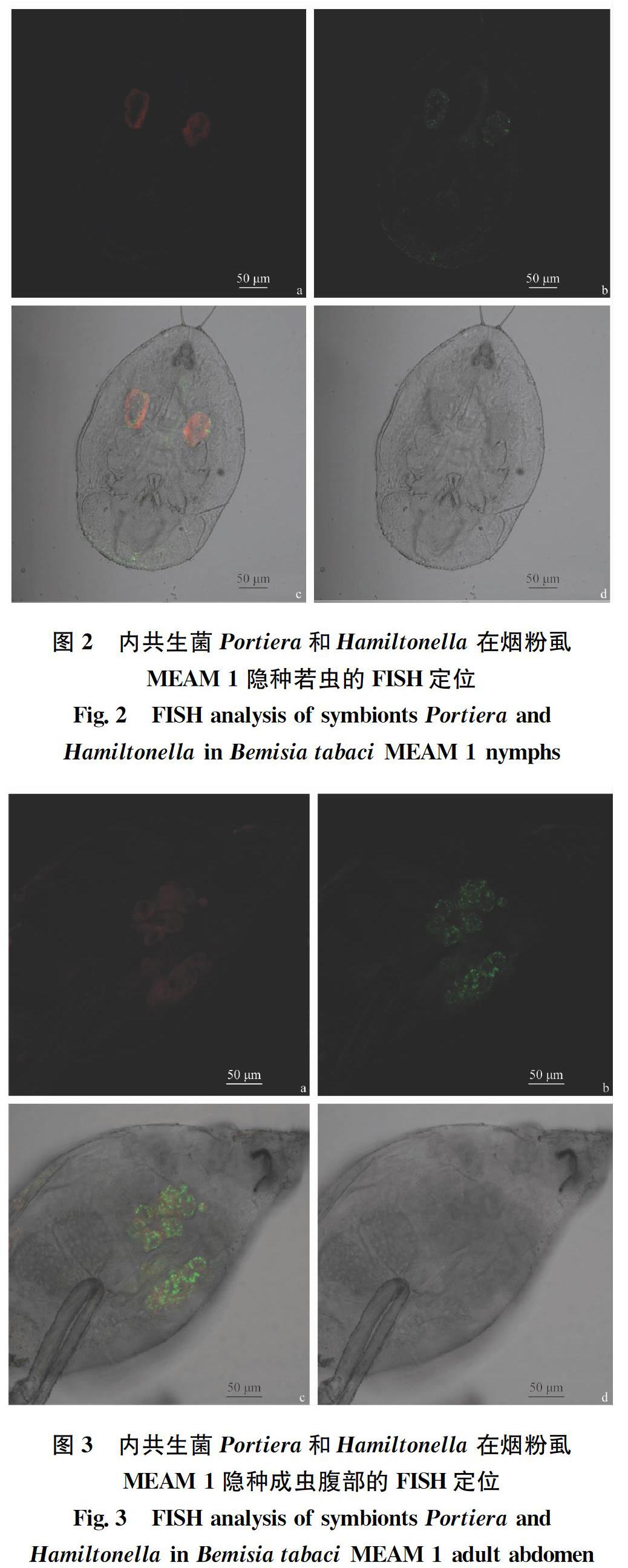
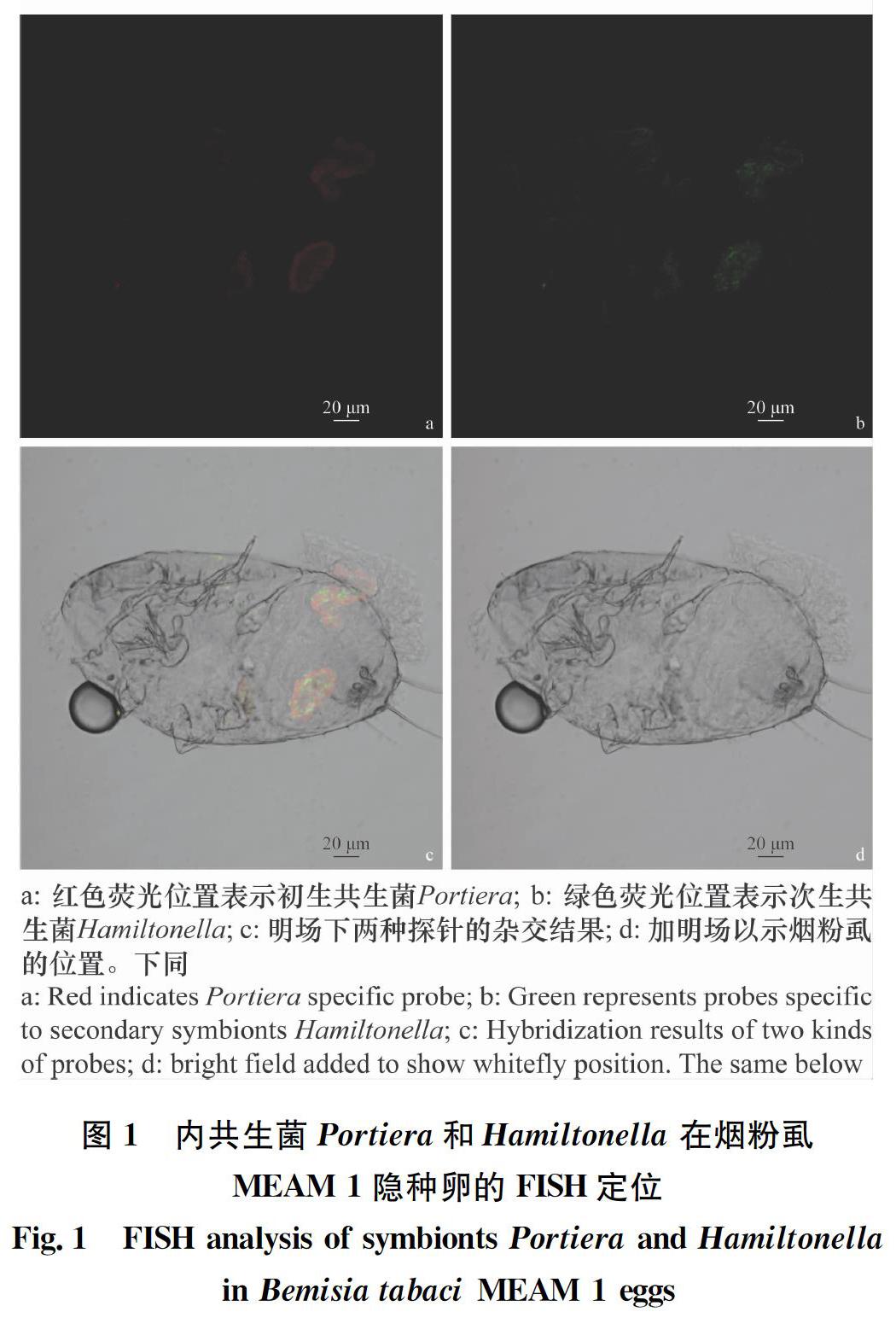
2.1 煙粉虱MEAM 1隱種中Portiera和Hamiltonella的定位 ?經FISH檢測Portiera和Hamiltonella在煙粉虱MEAM 1隱種卵(圖1)、若蟲(圖2)和成蟲(圖3)3個階段均有分布,且兩種共生菌均“集中”分布于含菌細胞內,其中Portiera聚集分布于含菌細胞的中心部位,Hamiltonella呈環形包裹于含菌細胞周邊。

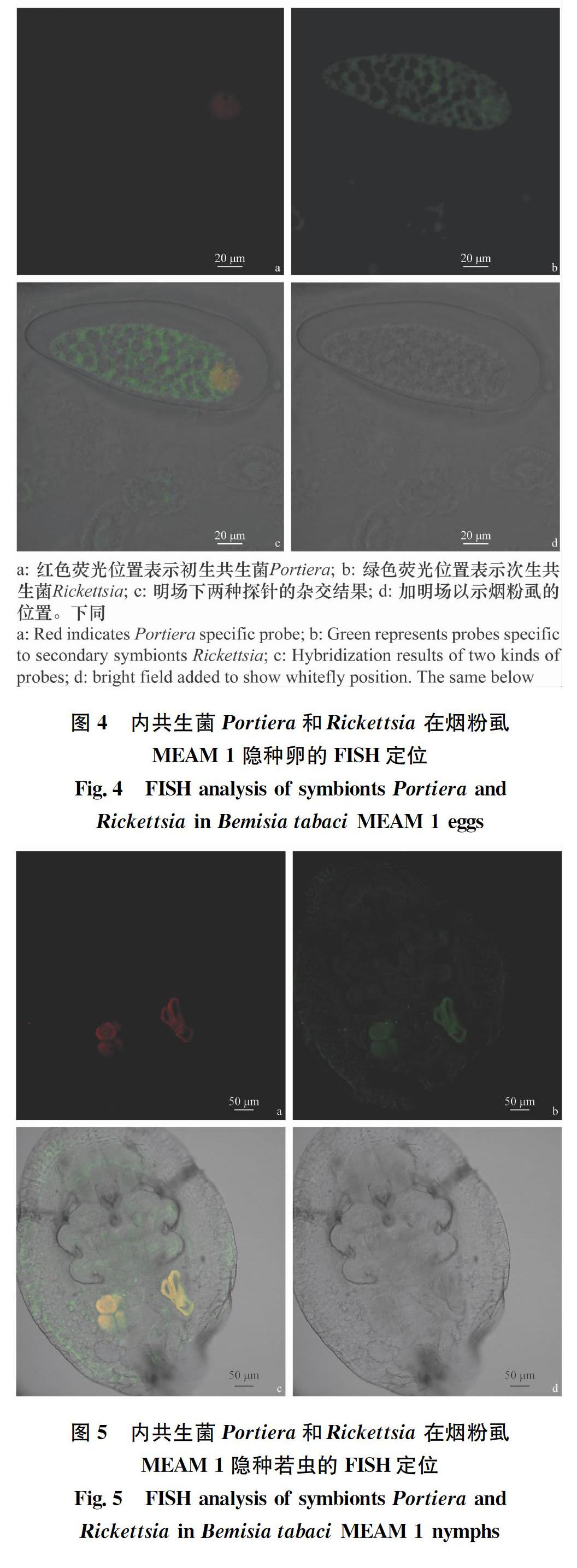
2.2 煙粉虱MEAM1隱種攜帶Portiera和Rickettsia的定位 ?經FISH檢測發現Portiera和Rickettsia在煙粉虱MEAM 1隱種各蟲態均有分布,初生內共生菌Portiera“集中”分布于含菌細胞內,次生內共生菌Rickettsia分布在含菌細胞內,也“隨機”分布于蟲體其他部位或器官的兩種分布類型(圖4~6)。

3 討論

煙粉虱的初生內共生菌Portiera集中分布于含菌細胞中,能夠為煙粉虱補充植物韌皮部汁液中缺失的營養物質,比如類胡蘿卜素等。Gottlieb等[38]證實以色列的MEAM 1隱種和MED隱種的初生內共生菌均集中分布于含菌細胞中。Singh等[39]發現印度的Asia Ⅰ和Asia Ⅱ兩個隱種均攜帶有初生內共生菌且均集中分布于含菌細胞中。我們的試驗結果與前人的研究結果是一致的。

次生內共生菌Hamiltonella也廣泛分布于不同的煙粉虱隱種和不同地理種群中。在我國,除了幾種煙粉虱本地隱種外,入侵煙粉虱MEAM 1和MED兩種隱種均攜帶有此種內共生菌[40]。本研究結果發現入侵我國的煙粉虱MEAM 1隱種攜帶的次生共生菌Hamiltonella分布于含菌細胞中但呈環形分布,包裹在初生共生菌的周邊。Su等[41]發現我國煙粉虱MED種群攜帶有次生內共生菌Hamiltonella,且通過原位雜交技術證實該菌的分布特征跟初生共生菌Portiera類似,主要分布于含菌細胞中。Gottlieb等[38]和Singh等[39]均在不同煙粉虱隱種和不同地理種群中發現類似的結果。

本研究發現,煙粉虱MEAM 1隱種攜帶的Rickettsia不僅存在于含菌細胞中,還隨機分布于其他不同的器官和部位,證明Rickettsia在MEAM 1隱種中的分布包含“集中”分布和“隨機”分布兩種不同類型。類似地,Gottlieb等[25]對MEAM1 煙粉虱中不同發育階段的Rickettsia進行了定位觀察,發現在卵期、若蟲期以及成蟲期均有分布。蛹期煙粉虱的Rickettsia主要存在腸道中,成蟲期主要分布于腹部和腸道附近,集中分布于中腸中,推測其可能在食物消化過程中發揮作用;此外,Rickettsia還隨機分布于寄主全身[25]。然而,Brumin等[31]利用電子熒光顯微鏡來研究Rickettsia入侵的特性,發現除含菌細胞外,煙粉虱的消化器官、唾液腺、生殖器官均被感染;同時觀察到類似Rickettsia的信號附著在菌胞外表面并可能被菌胞吞噬,該現象與Munderloh和Kurtti[42]所報道的Rickettsia能通過引起吞噬泡的形成而頻繁地在寄主細胞和組織之間移動的結論一致。總之,昆蟲體內Rickettsia的分布研究為未知的細菌-昆蟲間特殊相互作用和可能的傳播途徑提供了線索。

共生菌在寄主中的傳播方式主要有水平傳播和垂直傳播兩種。Caspi-Fluger等[30]研究發現Rickettsia菌可以通過寄主轉移到植物韌皮部細胞中,植物作為Rickettsia菌水平傳播的儲存器介導了昆蟲與共生菌之間的水平傳播。而煙粉虱體內攜帶的內共生菌的垂直傳播與含菌細胞有密切聯系。Himler等[20]研究發現Rickettsia菌在煙粉虱體內通過母代垂直傳播率達到99.17%,在同一寄主植物上,感染Rickettsia菌的雄蟲與未感染的雌蟲之間沒有水平傳播。Brumin等[31]研究發現Rickettsia菌沒有分布在含菌細胞內,而是通過早期侵入卵母細胞并存在于卵泡細胞和細胞質中,待卵子成熟后,它大部分被排除在外,然而,一些細菌細胞留在卵子中,確保它們轉移到后代。Rickettsia菌的垂直傳播主要由卵母細胞介導而不是含菌細胞。初生內共生菌Portiera和次生內共生菌Hamiltonella存在于含菌細胞內[38-39],并通過煙粉虱雌蟲由含菌細胞垂直傳遞給子代。本研究結果證明3種共生菌均能通過煙粉虱雌蟲垂直傳播給子代,但是垂直傳播的過程和機制有待一進步研究。

利用熒光原位雜交技術對煙粉MEAM1隱種攜帶的初生內共生菌Portiera和次生內共生菌Hamiltonella和Rickettsia定位研究表明,在煙粉虱各個發育階段,3種內共生菌均有分布,其中Portiera和Hamiltonella集中分布于含菌細胞中,而Rickettsia既分布于含菌細胞中,也均勻分布于蟲體其他部位。這些結果一方面證明了3種共生菌均能通過煙粉虱雌蟲完成垂直傳播,同時也明確了這些共生菌在入侵煙粉虱MEAM 1隱種各個發育階段的分布特征,研究結果為進一步揭示內共生菌參與的煙粉虱入侵機制打下基礎。

參考文獻

[1] BROWN J K, FROHLICH D R, ROSELL R C. The sweet potato or silverleaf whiteflies: Biotypes of Bemisia tabaci or a species complex?[J]. Annual Review of Entomology, 1995, 40(1): 511-534.

[2] OLIVEIRA M R V, HENNEBERRY T J, ANDERSON P. History, current status, and collaborative research projects for Bemisia tabaci [J]. Crop Protection, 2001, 20(9): 709-723.

[3] JONES D R. Plant viruses transmitted by whiteflies [J]. European Journal of Plant Pathology, 2003, 109(3): 195-219.

[4] WAN Fanghao, YANG Nianwan. Invasion and management of agricultural alien insects in China [J]. Annual Review of Entomology, 2016, 61(1): 77-98.

[5] BOYKIN L M, SHATTERS R G J R, ROSELL R C, et al. Global relationships of Bemisia tabaci (Hemiptera: Aleyrodidae) revealed using Bayesian analysis of mitochondrial COI DNA sequences[J]. Molecular Phylogenetics and Evolution, 2007, 44(3): 1306-1319.

[6] DE BARRO P J, LIU Shusheng, BOYKIN L M, et al. Bemisia tabaci: a statement of species status [J]. Annual Review of Entomology, 2010, 56(1): 1-19.

[7] DINSDALE A, COOK L, RIGINOS C, et al. Refined global analysis of Bemisia tabaci (Hemiptera: Sternorrhyncha: Aleyrodoidea: Aleyrodidae) mitochondrial cytochrome oxidase 1 to identify species level genetic boundaries [J]. Annals of the Entomological Society of America, 2010, 103(2): 196-208.

[8] LIU Shusheng, COLVIN J, DE BARRO P J. Species concepts as applied to the whitefly Bemisia tabaci systematics: How many species are there?[J]. Journal of Integrative Agriculture, 2012, 11(2): 176-186.

[9] FIRDAUS S, VOSMAN B, HIDAYATI N, et al. The Bemisia tabaci species complex: additions from different parts of the world [J]. Insect Science, 2013, 20(6): 723-733.

[10] TAY W T, EVANS G A, BOYKIN L M, et al. Will the real Bemisia tabaci please stand up?[J/OL]. PLoS ONE, 2012, 7(11): e50550.

[11] DALTON R. Whitefly infestations: the christmas invasion[J]. Nature, 2006, 443(7114): 898-900.

[12] ZHANG Changrong, SHAN Hongwei, XIAO Na, et al. Differential temporal changes of primary and secondary bacterial symbionts and whitefly host fitness following antibiotic treatments [J/OL]. Scientific Reports, 2015, 5: 15898.

[13] CHU Dong, ZHANG Youjun, BROWN J K, et al. The introduction of the exotic Q biotype of Bemisia tabaci from the Mediterranean region into China on ornamental crops [J]. Florida Entomologist, 2006, 89(2): 168-174.

[14] CHU Dong, WAN Fanghao, ZHANG Youjun, et al. Change in the biotype composition of Bemisia tabaci in Shandong province of China from 2005 to 2008 [J]. Environmental Entomology, 2010, 39(3): 1028-1036.

[15] PAN Huipeng, CHU Dong, GE Daqing, et al. Further spread of and domination by Bemisia tabaci biotype Q on field crops in China [J]. Journal of Economic Entomology, 2011, 104(3): 978-985.

[16] PASCUAL S, CALLEJAS C. Intra- and interspecific competition between biotypes B and Q of Bemisia tabaci (Hemiptera: Aleyrodidae) from Spain[J]. Bulletin of Entomological Research, 2004, 94(4): 369-375.

[17] HOROWITZ A R, GORMAN K, ROSS G, et al. Inheritance of pyriproxyfen resistance in the whitefly, Bemisia tabaci (Q Biotype) [J]. Archives of Insect Biochemistry and Physiology, 2003, 54(4): 177-186.

[18] DENNEHY T J, DEGAIN B A, HARPOLD V S, et al. Extraordinary resistance to insecticides reveals exotic Q biotype of Bemisia tabaci in the New World [J]. Journal of Economic Entomology, 2010, 103(6): 2174-2186.

[19] GHANIM M, KONTSEDALOV S. Susceptibility to insecticides in the Q biotype of Bemisia tabaci is correlated with bacterial symbiont densities [J]. Pest Management Science, 2009, 65(9): 939-942.

[20] HIMLER A G, ADACHI-HAGIMORI T, BERGEN J E, et al. Rapid spread of a bacterial symbiont in an invasive whitefly is driven by fitness benefits and female bias [J]. Science, 2011, 332(6026): 254-256.

[21] CHU D, GAO C S, DE BARRO P, et al. Further insights into the strange role of bacterial endosymbionts in whitefly, Bemisia tabaci: comparison of secondary symbionts from biotypes B and Q in China [J]. Bulletin of Entomological Research, 2011, 101(4): 477-486.

[22] SLOAN D B, MORAN N A.Endosymbiotic bacteria as a source of carotenoids in whiteflies [J]. Biology Letters, 2012, 8(6): 986-989.

[23] SANTOS-GARCIA D, FARNIER P A, BEITIA F J, et al. Complete genome sequence of “Candidatus Portiera aleyrodidarum” BT-QVLC, an obligate symbiont that supplies amino acids and carotenoids to Bemisia tabaci [J]. Journal of Bacteriology, 2012, 194(23): 6654-6655.

[24] RAO Qiong, ROLLAT-FARNIER P A, ZHU Dantong, et al. Genome reduction and potential metabolic complementation of the dual endosymbionts in the whitefly Bemisia tabaci [J]. BMC Genomics, 2015, 16(1): 226-239.

[25] GOTTLIEB Y, GHANIM M, CHIEL E, et al. Identification and localization of a Rickettsia sp. in Bemisia tabaci (Homoptera: Aleyrodidae) [J]. Applied and Environmental Microbiology, 2006, 72(5): 3646-3652.

[26] NIRGIANAKI A, BANKS G K, FROHLICH D R, et al. Wolbachia infections of the whitefly Bemisia tabaci [J]. Current Microbiology, 2003, 47(2): 93-101.

[27] BING Xiaoli, YANG Jiao, ZCHORI-FEIN E, et al. Characterization of a newly discovered symbiont in the whitefly Bemisia tabaci (Hemiptera: Aleyrodidae) [J]. Applied and Environmental Microbiology, 2013, 79(2): 569-575.

[28] EVERETT K D E, THAO M L, HORN M, et al. Novel chlamydiae in whiteflies and scale insects: endosymbionts ‘Candidatus Fritschea bemisiae strain Falk and ‘Candidatus Fritschea eriococci strain Elm [J]. International Journal of Systematic and Evolutionary Microbiology, 2005, 55(4): 1581-1587.

[29] ZCHORI-FEIN E, BROWN J K. Diversity of prokaryotes associated with Bemisia tabaci (Gennadius) (Hemiptera: Aleyrodidae) [J]. Annals of the Entomological Society of America, 2002, 95(6): 711-718.

[30] CASPI-FLUGER A, INBAR M, MOZES-DAUBE N, et al. Horizontal transmission of the insect symbiont Rickettsia is plant-mediated [J]. Proceedings of the Royal Society B: Biological Sciences, 2012, 279(1734): 1791-1796.

[31] BRUMIN M, LEVY M, GHANIM M. Transovarial transmission of Rickettsia spp. and organ-specific infection of the whitefly Bemisia tabaci [J]. Applied and Environmental Microbiology, 2012, 78(16): 5565-5574.

[32] CASS B N, HIMLER A G, BONDY E C, et al. Conditional fitness benefits of the Rickettsia bacterial symbiont in an insect pest [J]. Oecologia, 2015, 180(1): 169-179.

[33] CASS B N, YALLOUZ R, BONDY E C, et al. Dynamics of the endosymbiont Rickettsia in an insect pest [J]. Microbial Ecology, 2015, 70(1): 287-297.

[34] KLIOT A, CILIA M, CZOSNEK H, et al. Implication of the bacterial endosymbiont Rickettsia spp. in interactions of the whitefly Bemisia tabaci with tomato yellow leaf curl virus [J]. Journal of Virology, 2014, 88(10): 5652-5660.

[35] KONTSEDALOV S, ZCHORI-FEIN E, CHIEL E, et al. The presence of Rickettsia is associated with increased susceptibility of Bemisia tabaci (Homoptera: Aleyrodidae) to insecticides[J]. Pest Management Science, 2008, 64(8): 789-792.

[36] CHIEL E, GOTTLIEB Y, ZCHORI-FEIN E, et al. Biotype-dependent secondary symbiont communities in sympatric populations of Bemisia tabaci [J]. Bulletin of Entomological Research, 2007, 97(4): 407-413.

[37] 羅晨, 姚遠, 王戎疆, 等. 利用 mtDNA COI 基因序列鑒定我國煙粉虱的生物型[J]. 昆蟲學報, 2002, 45(6): 759-763.

[38] GOTTLIEB Y, GHANIM M, GUEGUEN G, et al. Inherited intracellular ecosystem: symbiotic bacteria share bacteriocytes in whiteflies [J]. The FASEB Journal, 2008, 22: 2591-2599.

[39] SINGH R H, SINGH A, POPLI S, et al. Infection of bacterial endosymbionts in insects: a comparative study of two techniques viz PCR and FISH for detection and localization of symbionts in whitefly, Bemisia tabaci [J/OL]. PLoS ONE, 2015, 10(8):e0136159.

[40] BING Xiaoli, RUAN Yongming, RAO Qiong, et al. Diversity of secondary endosymbionts among different putative species of the whitefly Bemisia tabaci [J]. Insect Science, 2013, 20(2): 194-206.

[41] SU Qi, OLIVER K M, PAN H P, et al. Facultative symbiont Hamiltonella confers benefits to Bemisia tabaci, an invasive agricultural pest worldwide[J]. Environmental Entomology, 2013, 42: 1265-1271.

[42] MUNDERLOH U G, KURTTI T J. Cellular and molecular interrelationships between ticks and prokaryotic tick-borne pathogens[J]. Annual Review of Entomology, 1995, 40: 221-243.

(責任編輯: 田 喆)

主站蜘蛛池模板: 亚洲精品卡2卡3卡4卡5卡区| 97人人模人人爽人人喊小说| 青草娱乐极品免费视频| 亚洲欧美日韩中文字幕在线一区| 亚洲欧美日韩综合二区三区| 色婷婷电影网| 久久美女精品国产精品亚洲| 国产一区二区免费播放| 在线看片国产| 亚洲一级毛片在线观播放| 无码专区在线观看| 性做久久久久久久免费看| 成人看片欧美一区二区| 全部免费特黄特色大片视频| 夜夜操国产| 国产噜噜噜视频在线观看| 欧美亚洲国产精品第一页| 国产丝袜91| 亚洲天堂首页| 黄片在线永久| 国产精品夜夜嗨视频免费视频| av无码一区二区三区在线| 5555国产在线观看| 国产精品女在线观看| 91视频免费观看网站| 欧美精品v| 日韩久久精品无码aV| 亚洲高清中文字幕| 人人妻人人澡人人爽欧美一区 | 99精品视频播放| 四虎成人精品| 国产精品99在线观看| 欧美久久网| 久久中文无码精品| JIZZ亚洲国产| 黄色网站不卡无码| 久久96热在精品国产高清| 免费毛片视频| 亚洲美女高潮久久久久久久| 国产一在线| 日韩二区三区无| 日本精品视频| 国产精品漂亮美女在线观看| 在线观看国产精品第一区免费| 久久综合九色综合97婷婷| 囯产av无码片毛片一级| 午夜精品久久久久久久无码软件| 91亚瑟视频| 国产女人水多毛片18| 国产在线精彩视频二区| 欧美高清视频一区二区三区| 日韩一区二区在线电影| 97色伦色在线综合视频| 国产男女免费完整版视频| 91综合色区亚洲熟妇p| 久久精品午夜视频| 色成人亚洲| 亚洲an第二区国产精品| 久草中文网| 日本91在线| 国产丝袜啪啪| www精品久久| 人妻中文字幕无码久久一区| 色婷婷综合在线| 伊人久久福利中文字幕| 亚洲乱码视频| 91精品国产综合久久香蕉922| 日本高清成本人视频一区| 99热这里只有精品免费| 久久人人爽人人爽人人片aV东京热| 亚洲国产成人久久精品软件 | 好吊妞欧美视频免费| 亚国产欧美在线人成| 久久亚洲美女精品国产精品| 亚洲AⅤ波多系列中文字幕| 国产精品亚洲片在线va| 91免费精品国偷自产在线在线| 久草视频中文| 精品剧情v国产在线观看| 欧美成人一级| 亚洲欧美日韩成人高清在线一区| 免费不卡视频|