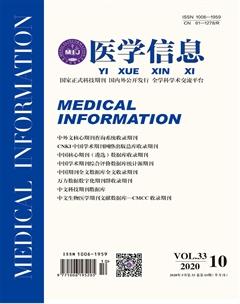
高校大學生健康行為狀況和中醫體質的關系研究
2020-06-19 08:28:46陸涵鈺徒文靜彭文雯
醫學信息 2020年10期
關鍵詞:大學生
陸涵鈺 徒文靜 彭文雯


摘要:目的? 探究大學生健康行為狀況和體質分布特點的關系,為大學生健康行為干預措施的制定提供參考。方法? 于2019年3~9月采用便利抽樣法抽取333名大學生,以標準化的中醫體質量表及《中醫9種體質類型判定標準》將大學生體質分為9種中醫體質類型,運用健康促進生活方式-Ⅱ(HPLP-Ⅱ)量表采集大學生健康行為數據,根據HPLP單項均分將學生分健康行為良好組(HPLP單項均分≥2.5分,175名)和健康行為不良(HPLP單項均分<2.5分,158名)組,比較兩組大學生健康行為狀況及其與體質類型的相關性。結果? 該校大學生HPLP-Ⅱ總分為(130.57±25.18)分,且健康行為良好組6個維度的單項得分與總分均高于健康行為不良組,差異有統計學意義(P<0.05)。大學生中醫體質平和質最多,占24.62%,其余8種偏頗質共占75.38%。居前4位的偏頗體質類型為陰虛質(14.11%)、陽虛質(12.91%)、濕熱質(12.91%)和痰濕質(11.71%);其中健康行為良好組平和質多于健康行為不良組,氣郁質少于健康行為不良組,差異有統計學意義(P<0.05),且健康行為不良組出現最多的3種偏頗體質為陰虛質、濕熱質、痰濕質。不同體質大學生HPLP-Ⅱ得分顯示,特稟質得分最高,其次為平和質,氣郁質得分最低;相關性分析顯示,健康行為不良組氣郁質的發生與人際關系、營養、壓力管理、自我實現維度得分以及總分均呈正相關(P<0.05)。結論? 該校大學生健康行為狀況整體良好,健康行為狀況與體質類型具有一定相關性。針對健康行為不良的學生,應鼓勵其改善不良生活習慣,合理膳食,保持積極樂觀的態度,改善偏頗體質,進而提高身體健康狀況。
關鍵詞:大學生;健康行為狀況;中醫體質;偏頗體質
Abstract:Objective? To explore the relationship between the health behaviors of college students and their physical distribution characteristics, and to provide reference for the formulation of intervention measures for college students' health behaviors.Methods? From March to September 2019, 333 college students were selected by the convenience sampling method, and the constitutions of college students were divided into 9 types of TCM constitutions based on standardized TCM physical fitness tables and "Judgment Standards for 9 Constitution Types of TCM". Health was used to promote lifestyle -Ⅱ (HPLP-Ⅱ) scale collects health behavior data of college students, and divides students into good health behavior groups (HPLP single average score ≥2.5 points, 175 students) and poor health behaviors (HPLP single average score <2.5 Points, 158 students) group, comparing the health behaviors of the two groups of college students and their correlation with physical types.Results? The total score of HPLP-Ⅱ of the college students was (130.57±25.18), and the single dimension score and total score of 6 dimensions of the group with good health behavior were higher than those with poor health behavior, the difference was statistically significant (P<0.05). College students have the most physique of traditional Chinese medicine, accounting for 24.62%, and the remaining 8 types of biased qualities account for 75.38%. The top four biased constitution types are Yin deficiency (14.11%), Yang deficiency (12.91%), damp heat quality (12.91%), and phlegm dampness (11.71%); among them, the group with good health behavior has more peace and health than health In the poor behavior group, the qi depression quality was less than that in the healthy behavior group, the difference was statistically significant (P<0.05), and the three most biased constitutions in the healthy behavior group were yin deficiency, damp heat, and phlegm and dampness. HPLP-Ⅱ scores of college students with different constitutions showed the highest scores for specialty traits, followed by peace quality and lowest score for depression. Correlation analysis showed that the occurrence of depression in the group with poor health behavior was related to interpersonal relationships, nutrition, stress management, and self. The achievement dimension score and the total score were positively correlated (P<0.05).Conclusion? The health behaviors of the college students are generally good, and there is a certain correlation between health behaviors and physical types. For students with poor health behaviors, they should be encouraged to improve their unhealthy living habits, eat a reasonable diet, maintain a positive and optimistic attitude, improve their biased physique, and then improve their physical health.
猜你喜歡
今日農業(2021年15期)2021-10-14 08:20:06
青春期健康(2020年22期)2021-01-12 00:50:58
下一代英才(酷炫少年)(2019年3期)2019-03-25 02:34:18
黃河之聲(2017年14期)2017-10-11 09:03:59
北方音樂(2017年7期)2017-05-16 00:32:46
教育與職業(2014年7期)2014-04-17 18:46:57
教育與職業(2014年16期)2014-01-19 01:24:34
中國火炬(2013年7期)2013-07-24 14:19:23
中國火炬(2010年9期)2010-07-25 11:45:09
中國火炬(2009年2期)2009-07-24 14:31:30