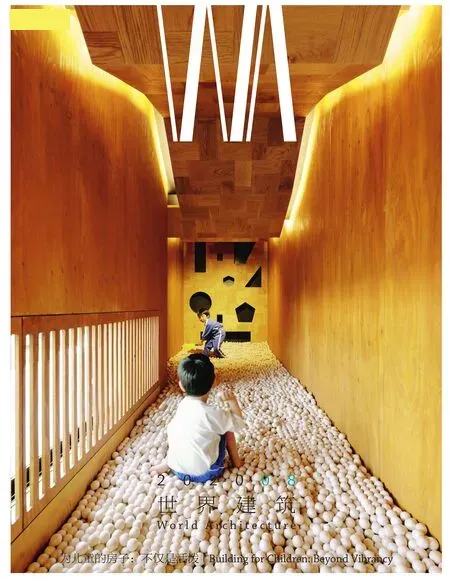
心蒙·蒙特梭利幼兒園,廈門,中國
2020-08-24 13:34:00建筑設計立木設計研究室
世界建筑 2020年8期
建筑設計:立木設計研究室
Architects: L&M Design Lab
樹林漫步
心蒙幼兒園的前身是一所小而美的“家庭園”,僅能容納約20個孩子,是在當地一位難求的頂尖園所,在亞洲蒙氏園圈子里也小有名氣。業主夫婦走遍全世界尋訪最好的幼兒老師,希望將原有“家庭園”升級為夢想中的 “幼兒園”。為避免被資本和盈利綁架,他們拒絕了絡繹不絕的投資人,不過這也為新園選址帶來了極大挑戰。
新園選址位于廈門島的海邊,原始建筑為形似郵輪的高層裙房,非常依賴于人工照明,同時也缺乏戶外活動空間,而在兒童的成長過程中,陽光、泥土、草地幾乎是最重要的物理空間要素。雖然原始建筑極不理想,但已經是業主夫婦能夠尋找到的“最佳”場所。建筑師被業主夫婦的初心和堅持打動,決定幫助他們將這個3層小黑樓改造為幼兒園。
出于考慮結構穩定和加固成本,設計在保留全部結構的基礎上打開了一個貫穿3層的中庭,確保所有教室實現雙面采光。中庭利用保留結構將“小樹林”搬進了原有建筑中,孩子們上下奔跑,猶如在樹林里穿梭。柱子成為“樹”,梁成為“橋”,連續的樓梯和滑梯圍繞“樹”盤旋而上,激活各層空間。樹屋平臺作為閱讀角和手工角,是小朋友的專屬空間。
全園以淺木色為整體基調,大面積的超白透明夾膠安全玻璃創造出純凈、公平、寧靜的空間環境。所有空間均采用了圓弧形倒角設計最大程度避免了各類尖角,孩子們可以恣意追逐、奔跑與玩耍,即使摔倒也不會嚴重受傷。三層成為室內外結合的整層活動場地,跑道從中庭衍生出來,利用連續自然的曲線劃分出不同主題活動區域,并通過塑膠跑道串聯起所有室內外活動。
幼兒園設計充分考慮了2~6歲兒童在幼兒園生活與成長的一切細節,從入園、換鞋、洗手、更衣、活動、喝水、閱讀、烘焙等都能夠由兒童獨立自主完成。空間尺度以2~6歲幼兒為基準,并根據1.5~3歲(IC教室)、3~6歲(CASA教室)的不同年齡段精細化設計。教室內采用柔和的色彩和材料,創造像家一樣安全、溫馨的氛圍,鼓勵孩子們激發自我的潛能。幼兒園的設計過程結合專業的蒙特梭利理念和知識,在確保自然和安全的基礎上,把童年最珍貴的自由還給孩子。
“所謂大學者,非謂有大樓之謂也,有大師之謂也”,幼兒園也是如此。盡管心蒙幼兒園沒有真實的泥土和草地,但堅守初心、獨立辦學使其能夠保持世界一流的教育質量和園所管理。建筑師將設計取名為“樹林漫步”,既是結構改造而形成的獨特中庭景觀,也希望在未來,心蒙幼兒園能夠真正擁有一片小樹林。

1 孩子們在滑梯下玩耍/Children playing under the slide

2 中庭/Atrium
3 光照/Sunlight
Wandering in the Woods
The predecessor of XinMeng · Montessori Kindergarten is a small and beautiful "family kindergarten", which can only accommodate about 20 children. It is a top-tiere local facility, hard for kids to be enrolled, and it also has reputation among the Asian Montessori Kindergarten. The owner and his wife went all over the world to look for the best kindergarten teachers, hoping to upgrade the original"family kindergarten" to the "kindergarten" which fit their dreams. To avoid being constrained by capital and profits, they have turned down an endless stream of investors, but this also poses a great challenge to choose the new location for the new campus.
The new campus is located on the coast of Xiamen Island. The original structure resembled a liner. It had limited space and heavily relied on artificial lights, which was against the common expectations of kindergartens. Sunlight, soil and grass are all essential spatial elements to children's growth. Although the original building is not ideal,it is already the "best" place that the owners and his wife could find. L&M was moved by the original intention and insistence of the kindergarten's owner and his wife, and decided to help them transform the three-storey dusky building into a kindergarten.
Out of considerations of structural stability and costs, L&M has kept the entire structure and created an atrium running vertically through three stories.Such design guarantees that all classrooms receive natural light from both sides. Taking advantage of the original structure, the atrium transforms the "liner"into a "woodland". Columns and beams immediately become trees and bridges. Continuous stairs and slides spiral up around the "trees", connecting and activating spaces. "Tree houses" provide private spaces for children to read and do handwork.
The kindergarten basically adopts light wood colour. Wide application of ultra-white transparent glue-clad safety glass creates a pure, fair and quiet environment. Arc chamfers instead of sharp corners help minimise potential hazards. Children can move freely and safely, won't be seriously injured even if them fall. The third floor provides a combination of indoor and outdoor activity areas connected by a plastic track. The track is an extension of the atrium and separates out various thematic activity areas.
The kindergarten thoughtfully considers the needs of children aged between 2-6, from entering the kindergarten, changing shoes, washing hands,changing clothes, activities, drinking water,reading, baking, etc., which can be completed by the children independently. The facilities are benchmarked against the needs of children of 2-6,distinguishing needs between those for children of one year and a half and 3, and those between 3 years and 6 years. Classrooms adopt soft colours and materials, creating a home-like space where child can fully express their potentiality. The design of the kindergarten has been drawing on the Montessori concepts and principles. Besides safety, we give freedom back to children.
"What makes a university is not the vast buildings, but the great teachers" is also made available for kindergarten. Although XinMeng · Montessori Kindergarten has no real soil and grassland, it adheres to its original intention and runs independently to maintain the world-class education quality and management. L&M calls the design "Wandering in the Woods", which means not only a unique atrium landscape formed by structural transformation, but also wish there will be a small forest in the future.
項目信息/Credits and Data
主持建筑師/Principal Architects: 劉津瑞,馮瓊/LIU Jinrui, FENG Qiong
競賽階段設計團隊/Design Team in Competition Stage: 張速,張淏晟,朱嗣君/ZHANG Su, ZHANG Haosheng, ZHU Sijun
實施階段設計團隊/Design Team in Implementation Stage:賴武藝,郭威,明香邑,馮菲,朱嗣君,楊煌偉,謝舜冰,林澤徽/LAI Wuyi, GUO Wei, MING Xiangyi, FENG Fei,ZHU Sijun, YANG Huangwei, XIE Shunbing, LIN Zehui
材料/Materials: 木飾面,水磨石,PVC地膠,ETPU彈性
地面/Wood finishing, waterstone, PVC floor adhesive, ETPU elastic floor
場地面積/Site Area: 2000 m2
建筑面積/Floor Area: 4500 m2
造價/Cost: 2200萬元/22M CNY
設計時間/Design Period: 2018.10-2019.01
竣工時間/Completion Time: 2019.08
攝影/Photos: 胡義杰/HU Yijie

4 場地選址/Situation
5 高層建筑遮擋采光/Adjacent high rise building blocks daylighting
6.7 改造過程/Reconstruction process
8 保留結構打開中庭/Creation of an atrium based on the original structure
9 樹林漫步/Wandering in the Woods

10 三層平面/Second floor plan
11 二層平面/First floor plan
12 首層平面/Ground floor plan
評論
傅筱:這個建筑師稱為“小黑樓”的三角形裙房除了東面以外,幾乎不見陽光。建筑師在三角形體量最深處挖了一個中庭,這是一個問題導向的設計操作,讓長邊布置的教室可以兩面采光,有意思的是中庭西面和南面均被高層環抱,如此減少了夏季的南向直射陽光和西曬,中庭在夏季和過渡季節不至于過熱,這是中庭在南方地區能否存活的關鍵。一些天橋、樓梯、滑梯與柱子連接,延伸了活動空間,同時也消除了中庭中間有兩根柱子的尷尬,中庭尺度不算大,但這些構件在里面并不顯得擁堵,這得益于精心的布局、柔和的色調以及自然光線帶來的明亮感。
薩拉·斯科特:該幼兒園被布置成一座垂直學園,這是近來在緊縮的房地產市場中變得較為普遍的一種形式。學園圍繞著一個3層通高的中庭布局,最大限度地為每個游戲室提供自然光和寬敞又通風的感覺。中庭內部有一系列蜿蜒的樓梯和平臺,還有一座大型不銹鋼滑梯,將不同樓層連接起來,使孩子們可以以一種有趣的方式在樓層間移動。
和諧的室內設計包括了柔和的色彩、弧形的門,并且設計成契合兒童的高度和尺寸,淺木色板材的使用帶來了溫暖的質感。兒童尺度的儲物柜和設施鼓勵孩子們的自主性,使他們能夠獨立完成儲物、更衣等環節。(龐凌波 譯)

13 孩子們跑向滑梯/Children Running for the Slide
Comments
FU Xiao: This triangular podium - "little black house",as called by the architects, has little sunlight except on the east side. The architects opened up an atrium in the deepest part of the triangular volume, which is a problem-oriented design approach, to let the playrooms arranged along the long side get double daylight. It is interesting that the west and south of the atrium are surrounded by the high-rise, hence reduction of direct sunlight from south and west in the summer to avoid overheating in summer and in the transition of seasons - the key that the atrium works in southern China. Some sky bridges, staircases, slides are connected to the columns, extending the space of entertainment while eliminating the obtrusion of two huge columns in the middle of the atrium. The void is in no large scale, but components in it are not crowded at all, thanks to the exquisite arrangement, soft colours and the brightness brought by natural light. (Translated by PANG Lingbo)
Sarah Scott: This kindergarten is arranged as a vertical school, a format that has become much more common in today's tight real estate market. The school is arranged around a large 3 storey void that maximises each playrooms access to natural light and provides a feeling airy spaciousness. Within the void is featured a meandering series of stairs & platforms and a large stainless steel slide that link the various levels and allow the children to move from level to level in a playful manner.
Harmonious interiors feature soft colours, curved doors and are designed for a child's height and scale,warmth is provided by the use of light wood coloured panels. The child-scaled fixtures and fittings encourage the children to be independent and to undertake activities such as storing their belongings and getting themselves ready by themselves.

14 柱為樹,梁為橋/Columns as trees and beams as bridges
15 潔凈的教室雙向采光/Cozy classrooms with light from both sides
16 柔和飽滿的光線/Full and gentle light
17 教室里的孩子們/Children in the classroom
猜你喜歡
娃娃樂園·綜合智能(2022年3期)2022-04-19 12:57:08
幼兒園(2020年14期)2020-11-10 09:06:24
現代裝飾(2020年7期)2020-07-27 01:27:42
流行色(2020年1期)2020-04-28 11:16:38
幼兒園(2020年22期)2020-03-29 02:17:52
幼兒園(2020年22期)2020-03-29 02:17:44
大灰狼(2018年9期)2018-10-25 20:56:42
藝術啟蒙(2018年7期)2018-08-23 09:14:18
動漫界·幼教365(大班)(2018年9期)2018-05-14 11:50:49
海峽姐妹(2017年7期)2017-07-31 19:08:17