
China Successfully Launched the Trial Version of the New-Generation Manned Spaceship Atop A LM-5B
2020-08-27 12:03:08DAIZhenying,GAOYiming
Aerospace China 2020年2期
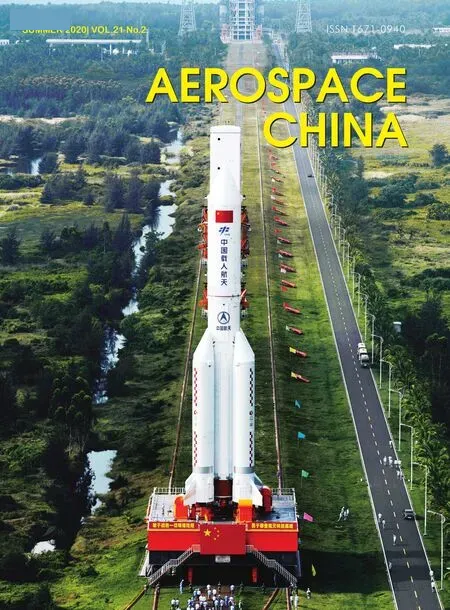
China's new large carrier rocket LM-5B made its maiden flight at 18:00 Beijing time on May 5,2020,launching the trial version of China's new-generation manned spaceship and a return cargo capsule for test into space.
China started its manned space program based on a threestep strategy in 1992.The first two steps have been completed,including sending astronauts into space,returning safely and launching a space lab as well as developing advanced space flight techniques and technologies for the construction of a space station.This mission initiated the third step of the strategy,constructing space station.
Developed by the China Academy of Launch Vehicle Technology,the LM-5B carrier rocket has a total length of about 53.7 m which is as tall as an 18-floor building,and a takeoff mass of about 849 tons.With a low-Earth orbit launching capacity of 25 tons,it can meet the requirement of launching 22 tons of space station modules into space.
Both the LM-5 and LM-5B have a core stage with diameter of 5 m and four 3.35 m diameter boosters.Compared with the LM-5,the LM-5B has one less core stage but a larger fairing,which is 20.5 m long and has a 5.2 m diameter.
LM-5 is capable of carrying payloads into a 36,000 km high geosynchronous orbit,to the moon 385,000 km from the Earth and to the Mars at least tens of millions of kilometres from the Earth.In contrast LM-5B is capable of carrying payloads into a 200 -400 km low-Earth orbit where the space station will be constructed.
This was the first time for China as well as Asia to launch spacecraft more than 20 tons,signifying China has the ability of transferring a 25-ton payload from Earth into LEO orbit and thus the ability to construct large space infrastructures such as a manned space station.This was a key step for China demonstrating it has become a major space power.
The rocket's core stage adopted a large thrust LOX/LH2 engine to directly launch the spacecraft into its preset orbit,signifying that China has become one of the countries that has an accurate orbit injection ability using a carrier rocket with one core stage and four boosters.
A series of key technological breakthroughs have been achieved such as the separation of the large fairing and the payloads in space and the precise control of the rocket to enter orbit directly with high thrust,laying a foundation for constructing China's space station.
The new-generation manned spacecraft is an upgraded transportation vehicle between the Earth and LEO orbit and will meet the requirements for China's space station operation and manned deep space exploration.The spacecraft comprises a service capsule and a return capsule.It can carry 6 -7 astronauts in one launch while conducting LEO missions in the future.
Developed by the China Academy of Space Technology,the trial version of the new-generation manned spaceship is nearly 9 m tall and about 4.5 m at its widest point.It weighs more than 20 tons.
This was the 331st launch of the LM series launch vehicle.(DAI Zhenying,GAO Yiming/China Space News)

The trial version of newgeneration manned spaceship is being launched atop a LM-5B Photo:SU Dong
- Aerospace China的其它文章
- Progress in Technology of Main Liquid Rocket Engines of Launch Vehicles in China
- The LM-2D Launch Vehicle is Being Hoisted
- Maiden Flight of the LM-5B Carrier Rocket
- LM-11 Launched Two New Technology Experimental Satellites
- LM-2D Carried Two Satellites into Space
- LM-2C Launched HY-1D Satellite Successfully