
U.S.Provocations Can’t Buck Peaceful Cooperation in the South China Sea
2020-09-21 08:40:37ByRENYUANZHE
CHINA TODAY 2020年9期
By REN YUANZHE
THE U.S. provocations around the South China Sea have recently intensified. Right on the occasion of the fourth anniversary of the ad hoc tribunal ruling on the South China Sea arbitration, on July 13, the U.S. Secretary of State, Mike Pompeo, issued the statement “U.S. Position on Maritime Claims in the South China Sea,” saying that, “Beijings claims to offshore resources across most of the South China Sea are completely unlawful, as is its campaign of bullying to control them.” The statement denies Chinas indisputable sovereignty over Meiji Reef and Renai Reef, and refuses to recognize Zengmu Shoal (roughly 20 meters below the surface) as a part of China. Two days after Pompeos statement, the U.S. Navy Arleigh Burke-class destroyer USS Ralph Johnson (DDG-114) arrived in the waters near the Nansha Islands to carry out the socalled “freedom of navigation” operation. This year, the U.S. Navy has carried out at least six such operations and conducted various other operations to demonstrate their military presence. The U.S. Air Force often sends bombers over the area. Whats more, aircraft carriers USS Nimitz and USS Ronald Reagan held an exercise in the South China Sea on July 17, the second time in a month. The two aircraft carrier battle groups carried out the same exercise on July 4. This was the first dualcarrier military exercise conducted by the U.S. Navy in the South China Sea since 2014. The series of actions fully exposed the U.S. intention to further contain China. Although the COVID-19 epidemic has left its deep scar on the country, the Trump administration has still escalated military operations in the South China Sea, which are more aggressive and provocative than before. The U.S. militarization has become the biggest threat to peace and stability in the South China Sea.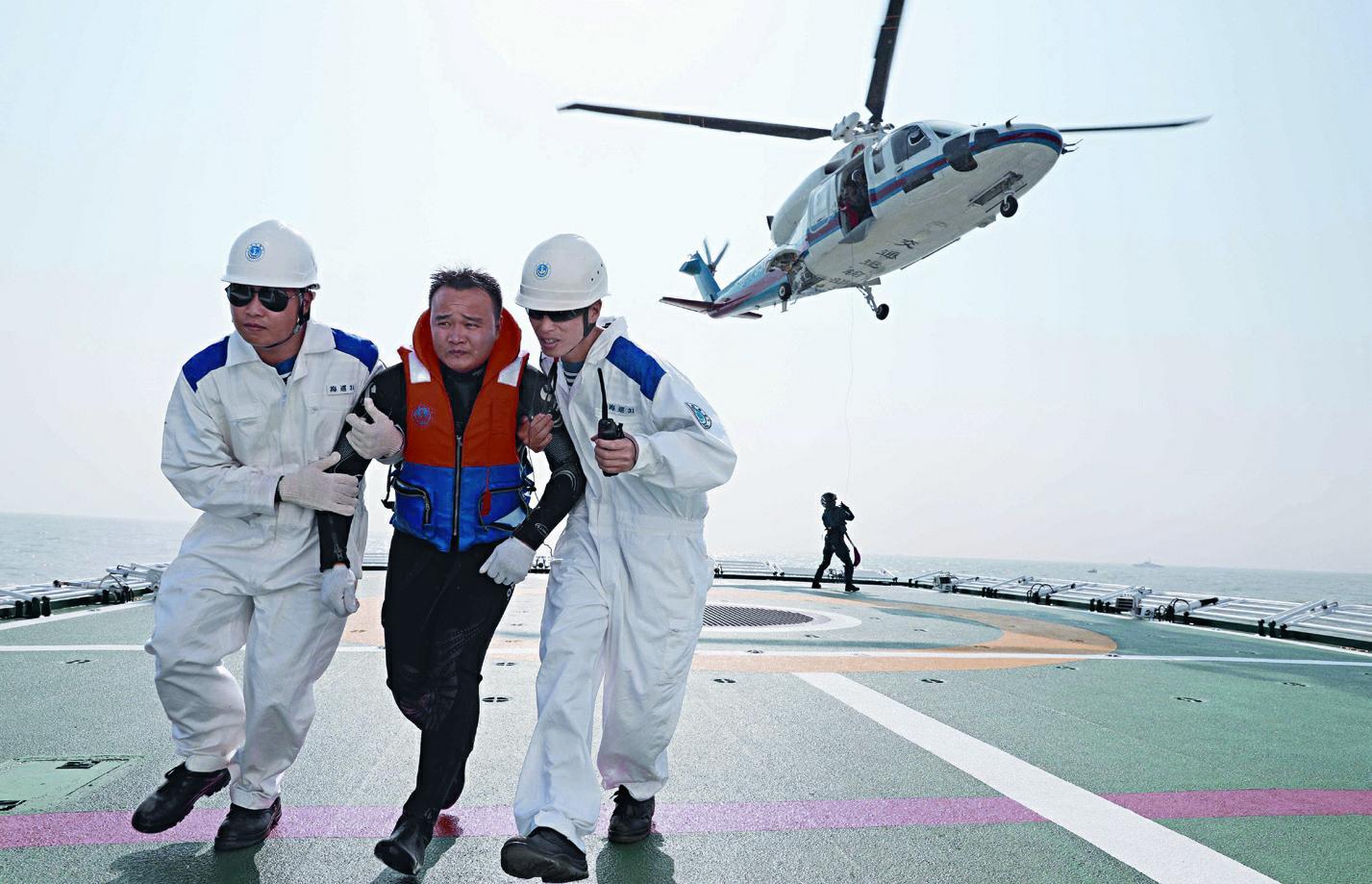
Bullying from the U.S. Historically, the U.S. has long adopted a neutral stance on disputes over the sovereignty and maritime rights of the South China Sea. Whether it was the conflict between China and Vietnam around the Chigua Reef in 1988, or the Meiji Reef dispute between China and the Philippines in 1995, the U.S. government at that time basically remained neutral and hoped that the South China Sea dispute could be resolved peacefully. Fundamentally speaking, the bottom line of the U.S. on the South China Sea issue for a long time had been that any conflict in the South China Sea should not affect its freedom and safety of navigation. After President Obama took office in 2008, he made a series of adjustments to the U.S. global strategy. The South China Sea issue has gradually become an important starting point for his “Asia-Pacific rebalancing” strategy. The Obama administration then frequently intervened in the South China Sea issue, including the release of the U.S. policy on the South China Sea in 2014 and the launch of the“freedom of navigation” operations program in 2015. These actions had changed the geo-strategic situation and made the South China Sea issue increasingly one of the core aspects of Sino-U.S. relations. During the Trump administration, the contention between China and the U.S. around the South China Sea issue has become more intense. The U.S. regards the issue as the top priority of its Indo-Pacific strategy and has gradually escalated its militarization actions in the South China Sea, making the situation there more perilous. Pompeos recent policy statement has completely overthrown the neutrality stance adopted by previous U.S. administrations on the issue, and has clearly taken sides and an-tagonized China. The statement runs counter to the international practice that in international disputes over sovereignty and maritime rights and interests, nonrelated parties should not be involved in the discussion. The recent statement fully demonstrates the U.S. bullying diplomacy. According to the Wall Street Journal, this statement marks the U.S.s departure from the previous practice of “not taking sides on maritime disputes in the South China Sea,” and may indicate that the U.S. will increase its efforts to challenge Chinas sovereignty claims through military, diplomatic or legal means.
On the one hand, the policy change reflects that in the face of the continuous spread of COVID-19 in the U.S., the Trump administration has continued to pass the buck to China for its failed anti-pandemic policy, divert attention from the mounting domestic problems, and take advantage of the issue to win over voters for re-election in the latter half of the year. On the other hand, the policy change also projects the administrations worry that the pandemic may expedite the change of the international landscape and alter the balance of power between China and the U.S. Out of all these considerations, the U.S. has strengthened its strategic competition with China. The changes in the South China Sea policy are in line with the Trump administrations strategic need to suppress and contain China in the political, diplomatic, and legal fields. At present, the long-term repercussion and impact of the hegemonic mentality held by the right-wing conservative forces of the U.S. Republican Party on Sino-U.S. relations, and the South China Sea issue, cannot be underestimated.
Peaceful Waters
Chinese people have had activities in the South China Sea for more than 2,000 years. China was the first country to discover, name, develop, and utilize islands and related waters in the South China Sea, and was the first country to continuously, peacefully, and effectively exercise sovereignty and jurisdiction over the islands and related waters. Chinas sovereignty over the South China Sea islands and its related rights and interests in the area have been established over a long historical process and have a sufficient historical and legal basis. While firmly safeguarding national territorial sovereignty and maritime rights and interests, China has always been committed to resolving related disputes through consultation and negotiation with directly related sovereign countries, establishing rules and mechanisms to control differences, and achieving mutual benefit and win-win results through cooperative development. Meanwhile, China firmly safeguards the freedom of navigation and overflight in the South China Sea that all countries enjoy in accordance with international law, firmly maintains peace and stability in the South China Sea, and is committed to building the South China Sea into a sea of peace, friendship, and cooperation.
In recent years, China has continued to push forward dialogue and cooperation with neighboring countries on the South China Sea issue with positive progress made. China-Vietnam and China-Philippines bilateral consultation mechanisms are advancing steadily, while China-Malaysia and China-Indonesia consultations have properly handled their differences through bilateral channels. The situation in the South China Sea has stabilized and improved. Meanwhile, China has continuously promoted cooperation with countries in the region in the fields of oil and gas, law enforcement, scientific research, environmental protection, and fisheries with positive results achieved. With the comprehensive and effective implementation of the Declaration on the Conduct of Parties in the South China Sea (DOC), China and ASEAN countries have maintained close consultations on advancing pragmatic maritime cooperation and formulating the Code of Conduct in the South China Sea (COC), and have successfully trialed the ChinaASEAN senior diplomats hotline platform.
On October 31, 2017, for the first time, China and ASEAN countries carried out a joint large-scale maritime search and rescue exercise, and at the 2017 ChinaASEAN Summit adopted the Declaration for a Decade of Coastal and Marine Environmental Protection in the South China Sea (2017-2027). From the second half of 2018 to the first half of 2019, China and ASEAN countries held two naval military drills with the purpose of further enhancing their capacity to respond to threats in non-traditional security fields and jointly deal with maritime emergencies. In 2019, Southeast Asian countries and China made landmark progress in the negotiation of the COC. The related parties completed the first review of the draft of the single consultation text of the COC earlier than expected. The second review is expected to start soon. This shows the determination of countries in the region to jointly formulate regional rules and maintain peace and stability in the South China Sea.
The U.S. has been creating tension for its own benefit in the South China Sea in recent months, which will not buck the general trend of close cooperation among regional countries. According to the trade statistics from January to June 2020, released by Chinas General Administration of Customs, ASEAN has become Chinas largest trading partner for the first time, and China has closer industrial ties with ASEAN countries such as Vietnam, Malaysia, and Singapore. The South China Sea issue will neither undermine the development of China-ASEAN relations, nor should it become the core of China-U.S. relations. As remarks on the U.S. South China Sea statement by the spokesperson of the Chinese embassy in the U.S. put it, “The United States is not a country directly involved in the disputes. However, it has kept interfering in the issue. We advise the U.S. side to earnestly honor its commitment of not taking sides on the issue of territorial sovereignty, respect regional countries efforts for a peaceful and stable South China Sea, and stop its attempts to disrupt and sabotage regional peace and stability.”
Dialogue and Cooperation Critical
The contention on the South China Sea issue reflects the unprecedented complexity of China-U.S. relations. The current severe challenges facing the bilateral relationship are mainly posed by some people in the U.S., who, out of ideological prejudice, spare no effort to portray China as an adversary or even an enemy, and try every means to contain Chinas development, and do whatever it takes to hinder China-U.S. relations. Chinas U.S. policy has always maintained a high degree of stability and continuity. China is willing to build a China-U.S. relationship based on coordination, cooperation, and stability without conflict or confrontation, featuring mutual respect and win-win cooperation. Chinese President Xi Jinping has repeatedly emphasized: China has many reasons to get China-U.S. relations right, and not one reason to spoil them. As long as both parties have the will to improve and develop China-U.S. relations, they can get the bilateral relationship through the current predicament and get back on track. On the South China Sea issue, the U.S. should build a more objective and calm understanding of China and formulate a more rational and pragmatic South China Sea policy.
