
Beliefs Exhibited on Clothes–Costumes of the Yao People
2020-09-21 08:40:37ByGUOZHIDONG
CHINA TODAY 2020年9期
By GUO ZHIDONG
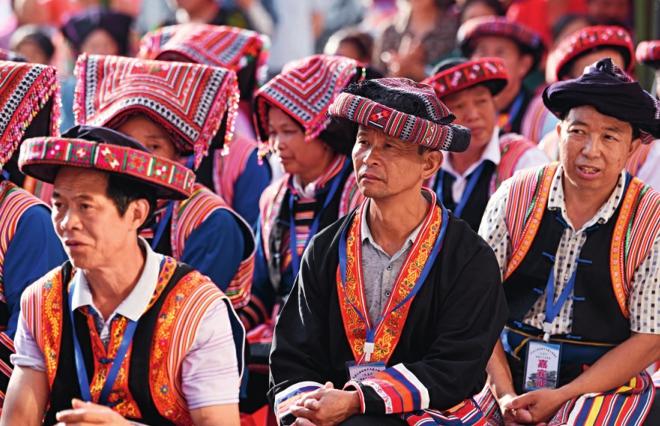
THE Yao people are the most widely distribut- ed ethnic minority group in southern China, mainly living in Guangxi Zhuang Autonomous Region and the provinces of Hunan, Guangdong, Yunnan, Guizhou, and Jiangxi, with the largest concentration of them in Guangxi. They are also one of the oldest ethnic groups in China. Legend has it that the Yaos are the descendants of a mythical king called Panhu. Their long history has bred a rich and unique ethnic costume culture.
The clothing of the Yao people is very colorful, having such colors as blue, white, black, and red, while the main colors of their costumes vary with the style of different sub-ethnic groups within the Yao people. Generally speaking, their apparel is famous for its colorful, complicated patterns and exquisite workmanship. Yao women who are proficient in embroidery often embroider elaborate patterns with colorful silk threads along the neckline, skirt, cuffs, bottoms of trouser legs, and hemlines. Most of these patterns have been passed down for many generations, not only serving as a beautiful decoration, but also becoming a carrier of the Yao culture.
There are many sub-cultural groups of the Yao, and the style of each sub-groups costume has its own characteristics. In the Nandan area of Guangxi, the mens clothing there is divided into formal dress and plain clothes. Most of the plain clothes are made in dark blue and have stand-up collars and front buttoned jackets. The formal style of clothes, on the other hand, usually has the coat edged with blue cloth. Whether its formal or casual, the upper garment usually has a chicken pattern embroidered on both sides. The trousers, made of white cloth and stretching down over the knees, have a unique set of five red patterns at knee, including three long lines in the middle and one short line on each side, symbolizing the bloody fingerprints of their ancestors when they fought on battlefield in times past. The bottom portion of a trouser leg has a trim of black cloth. For this reason, the Yao people in Nandan are also known as the “white trouser Yao.”
Womens summer clothing, or a gown, consists of two pieces of cloth joined at the shoulders, black at the front and dyed and embroidered back. In winter, they usually wear right lapel sleeve clothing on the top. Whatever the season, they wear a blue pleated skirt which displays circular patterns dyed onto it with tree sap and a red hem line.
The Hong Yao (or Red Yao) reside in Longsheng,Guangxi, and their clothing is primarily red, decorated with various patterns, hence the name. The clothes are mainly embroidered and woven by the local people themselves. The embroidered clothes are made for the most part from dark blue cotton cloth with red and silk threads of other colors. The embroidered patterns include the dog totem images worshiped by the Yao people, the animal images of lions, deer, dragons, unicorns, phoenixes as well as patterns of landscape, flowers, trees, fruits, and vegetables, all of which symbolize good weather and harvest. The woven clothes are made from cloth woven on old-fashioned looms with white threads as warps and red threads as wefts. There are two twoinch square “King of Yao seal” patterns on the chest. It is said that the wearer of the patterns will have the protection of the king and live and work in peace and contentment.
The clothing of the Landian Yao living in the Hekou area of Yunnan Province is also an important part of the Yaos clothing culture. Womens clothes mostly consist of long-sleeve blouses with a black background, white pointed collars, and a pair of silver buttons on the neckline to fix the two bundles of wool hanging over the chest. The wool is mainly pink, but there are also peach, bright yellow, and
other colors. The upper garment hangs down over the knee with side vents, and a belt is worn around the waist. The cuffs are set with sky blue edges, and the outermost edge is inlaid with a circle of bright red. The trousers are black with slim fitted legs and a sky blue line along the edge about one centimeter wide. When wearing festive costumes or attending weddings or other ceremonies, a colorful and chic patterned shoulder pad will be added. An adult woman of the Landian Yao also needs to wear a round or oval bamboo made headdress of about 15 centimeters in diameter. Men often wear black longsleeve shirts without collars, with cuffs containing a sky-blue edge, a black waistcoat with silver buttons, and trousers.
Hongtou (Red Head) Yao, distributed in Jinping area of Yunnan, also have their own style of dress. The headdress of Hongtou Yao women are very peculiar, which is wrapped in a cone or cylinder with red cloth, just like a banana flower in full bloom, hence giving rise to the name of the sub-group. Hongtou Yao peoples clothing are primarily made in dark blue, symbolizing the solemnity and mystery of the mountains, while some are red, which symbolizes liveliness and enthusiasm. On the basis of these two main colors, they are combined with yellow, green,white, orange, and other colors. Womens clothes and trousers are relatively loose fitting. The upper part of the costume is a long-sleeve blouse, and the lapels and corners are decorated with colorful cross stitch embroidery. On the bottom, women wear straightleg pants made of indigo dyed and woven cloth. The trousers are also decorated with cross stitch patterns. Except for the inner thigh and buttock areas, almost all of the trousers are covered in designs. A rectangular waist pad, made of indigo dyed and woven cloth, can either be a single layer or double layers. It is decorated with cross stitch embroidery and has a long embroidered belt on both sides.
Hongtou Yao men wear collar front button shirts, with the necklines being decorated with cross stitch embroidery patterns, while the outfit is a black homespun sleeveless mandarin jacket on the top and wide crotch trousers on the bottom. Men usually wrap a piece of dark blue cloth around their heads, and some of such cloth are decorated with simple embroidery.
The Guoshan Yao are distributed in Jiangyong area of Hunan Province, whose aesthetic style of clothing is mainly natural and simple. The change of clothing in different seasons is not obvious. Both men and women like to wear colorful clothes, that is, the main color is deep blue but is mixed with various colors including red, yellow, blue, white and black. This is a typical feature of Jiangyong Guoshan ethnic costumes. The traditional dress of Guoshan Yao women consists of a dark blue cloth robe with loose trousers, a chest covering with flaps on the front, and a pair of pointed shoes. Guoshan Yao women like to wear ox horn neck ornaments and all kinds of silver jewelry.
There are many types of costumes which the Yao people wear, but each of them have the common characteristic that they attach great importance to decorative patterns, including patterns of animals, plants, stars, landscape, and other geometric patterns. This is closely related to the spiritual beliefs and history of this ancient ethnic group.
One of the animal patterns worth mentioning here is the dog pattern. According to tradition, the Yao people are the descendants of a mythical dragon dog called King Pan or Panhu. As it was recorded in the Book of the Latter Han, “There is a dog with colorful fur named Panhu ... The emperor had no choice but to marry one of his daughters off to Panhu...” Panhu mentioned in the book is also seen on the totem of the Yao. As a result of this tradition, dog patterns carry a very important significance when sewn onto the Yao costume. Dog patterns are often stitched in the prominent parts of clothes, skirts, turbans, and waistbands. With striking red and white silk threads and the cross-stitching techniques, the images thus produced are simple and vivid: some are running, some arranged in rows, and some others paired-up.
The tree patterns are a more common sight. In ancient times, the Yao ancestors lived in the mountains for many generations, picking fruits from trees for food, building houses with logs, covering the body with bark and leaves to keep warm, and picking medicinal herbs when they were sick. This is why the Yao people have infinite reverence and gratitude for trees. Trees with luxuriant branches and leaves, standing tall and straight, symbolize vigor and vitality, and so have become a very popular pattern which is often embroidered into prominent positions of clothes, trousers, and headdresses.
The traditional costumes of the Yao people have been passed down from generation to generation. They record the history of this ethic group and show their unique cultural beliefs and customs, and as a result have become a gorgeous chapter of the Chinese national costume culture.
