
Colors of Fall on the Ulan Buh Grassland
2020-09-21 08:40:37ByZHAOYANQING
CHINA TODAY 2020年9期
By ZHAO YANQING
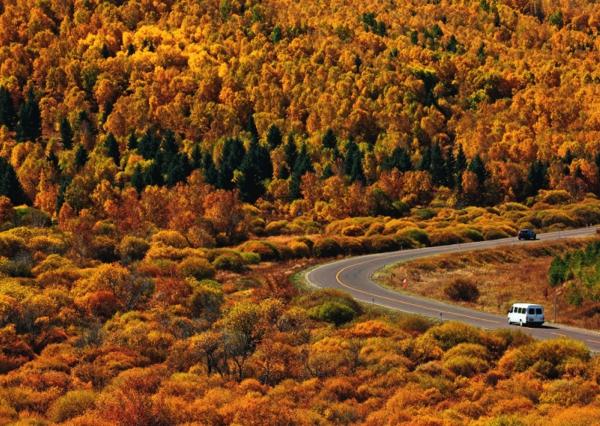
THE largest grassland nearest to Chinas capi- tal, Beijing, is located about 300 kilometers from Beijing in the southwest region of the Keshiketeng Banner, Chifeng City, Inner Mongolia Autonomous Region. It is called the Ulan Buh Grassland.
The Ulan Buh Grassland is dispersed with hills and plains and decorated with forests and flatlands, displaying natures ornate beauty and unrestrained wilderness at the same time. Here in the grasslands, the stories of brave hunters of ancient royal families and legendary tales of romance of the grassland peo- ple were lived out. It is home to the natural beauty of mountains and rivers, and has human development, domesticated oxen, horses, and sheep, as well as wild rabbits, weasels, and foxes. It also provides a haven to the grassland eagles, magnificent golden eagle, as well as the numerous egrets, magpies, and crows.
After autumn arrives, the grassland explodes into a million different colors. The ground is carpeted with various shades of yellow from light brown to dark caramel, appearing ever so much like a vast wool blanket that covers the land on cold mornings during this season. Standing out in stark contrast to this multi-hued carpet of nature are the pure white Mongolian yurts. The various bundles of harvested grass from the grassland resemble twinkling stars in a clear night sky. Cattle and horses are kept in neatly wooden fenced areas in the meadows where there is an abundance of grass for them to eat.
The Ulan Buh Battle
The name Ulan Buh in Mongolian means a red mountain that is shaped like an altar. There is a lake to the west of the urn-shaped Ulan Buh Peak that is called Jiangjun Paozi, meaning the General Lake, by the locals. There are vast open tracts of land on all four sides. The region is the site of the famous historical Ulan Buh battle that was fought there in the late 1600s. In 1691 during the 30th year of the reign of Emperor Kangxi (1654-1722) of the Qing Dynasty(1644-1911), an armed rebellion was launched by a tribal separatist named Galdan in the northwestern region of Junggar, who began to make his way towards Inner Mongolia in an attempt to bring division to the Qing Dynasty. Gerdan led an army of 300,000 men in an invasion of Ulan Buh. Emperor Kangxi was infuriated when he got news of the rebellion and united his army together to quell the uprising.
Galdans troops were defeated several times by the well-trained Qing forces. During the last battle they tied the legs of camels and lined them up on the ground as a barricade, and shot arrows and fired guns from behind. The Qing government troops, under the direction of the commander Tong Guogang(Emperor Kangxis uncle), bombarded this encampment of camels with cannons, and soon destroyed it. Defeated, all Galdan could do was escape under the cover of night.
The shape of the Ulan Buh Peak, according to folklores, was formed by the blasting of Qing military cannons. The General Lake was also created by the blasts of those cannons. According to local people, they have found cannon barrels left behind by the Qing army, as well as fragments of helmets and rusted arrows near the lake. During the battle of Ulan Buh, commander Tong was killed, staining the water of the lake with his blood.
In ancient history, this area was Tuergenyizhaer, one of Qing Dynastys 72 Mulan Paddock enclosed hunting grounds. It also was an important area for the nomadic Mongolian people. Back in the day, every year during the months of autumn, the emperor would host a large event that included hunting, horseback archery, and horse racing, all to provide well-rounded training for the royal family and nobles, and more importantly, the selection of talented people and even future emperors. Each year when the imperial hunting was held in autumn, Mongolian nobles were invited to it, and the Qing emperor would make use of the opportunity to meet with leaders of different tribes and deliberate with them on various matters. The Mulan autumn hunting was an activity that had deep strategic significance and political influence, making it more than just a simple hunting activity.
White is a color of high honor and respect in Mongolian culture. When people welcome guests, they present them with a white Hada, (a white silk scarf)and white horse milk wine called kumiss. Mongolian people do not consider the color to be cold or plain, on the contrary, to them white and purity is the symbol of their ancestors and deity. The first historical record of the Mongolian culture describes the legend of a black wolf and white deer giving birth to the Mongolian people.
In addition to the white Mongolian yurts and piles of bound up hay that decorate the vast grasslands stretching off into the horizon, piles of stones in various sizes can be seen here and there. Branches of willow trees are stuck into the rock piles and colored flags denoting religious connotation flap in the wind. These flags signify the sound of the grassland people offering their prayers to the heavens, and their flapping in the wind sounds like the reading of Sanskrit scriptures. These rock piles are called Oboo, and are an important part of Mongolian cultural traditions and their ancient religious system. Mongolians have the tradition of Oboo sacrifices in which they use the Oboo rock piles to make sacrifices to the Oboo gods. Local herdsmen use the Oboo sacrifices to present their prayers for blessing of good weather, thriving domestic animals, freedom from disease and disasters, and peace and goodwill. Everyone who passes by an Oboo rock pile gently places a rock on it, offering their prayer for peace and success for life.
Training and Raising Horses
After the Peoples Republic of China was founded in 1949, a military ranch was established in the central area of the Ulan Buh Grassland, also called the Red Mountain Ranch. Within the ranch lay grassland, dense forests, clear marshes, and untouched bodies of water.
The ranch is home to nearly a thousand different kinds of plants, including picea mongolica and koyama spruce trees, which have been called “biological gene bank” and “living fossils.” It also produces edible plants like mushrooms, chrysanthemum, and fiddlehead, and rare herbs like Chinese herbaceous peony and radix bupleuri. There are also red deer, Mongolian gazelle, roe deer, and wild pigs that can be seen everywhere. As fall arrives, the grassland displays a large palette of stunning colors. The trees of the birch forest glisten on the mountains in their soft yellow colored leaves, while at the foot of the trees are burgundy bushes, and an array of other natural splendors that make their presence during the early fall months.
The nomads of the Ulan Buh Grassland are no longer nomadic. Today they have fixed pastures and well-established villages. Each village of various size has its own inns for passersby, while herding has almost become a sideline industry. The proprietress of the inn will lay down her whip and check guests into their rooms with great hospitality.
As the sun sets over the grassland, it shrouds it like a delicate garment. The red leaves on the hills are not as striking as when the sun is shining brightly over them, but they are painted with soft, rich, light golden colors, so are the horses roaming around.
The colorful mountains after the sunset are not as enchanting as they were during the day, but their quiet beauty resembles a sleeping beauty with distinct mountain crest silhouetted along the horizon which extends like a long stream of a womans hair off into the distance. The water of the Wild Duck Lake reflects the red glow of the sunset, looking like a mirror silently reflecting the beauty of a young woman putting on her makeup.
The New Life of Mongolian Herdsmen
Tiantaiyong Village in Hexigten Banner includes a community of more than 20 families called Ham-aba, or Toad Dam. The origin of Hamaba is unknown, and even local elders do not seem to know where the name originated from or why so many toads live there. Despite this fact, many things on the Mongolian grasslands are connected with toads, like toad slopes, toad ravines, and so on. This seems to demonstrate how the grassland has an abundance of water and exists harmoniously together with wetlands and rivers.
The small village is so hidden away back in a valley, and the houses are difficult to spot that only by standing near the edge of the ravine can it be discovered. Houses in the village are scattered around, distinguished by red and blue roofs with wooden palisade walls. A dirt road leads through the village, connecting families with the round and oval wooden palisade fenced pastures for oxen, sheep, and horses. What stands out the most are the small enclosed orchards in which neatly planted rows of green vegetables decorate the otherwise hidden village.
There are about 100 residents in the village, who busy themselves with daily duties of planting vegetables and raising animals. In September, fall is already giving way to winter, and the local people begin the process of collecting reserves of grass for the winter months. Grass is harvested from the meadows with machines which leave a trail of smoke behind but then soon disappears in the cold air of the wilderness. The sound of tractors can be heard on the road behind the village. Trucks return loaded with fodder to be used for animals. Satisfied looks can be seen on each family members face from the driver, his wife, children, and pet dogs.
Many women busy themselves in their gardens, carrying heavy baskets on their arms. For supper, there will certainly be many green vegetables on the menu. After the dust in and outside the village has settled, women call out to their children, and the children answer in a gentle voice that matches the fragrance of the food in the valley, creating a warm covering for the village. Outside the village, crows and magpies flock together, flying everywhere in groups, but not fighting for territory nor flocking together.
Morning hours are very busy in the village. Early in the morning, even the dullest bulls are happy when they set out for the pasture, making loud noises for all to hear. On the other side of the farm, lambs and young calves who have been silent all night cannot restrain their glee on being let out into the pastures on the distant hillsides with the shepherds following behind them. Hours later at dusk, the shepherds return swinging their whips in their hands and guiding their herds of sheep and oxen back into their folds for the night. This brings yet another day on the grasslands to a perfect end.
