
Guarding the Plateau
2020-09-21 08:40:37BystaffreportersLIYUAN&WANGYUANYUAN
CHINA TODAY 2020年9期
By staff reporters LI YUAN & WANG YUANYUAN
DUBBED the “roof of the world,” the “third pole,” and the “water tower of Asia,” the QinghaiTibet Plateau is of prominent ecological significance. It helps adjust the climate in Asia and the entire Northern Hemisphere.
Upholding the principle of green development in Tibet Autonomous Region, the Chinese government has rolled out a series of measures to safeguard the ecology of Tibet. They include the Plan for the Ecological Safety Barrier Protection and Improvement in Tibet(2008-2030), the afforestation project along the Yarlung Zangbo River, Nujiang River, Lhasa River, Nianchu River, Yalong River, and Shiquan River, and the strategy and action plan for preserving biodiversity in Tibet Autonomous Region. With stringent measures and effective systems in place, Tibet sees a well-preserved ecosystem shoring up endeavors to improve peoples livelihood and sustain economic and social progress.
Environmental monitoring programs by institutes like the Chinese Academy of Sciences showed that the water quality of 95.7 percent of major water functional zones in Tibet met set standards, and that Tibet saw its air quality rated as good in 97.5 percent of the days in a year. Forests, grasslands, wetlands, glaciers, snow mountains, and wildlife across the region are all well preserved. With most parts remaining in their natural state, Tibet is still one of the regions with the best ecological environment across the world.
Protection around the Pangong Lake
A 12-kilometer drive northwestward from the county seat of Rutog in Ngari Prefecture, Tibet, brings people to a cerulean lake set amidst rolling mountains, called the Pangong Lake.
A typical endorheic lake with fresh water in the east and saline water in the west, the Pangong Lake hosts the highest-altitude bird island in the world, and is home to over a dozen species that are under state protection including black-necked cranes, Tibetan antelopes, brown-headed gulls, and snow trouts.
To preserve the lucid waters, a wetland nature reserve was established at the autonomous region level in 2002, a national forest park built in 2004, and a nature reserve administration established in 2007.
Wetland ranger Sonam Dawa, along with 39 other local herdsmen, patrol the reserve on a regular basis and discourage people from illegal fishing or bird egg theft.
It is a tough job to patrol a nature reserve measuring 56,303.22 hectares at an average elevation of 4,240 meters.“It takes as long as a whole day to finish a patrol around the reserve even if we drive,” said Sonam Dawa.
However, most of Sonams work is done on foot, from collecting garbage and nursing trees on the lakeside to checking up on nestlings and spawning fish. The rangers skin glows with a rich tan and leathery texture developed over the 12 years he spent guarding the lake.
“Birds were living close to people in the past when there were no buildings on the lakeside. As its popularity increased, the lake received more and more tourists, which scared away the birds,” Sonam recalled. “Now, they are back thanks to the protection efforts.”
Thanks to the routine protection and ecological restoration projects, Pangong Lake and its surrounding region are seeing increasingly improved quality of water, air, and soil, as well as vegetation. According to the 2019 environment condition communique released by Tibet Autonomous Region, the water quality of the Pangong Lake was graded Class II, the second best in Chinas evaluation system.
Tying in with improving environment are economic returns from booming tourism. Since 2011, the local government has invested more than RMB 12.2 million in infrastructure projects to facilitate tourism. As of June 2020, Rutog County had received 69,567 tourists, generating RMB 97.39 million in tourist revenue. Tourism has created 652 jobs thus far, and generated a total income of RMB 192,000 for local residents.
A “Green Hada” for Yarlung Zangbo River
The Yarlung Zangbo River is one of the highest altitude major rivers in the world. It is known as the cradle of Tibetan culture. However, people living in Shannan, a city located along the rivers middle reaches, have mixed feelings toward it.
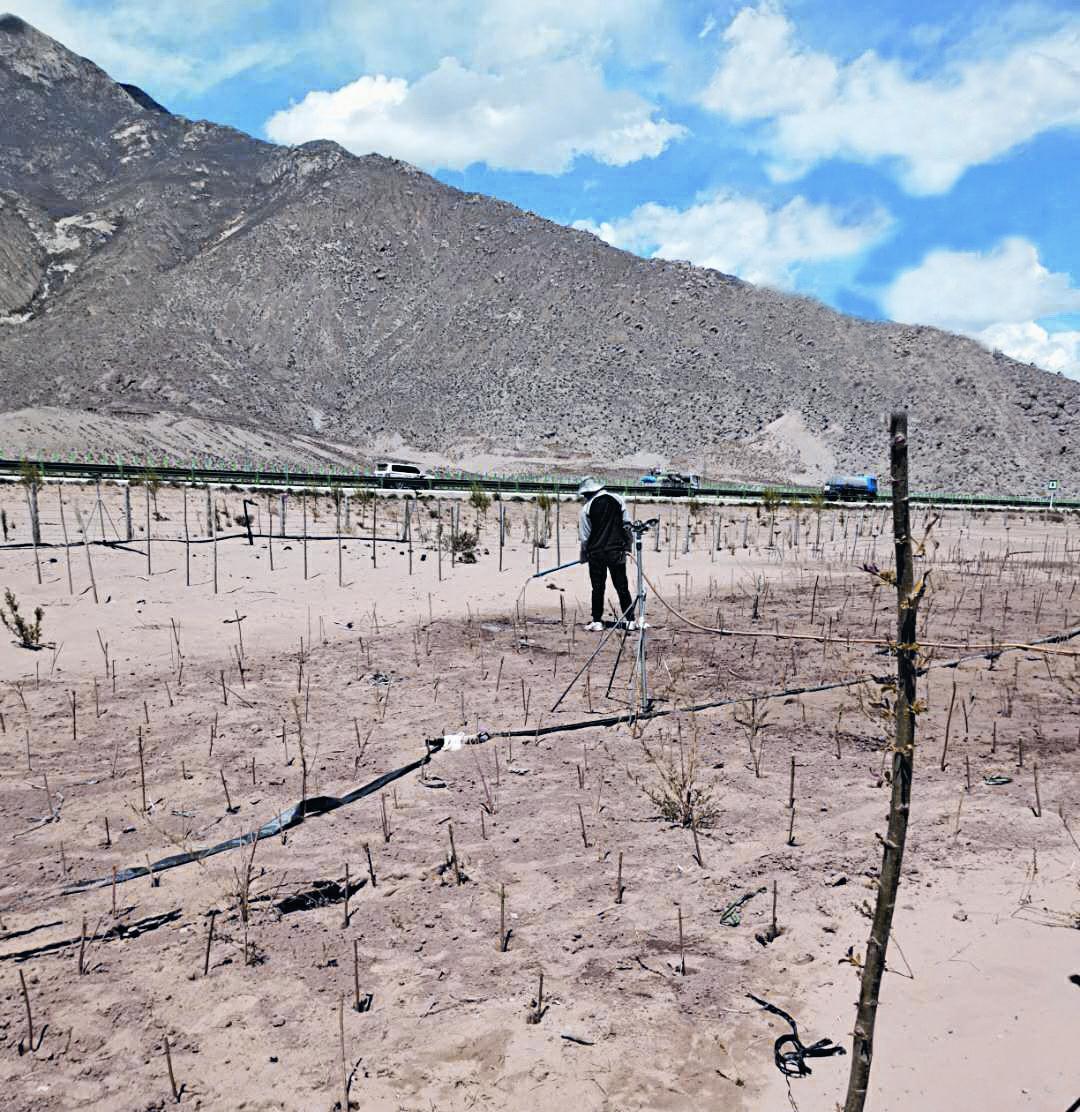
As the terrain flattens, the river deposits muds and sand in its middle reaches. After the wet season, the water level drops, exposing and drying the deposited mud and sand. Wind then blows the sand across farmland and roads, forming traveling dunes.
In the 1980s, local people became fed up with the sand and began to afforest the region on a large scale. They built breakwaters, adopted planting techniques catering to local conditions, and made straw checkerboards on sandy ground to hold the sand in place in an effort to tame the sand.
In 2009, the Chinese government approved the Plan for the Ecological Safety Barrier Protection and Improvement in Tibet(2008-2030). Highlighting projects for curbing desertification, the document called on various sectors to contribute to ecological preservation in Tibet.
Elion Resources Group, a private Chinese company dedicated to eco-restoration, afforestation, and sand erosion prevention projects, is one of the contributing forces. In May 2017, the company initiated a RMB 683 million project for preventing and curbing sand erosion in Shannan.
“We have already invested RMB 70 million in the project, creating 615 jobs for local people,” said a spokesperson of Elion. Having afforested a sandy area of 510 hectares as of now, the project has generated a total of around RMB 4 million in earnings for the locals.
Following Elion, more and more social groups came to help Tibet protect its environment. In 2017, with the support of the local government, a private business built a seedling nursery base in Zhanang County of Shannan for afforestation projects.
Chokyi Drolma is a college student on summer vacation in Zhanang County. She is now doing a gig job at the nursery base. “While earning some money, I contribute to environmental protection in my hometown,” she said.
Thanks to the participation of businesses and local people like Chokyi, the valley in the middle reaches of the Yarlung Zangbo River is now covered by a green belt of forests measuring 160 kilometers in length and 1,800 meters in width. To local people, the belt is a green hada, a ceremonial silk scarf offered to guests as a token of respect in local traditional culture. Thanks to the“hada,” the number of sand-dust days in Shannan has dropped from more than 60 to around just seven a year.
In 2019, Tibet Autonomous Region earmarked RMB 11.7 billion for building eco-safety barriers, and scaled up investment in the afforestation project. Official statistics showed that the area covered by forests in the autonomous region has reached 14.91 million hect- ares, meaning 12.14 percent of the region is forested, ranking first in the country.
Escorting Tibetan Antelopes Home
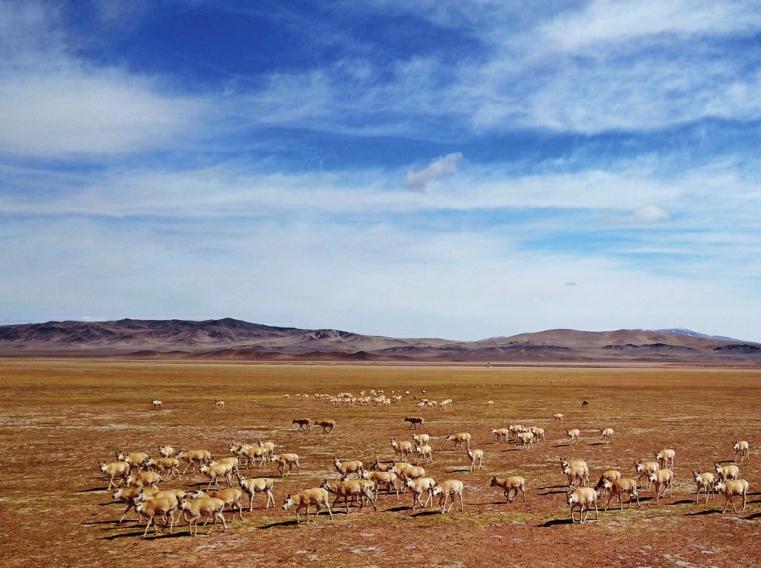
On July 26, a video gripped peoples attention in a WeChat group for local forestry and grassland administration in Gerze County of Ngari Prefecture. The video showed more than 3,000 female Tibetan antelopes and their offspring roaming in the county. The antelopes were heading back to their habitat after giving birth in the north.
According to Rigzin Norbu, director of the forestry and grassland administration in Gerze County, the video was filmed by a ranger from the Chang Tang Nature Reserve during a routine patrol.
He said there are three passages Tibetan antelopes usually take in Gerze County during their migration. Around late April to mid-May, antelopes migrate northward to give birth. Then around late July and early August, female antelopes bring the newborns back to their habitat under the protection of several male antelopes.
“We set up stations along the three passages to protect the antelopes,”Rigzin said. Workers at the stations offer timely help to trapped or wounded antelopes, clear off obstacles that may block the migration, and enforce temporary traffic control to ensure the animals safe crossing if they accidentally wander onto the road.
Built in 1993, the Chang Tang Nature Reserve is the highest average altitude nature reserve in the world. The 298,000-square-meter land is home to many wild animals including Tibetan antelopes, Tibetan gazelles, kiangs, and yaks. The area of the reserve in Gerze County measures around 106,000 square kilometers. Thanks to intensifying protection efforts, the number of Tibetan antelopes has risen to over 200,000.
