陽臺:現代建筑元素的傳奇
2020-10-22 07:14:22湯姆阿韋馬特TomAvermaete
世界建筑 2020年10期
關鍵詞:建筑
湯姆·阿韋馬特/Tom Avermaete
徐知蘭 譯/Translated by XU Zhilan
“沒有任何其他元素像過于寬闊的陽臺一樣破壞了建筑立面的開洞形式……優秀的建筑不會出現這些元素。”[1]148-149
令人煩惱的建筑元素登上歷史舞臺
陽臺原先是軍事堡壘外墻上的附屬物,是用來向敵人投擲導彈的空間,一直以來都是涵義豐富的建筑元素。自從法國建筑理論家卡特勒梅爾·德·坎西于1833年在其《建筑歷史辭典》中首次提到陽臺之后,它就一直被當成一個怪物,一位不速之客,甚至惹是生非的角色。和許多19世紀的建筑師一樣,卡特勒梅爾對現代主義的“陽臺潮流”持有極端批判的態度,并認為“建筑作出的犧牲最大,尤其是外立面及其細部比例。”[1]他認為陽臺玷污了建筑,并把它形容為“開胃菜假發”,理由是“因為它與主體結構無關的性質”[1]142-146。
如何馴服陽臺這一令人煩惱的建筑元素,把它納入現代建筑元素的常用清單中,成為現代主義建筑運動的一項重大挑戰。在建筑中吸收陽臺的元素,最初是通過改革派的措辭來實現的,即提供民主的健康與衛生條件,而在20世紀初,這與得到充足的日照和呼吸新鮮空氣息息相關[2]。在19世紀晚期的建筑學討論中仍然令人感到不安的元素,現在卻已占據了建筑學話語的核心地位。
1929年出版的《自由生活》是第一屆國際現代建筑協會(CIAM)的大會成果,瑞士批評家希格弗萊德·吉迪恩通過封面圖片,把陽臺牢牢置于更廣泛的現代主義修辭語境下,是走向新生活方式的解放宣言……[3]陽臺被描繪為引入日照、空氣和開闊空間的建筑元素。在這本書的插圖中,通過和黑暗的監獄老牢房進行對比,陽臺被進一步納入了有邏輯的現代主義居所。文字和圖片都暗示著現代建筑要素具有治療的作用,能夠治愈被束縛在舊式經濟住房中的住戶。吉迪恩曾經在另一本著作里解釋過:“這種‘新建筑’已經一次又一次無意識地使用這些突出于立面的‘陽臺’了。為什么呢?因為人們需要居住在能夠盡可能突破舊式均衡感的建筑里,而那種感覺恰恰來源于軍事堡壘一般的幽閉空間。”[4]到了20世紀20年代和30年代,陽臺逐漸成為一些現代建筑理論和實踐的核心要素[5],它開始成為現代主義住宅具有的顯著特征。
現代陽臺具有自由解放和療愈性的特點不僅事關建筑學的先鋒派,在各類政治理論中也得到了響應。陽臺在紅色維也納的住宅政治中扮演了核心角色,正如卡爾·恩于1931年在聲名狼藉的卡爾馬克思大院i投入使用的當天發表的報刊文章所述:“這些住宅沒有任何冗余的裝飾,光潔平整,但它們擁有價值連城的珍寶,那就是沿著整個正立面連續展開的陽臺,讓每一套公寓都能有一座陽臺。”[6]就在它建成不久之后制作的一幅住宅大樓拼貼畫,已經領會到了對于重獲新生的人來說,陽臺在維也納的居住政治中多么至關重要。
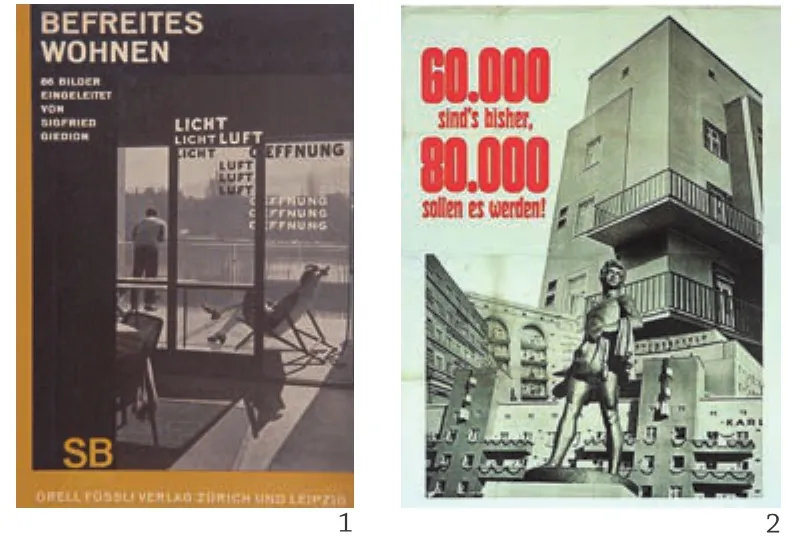
1 希格弗萊德·吉迪恩所著的《自由的居所》封面上的陽臺看起來像是日照、空氣和開放性的先驅者,1929/Cover of Sigfried Giedion,Befreites Wohnen.On which the balcony appears as harbringer of light, air and openness, 1929.
2 用卡爾·馬克思大院的各種陽臺拼貼畫來宣傳維也納住宅政治的海報,齊格弗里德·維埃爾,1932/Poster championing Viennese housing politics with collage of various balconies at the Karl-Marx-Hof, Siegfried Weyr, 1932.
個體與群體,為最多的人提供遮蔽
戰后的建筑文化激活了陽臺的要素,以應對由建成環境的政治、社會、文化和經濟影響變化所帶來的各種問題。陽臺成為戰后諸多核心問題中最首要和最重要的協調因素,對于這一點,社會學家丹尼爾·貝爾在1956年總結道:“對一些人來說,它可能可以讓我們從機械化的社會中獲得個體的自我感受。”[7]在二戰之后從北半球到南半球、從斯德哥爾摩到卡薩布蘭卡的無數大規模住宅開發項目中,如何在更廣闊的城市環境中為普羅大眾創造以及個人領域的問題將成為城市規劃師和建筑師最關心的核心議題之一。
陽臺成為各類不同住宅項目中應對這種群體與個體之間矛盾的“最出色的建筑元素”。法國建筑師杰拉德·格蘭德沃在巴黎附近的克雷代伊設計的住宅項目“卷心菜”就為我們提供了一個有趣的案例,它是法國政府推動的一系列住宅項目“光榮的30個項目”[8]之一。“卷心菜”建筑群由10座15層高的塔樓組成,建成于1970年代早期,是出于“為最多的人提供住房”的目的進行的實驗性項目。這一類項目所面臨的挑戰在于,這些為未來大眾社會所設計的建成環境產生了新的集體主義和匿名性之間的關系。
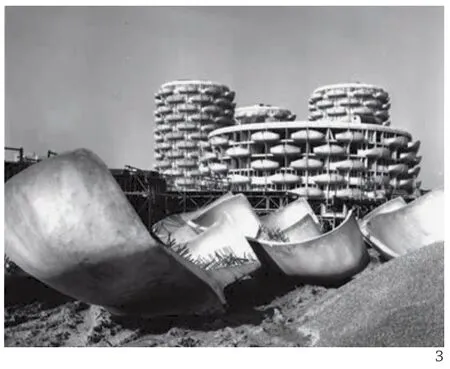
3 陽臺在“卷心菜”項目中是個人與群體之間的調節器,巴黎附近的克雷代伊,杰拉德·格蘭德沃,1972/The balcony as a regulator between individual and mass at Les Choux,Creteil, near Paris, Gerard Grandval, 1972 (攝影/Photo:Henri Locuratolo)
在法國預制混凝土技術發展的支持下,格蘭德沃提出了一套花瓣狀陽臺的體系,可以為建筑提供獨特的造型和相應的可識別性,但最重要的是它設計了新的形式,可以用來在私人和集體的領域邊界提供“遮蔽”,也讓住戶在個人空間體驗的過程中感受到高度私密性與公共領域之間的關系:“在克雷代伊,反而有一種想要打破平庸的大型組裝構件的欲望。然而,舉例來說,其表面則是定額分配的。為了補償這一缺陷,我想象出寬闊的陽臺。我認為,它們必須能夠避免被他人窺視的侵擾,否則人們就不會使用它們。這就是我獲得懸挑的花瓣形式靈感的過程。”[9]
作為一種在法國政府主導的強烈集體主義導向的建成環境和個人之間進行調和的嘗試,格蘭德沃采用了預制混凝土的陽臺元素。在最廣大人民的社會現實和個人的現實之間的的領域能夠通過陽臺進行表達,說明陽臺在其中具有關鍵作用。
紀念碑和壁龕:里卡多-波菲爾,西班牙巴塞羅那市瓦爾登
在西班牙弗朗哥統治時期,有許多關于個體與大眾之間關系的思考。弗朗哥政府對公共住宅幾乎不進行任何投入,其政策也主要傾向于補貼個人的按揭貸款,偶爾會建設少量的公共住宅項目。然而,西班牙建筑師波菲爾幾乎和格蘭德沃同時,也通過巴塞羅那的瓦爾登7號住宅項目,提出了他對大眾與個體交匯的觀點。波菲爾把這種交匯重新定義為大眾住宅的紀念性尺度和居民人性化尺度之間的張力。陽臺在這一定義中起到了重要的作用。在瓦爾登的住宅項目中,公寓建筑的紀念性通過一個被折疊進帶有空腔的巨大城市形態中的封閉體量進行強調。
"Nothing spoils the form of the openings more then the inordinate length of the balcony…These elements are foreign to good architecture."[1]148-149
A Disturbing Element Entering the Stage
Originally a military entity that was attached to the wall of fortress and used to project missiles to the enemy,the balcony has always been a charged architectural element. From its very entry on the stage of modern architectural culture it has been looked upon as a stranger, an unwanted visitor or even a troublemaker –as emerges from the writings of the French architectural theoretician Quatremère de Quincy in hisDictionnaire Historique d’Architecture, from 1833.
As many 19th century architects, Quatremère was extremely criticical of the modern "balcony fashion"and held that "the architecture is most often sacrificed,especially the exterior facades and the proportions of their details."[1]He identified the balcony as a polluting element and described it as a "hors-d’oeuvre postiche" (appetizing hairpiece) "because of its nature,independent of the main construction."[1]142-146
Taming the disturbing architectural element of the balcony, making it part of a universalist catalogue of modern elements, would become one of the big challenges of the modern movement in architecture.This domestication of the balcony was primarily achieved by locating it within a reformist rhetoric of the provision of democratic admission to health and hygiene, which in the early twentieth century became strongly related to the access of sun and air.[2]What in the late 19th century was still discuss as a disconcerting element, was now given a place at the centre of modern architectural discourse.
On the cover ofBefreites Wohnen (freed living)that was published in 1929 as a result of the first Congres Internationale d’Architecture Moderne (CIAM)the Swiss critic Sigfried Giedion locates the balcony firmly in a broader modernist rhetoric on emancipation towards new ways of living...[3]The balcony is depicted as the element that introduces licht (light), luft (air)and oeffnung (openness). In the photographic pages of the book the balcony is further inserted into a modernist logic of dwelling by contrasting it with a dark prison cell. Text and images suggest that the modern architectural element has curing powers that have the capacity to heal the imprisoned occupant of oldfashioned tenements. In another publication Giedion explains that, "The 'new architecture' has unconsciously used these projecting 'balconies' again and again. Why?Because there exists the need to live in buildings that strive to overcome the old sense of equilibrium that was based only on fortress-like incarceration."[4]In the late 1920s and 1930s the balcony is gradually given a central place in several modern architectural discourses and practices.[5]It becomes a conspicuous feature of the modernist house.
The emancipatory and healing character of the modern balcony was not only a matter the architectural avant-garde, but also resonated in political discourses. In the housing politics of Red Vienna the balcony would receive a central role,as a newspaper article with Karl Ehn in 1931 on the opening day of the infamous Karl-Marx-Hof makes clear: "Smooth, without any unnecessary ornamentation, the houses were built, but so much more valuable jewelry are the balconies, which continuously expands the whole front, so that each apartment has a balcony."[6]A collage of the housing complex, made right after its completion, grasps how the balconies were crucial elements in the Viennese dwelling politics for a new man.
Individual and Mass, or Screening the Greatest Number
Within post-war architectural culture the element of the balcony is activated to deal with a variety of issues that emerge from the changing political, social, cultural and economic role of the built environment. The balcony becomes first and foremost a mediator in one of the central issues of the postwar period, which sociologist Daniel Bell summarized in 1956 as "the possibility for some few persons of achieving a sense of individual self in our mechanized society."[7]In the numerous large-scale housing developments that occur after the Second World War as well in the North as in the Global South, from Stockholm to Casablanca, this issue of creating and individual realm within a broader urban environment for the masses would become one of the central concerns of urban planers and architects.
The balcony becomes the "architectural element par-excellence" to deal with this issue of mass and individual in a wide variety of housing projects. The French architect Gerard Grandval offers an interesting example in his housing project Les Choux in Creteil near Paris, one of the multiple housing projects that was initiated by the national government in France ofles trente glorieuses.[8]The Les Choux complex which consists of ten towers, each fifteen stories high, was built in the early 1970s as an experimental approach with "housing for the greatest number". The challenge in these type of projects was the engagement with the new collectivity and anonymity that emerged from these housing environments for an upcoming mass society.
Supported by the evolution of precast concrete in France, Grandval proposed a system of petal shaped balconies, these gave the buildings their unique appearance, as well as a particular identity, but above all installed a new figure of "screening" the border between the real of the individual and that of the mass,allowing as such as well a visual engagement with the public realm and a high degree of privacy for the individual spatial practices of the occupants: "At Créteil,there was instead a desire to break with the banality of large assemblies. Nevertheless, the surfaces were,for example, very quotas. To compensate, I imagined large balconies. I thought they had to be protected from prying eyes, otherwise they would not be used. This is how I got the idea of these cantilevered petals."[9]
In an attempt to mediate between the strongly mass-oriented approach of the built environment by the French government and the real of the individual Grandval relies on the element of prefabricated concrete balconies. The balconies play a key role in articulating a realm that could negotiate between the societal reality of the greatest number and that of the individual.
Monument and Niche: Ricardo Bofill, Walden
In Spain of the Franco regime thinking about the relation between individual and mass was heavily loaded. The Franco government invested very little in public housing and policies were mainly directed at subsidizing private mortgages with occasionally a few public housing projects.Nevertheless, almost simultaneously to Grandval,the Spanish architect Bofill offered his view on the encounter between mass and individual for the housing project Walden 7 in Barcelona (1970-1975).Bofill redefines this encounter as the field of tension between the monumental scale of mass housing and the individual scale of the inhabitants. Balconies play an important role in this definition. In the Walden housing project the monumentality of the apartment buildings is emphasised by threating them as a closed grossform that is folded into an enormeous urban formation with cavities:

4.5 瓦爾登7號住宅的陽臺是反轉的壁龕,西班牙巴塞羅那,里卡多·波菲爾,1970-1975/Walden 7 Housing with the balcony as an inverted niche, Barcelona, Ricardo Bofill, 1970-1975.
“立方體和筒倉……我們在這里看到了瓦爾登項目建筑的構成規則,也就是被設計為像北非要塞一樣的空間形式,仿佛是一個個立方體堆砌構成的崖面。它在幾何層面既是封閉環形的又是分叉形狀的。我刻意地在室內空間設計中加強了透視突然反轉的眩暈感。目的是讓人們對居住空間有非常強烈的體驗。”[10]16-17為了表現建筑的宏偉氣勢,這里加入了完全不同尺度的元素——也就是小體量的半圓形陽臺,形成小龕室,它們不僅參與居民的個人生活,也象征著個人與群體社會之間的新關系。對波菲爾來說,陽臺作為一種“原型”,能夠“幫助克服設計師一時心血來潮想要投身于整個社區的無意識心態,讓個人能夠加入社會的共同基金[10]164。波菲爾本人對這些建筑元素的原型有一種超現實主義的強烈態度:“樓梯無處可達的悖論,建筑要素懸而未決的荒謬,空間既有力又無用的狀態,這一切通過張弛有度的不均衡感、按奇特的比例組合起來,卻產生了神奇的效果。”[11]
瓦爾登項目中的陽臺就具有這樣看似荒謬實則有效的作用。這些陽臺既提醒了人們地中海地區長期以室外空間作為起居空間補充要素的傳統,又以其面對紀念碑式的住宅建筑體量所展現出的尺度之微小和兩相并置的狀態,令人們產生了不同的解讀方式。這些陽臺并不是供人們停留或觀賞風景使用的,而且因為面積十分有限,實際上幾乎無法實現這些功能,而只是讓人們能夠出現在陽臺上。它讓居民能夠出現在公共區域,但最重要的是讓每位居民個人都能在其身處的群體住宅矩陣中找到自己的位置。瓦爾登項目的室外陽臺在體現個性化特征的同時,也表現出在一個大眾社會中絕對不可能實現個性化的悖論。
在瓦爾登住宅項目氣勢恢宏的開敞式室內大廳內,各類形狀各異的陽臺也占據了空間的核心位置,從小尺度的圓形陽臺到半圓形陽臺,從更大體量矩形陽臺到橢圓形陽臺,應有盡有。它們不再和個體的居住環境產生直接的聯系,而是和建筑的集體空間產生關聯。它們和各種樓梯、廊橋和走廊共同構成了復雜的集體主義交通流線網,且在其中具有特殊意義。它們的作用是要將半集體主義的空間引入瓦爾登住宅項目的室內。這些陽臺通過在巨大的集體主義空間內為住戶提供小尺度的壁龕空間,供他們長期或短期使用,延伸、補充并打破集體主義建筑體系,表達了群體與個人之間的空間張力。
私人領域的粗暴疊加:白塔,弗朗西斯科·哈維爾·薩恩斯·德·奧伊薩,西班牙馬德里,1964-1969
和格蘭德沃與波菲爾的例子一樣,弗朗西斯科·哈維爾·薩恩斯·德·奧伊薩也通過對現代高層建筑進行歐洲類型學定義的嘗試,關注如何表達新的集體主義。薩恩斯·德·奧伊薩想象中的高層建筑,和北美地區那些由層層樓板粗暴疊加構成的大樓有所不同,而是更契合歐洲地中海地區錯綜復雜的集體主義氛圍的建筑類型:“委托方對這一點非常明確,不需要提出一種新形式的社會生活或家庭生活。西班牙的市場和消費者社會早已對此進行了嚴格的限定。在這種情況下,建筑師只需要為那些為滿足‘居住’要求而建立和提出的方案在垂直方向上設計新的組織方式。”1)
在他的“白塔”項目中,陽臺在定義這種集體主義的過程中非常重要,它盡可能在兩種不同的垂直居住方式之間取得協調,其中一種是“作為物理空間的地理形態在垂直方向上的延伸,使每個人都能與地面保持直接聯系……這就是‘城堡式的居住方式’。一座城堡原則上是一種建立在有標志信息的物理空間地理系統上的方式,是另一種地理形態,進一步凸顯或強調了它本身。”第二種可能性則是“膠囊式的居住方式”,它是一種在透視關系之外、以非常精巧的方式用玻璃紙包裹起來的居住環境,是懸浮在空中的住宅。常見于這一模型的集體主義關系非常新穎,與前兩個例子截然不同——應該從技術、社會學和人文主義的角度對其進行徹底深入的調查[12]。
薩恩斯·德·奧伊薩提出了一種新的類型,介于上述的兩個極端情況之間,同時象征了私人空間與當時流行的集體主義形式之間的連結感和分離感。這座完全暴露于室外的混凝土大樓矗立在馬德里的天際線上,高達71m。大樓從里到外都表現出其與生俱來的天然有機屬性,甚至其墻面也從地面一直無縫延伸到天花板。半圓形的陽臺緩和了原始而重復出現的圓形體量相交處形成的尖銳夾角。這些陽臺從一側向另一側逐層爬升,它們不僅以這種方式形成了體量與光影,組合成非對稱感的有趣韻律,也為大樓的不同私人空間形成了彼此連接的關系。
重新洗牌的私密文化:坎迪利斯、伍茲、博迪安斯基,“中心職業發展區”項目,摩洛哥卡薩布蘭卡,1952
陽臺不僅能代表新的集體主義形象,同時也能代表具有文化意義的居住傳統,這可以通過3位在法國執業的建筑師——“建造者工作室”駐非洲辦事處的喬治·坎迪利斯、沙德拉奇·伍茲和維克多·博迪安斯基在摩洛哥城市卡薩布蘭卡郊區精心設計的項目中得到闡釋。19世紀末的法國建筑歷史學家皮埃爾·普拉納在《建筑和施工百科全書》一書中認為“我們從未在亞洲或北非的任何一座穆斯林住宅中觀察到對陽臺的使用。因為它會完全違背這些族群的習俗,陌生人不可以入侵其生活的私人領域。”[13]對“建造者工作室”來說,在對最新潮的現代居住類型進行定義的過程中,陽臺的文化涵化作用在1950年代初期成為其主要的考量因素。
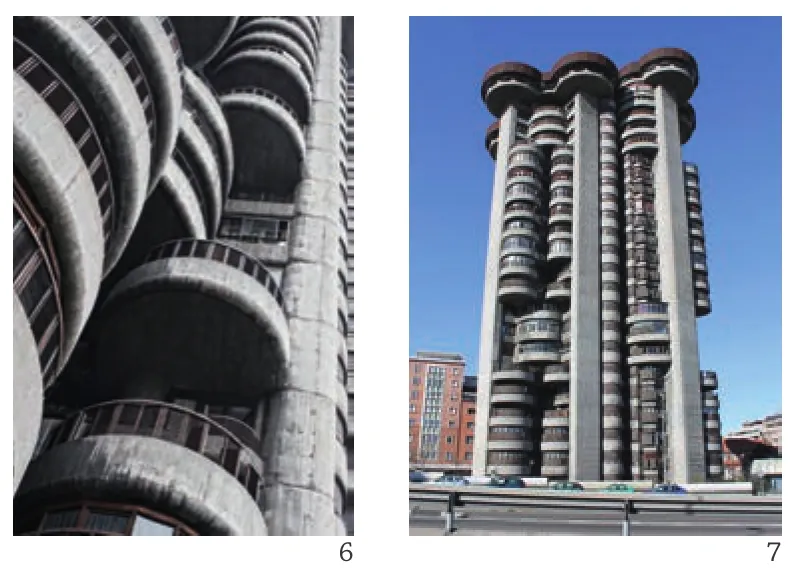
6.7 在“白塔”項目中,陽臺是新高層建筑類型中的關鍵要素,西班牙馬德里,弗朗西斯科·哈維爾·薩恩斯·德·奧伊薩,1964-1069/The balcony as a key element of a new skyscraper typology at Torres Blancas, Madrid, Francisco Javier Sáenz de Oiza, 1964-1969.
(6 圖片來源/Source: Efrén Rodriguez ; 7 圖片來源/Source:Luis García)
"Cubes and silos ... Here we see the principle of composition of Walden, designed as a casbah in space cubes stacked on top of each other like a rock slant. It is the geometry of the 'O' and 'X'. In the interior, I purposely increased the sheer dizzying,sudden reversals of perspective. I wanted the living space feel very strong."[10]16-17To this grand gesture,a completely different scale element is added: small dimensioned semi-circular balconies that function as little niches that not only play a role in the individual life of inhabitants, but moreover symbolize the new relation between the individual and mass society. For Bofill the balcony is an "archetype" that "overcomes the whim of a designer to plunge the heart of the unconscious of an entire community: it connects the individual to the mutual fund of a society."[10]164Bofill himself holds a particular relation to these archetypical architectural elements an attitude which he describes as surrealist, cultivating: "the paradox of stairways that lead nowhere, the absurdity of elements suspended in the void, spaces both powerfull and useless, whose strange proportions become magical through a sense of tension and disproportion."[11]
The balconies at Walden play this paradoxical role. They appear as elements that remind of a long Medditerenean tradition of outdoor rooms that complement interior dwelling spaces, but their small size and their confrontation with the monumental form of the housing blocks suggest a different reading. These balconies are not places to stay or appropriate, their limited surface makes this virtually impossible, but merely to appear. It allows the inhabitant to appear in the public realm, but above all locates the individual inhabitant within the matrix of mass housing of which he is part. The balconies at the outside of Walden are simultaneously the markers of individuality, and of the absolute impossibility of that individuality within a mass society.
At the spectacular open-air interior lobbies of Walden there is also a central role for balconies which vary in shapes from small circular and semicircular, to larger and rectangular or oval in shape.These balconies are no longer directly connected to the spaces of the individual dwelling, but rather to the collective realm of the building. They are the special parts of a complex network of collective circulation spaces of stairs, bridges and gallery spaces. Their role is to introduce semi-collective spaces within the interior world of Walden. By extending, complementing and punctuating the collective circulation system they represent the field of tension between mass and individual, by offering the inhabitants small niches for short-term or long-term appropriation within the massive realm of collectivity.
A Brutal Layering of Private Domains:Torres Blancas, Francisco Javier Sáenz de Oiza,Madrid, 1964-1969
Just as in the case of Grandval and Bofil,Francisco Javier Sáenz de Oiza was concerned with articulating a new collectivity in his attempt to define a European typology for a modern skyscraper.Saenz de Oiza imagined a skryscraper that did not conform to the blunt juxtaposition of floors, as was the case with the North American skyscraper, but rather a typology that was more in tune with the intricate collectivity of Mediterenean Europe: "The client was very explicit on this point: It was not to make a proposal for a new form of social or family life. The Spanish market and consumer society, had,with sufficient rigor defined its requirement. The role of the architect in this case was only to propose a new vertical organisation of those established and supposed program requirements of 'dwelling'."1)
The balcony would play an important role in defining this collectivity in his project for the Torres Blancas, which tried to mediate between two models of vertical living, a first one being "a kind of vertical extension of the topography of the physical space so that no man loses direct contact with the earth...It is the 'castle-dwelling': a castle in principle is a way of imposing on a marked physical topography,another topography that highlights or strengthens it." A second possibility is the "capsule-dwelling":a dwelling environment that is subtly packed with cellophane wrap Out of this perspective, the house floats above the ground. The common collective relations of this model, are very new, very different from the other and the first case: they should be investigated in all of its depth in technical,sociololgical and humanist senses.[12]
Somewhere between the two extremes described above, Sáenz de Oiza suggests a new typology that symbolizes simultaneously the connectivity and separation of private domains into a newfangled collective form. This exposed concrete towers rise 71 metres above the Madrid skyline. Its intrinsic organic nature is carried throughout all aspects of the tower, even the walls flow seamlessly from floor to ceiling. The balconies,which are semicircular in form, serve to soften the sharp angled intersections of the primary circular volumes. They not only jog from side to side as they rise, creating an interesting asymmetrical rhythm of massing and shadow play, but also create relations between the different private domains of the tower.
Shuffled Cultures of Privacy:Candilis – Woods – Bodiansky, Carrieres Centrales, Casablanca, 1952
The balcony was not only a figure of new collectivities but also of the persistence of conventional and culturally-defined dwelling practices,emerges from the project that three French-based architects – Georges Candilis, Shadrach Woods and Victor Bodiansky working for ATBAT-Afrique –elaborated for the periphery of the Morrocan city of Casablanca. While at the end of the 19th century the French architectural historian Pierre Planat inthe Encyclopédie de L'Architecture et de la Constructionhad still claimed that "In not a single Musulman house in Asia or North-Africa we perceive a balcony. This would be completely contrary to the mores of these people in which strangers can not penetrate in the intimacy of life."[13]for the ATBAT the assimilation of this cultural aspect of the balcony would become in the beginning of the 1950s a main consideration in the definition of newfangled modern dwelling typologies.
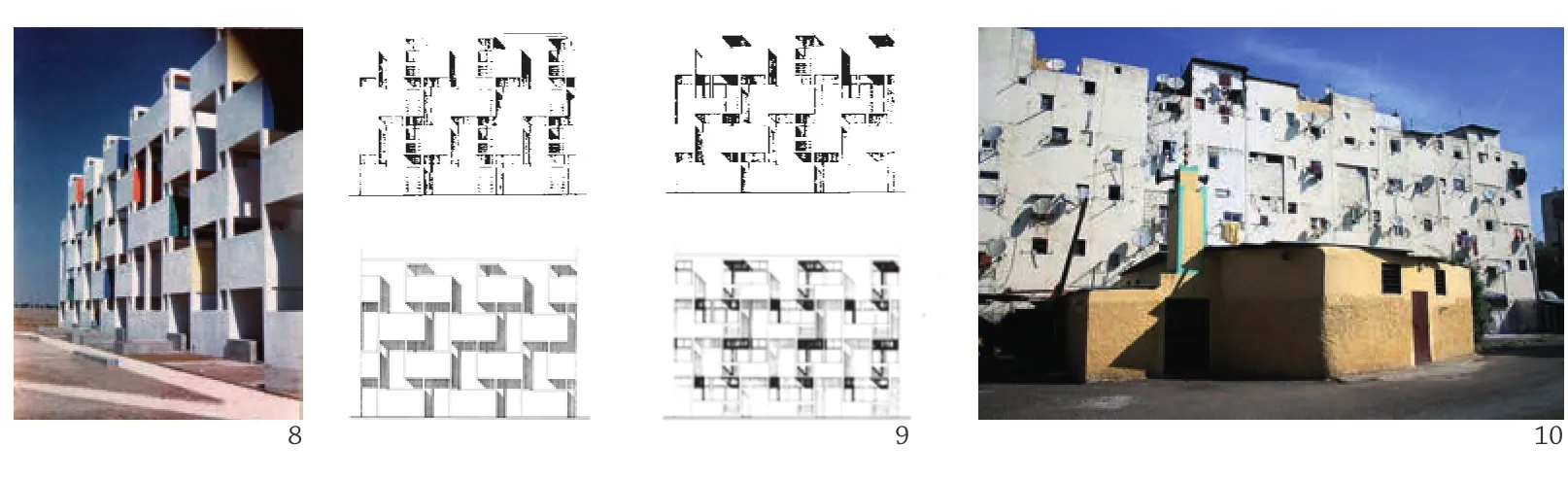
8 “中心區職業”住宅項目的陽臺在建成后很快交給穆斯林使用,摩洛哥卡薩布蘭卡,喬治·坎迪利斯、沙德拉奇·伍茲、維克多·博迪安斯基,1952/Carrieres Centrales Housing with the balconies for muslims short after realization,Casablanca, Georges Candilis– Shadrach Woods – Victor Bodiansky, 1952
9 對陽臺面向公共區域的不同文化表達方式的研究,摩洛哥卡薩布蘭卡,喬治·坎迪利斯、沙德拉奇·伍茲、維克多·博迪安斯基,1952/Studies of the different cultural articulations of the balcony towards the public realm, Casablanca, Georges Candilis– Shadrach Woods – Victor Bodiansky, 1952.
10 “中心區職業”住宅項目的陽臺在建成后交給穆斯林使用的現狀,摩洛哥卡薩布蘭卡,喬治·坎迪利斯、沙德拉奇·伍茲、維克多·博迪安斯基,1952/Carrieres Centrales Housing with the balconies for muslims, Current condition,Casablanca, Georges Candilis– Shadrach Woods – Victor Bodiansky, 1952
(8-10 圖片來源/Sources: Woods Archive, Columbia University)
他們當時受到1940年代初著名城市規劃師米歇爾·埃科查德的文化主導論啟發,正在尋求一種現代的居住形式,使它既能體現居住與生活的進步方式,又能與傳統方式保持協調。為了達成這個目標,“建造者工作室”北非辦事處的建筑師重點關注了公共領域和私人領域的空間設計,并更精準地著眼于處理兩者之間的關系。這種對私人領域和公共空間之間關聯特征的強調,最初來源于“建造者工作室”建筑師對偏遠地區居住形式進行調查的顯著成果,這一成果也被納入了他們的貧民窟項目中。這些調查強調了在偏遠地區的居住環境中,私人與公共空間之間涇渭分明的現場,如何重新出現在了貧民窟的臨時建筑類型中。
更重要的是,“建造者工作室”對過渡空間的強調也應該看作是對當時把歐洲高層住宅移植到北非環境后進一步發展的批判。正如布魯諾·韋西埃所述,在法國戰后建筑重建運動中,人們對這些過渡空間設計的關注度和投入度都逐漸減弱[14]。出于居住環境需要理性化的需求,建筑師和工程師在他們住宅設計中逐漸省略了這個空間。韋西埃記錄了,像室外平臺和連廊這樣的過渡性建筑元素如何在戰后的法國,尤其是在高密度高層住宅設計的過程中大量消失的過程。
從這個角度看,“建造者工作室”的建筑師在《穆斯林、歐洲、猶太人住宅》(1953)的研究中表現出對位于私人領域和公共區域之間的室外居住空間的強烈關注,是可以理解的。在這個項目里,私人和公共區域之間的關系及其物質載體被認為是居住文化的核心要素。項目探索性地調查了各類室外居住空間的特征及其在個人空間和公共領域之間的過渡作用。“建造者工作室”的建筑師區分了穆斯林住宅、猶太人住宅和歐洲住宅的差別,其中,穆斯林住宅的室外起居空間與私人空間聯系非常密切,卻與公共區域完全隔離。在另外兩類住宅中,公共和私密空間的區隔取決于空間通透程度的不同。
坎迪利斯和伍茲從這些私人與公共區域之間的聯系方式出發,為各種獨特的居住文化設計了不同的類型。這些不同類型的特點在于在建筑學定義的背景下,私人空間與公共區域、以及和其他相鄰空間之間的邊界所具有的功能。然而,坎迪利斯和伍茲卻認為私人空間和公共區域之間的關系并不只和建筑學的定義有關,他們相信居住行為在其中也有重要的作用:“私人與集體領域之間的關系一次又一次地通過日常行為進行限定,永無止境。”2)
文化交融的場所:費迪南·普永,迪阿·埃爾·馬庫住宅,阿爾及利亞阿爾及爾,1957
費迪南·普永在其1957年在阿爾及利亞首都阿爾及爾市海灘坡地上設計的迪阿·埃爾·馬庫住宅項目中表明,陽臺也可以被看作不同居住文化模式之間邂逅、對峙或調停的場所。
普永想要建立一處多元文化相互疊加的鄰里住宅社區。在他看來,歷史上的阿爾及爾強烈地表現出兩種不同的文化——土耳其的奧匈帝國文化背景和伊斯蘭教統治下的西班牙文化。在迪阿·埃爾·馬庫住宅中,墻體的紀念性特征令人聯想起土耳其的軍事壁壘,其內部廣場、花園和露臺的靈感則汲取自西班牙塞維利亞和格拉納達的柱廊、噴泉和瀑布景觀。建筑師含蓄地表明這些技藝最早來源于法國。
然而,陽臺作為建筑元素在其中發揮了協調不同文化的作用,這一特殊的建筑要素成為普永此后偏愛的文化交融場所。這在被稱為“圖騰塔”的項目里中體現得尤為明顯,它由普永和雕塑家瓊·阿馬多合作設計完成。這座陽臺塔樓的不同組成部分表現了普永在阿爾及爾辨認出的各類居住和建筑文化。分布在較低層陽臺上的木結構腳手架代表了傳統的土耳其住宅。塔樓上樓層較高的陽臺裝有預制的陶瓷構件組成的面板,代表了現代建筑手法,而形狀各異、五彩繽紛的雕塑感元素則來源于更古老的游牧民族居住方式及其裝飾要素。
這種把來源于不同建筑傳統的建筑構件組合在一起的思想——無論是土耳其式、鄉土式還是現代式——都是費迪南·普永現代建筑手法的重要組成部分。他認為現代建筑并不意味著必須引入一套普遍使用的模型,而是意味著“不同的建筑文化和不同氛圍彼此相遇,從而共同形成當代境遇下的真實環境。”[15]在迪阿·埃爾·馬庫的住宅建筑“圖騰塔”中,普永說明了這個過程需要藝術家、陶藝家、雕塑家、以及像細工木匠、鎖匠和石匠這樣充滿靈感的手工藝匠共同參與。普永認為,其最終完成的建造仰賴地方手工藝人的參與,不僅能節約成本,也能營造出令居住在這些建筑里的人特別欣賞的建筑特征。
私人文化的層次:宜居的景框,蓬蒂公寓,意大利米蘭,1953-1954
吉奧·蓬蒂發現,陽臺不僅能表現出居住者的品位,還能成為日常居住生活的場所,由此在重新定義私人領域和城市的公共領域之間關系的過程中起到重要的作用。這位意大利的建筑師因此依據地中海地區的許多窗花、敞廊和凸窗所代表的傳統,在住宅和城市的界限之間巧妙地采用了一系列遮蔽要素。
蓬蒂在被稱為“宜居的景框”項目中,設計了一種能適應不同居住形式的陽臺。它是一套由多層景框、屏風和面板層疊構成的系統,通過日常物件、藝術品和特殊裝置,讓各種不同的使用方式都能盡情體現在陽臺的這幅畫布上,并由此細致入微地定義了公共領域和私人領域的各種轉換過程。蓬蒂在若干展覽中對他這些厚重的陽臺進行了探索展示,在其中進一步研究了公共與私人邊界的時間特質。結果表明,厚重的陽臺不僅能提供各種不同的遮蔽形式,也能夠表達和揭示出居住者的身份。很有可能蓬蒂自己也未完全認識到,他已經開始在作品中表達陽臺所具有的微觀政治維度——通過切實地介入私人與公共領域的邊界,在建成環境中為其居住者提供一個主動表現自己的機會。
日常政治場所:安東尼奧·科德奇,薩莉亞的車庫住宅,西班牙巴塞羅那,1968-1973
正因為陽臺處于個人空間和公共區域之間的關鍵位置,因此也是一項卓越的政治要素。陽臺遠遠地從高處延伸進公共區域的特征已經讓其成為在表現政治權利時備受青睞的建筑元素。陽臺是人們表達微觀政治觀點、演說政治策略和展現參與者的建筑元素,許多政治演說的背景就是陽臺,此外它也是一處體現不同微觀政治形式的場所。早在1714年,建筑理論家塞巴斯蒂安·勒克萊爾在其《建筑論文:將要投身于這項高貴藝術的年輕人所需的評論和觀察》中把陽臺形容為:“高高在上的小空間”[16]。
Inspired by the culturalist perspectives of Michel Ecochard, who was the main urban planner of Casablanca in the beginning of the 1940s, they were searching for a way to define modern dwellings that were simultaneously progressive and attuned to conventional ways of dwelling and living. To obtain this the architects of ATBAT-Afrique focused on the design of public and private space, and more precisely on the relation between the two. This emphasis on the character of the intermediate realm between the private and the public was, in the first place, the obvious result of the study of rural dwelling patterns and their transplantation into the bidonvilles that the ATBAT architects performed. These investigations underlined how the strong separation between private and public domains of the rural dwelling re-emerged in the temporary typologies of the bidonvilles.
More important, however, is that ATBAT's emphasis on the intermediate realm should also be understood as a critique of contemporary developments in European models of high-rise housing transplanted into the North-African context.As Bruno Vayssiere illustrated, it can be argued that within French post-war building production there was a decreasing attention and elaboration of this intermediate sphere.[14]Under the guise of rationalization of the dwelling environment,architects and engineers increasingly erased this realm from the housing models they proposed. Vayssi.re documented how in post-war France, especially in the design for dense high-rise housing developments,intermediate architectural elements such as outdoor terraces and galleries largely disappeared.
It is from this perspective that the strong attention for outdoor dwelling space situated in-between the private and the public realm, as shown in the study forHabitations musulmans/européennes/israélites(1953) by the ATBAT architects, should be comprehended. In this project the relation between the private and the public realm and its material manifestation is considered one of the essential aspects of dwelling culture.The project was an exploratory investigation of the character of outdoor dwelling spaces and their role in mediating between the private and the public realm. The ATBAT architects distinguished between Muslim dwellings – where the outdoor dwelling space is in close connection to the private sphere and at the same time completely separated from the public realm – and Israeli and European dwellings.In the last two categories the relation between the public and private sphere is based on different degrees of transparency.
Taking these different relationships between the private and the public realm as a point of departure,Candilis and Woods developed several typologies for particular dwelling cultures. The particularity of the different typologies is a function of the architectural definition of the borders between the private and the public realm and their relation to adjacent spaces. However, Candilis and Woods did not consider the relation between the private and the public realm uniquely a matter of architectural definition, but also believed that dwelling practices played an important role: "The relation between the private and the collective domain is relentlessly defined in everyday practices."2)
Loci of Cultural Metissage:Fernand Pouillon, Diar el-Mah?oul Housing,Algiers, 1957.
That the balcony also can be regarded as the locus for the encounter, confrontation or mediation between different cultural patterns of dwelling was in 1957 illustrated by Fernand Pouillon in his housing project for Diar el-Mah?oul on the slopes of the bay in the city of Algiers. Pouillon wanted to create a housing neighborhood that was culturally multilayered. In his view, historic Algiers expressed the presence of two cultures strongly: Ottoman and Islamic Spain.In Diar el-Mah?oul, the monumental quality of the walls referred to the Ottoman ramparts, whereas the interior squares, gardens, and patios were inspired from Seville and Granada in their porticos, fountains,and cascades. The architect implicitly stated that the technical inventiveness were French.
However, it was the architectural element of the balcony that would play the role of the mediator of different cultures; this specific architectural element would become for Pouillon the preferred locus of a cultural métissage. This becomes particularly clear in the so-called Totem Tower (tour a totem) that was designed together with the sculptor Jean Amado.This tower of balconies is composed of different parts that refer to various dwelling and building cultures that Pouillon discerned in Algiers. The wooden scaffold work in the lower parts of the balconies refer to the architecture of traditional Ottoman housing.The higher balconies of the tower refer with their screen of prefabricated terracotta elements to a modern way of building, while the colorful sculptural elements make reference to tribal patterns and decorations that belong to the old forms of dwelling.
This idea of combining architectural components from various architectural traditions – as well ottoman,vernacular and modern – was very much part of Fernand Pouillon’s approach to contemporary building.In his view modern architecture was not about the import of a universal model, but rather about"an encounter between different building cultures,different atmospheres, that together form the reality of a contemporary condition."[15]In his Totem Tower in Diar el-Mah?oul Pouillon illustrates that this required involvement with artists, ceramists and sculptors,along with inspired craftsmen such as cabinetmakers,locksmiths, stonecutters. Pouillon held that the resulting construction processes achieved a reduction costs because of its reliance on local craftsmanship,but also created features that would be particularly appreciated by those who inhabited the buildings.
Layers of Private Cultures :Inhabitable Viewing Frames, Ponti Apartments,Milan, 1953-1954
That the balcony not only could address the taste of inhabitants, but also could act as a locus of everyday dwelling practices and thus play an important role in the redefinition of the relation between the private realm of the dwelling and the public realm of the city was explored by Gio Ponti. The Italian architect relied therefore on a Meditereneean tradition of subtly screening the border between the house and the city as represented in the multiple mashrabiyas, loggias and oriel windows in the region.
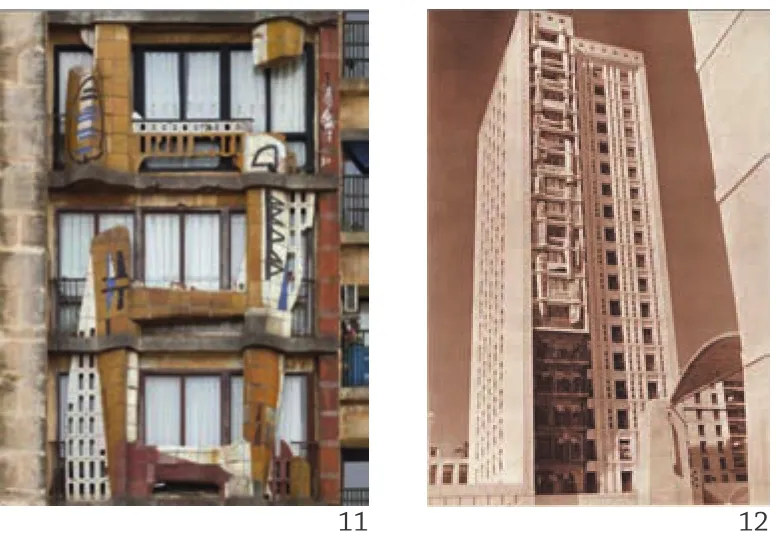
11.12 在迪阿·埃爾·馬庫住宅項目的“圖騰塔”中陽臺作為文化融合的場所,阿爾及利亞的阿爾及爾市,費迪南·普永,1957/The balcony as a locus of cultural métissage at Totem Tower at the Diar el Machoul Housing, Algiers,Algeria, Fernand Pouillon, 1957.(圖片來源/Sources:Pouillon Archives)
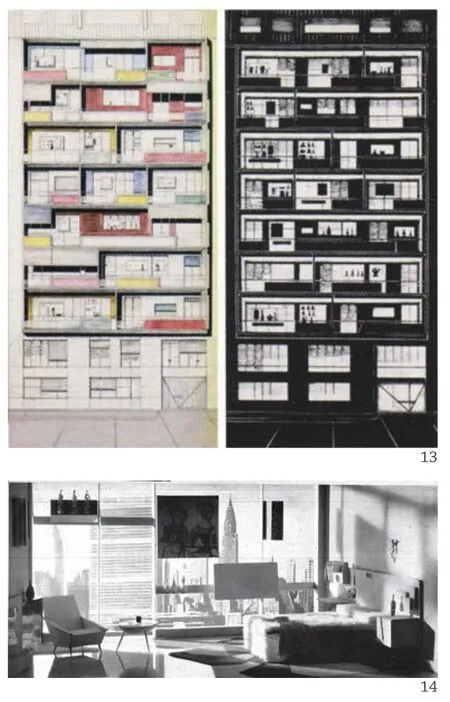
13 陽臺的微觀政治維度在“宜居的景框”項目中得以體現,德扎大道公寓,意大利米蘭,吉奧·蓬蒂,1956-1957/The micro-political dimension of the balcony turned into a project of Inhabitable viewing frames, Via Dezza apartments, Milan,Gio Ponti, 1956-1957.
14 某次展覽展出的“宜居的景框”設計原則,吉奧·蓬蒂,1954/Principle of the inhabitable viewing frame (finestra arredata) on an exhibition, Gio Ponti, 1954.
(13-14 圖片來源/Sources: Ponti Archives)
戰后時期,建筑師安東尼奧·科德奇曾為1962年的羅約蒙特“十次小組”展示了一系列建有陽臺的建筑,正是他指出了陽臺能夠協調環境中的微觀政治干預手段的這個特點3)。科德奇認為陽臺可以有新的定義,它能依靠“彼此分擔的責任,是一片建立在未來使用者共同參與前提下的生境。”[17]科德奇于1960年在《Domus》雜志發表了一篇論文,其中精心闡述了這一建筑思想,文章的標題被故意設為“我們現在不需要天才”。在他為巴塞羅那薩莉亞的車庫住宅(1968—1973)所做的設計中,這位西班牙建筑師說明了如何把這一思想體現在設計策略里,他在項目里把陽臺當作能夠多重兼容的空間。這些基本的建筑造型留有少量的未完成部分,讓用戶能夠根據自己的居住需求進行改造和建造完成,以體現其個性特征。
宏觀政治和微觀政治的交匯處:阿里耶·沙龍,吉洛住宅,耶路撒冷,1975
毫無疑問,對陽臺的微觀政治角色做過的最廣泛的研究者之一,非以色列建筑師阿里耶·沙龍莫屬,他也是一位包豪斯學校的畢業生,他在耶路撒冷南部的一座山坡上設計新建的吉洛住宅項目,其中包括250套不同尺度的公寓。在地緣政治氣氛緊張的1970年代,身處以色列的沙龍自然非常鮮明地把他的住宅項目和當時有關居住和建筑的空間實踐緊密聯系在一起。沙龍的兩條主要設計原則來源于所謂的地中海建筑傳統和耶路撒冷建筑傳統。他以4.5m見方的模數布置住宅平面,這一模數和他在當時耶路撒冷老城和散落周邊的阿拉伯村莊中觀察到的尺度一致。這個項目的建筑由4.5m寬和2.6m深的模塊沿著平面和截面方向堆疊形成。
第二項原則與開敞空間的專門用途有關——如庭院、拱廊、室外臺階和陽臺等。毫不夸張地說,這些室外空間就是為新移民以色列的家庭和公民提供的空間。從以色列獨立的最初幾年開始,住房政策就把移民當作拓荒的公民,基于自助原則為他們提供住房,這也是以自治政府思想作為前提的猶太民族主義核心原則。為新到以色列的移民提供的自助式住房包括國家提供的核心住宅,通常以建筑材料的形式(主要是木料和混凝土塊)出現,可供人們自主建造基本的住宅,后期可以由移民根據意愿自行擴建。
吉洛住宅中的陽臺響應了這些自治政府和自建房屋的原則,這些原則是以色列民族主義非常核心的思想。它們被認為是單個家庭在其有限的范圍內能夠完全享有的自由。和他的許多其他規劃一樣,沙龍認為新來的公民能利用陽臺空間積極地建立自己的現代生活方式。然而,阿里耶·沙龍在吉洛住宅中實行的最激進的決定卻并未把陽臺的私人空間和集體區域完全分隔開。現實完全相反,每套公寓都有陽臺,而通過從地面一直爬升到屋頂通道的室外樓梯總會經過其中一兩個陽臺。在私人空間和集體空間之間設置這樣直接和徹底的接觸方式表明,在沙龍的設想中,自治政府和自建房屋根本不是所謂的“個人主義”或甚至“無政府主義”。自建房屋的思想被當成人們正在集體成就的更宏大項目的一部分,并且在本質上,最重要的是彼此合作。
把陽臺當作自建房屋的場所也要求人們對現代建筑要素的變形能力進行反思。在吉洛住宅中,把自建房屋的思想理解為對原有平面的擴建。如果是這樣,那么居住者對某項建筑元素進行改造的行為,并不能代替人們在廢墟中搜尋舊物件的輕度實用主義普遍觀念,卻完全有可能把每一次對原始平面和原始形式的反應都理解為它們可以構成其自身的普世主義宣言。
陽臺的美麗新世界2020
通過對戰后建筑文化中的陽臺要素的回顧,揭示出了人們試圖重新奪回陽臺所具有的一系列文化、社會和政治力量的相關理論與實踐。尤其是整個地中海地區,從西班牙、法國和意大利,到以色列、阿爾及利亞和摩洛哥,陽臺作為建筑元素似乎已經成為需要在不同條件和文化背景下不斷進行修正、同化和融合的對象。
陽臺不僅僅是建筑師需要關心的元素,2020年新冠病毒肆虐全球,這一點變得顯而易見。為了控制新冠病毒的蔓延,從2020年3月開始許多市民被建議待在自家的私人空間內。在國家公權力前所未有地侵入日常生活的背景下,市民被限制使用公共區域,并且把公共接觸減少到最低程度。像“居家隔離”和“保持社交距離”這樣的口號已經成為城市日常話語的一部分。4)
幸好,在當代社會,人們并不能理所當然地接受切斷公民與社會生活和公共區域聯系的要求。相反,公民會想方設法接近公共社會,包括用其他方式團聚,采用其他的策略進行分享、照顧和提供支持,也就是說用各種不同的方式實現共惠共享。雖然數字科技提供了一套全新的渠道和模式進行碰面、交流與合作,但在模擬信號的世界、在歐洲的鄰里社區和城市中,人們也發明了新的溝通方式。其中扮演了關鍵角色的一項城市要素就是陽臺。
在2020年初的幾個月,陽臺在人們的日常生活中獲得了新的意義和重要性。首先,陽臺為人們提供了不需要真正進入公共空間就可以在其中出現的方式。許多人在陽臺提供的安全空間里參與城市生活。無論是注視過往的行人還是和鄰居聊天,多虧有了陽臺的安全空間,這些行為才有可能繼續。其次,陽臺也成為一個人能夠進入露天環境、同時又與他人保持距離的室外空間。人們為現在的陽臺創造了許多新的使用方式。人們在陽臺上玩游戲、做運動、冥想等等。第三,陽臺也重新獲得了作為政治空間的地位。在新冠病毒流行期間,人們希望自己的政治呼聲能被聽見,包括他們對政治決策的失望,或他們對面臨危險境況的醫務工作者的支持等話語。公眾能通過陽臺的城市空間進行表達——人們在陽臺上掛出條幅,或只是在一天中特定時刻以拍手的方式來表達政治觀點。
摩洛哥社會學家弗朗西斯科·納韋斯-布沙尼納認為陽臺是“接壤空間,‘過渡的空間’,是室內與室外、公共與私人之間類似門鎖的存在,它們是‘正當其所的場所’”[18]。納韋斯-布沙尼納指出這些接壤空間能夠“保持距離”,并且因此其含義和使用將不可避免地與室內與室外、公共與私人空間之間的過渡、轉換和決裂產生關聯。納韋斯-布沙尼納寫到,接壤空間的特點是建筑內外的相互對立,室內與室外的通道別有意味,以及開敞與封閉之間復雜的挑戰關系。
In his project for so-called "inhabitable viewing frames" Ponti develops a balcony arrangement that can accommodate different forms of inhabitation. It is a layered system of frames, screens and surfaces that offers a canvas on which various forms of appropriation – through everyday things, art objects and special installations – could be projected and thus define nuanced transitions between the public and the private realm. Ponti experimented with his thick balconies in several exhibitions in which the temporal character of the border between public and private was further investigated. These illustrated that the thick balcony not only offered the possibility of various ways of screening but also for articulating and exposing the identity of the inhabitant. Most likely without fully realising, Ponti started to address in his projects the micro-political dimension of the balcony – pointing to its capacity to offer the inhabitant an active role in the built environment through concrete intervention at the edge between the private and the public domain.
Sites of Everyday Politics:
Antonio Coderch, Viviendas de las Cocheras de Sarrià, Barcelona, 1968-1973
Because of its crucial position between private and public realms the balcony is a political element par excellence. Its elevated outreach to the public realm has turned the balcony into a preferred architectural element for the exercise of political power. The balcony is the architectural element on which the macro-political viewpoints, strategies and actors are represented, as being represented by the many political speeches thawere given from balconies, but it is also a site of various forms of micro-politics. Already in 1714 the architectural theoretician Sebastien Le Clerc described in hisTreatise of Architecture: With Remarks and Observations Necessary for Young People Who Would Apply Themselves to That Noble Art.the balcony as "une petite place élevée en l'air."[16]
In the post-war period it was the Spanish architect Antonio Coderch, who presented a collage of a balconized structures to the Team 10 Royaumont meeting (1962) to point to this particular aspect of the balcony: its capacity to accommodate micro-political intervention in the environment.3)Coderch looked upon the balcony as a site that could contribute to a new definition of architecture that would rely on a "sharing of responsabilities, habitat based on the participation of the future user."[17]Coderch had elaborated this idea of architecture as a matter of co-production in a 1960 article forDomus, which he provocatively entitled "We do not need geniuses right now". In his proposal for the Viviendas de las Cocheras de Sarrià in Barcelona (1968-1973) the Spanish architect illustrates how this can be implemented in a design strategy. In this project the balconies are understood as polyvalent spaces. Basic architectural figures that are left slightly unfinished so that users could adapt and complete the spaces to suit their dwelling needs and reflect their individual personalities.
Places of Encounter Between Macro- and Micro-politics:Arieh Sharon, Gilo Housing, Jerusalem, 1975
One of the most pervasive investigations of the micro-political role of the balcony was beyond doubt given by Israeli architect and Bauhaus graduate Arieh Sharon in his design for the new Gilo housing comprising 250 apartments of various sizes located on a hill south of Jerusalem. In the charged geopolitical climate of 1970s Israel it is no surprise that Sharon explicitly related his housing project firmly to the existing spatial practices of dwelling and building. Sharon bases his projects on two principles evolved from so-called Mediterranean and Jerusalem building traditions. He conceives his housing on a repetitive modular grid of 4.5 metres,a module that he discovered in existing structures in the Old City and in the free packing of the Arab village. In this project the buildings are staggered in cross-section as well as in plan by modular packing of 4.5 m width and 2.6 m depth.
A second choice relates to the specific use of open spaces: courtyards, arcades, outside steps and balconies. These outside spaces were literally considered as domains that were offered to the new families and citizens of Israel. Housing policies had,from the first years of independence, looked upon immigrants as pioneer citizens that were provided housing based on the principle of self-help, a core principle of Jewish nationalism premised on the idea of self-governance. The self-help housing options available to immigrants upon arrival in Israel included core housing provided by the state, which often took the form of building materials (primarily timber and concrete blocks) for auto-construction of basic dwellings which might later be expanded through the initiative of the immigrants themselves.
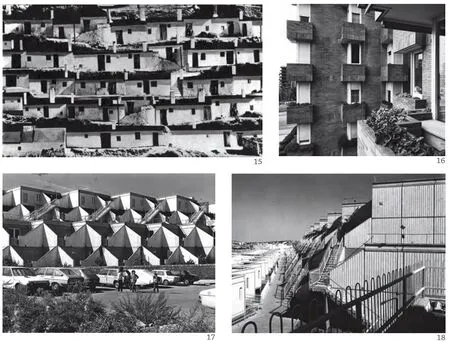
15在羅約蒙特“十次會議小組”上展示的一幅布滿了陽臺的建筑拼貼畫,安東尼奧·科德奇,1962/Collage of a balconized structure presented at Team 10 meeting in Royaumont, Antonio Coderch, 1962.
16 陽臺緩和了建筑邊緣,薩莉亞的車庫住宅,西班牙巴塞羅那,安東尼奧·科德奇,1973/The balconies are part of the frayed edges of the buildings at Viviendas de las Cocheras de Sarrià, Barcelona, Antonio Coderch, 1973.
17.18 吉洛住宅的陽臺是使用的領土,耶路撒冷,阿里耶·沙龍和艾爾達·沙龍,1975/Gilo Housing with the balconies as a territory of appropriation, Jerusalem,Arieh Sharon and Eldar Sharon, 1975. (圖片來源/Sources: www.ariehsharon.org)
除了對過渡功能的訴求,接壤空間的另一個特點也包含了一項簡單的事實,也就是說它們是“附加”給其他空間的。他們具有附屬的特點,并且與其他空間擁有共同的邊界。陽臺的這種雙重面向為這一元素提供了獨特的語義負荷。一方面,陽臺因為具有介于兩者之間的特點,似乎是非常有張力的建筑元素。它們能在不同建筑元素之間、不同區域和空間之間協調一致,并因此獲得高濃度的語義負荷。它有成為一種連接形式的潛質,可以成為補充要素或反義要素,它像一個過門。另一方面,陽臺也是一種釋放語義負荷的形式。它的附屬特征暗示了陽臺相對于其他的建筑空間而言具有某種中立性質,它能夠適應許多不同的空間活動,可以在更廣泛的背景下進行解讀。
正是因為陽臺具有這些邊界接壤的特征,使它在所有其他城市要素中獲得了一席之地。最近新冠病毒的經驗表明,在我們的城市里存在對于接壤空間的需求,所以,陽臺的傳奇應該成為當代建筑實踐與思想的“秩序維持要素”。陽臺應該開始恢復為成熟的建筑元素,參與到它的文化、社會和政治語義負荷之中。
The balconies in the Gilo housing were thought to echo these principles of self-governance and selfbuilding that were so central to Israeli nationalism.They are conceived as free-zones that can be within their limits fully appropriated by the single families.Just as in many of his other plans Sharon held that the new citizens could use the domain of the balconies to actively fashion a modern life-style of their own.However, the most radical decission of Arieh Sharon in the Gilo housing is that the private domains of the balconies are not separated or excluded from the collective realm. Quite on the contrary. The access to the different balconies is by external stairs that climb from ground-level to the roof passing through one of the two balconies, with which each apartment is provided. This figure of a direct, radical encounter between private and collective domains, illustrates that in Sharon's vision the self-governance and self-building is not related to what elsewhere is called "individualism" or even "anarchism".The idea of self-building is regarded as part of a bigger project which is carried by the collective and is first and foremost cooperative in nature.
The idea of looking upon the balcony as site of self-building also invites for a reflection on the transformative capacity of modern architectural elements. In the Gilo housing the idea of self-building is defined as an extension to the initial plan. Taken this way, the repurposing of an architectural element by its inhabitants does not replace a universalist conception with a kind of small-scale pragmatism of a withered subject picking through the wreckage, but rather opens up an entirely new field of possibility in the understanding that each response to the initial plan and form constitutes its own universalist claim.
The Balcony Anno 2020
Looking at the balcony in postwar architectural culture reveals an image of practices and discourses that attempt to recapture the particular cultural,social and political charge of the balcony. Especially across the Mediterenean, from Spain, France and Italy to Israel, Algeria and Morocco, the architectural element of the balcony seems to have been the constant subject of revisions, of assimilations and acculturations to specific conditions and cultures.
That balcony is not only a concern for architects became clear in 2020, when the COVID-19 pandemic hit the world. As part of the attempts to mitigate the COVID-19 pandemic, many citizens were from the beginning of March 2020 advised to permanently remain within the private domain of their home. In an unprecedented intrusion of the State in everyday life,citizens were required to restrict their use of public space as well as their public interactions to the bare minimum.Slogans as "confinement" and "social distancing" became part of the ordinary discourse on the city.4)
Dissociating citizens from social life and from the public sphere is, fortunately so, in contemporary societies not an idea that is docilely accepted. On the contrary, citizens have searched for alternative ways to appear in public, for other modes of meeting one another, for other tactics to share, care and support– for different ways of commoning. The digital sphere has offered a panoply of new channels and modes of encounter, exchange and collaboration, but also in the analogue world, in the neighborhoods and cities of Europe, alternative ways of doing were developed.One urban element has played a key role: the balcony.
In the first months of the year 2020 the balcony gained a new meaning and importance in every day life and this from multiple perspectives. First, the balcony offered a way to appear in public space without being litterally immersed in it. Many people observed and participated in urban life from the safe space of the balcony. Watching the passers-by or engaging in a talk with your neighbours remained possible thanks to the safe space of the balcony. Second, the balcony became also an exterior space where one could be outside, in the open air, but nevertheless distance from others.Many new appropriations of existing balcony came into being. People were playing games on balconies,were doing sports, were meditating and so on. Third,the balcony was also recaptured as a political space. In times of COVID people wanted to make their political voices hear, about their disappointment with political decision-making or their support for care workers dealing with his precarious situation. The balcony was the urban space from which these public could be articulated: people were hanging banners on their balconies, or simply clapping their hands at the certain moments of the day to express their political opinion.
The Moroccan sociologist Fran?oise Navez-Bouchanine has qualified the balcony as a "limitrophic space [that]is an 'intermediate space', a sort of lock between the inside and the outside, between the public and the private, these are 'places in-their-own-right'."[18]Navez-Bouchanine points out that these limitrophic spaces have the capacity ‘to create distance’ and thus that their meaning and appropriation is inextricably related to the transitions, shifts and ruptures between inside and outside, between public and private space. Limitrophic spaces are, writes Navez-Bouchanine, characterised by a charged play between inside and outside, by the loaded passage between interior and exterior, by the complex challenges of opening and of closure.
Nexto this mediating appeal, limitrophic spaces are also characterised by the simple fact that they are "added to" other spaces. They have an auxillary character and are bordering other spaces. This janusfaced character of the balcony offers the element a particular semantic load. On the one hand, the balcony seems to be an architectural element that is fully charged because of its in-between character. The balcony mediates between different other architectural elements, between realms and spaces, and receives therefore a dense semantic load. It is charged with the potentiality to be a connector, a complement or even an antipode; it appears as a threshold. On the other hand, the balcony is a figure of discharge. Its auxillary character implies that the balcony holds a certain neutrality vis-à-vis the rest of the building, that it can accommodate a variety of spatial practices, that it is available for a broad horizon of interpretations.
It are these limitrophic characteristics, that offer the balcony such a specific place between all other urban elements. The recent experiences with COVID-19 illustrate that there is a need for limitrophic spaces in our cities and thus that the saga of the balcony should be a "rappel a l'ordre" for contemporary architectural practice and thinking.It is an invitation to start reclaiming the balcony as full-fledged architectural element and thus engage with its cultural, social and political charge.
譯注/Note from Translator
i 卡爾·馬克思大院是奧地利維也納的一座著名大型公共住宅 ,位于第19區德布靈的海利肯施塔特社區。卡爾·馬克思大院長達1100m,跨4個路面電車站,是世界上最長的單體建筑。
注釋/Notes
1)“委托方對這一點非常明確,不需要提出一種新形式的社會生活或家庭生活。西班牙的市場和消費者社會早已對此進行了嚴格的限定。在這種情況下,建筑師只需要為那些為滿足‘居住’要求而建立和提出的方案在垂直方向上設計新的組織方式。如果讀者要想在我們的方案中找到超出我們所提供的內容,我們會溫和地提醒他,他可能不可避免地產生自相矛盾。白塔并不是為了創造新的房間形式創作的,而是為了以新的方式把房間垂直地納入空間之中。”/"The client was very explicit on this point:it was not a question of making a new proposal for a social or family way of life. The Spanish market, and its society of consumers, had, with sufficient rigor defined its demand. The role of the architect in this case was only to propose a new vertical organisation of those established and supposed programmatic demands of 'living'. If the reader wants to find in our proposal more than what we offer, we gently warn him about his possible and inevitable contrariness. Torres Blancas was not intended to be a new form of room but a new way of vertically inserting the room into space."https://etsav.upc.edu/ca/escola/serveis/biblio/oiza/documents/cuadernos.pdf
2)喬治·坎迪利斯. 穆斯林、歐洲和猶太人住宅.未出版文字,坎迪利斯/IFA, (318/7),1953,2.原文引自法語/ Georges Candilis. Habitations musulmans/européennes/israélites. unpublished project text, in:Candilis/IFA, (318/7), 1953, 2. Quote in French: La relation entre le domaine privé et collectif est aussi bien définie dans les pratiques quotidiennes.
3)更深入的討論請見《藍色廣場》第4期,1962 /For a discussion of this contribution, see Le Carre Bleu,no. 4, 1962.
4)意大利哲學家喬治·阿甘本的相關論述詳見[2020-04-14].http://autonomies.org/2020/04/giorgioagamben-social-distancing/See in this respect the writings of Italian philosopher Giorgio Agamben.[2020-04-14]. http://autonomies.org/2020/04/giorgio-agamben-social-distancing/
猜你喜歡
北方建筑(2021年6期)2021-12-31 03:03:54
文苑(2020年10期)2020-11-07 03:15:36
現代裝飾(2020年6期)2020-06-22 08:43:12
現代裝飾(2020年4期)2020-05-20 08:55:08
攝影之友(影像視覺)(2019年2期)2019-03-05 08:27:16
藝術家(2017年3期)2018-01-26 08:54:49
文學自由談(2016年3期)2016-06-15 13:01:16
福建農業科技(2016年10期)2016-03-07 09:46:49
少兒科學周刊·兒童版(2015年6期)2015-11-24 03:49:38
中國工程咨詢(2015年4期)2015-02-14 03:49:56