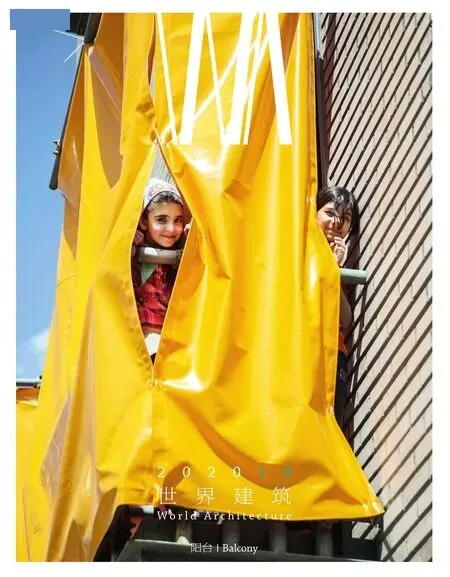
邦普朗2169號綜合體,布宜諾斯艾利斯,阿根廷
2020-10-22 07:14:30建筑設計塞巴斯蒂安阿達莫馬塞洛費登
世界建筑 2020年10期
關鍵詞:功能
建筑設計:塞巴斯蒂安·阿達莫,馬塞洛·費登
Architects: Sebastián Adamo, Marcelo Faiden
從混合空間到差異空間
終于,幾乎所有人都認同我們的城市應當緊湊、密集、功能多樣。盡管這些方面存在數量上的微妙差別,我們大部分的努力都是為了鞏固不同于《雅典憲章》中所概括的實證主義的城市模型。
農村人口向城市中心的遷移使得想象中的城市密度大大增加了,這迫使我們放棄了一個大面積的地塊僅實現單一功能的想法。我們設想以不同方式拓展城市功能,使其更豐富多樣。被稱為混合功能的大型建筑就是這種工作路線的一個例子,將不同功能集中在一個項目中。今天,我們掌握了在設想的城市模型和大型建筑物之間建立某種連續性的技巧,然而,在一般規模的建筑中,此種關系尚未得到關注。
邦普朗2169號綜合體試圖在這個話題中找到自己的定位,由于其自身的體量難以復制大規模項目的組織策略。在這種情況下,設計的入手點在于通過同質空間解決功能多樣性的問題。與構建一個容器來容納已有的功能不同,設計賦予它包容不同可能性的結構。通過5扇垂直于隔墻的飄窗,界定了工藝基礎的同時還提供了充分的自由度,形成在功能上不確定但空間上明確的環境。雖然我們的活動范圍局限在物理區域,但我們的想象卻超越了它的邊界,直到我們可以精確地描述它。采用新的方式利用城市,對其功能進行更新,或是更新我們已知的混合功能的外觀,這些關注點是進行設計決策的要點。這個項目證明,保持對每個單元使用對象的敏感度,并設想每個空間利用帶來的挑戰,可以使我們看到一種新的生活方式。□(龐凌波 譯)

1 外景/Exterior view
項目信息/Credits and Data
客戶/Client: Fideicomiso Bonpland 2169
地點/Location: Bonpland 2169. Ciudad Autónoma de Buenos Aires, Argentina
合作/Collaborators: Paula Araujo Varas, Ezequiel Estepo,Marcos Altgelt, Martinica De Barba
結構/Structure: AHF S.A. Ing. Alberto Fainstein.
衛生設施/Sanitary Facilities: Julio Blanco.
電氣設施/Electrical Facilities: Ing. Daniel Gatti.
施工管理/Construction Managment: adamo-faiden
攝影/Photos: Javier Agustin Rojas.

2 夜景/Night view
3.4 入口/Entrance
From the Mixed-Use to the Diff-Use
Finally, almost everybody agrees that our cities should be compact, dense and programmatically diverse. Although there are quantitative nuances regarding these points, most of our efforts aim to consolidate a model of a city different from the positivism outlined in theAthens Chart.
Rural migrations to urban centres overflowed imagined densities, forcing us to abandon the idea that there is a single programme linked to large areas of land. Assuming this condition has led us to imagine different ways to swell and diversify the thickness of our cities. The large-scale constructions called Mixed-Use are an example of this line of work where buildings with diverse programmes converge in a single project. Today we have techniques capable of establishing certain continuity between the proposed city model and large-scale constructions.However, in the range of the average scale, this relationship has not been addressed in depth.
The Bonpland 2169 building tries to position itself in this debate, understanding in advance that its size will prevent it from reproducing organisational strategies linked to a larger scale of work. In this case,the starting point is to address the diversity of uses through spatial homogeneity. Instead of projecting a container to host previously established programmes,a structure open to different appropriations is offered. A programmatically unstable but spatially specific environment, organised by means of five bays perpendicular to the dividing walls that delimit their technical aptitude at the same time that they offer a good margin of flexibility. Although our field of action is circumscribed to the area of material organisation, our field of reflection overflows it until we can accurately report it. The attention towards the new ways of using the city, the updating of its programmes or the appearance of hybrid instances among the uses that we already know, are here moments of vital importance. The main argument of this project is developing a sensitivity according to the objects that each unit will occupy and assuming the challenge of each spatial appropriation allows us to see a new way of living.


11 陽臺/Balcony
評論
胡恒:在集合住宅設計中,將陽臺當作“室內”空間序列的一部分,并以之來確定“室外”立面的形態,尚屬常見。而比例系統從平面到剖面,再到立面,逐層對應,則是更高明的手法。自勒·柯布西耶的馬賽公寓開始,后繼者不絕。2169號綜合體就是一例。設計者顯然深諳此道,空間一體化的操作相當熟絡。陽臺是個重點。它與馬賽公寓那些常規做法有些不同,仿佛是把街上的草皮花圃挪了一些塊塊到空中。其中大部分是景觀,人能走動的只有短短一截小道。設計者大概是想把陽臺做成空中“野園”,讓都市之人在高處也有身處大自然的感覺,或當夏日炎炎,深長的陰影與滿眼的綠意可以降溫消暑。不過,對筆者來說,將大自然與都市生活硬生拼在一起并不妥當,而把公共空間的使用方式拉進日常生活,更是危險(自由意志受損)。我想,居住者在新鮮勁過了之后,可能也會覺得別扭,繼而重新裝修:拆掉鐵絲網、搬除草皮、鋪上石板,然后放上躺椅和茶幾。
周漸佳:陽臺作為一種面層/立面層。邦普朗2169綜合體中提出了一種重新理解陽臺的方式——陽臺與外墻這兩個截然不同的構件在這個項目中獲得了統一。將陽臺/外墻作為邊界處理的方式建立了一種內與外更明確的區分,綜合體的主體向內收縮,成為整棟樓的核心,扎實而明確;陽臺形成的外部邊界放松而多變。帶有工業感的金屬網在住宅建筑中的應用并不多見,在這個項目中,通高的金屬網將陽臺定義為一個連續、整體的面,如同罩在公寓主體上的紗籠。種植的植物則強化了工業與自然間的反差,精致而符合傳統陽臺尺度的點綴型綠植并沒有出現,取而代之的是更加接近于地面種植的植物。正因為建筑師將陽臺視為建筑整體的一部分而非構件,由此釋放出空間處理、呈現與使用方式上新的可能。
Comments
HU Heng: In amalgamated dwelling design, it is not rare to use balcony as a part of the "interior" space sequence and to define the form of "exterior" fa?ade. But it is a higher level method that applies the proportion system from plane to section and then to fa?ade, corresponding level by level.Since the Marseilles Apartment by Le Corbusier, there have been continuous followers, and No. 2169 is one of them.The designer of the project apparently knows well about the method, indicated by his skillful operation on space integration. Balcony is the key point. Different from the conventional method used on Marseilles Apartment, in this project it seems that the sward and parterre on street are transplanted into the air in pieces, most of which function as landscape and only small section can be walked on by people. The designer probably intends to shape the balcony into an air "wild garden", providing a feeling of being in nature for people living in metropolis. Or, the long shadow and green colour can be used to cool down in a hot summer day. However, to me, a rigid scrabbling up between the nature and urban life is not so appropriate, and drawing the using mode of public space into daily life is even more dangerous (for dilapidating free will). I believe after the sense of novelty, the dwellers may feel a little awkward about the space, and start redecoration: tearing down the iron network, removing the sward, paving slates, and putting down their deck chairs and end tables. (Translated by QIAN Fang)
ZHOU Jianjia: Balcony as a frontal plane. Bonpland 2169 building proposes an alternative way to understand the balcony. The two different components, the balcony and the fa?ade, are unified in this project. Treated as a distinct boundary, the body of Bonpland shrinks inward and becomes the core of the building, being fit and concrete;the external border formed by the balcony is loose and changeable. The full height metal mesh defines the balcony as a continuous surface, while the plants reinforce the contrast between industry and nature. Wild plants are planted instead of exquisite ones. Just because the architect regards the balcony as an integral part of the building rather than a component, it also releases new possibilities in the way of handling, presenting and using space.

12.13 內景/Interior views
猜你喜歡
鐘表(2023年5期)2023-10-27 04:20:44
中華詩詞(2022年6期)2022-12-31 06:41:24
當代陜西(2021年21期)2022-01-19 02:00:26
中學生數理化(高中版.高考數學)(2020年1期)2020-02-20 13:23:44
經濟技術協作信息(2018年11期)2019-01-14 03:07:20
中國科技論壇(2017年7期)2017-07-25 08:49:53
制造技術與機床(2017年3期)2017-06-23 08:11:33
媽媽寶寶(2017年2期)2017-02-21 01:21:24
國際漢語學報(2016年1期)2017-01-20 08:21:20
中國中醫藥現代遠程教育(2014年22期)2014-03-01 04:32:55