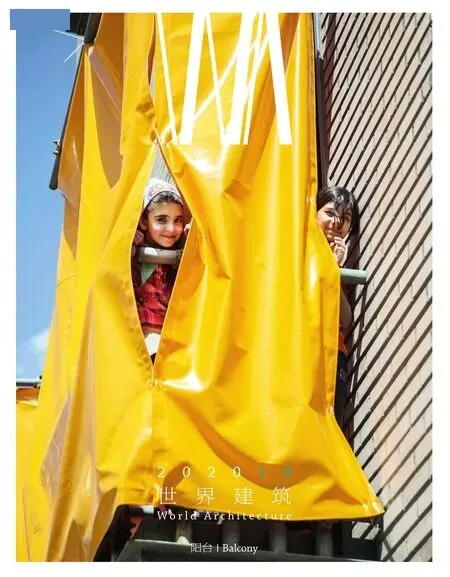
中國建筑設(shè)計研究院創(chuàng)新科研示范中心,北京,中國
2020-10-22 07:14:36建筑設(shè)計柴培根周凱中國建筑設(shè)計研究院有限公司
世界建筑 2020年10期
建筑設(shè)計:柴培根,周凱/中國建筑設(shè)計研究院有限公司
Architects: CHAI Peigen, ZHOU Kai/China Architecture Design & Research Group
1988年,改組后的中國院從建設(shè)部南配樓搬遷至車公莊大街19號院。
在20多年的時間里,隨著中國院的發(fā)展,大院內(nèi)的辦公建筑一直處在持續(xù)更新建設(shè)的狀態(tài),其中2000年建成2號辦公樓,2002年建成3號辦公樓,2010年進行了1號樓改造和外立面更新。
2011年,院集團啟動了中國院創(chuàng)新科研示范中心(以下簡稱“創(chuàng)新樓”)的建設(shè)計劃,選址是19號院西北角原食堂、籃球場、鍋爐房的位置。不同于1-3號樓的單純辦公屬性,創(chuàng)新樓要將原場地服務(wù)于大院的功能還建于新建筑中,同時隨著院墻被取消,面向城市的開放性要求也讓其成為更具復(fù)合功能的辦公綜合體。
創(chuàng)新樓的建設(shè)意味著需求的增長,空間的擴張,因此19號院兒也要改變封閉的狀態(tài),一方面要整理內(nèi)部的環(huán)境關(guān)系,同時還要重新定義邊界,構(gòu)建新的鄰里關(guān)系。作為城市有機更新區(qū)的一次實踐,在處理這些關(guān)系的過程中,第一步就是要解決與周邊居住區(qū)的日照關(guān)系。
朝陽庵社區(qū)沿文興西街有兩個東西向的單元,根據(jù)日照分析,這里是創(chuàng)新樓的形態(tài)需要避讓的日照最不利點。在高度和用地范圍的限制下確定最大的可建設(shè)體量后,以日照最不利點為基點,陽光的移動軌跡會把最大可建設(shè)體量雕琢成一個不規(guī)則的原型。日照原型是外在的限制,而獲得更大的使用空間是內(nèi)在的需求,原型正是基于這一里一外兩種力量的擠壓而被塑造出來。
在建筑外部,我們用兩組退疊的平臺擬合了最大的日照控制范圍,同時提示了日照原型中高度角和掃掠角兩個形態(tài)特征。
兩組連續(xù)的室外平臺制造了某種動靜結(jié)合的場所戲劇性。一組平臺是各層專屬的花園。在建筑投入使用后,每個花園都得到了各部門的精心布置。長期在室內(nèi)伏案工作的員工有機會在這里遠眺城市,俯瞰球場,與同事打個招呼,或者在這里舉行小型活動。平臺上的風景吸引著每一層的員工,讓封閉的大開間辦公區(qū)與自然環(huán)境建立起更直接的聯(lián)系。
而另一組平臺可以連續(xù)攀爬,以籃球場為起點組織起立體開放的路徑到達各層辦公室,設(shè)計師可以在上班時或午飯后拾級而上,不必非要選擇電梯,這也在疫情期間成為一條健康路線。平臺吸引大家走到戶外,引導(dǎo)并落實行為節(jié)能的健康理念,讓綠色不僅是一個概念,更在每天的生活中成為深入人心的行為準則。
而在建筑內(nèi)部,中庭順應(yīng)退臺的形式,成為獨樹一幟的內(nèi)部空間,也營造出了合理的尺度與氛圍。與強調(diào)效率的大開間辦公區(qū)不同,這里是非正式的辦公區(qū),各設(shè)計部門都能以靈活的方式使用這片區(qū)域。中庭空間自下而上仰視,逐層收分強化了空間的透視,單一空間又有某種儀式感和紀念性。而自上而下俯視時,各層使用部門對中庭區(qū)域的個性化利用,又呈現(xiàn)出多樣性的生活化場景。
當建筑能夠包容或引發(fā)城市生活的活力時,創(chuàng)新樓多元復(fù)合的狀態(tài)也在一定程度上改變了中國院作為大型設(shè)計機構(gòu)通常給人留下的印象,消解了以效率為先的大開間辦公環(huán)境的枯燥與單調(diào)。平臺、中庭、球場這些場所打破了封閉的空間邊界,不期而遇的交流,生活化的場景,都成為對設(shè)計行為的支撐,由此集合的場所也體現(xiàn)了設(shè)計企業(yè)的特征。

1 北側(cè)鳥瞰/Aerial view from the north
2 東側(cè)鳥瞰/Aerial view from the east
In 1988, the restructured China Architecture Design & Research Group (CADG) was relocated to No.19 Chegongzhuang Street from the southern annex building of Ministry of Construction.
During the past 20 years, both newly-built and renovation projects were witnessed in the No.19 compound with the development of CADG,including the completion of 2# Office Building in 2000, the completion of 3# Office Building in 2002,and the renovation and upgrade of fa?ade of 1#Office Building in 2010.


3 總平面/Site plan
1-1#辦公樓 2-2#辦公樓 3-3#辦公樓 4-創(chuàng)新科研示范中心 5-建研院物理所 6-新大都飯店 7-國誼賓館 8-朝陽庵社區(qū)
4 北側(cè)外景/Exterior view from the north
In 2011, CCTC, the parent company of CADG,initiated the construction plan for the CADG Innovation & Scientific Research Demonstration Centre (short as Innovation Centre hereinafter),which would be located at the northwestern corner of the No.19 Compound where the former canteen, basketball court and boiler room was situated. Unlike the 1#, 2# and 3# Office Buildings mentioned above, the Innovation Centre was planned as a multi-functional office complex with the former functional spaces on site relocated in the building. Meanwhile, its openness to the city, a result of demolition of the enclosing wall of No.19 compound, must be complemented with its highly comprehensive functional prgramming.
The increasing demands for both functions and spaces, reflected in the construction plan of the Innovation Centre, required overhaul to the enclosure of the compound by integrating the functions inside the compound and redefining the compound's boundary and relationship with the neighbourhood.Among all problems to be solved in this urban renewal project, the most crucial one was related to sunlight screnning of surrounding apartments.
In Chaoyang'an housing estate, which was situated along Wenxing West Street bordering the Innovation Centre, there were two east-west oriented units of apartments, which were calculated by computer-aided screening analysis as the least favourable daylighting point for our design. With the maximum volume of the centre determined by height and land occupation restrictions, an irregular-shaped prototype was generated based on the location of this point and the trajectory of the sun. It was shaped and determined by both the external restrictions of sunlight screening and the internal demands for more space.
On the exterior, we fitted two sets of retreating terraces within the maximum sunlight control range and implied the two morphological characteristics which are shaped by sun angles.
The two sets of continuous terraces together create a dramatic combination of movement and static. One set of the terraces is the exclusive garden on each floor which has been carefully distributed to various departments. Employees who have been long-time indoor working have the opportunity to take a break, to hold events, and to overlook the city. The dynamic sceneries on the terraces attract employees on each floor, allowing the closed large-open office area to establish a more direct connection with the natural environment.
Another set of terraces is using the basketball court as a starting point to organize an open path to each floor. People can use the continuous stairs during lunch break and after work to avoid using elevators, which has become a healthy route during the pandemic COVID-19. The two sets of terraces are encouraging employees' engagement in outdoor activities, advocating a sustainable lifestyle, making it not only a design concept but also a practical behavior standard.
In the interior, the atrium was endowed with unique spatial features due to the terraced form of the building, as well as scales and atmosphere appropriate to a working space. Unlike the efficiency-oriented open office space with large spans, the atrium served as a multi-storied informal business area that could be utilised by all the design teams in a flexible way. Seen from the ground, the narrow space overhead strengthened the sense of perspective, presenting a sense of ritual and commemoration. Seen from the top, various scenes on different floors of the atrium revealed the diversified lifestyles of the teams, enhancing spatial diversity.
With its inclusion and stimulation of the city's vigor, the diversified status of the Innovation Centre shifted the stereotype of large design firms like CADG to some extent by avoiding the monotony of the efficiency-oriented office space with large spans.The terraces, the atrium and the basketball court blurred the boundary of the enclosed space. The improvised communication and scenes of various lifestyles in the space could serve as the backdrop for design activities, presenting a space with authentic features of a design firm.

5 體量生成/Design procedure
項目信息/Credits and Data
客戶/Client: 中國建設(shè)科技集團/China Construction Technology Consulting Co., Ltd.
地點/Location: 北京市西城區(qū)車公莊大街19號院/ No.19 Chegongzhuang Street, Xicheng District, Beijing, China
施工方/Contractors: 北京城建集團有限責任公司/Beijing Urban Construction Group Co., Ltd.
設(shè)計主持/Architects in Charge: 柴培根,周凱/CHAI Peigen, ZHOU Kai
設(shè)計總指導(dǎo)/Project Director: 修龍,崔愷/XIU Long, CUI Kai
設(shè)計團隊/Design Team
項目經(jīng)理/Project Manager: 馬海,劉鵬/MA Hai, LIU Peng
建筑/Architecture: 田海鷗,任玥,李穎,李楠,張東,楊文斌,婁莎莎,戴天行/TIAN Haiou, REN Yue, LI Ying, LI Nan, ZHANG Dong, YANG Wenbin, LOU Shasha, DAI Tianxing結(jié)構(gòu)/Structure: 霍文營,孫海林,郭家旭,高芳華,陳文淵,陸穎,劉會軍/HUO Wenying, SUN Hailin, GUO Jiaxu, GAO Fanghua, CHEN Wenyuan, LU Ying, LIU Huijun,Lu Ying, LIU Huijun
給排水/Water Supply and Drainage: 趙世明,趙昕,趙鋰,郭汝艷,李建業(yè),張超,陶濤,俞劍峰/ZHAO Shiming, ZHAO Xin, ZHAO Li, GUO Ruyan, LI Jianye,ZHANG Chao, TAO Tao, YU Jianfeng
暖通空調(diào)/HAVC: 潘云鋼,何海亮,宋孝春,李娥飛,李嘉,祝秀娟,郭宇,唐艷濱,陳濤/PAN Yungang, HE Hailiang, SONG Xiaochun, LI Efei, LI Jia, ZHU Xiujuan,GUO Yu, TANG Yanbin, CHEN Tao
電氣/Electrical Engineering: 陳琪,王旭,何學(xué)宇,李俊民,林佳,徐世宇,夏鑫,郭濤/CHEN Qi, WANG Xu, HE Xueyu, LI Junmin, LIN Jia, XU Shiyu, XIA Xin, GUO Tao
智能化/Intelligent: 任亞武,王青,唐藝/REN Yawu,WANG Qing, TANG Yi
總圖/General Plan: 高治,吳耀懿/GAO Zhi, WU Yaoyi
經(jīng)濟/Economy: 趙紅,禚新倫/ZHAO Hong, ZHUO Xinlun
室內(nèi)設(shè)計/Interior Design: 張曄,饒勱,韓文文,顧大海,王佳旭,李申,郭林/ZHANG Ye, RAO Mai, HAN Wenwen, GU Dahai, WANG Jiaxu, LI Shen, GUO Lin
景觀設(shè)計/Landscape Design: 趙文斌,劉環(huán),李旸,王婷,劉子渝,盛金龍/ZHAO Wenbin, LIU Huan, LI Yang,WANG Ting, LIU Ziyu, SHENG Jinlong
景觀及室內(nèi)機電/Landscape and Interior Mechatronics: 李甲,魏華,曹誠,時凱,曹雷,王夢姝/LI Jia, WEI Hua,CAO Cheng, SHI Kai, CAO Lei, WANG Mengshu
合作/Collaborators:
BIM設(shè)計顧問/BIM Design Consultants: 于潔,秦軍,劉慶(中國院BIM中心)/YU Jie, QIN Jun, LIU Qing ( BIM centre, CADG)
綠色建筑顧問/Green Building Consultants: 林波榮(清華大學(xué)建筑學(xué)院),郝軍,李天陽,吳越超,劉敏,李新中,曾巍(中設(shè)咨詢公司),周宴平(設(shè)能建筑咨詢)/LIN Borong ( School of Architecture, Tsinghua University), HAO Jun, LI Tianyang, WU Yuechao, LIU Min, LI Xinzhong, ZENG Wei ( China Building Design Consultants Co.), ZHOU Yanping(energydesign (Shanghai) Co. Ltd.)
幕墻顧問/Curtain Wall Consultants: 田沂忠,楊振偉(道澈科技)/TIAN Yizhong, YANG Zhenwei (DOORTURE)
照明顧問/Lighting Consultants: 王東寧,郭偉(優(yōu)雅士照明)/WANG Dongning, GUO Wei ( China United Artists Lighting Design Corp. Ltd.)
建筑面積/Gross Built Area: 41,434 m2
造價/Cost: 400 million CNY
竣工時間/Completion Time: 2018
攝影/Photos: 張廣源,周凱,李季/ZHANG Guangyuan,ZHOU Kai, LI Ji

6 東南側(cè)外景/Exterior view from the southeast
7 主入口/Main entrance

8 首層平面/Ground floor plan
9 二層平面/First floor plan
10 三層平面/Second floor plan
11 平臺俯瞰/Aerial view of the terrace
12 設(shè)計研討會/Design seminar

18.19 平臺活動/Activities on the terrace
評論
范路:中國建筑設(shè)計研究院創(chuàng)新科研示范中心,是一個建筑紀念性和日常生活辯證統(tǒng)一的項目。苛刻的日照控制線,把建筑削切成不規(guī)則的體量,這就和內(nèi)部多樣的空間使用需求之間產(chǎn)生了張力。創(chuàng)新樓設(shè)計充分利用這一內(nèi)在矛盾,順勢激發(fā)多元建筑形象,并創(chuàng)造出多種生活場景。最大的斜切面被強化,塑造出主樓獨特的形象。另一方面,建筑師基于對場地中日常生活和記憶的敏感,以籃球場為視覺焦點,設(shè)計了一系列小尺度的看臺式屋頂平臺,提供了讓室內(nèi)外人群共同使用的階梯狀屋頂廣場。這就像歐洲中世紀的小城,在一片低矮的民居房子中間矗立著哥特教堂。創(chuàng)新樓的整體氣質(zhì)也是如此。二元對比,相互促進。平臺上充滿活力的日常生活成為主樓的背景,而高大主樓則為日常生活提供了一個精神錨固點。
張昕楠:以坡狀的連續(xù)露臺滿足北側(cè)的住宅采光并創(chuàng)造開放的城市地景,是解讀中國建筑設(shè)計研究院創(chuàng)新科研示范中心的關(guān)鍵。該項目的連續(xù)露臺為公共事件的發(fā)生提供了可能,更成為了向城市展示的界面。同時,通過流線和視線的設(shè)計形成了兩種不同屬性的領(lǐng)域,東側(cè)以路徑創(chuàng)造高程上的連接,增強空間行為的連貫性和開放性;而另一側(cè)僅與室內(nèi)對應(yīng)層連通,彼此獨立保證了一定程度的私密性。
Comments
FAN Lu: In the project of CADG Innovation & Scientific Research Demonstration Centre in Beijing, a dialectical unity between architectural monumentality and everydayness. The irregular building volume is determined by height and land occupation restrictions and the control line of the sun trajectory, which brings about a kind of tension between exterior shape and internal demands of more space. In the design process, the intrinsic contradiction has been recognised as the generator to produce the predominant architecture image and to create various scenes of life. The big scale diagonal plane is intensified to endow the building with unique shape. While on the other hand, the architect sets a series of set-back roof terraces based on his memory of the everyday life ever happened on site and creates a stair-stepping roof plaza for various kinds of people. Then the lifeful activities on roof terrace become the background of the tall main part of the building, while the latter acts as the spiritual anchoring point for daily life.
ZHANG Xinnan: The key to interpret CADG Innovation & Scientific Research Demonstration Centre is to understand the sloped continuous terraces, that meet the day lighting requirement of the residential building to the north side, while also act as open urban landscape. The continuous terraces of this project provide possibility for public event, and also become the interface to showcase to the city. Meanwhile, through circulation and sight design, two fields of different attributes are created. On the east side, connection is built in the vertical direction via pathways, enhancing the connectivity and openness of spatial behaviours; on the other side,connection is only available to the corresponding interior levels, assuring independency and certain degree of privacy. (Translated by WANG Xinxin)

20.21 頂層角部陽臺休憩空間/Recreational space at the corner of the balcony on the top floor
22 平臺上舉辦的展覽開幕式/Exhibition Opening Ceremony on the terrace
猜你喜歡
北方建筑(2021年6期)2021-12-31 03:03:54
文苑(2020年10期)2020-11-07 03:15:36
現(xiàn)代裝飾(2020年7期)2020-07-27 01:27:42
現(xiàn)代裝飾(2020年6期)2020-06-22 08:43:12
現(xiàn)代裝飾(2020年4期)2020-05-20 08:55:08
流行色(2020年1期)2020-04-28 11:16:38
藝術(shù)啟蒙(2018年7期)2018-08-23 09:14:18
海峽姐妹(2017年7期)2017-07-31 19:08:17
Coco薇(2017年5期)2017-06-05 08:53:16
福建農(nóng)業(yè)科技(2016年10期)2016-03-07 09:46:49