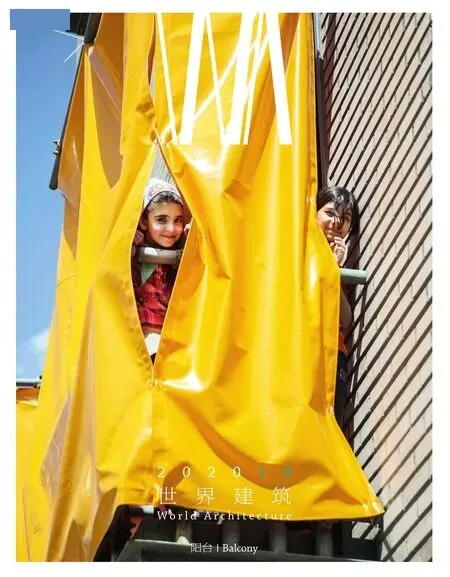
贈陽庵,北京,中國
2020-10-22 07:14:48設(shè)計繪造社
世界建筑 2020年10期
設(shè)計:繪造社
Design: Drawing Architecture Studio
由繪造社設(shè)計的“贈陽庵”,將一處典型的北京兩室兩廳商品房,打造成為一個具有古典空間精神又滿足現(xiàn)代生活需求的兩口之家。本案所處的樓房是高板結(jié)構(gòu),立面選用了西班牙式的裝飾風(fēng)格。戶型南北通透,層高2.9m,內(nèi)部幾乎所有的墻都可以拆除,北面有一處贈送的陽臺(上下兩層錯開,根據(jù)法規(guī)不算面積)。
1 贈陽庵
陽臺成為本案最特別的條件。由于是贈送的,開發(fā)商售樓時不能提前封上;由于錯層,陽臺的頂也沒有,所以封陽臺接近于搭一個小房子,室內(nèi)設(shè)計突然有了建筑設(shè)計的意味。這處贈送的陽臺成了本案的題眼,也是名字的由來。“贈陽庵”受到了日本建筑師藤森照信“高過庵”的影響,業(yè)主也喜歡日本文化,希望在陽臺上做一個榻榻米。“高過庵”是位于鄉(xiāng)野的茶室,像世外桃源里的童話小屋。“贈陽庵”則委身于北京市區(qū)的商品住宅小區(qū),是都市宅男宅女的樂土。
1.1 大屋頂
在藤森照信的“繩紋建筑五原則”里,他把第五條給了坡屋頂,用坡屋頂對抗現(xiàn)代主義的平屋頂。他認(rèn)為坡屋頂應(yīng)該盡可能地低垂,人從下方看到斜面會想攀登,由上往下看會想往下滾,從而刺激了人的身體性,并由此感到空間的活力。
但坡屋頂讓空間損失較多。作為折中,贈陽庵采用了弧形的屋頂,外加一個老虎窗,既保留了坡屋頂?shù)镊攘Γ布骖櫩臻g使用效率。秉承滕森的教誨,“贈陽庵”的弧形屋頂盡可能向下延伸,只留下陽臺欄板上方的一道縫作為橫窗。刻意細(xì)分的窗格讓尺度失真。橫窗衍化為庵的立面,原有的陽臺欄板成為庵的臺基(地面)。弧形的屋頂終于快垂到“地面”了。此刻屋頂突然巨大起來,因為它有“立面”(橫窗)3倍之高,老虎窗儼然是藏在屋頂里的閣樓。
1.2 小屋里的巨人
日落黃昏,黑暗把背景隱去。贈陽庵被從環(huán)境中隔離開來,成為一個3層高的大房子。人站在老虎窗前,從庵的三層閣樓探出頭,仿佛庵里供的一尊大佛。這個聯(lián)想來自于奈良東大寺大佛殿上方的棧唐戶。在每年特定的慶祝日,棧唐戶會被打開,人們可以從殿外看到里面大佛的頭。巨大的棧唐戶就像一扇小窗,出挑的屋檐和斗拱組成一頂花轎。東大寺曾是世界上最大的木結(jié)構(gòu)建筑,但它讓里面的大佛成了轎子里的新娘;贈陽庵是個極小的“房子”,但它讓主人成為巨人。
2 回到古典
在藝術(shù)上,回到古典和走向未來同樣有趣,本案通過以下方式回到古典。
2.1 房間的裂變
原有戶型的兩室兩廳對應(yīng)的是三口之家的生活。這與兩口之家的生活要求本質(zhì)不同。由于戶型內(nèi)所有的墻體都可以拆除,本案對平面進(jìn)行了重新規(guī)劃。拆除墻體是為了重新圍合。本案并沒采用時下流行的全開敞布局,相反,本案希望回到古典式的包裹感強(qiáng)的小房間。原有的門廳被切分成玄關(guān)與小書房。原有的次臥被切分成和室與餐廳,原有的一個大衛(wèi)生間被改造為浴室、衛(wèi)生間和化妝間3個獨立的房間。本案希望在這個90m2的戶型中創(chuàng)造豐富的空間體驗,人在行走的過程中穿過一個接一個的空間而不是一覽無余式的體驗,這樣的空間體驗是古典的。
2.2 龕室
空間的裂變帶來一些古典空間常有的龕室一樣的封閉小空間。在每個人都與全世界互聯(lián)的今天,人們或許需要這樣的小空間,感受墻壁緊貼身體的包裹感,以此獲得內(nèi)心的寧靜。
書房就是這樣一個龕室空間。除了小,還要幽暗,營造一種中世紀(jì)修士書房的感覺。本案將窗戶收到最小,形成一個狹長的光縫。一道光,一張桌,一把椅子和一個書柜占滿書房空間。

1.2 贈陽庵外景/Exterior views of Free Balcony An
茶室是東方式的龕室。日本茶室的空間是一個不斷縮小的演變過程,千利休最終把茶室定為兩疊半,約為4m2。他還發(fā)明了躙口——茶室特有的小型出入口,無論是武士還是平民,進(jìn)出都需跪著膝行才能進(jìn)入,從而體現(xiàn)空間的平等。具體到“贈陽庵”的茶室,抬高的地板和壓低的門梁,迫使人要爬進(jìn)茶室。坐在茶室的地板上,仰望抹土(硅藻泥)的圓弧屋頂,仿佛身處一個洞穴,4扇形狀各異的窗戶,猶如4個洞口,洞中喫茶遙想壺中天地。
2.3 壁柜即墻體
空間更加豐富的劃分并不會犧牲空間的使用效率,因為劃分空間的不是墻而是壁柜。主臥與客廳的隔斷是大衣柜,玄關(guān)與書房的隔斷是書柜。以收納空間當(dāng)墻不僅提高了效率,還獲得了一種古典建筑墻體的厚度。門不再是門,而是門洞。這讓空間獲得了古典的質(zhì)量,與平面布局的原則契合。
2.4 對稱
韋斯·安德森的電影畫面的迷人之處就是構(gòu)圖的對稱。對稱是古典設(shè)計的原則,它具有強(qiáng)烈的儀式感。本案希望為業(yè)主提供幾處有儀式感的生活空間,為平淡的日常生活增添一些精彩。
櫥柜、中島臺、餐桌、邊柜組成了一個軸線,強(qiáng)烈的對稱讓烹飪和用餐有了一絲神圣感。陽臺、凳子和陽臺門洞形成另一組對稱。窗框的劃分故意加密,讓左右兩端的開啟扇和中間的固定扇保持尺寸一致和對稱,使陽臺澆花或曬太陽的日常活動變得有些莊嚴(yán)。

3 業(yè)主和建筑師合影/The owner and the architects
2.5 材料、裝飾和細(xì)節(jié)
阿道夫·路斯認(rèn)為裝飾即罪惡。以今天的觀點,路斯的建筑到處是裝飾。但他的裝飾不但不罪惡,反而分外迷人。路斯用豐富的材料進(jìn)行裝飾,材料的交接處理就是他的線腳,他把材料、裝飾、空間混合為一體。裝飾即材料即空間。
本案也選用了豐富的材料:木飾墻面和地板采用原色橡木條分格、栗色橡木地板填充的方式。家具使用了黑色烤漆、原色橡木、栗色橡木貼皮、灰色大理石和紅銅。壓花玻璃作為室內(nèi)窗洞的材料,讓光影朦朧細(xì)碎。綠色馬賽克瓷磚是濕區(qū)的主要材料,和室墻面為硅藻泥。
材料的分布不是以面(墻面、地面)的轉(zhuǎn)折為界限,也不是以空間(房間)為界限。上述的劃分太過現(xiàn)代。繪造社將吊頂?shù)牟牧涎由斓綁γ妫瑝γ娴牟牧涎由斓降匕濉_@使得墻裙、腰線這些古典空間元素出現(xiàn)。它們不僅僅是裝飾,它們恰恰是結(jié)合了日常使用的經(jīng)驗。人手可及的地方用堅固有質(zhì)感的材料,既滿足功能的需要(易清理),也符合手感的需要(可撫摸)。
2.6 畫
墻上掛的畫在當(dāng)代建筑中成為可有可無的裝飾,但在古典空間中它們非常重要。本案要恢復(fù)掛畫的傳統(tǒng),但是畫不再是獨立的存在,而是與空間融為一體的組成部分,它被理解為墻面局部的材料、顏色和肌理。
本案選用了瑪莉美歌的印花布作為墻面上的畫。電影《海鷗食堂》提到過,芬蘭是距離日本最近的歐洲國家,飛行只要10小時。在美學(xué)上,芬蘭與日本極其近似,簡約但有溫度。在“贈陽庵”中,由和室空間開始的室內(nèi)設(shè)計結(jié)束在斯堪的納維亞的印花布上,體現(xiàn)出世界文化的極其豐富和極其相似。
過去與未來、古典與現(xiàn)代、本土與異地在建筑上沒有嚴(yán)格的邊界。本案希望通過對古典空間的挖掘探索當(dāng)代居住空間的形式,通過對日本傳統(tǒng)和室的挖掘創(chuàng)造當(dāng)下住宅陽臺的北京風(fēng)格。回到古典是為了走向未來,描繪異域是為了開拓本土。
Designed by Drawing Architecture Studio (DAS)for a couple, Free Balcony An is an interior design that transforms a typical two-bedroom apartment at a commercial housing community in Beijing to a home both carrying the spirit of classical space and fulfilling the needs of modern life. The apartment is located in a slab-type building. Its fa?ade is featured with Spanish style decoration. The apartment is north-south transparent with a ceiling height of 2.9 m. All the interior walls can be removed. At the north end of the apartment, there is a small balcony given by the developer for free (according to the local regulation, the staggered balconies do not count within the total area for sale).
1 Free Balcony An
This free balcony became the most special feature of the project. Because it was complimentary, the developer couldn't close it when it was sold; because it is staggered, the balcony even didn't have any roof. So, when the owner wants to close it, it is like building a small house. Thus, the original demand for interior design had a meaning of architectural design. The free balcony became the focus of this design and also inspired the name of the project. The design of Free Balcony An was influenced by the Japanese architect Terunobu Fujimori's Takasugi-an Tea House (a teahouse built too high). The client also likes Japanese culture and hoped to include a "tatami" on the balcony. While Takasugi-an is a teahouse in the countryside like a fairytale cottage beyond the reach of the mundane world, Free Balcony An is situated at a commercial housing district in the inner city of Beijing as an oasis for the urban home lovers.
1.1 Big Roof
In hisFive Points of Jomon Architecture,Tenorobu Fujimori made the sloping roof as the fifth one. He tried to use sloping roof to stand against the flat roof by Modernism. He argued that the sloping roof shall be as low as possible and it will encourage people to climb when looking upwards and to roll down when looking downwards, which stimulates one's body and makes one feel the dynamism of the space.
But a sloping roof will lose too much space.As a compromise, Free Balcony An adopts a curved roof with a roof window, which retains both the character of sloping roof and efficiency of space utilisation. Following Fujimori's instruction, DAS extended the curved roof of Free Balcony An downwards as much as possible and only left a narrow opening above the original breast board of the balcony as a horizontal window. The subdivided lattices of the window create an illusion for the scale. The horizontal window becomes the fa?ade of the An and the original breast board becomes its base. Close to the "ground" (the original balcony breast board), the curved roof is suddenly enlarged as it is about 2 times taller than the "fa?ade" (the horizontal window). The roof window seems like an attic hidden in the roof.
1.2 The Giant in the Small House
As the sun sets in the dusk and the darkness hides its background, Free Balcony An is isolated from the surroundings and becomes a threestorey big house. As standing in front of the roof window with head out of the attic, one would look like a giant statue of Buddha in the An. Such an association comes from the observation window on the upper part of the Great Buddha Hall of Todai-ji Temple in Nara. During certain days of celebration each year, the window will be opened so the visitors can see the face of the Buddha from outside of the hall. The huge observation window is like a small opening, while fly eaves and dougong (bracket units)make up a palanquin. Todai-ji Temple used to be the largest building of wooden structure in the world,but it makes the Budda like a bride in the palanquin.Free Balcony An is a tiny "house", but it makes its owner a giant.
2 Return to the Classics
In the world of arts, returning to the classics is as same interesting as going to the future. In the design of Free Balcony An, DAS chose to return to the classics by the following means.

4 原始平面/Original plan
5 改造后平面/Final plan
6 剖面/Section
2.1 Division of Rooms
The original two-bedroom floor plan was designed for a home of three, which was very different from what the client needs for their life.Since all the walls can be demolished, the interior is entirely conceived. The reason for taking down the walls is for enclosure. Instead of a popular open plan, the design aims to return to the classical small rooms which give a strong sense of enclosure.The original entrance is divided into entrance and study. The second bedroom is turned into tearoom and dining room. The washroom is separated into 3 independent parts – shower, toilet, and dressing room. The new layout provides a rich spatial experience for this 90 m2apartment. When walking inside, one would feel going through one room after another rather than seeing everything at a glance.Such a spatial experience is classical.
2.2 Sacred Room
The division of the space creates some small enclosed rooms like shrine rooms often seen in the classical space. Today when everyone is connected to the world, such a small space might be even more precious in which one could feel one's body close to the walls and gain some inner peace.
The study is exactly such a shrine room. Besides being small, it is also dark in order to bring into the room the atmosphere of a Medieval monk's chamber.The window is reduced to its minimum size and becomes a thin crack for light. A streak of light, a table, a chair, and a bookshelf occupy the whole study.
The tearoom is an oriental shrine room. The evolution of Japanese tearoom is a process of minimisation. Sen no Rikyū ultimately set 2.5 tatami mats, or 4 m2, as the standard size for an ideal tearoom. He also invented nijiriguchi, a kind of small entrance especially for tearoom. Everyone,regardless of samurais or civilians, must get down to their knees in order to get in, which exemplifies the spatial equality. In the case of Free Balcony An, the floor is raised and the door beam is lowered so one is forced to crawl into the tearoom. As sitting on the wooden floor and looking up to the curved ceiling covered with clay (diatom mud), it feels like being in a cave with four windows of different shapes as the openings of the cave, which is perfect for some contemplation over a cup of tea.
2.3 Cabinet as Wall
The rich division of the space will not sacrifice the efficiency of space utilisation, as what is used for division is not wall but cabinet. The partition between bedroom and living room is used for clothes, with the one between entrance and the study for books. Making the storage as the wall does not only increase the efficiency but also create a thickness for the wall that can only be seen in classical architecture. The door is not a door anymore, but a doorway. Such a design gives the space some quality of classical interiors, which fits the purpose of the room layout.
2.4 Symmetry
The charm of the cinematography of Wes Anderson's films lies in the symmetrical composition.Symmetry is one of the principles of classical design and generates a strong sense of ritual. DAS hoped to bring some rituals into the ordinary daily life by creating some exceptional space for the client.
The kitchen cabinet, island, dining table, and sideboards form an axis. The strong symmetrical arrangement makes cooking and dining almost a sacred performance. The main balcony, stool, and balcony doorway are designed as another set of symmetry. The big window is equally divided by an array of dense vertical lines with openings on the two ends, setting up a somehow solemn stage for daily activities like watering the plants or sitting in the sun.
2.5 Material, Decoration, Detail
Adolf Loos claimed that decoration is crime. Based on today's standards, his architecture is filled with decoration. However, they are not criminal, but rather charming. Loos used rich materials for decoration. The junctures of different materials are his moldings. He integrated material, decoration, and space into one.Decoration becomes material and space.
DAS also used various materials in this case.The wall and floor are covered with grids created by natural varnished oak stripes and chestnut-coloured oak planks. The furniture is made from blackpainted boards, natural varnished oak, chestnutcoloured oak veneer, grey marble, and red copper.Corrugated glass is used for the window opening,making the shadow hazy and crushing. Green mosaic is for the wet areas. The wall of the tearoom is covered in diatom mud.
The distribution of materials is neither based on the boundaries of the surfaces (wall and floor)nor on those of the spaces (rooms). Such divisions are too modern. In DAS' design, the material for the ceiling is extended to the wall and that for the wall is extended to the floor. Thus, classical elements like wainscots and chair rails have appeared. They are not merely decoration. They have combined daily user experience. The accessible places are covered by solid and tactile materials, not only for functional purpose (easy to clean), but also for feel (touchable).
在那以前,尼爾森兄弟一直陷在那場荒唐愛情的亂麻(也是一種常規(guī))里,回到圖爾德拉以后,他們希望恢復(fù)他們先前那種男子漢的生活。他們回到了賭博、斗雞場和偶爾的斗毆之中。有時候他們也許自以為擺脫了煩惱,但是兩人常常找一些站不住腳的,或者過分充足的理由,分別外出。快過年時,老二說要去首都辦些事。克里斯蒂安便直奔莫隆,在上文已經(jīng)提到過的那座房屋前面的木樁那兒,他認(rèn)出了愛德華多的花馬。他進(jìn)了屋,發(fā)現(xiàn)另一個也在里面,排隊等候。克里斯蒂安對他說:“長此下去,我們的馬會累垮的,不如把她留在身邊。”
2.6 Painting
Paintings on the wall have become dispensable decoration in contemporary architecture. However,they are very important in classical space. In the design of Free Balcony An, the tradition of using paintings is restored. They are no longer some independent existence, but become part of the space. They are understood as the material, colour,and texture for part of the wall.
Some signature designs from the Finnish textile label Marimekko are framed as the paintings on the wall. In the movieKamome Shokudō, it is said that geographically Finland is the closest European country to Japan with only 10 hours' flight. In terms of aesthetics, Finnish and Japanese are very similar,both simple and warm. The interior design of Free Balcony An starts from a Japanese tearoom and ends on the floral prints from Scandinavia, indicating the extravagance and similarity of the global culture.
In architecture, there are no strict boundaries between the past and future, the classics and modern, the local and exotic. By referring to the classical space and traditional Japanese-style room,DAS hoped to explore the form of contemporary living space and to create a unique Beijing style for the local residential balcony. To DAS, returning to the classics is to approach the future; and depicting the exotic is to develop the local.
項目信息/Credits and Data
設(shè)計團(tuán)隊/Design Team: 李涵,胡妍,張欣桐,季嘉為,桑瑜,張元博/LI Han, HU Yan, ZHANG Xintong, JI Jiawei,SANG Yu, ZHANG Yuanbo
建筑面積/Floor Area: 90 m2
設(shè)計/建成時間/Design/Completion Time: 2018
攝影/Photos: 夏至/XIA Zhi


7 贈陽庵內(nèi)部/茶室/ Tearoom, interior of Free Balcony An
8 建筑師為茶室創(chuàng)作的插畫《雪夜品茗》/The architect's drawing for the tearoom
9-11 贈陽庵內(nèi)部/茶室/Tearoom, interior of Free Balcony An
評論
金秋野:“贈陽庵”項目中,李涵深入探討了“繪”與“造”的關(guān)系。此前“繪造社”的實踐,繪就是繪,造就是造,涇渭分明。在這個作品中,李涵以真實的材料為填充物,以材料的交界為線條,以墻壁的內(nèi)表面為圖紙,進(jìn)行“三維繪制”。對稱、翻轉(zhuǎn)、對位、一絲不茍。內(nèi)表面圍合出空間,垂直面上的“圖畫”向水平面轉(zhuǎn)折而在關(guān)系上保持連續(xù)。主體材料一共5種:深色橡木地板,淺色橡木分隔條(與可移動家具相同),灰色大理石,綠色馬賽克,白色乳膠漆墻面和天花板。內(nèi)陽臺作為空間焦點使用了米色灰泥和壓花玻璃。淺色飾帶為線、深色橡木為面的基本構(gòu)圖邏輯,從墻面一直延伸到分割空間的固定家具,破除了方盒子空間的體積感。李涵也曾用“圖繪”的方式來界定空間,但使用的不是真實的建筑材料。“贈陽庵”可以說是第一次將兩者整合在一起,以“造”為“繪”。
張昕楠:無論是在計劃經(jīng)濟(jì)還是市場經(jīng)濟(jì)時代,之于集合住宅陽臺的個人化利用是中國社會為數(shù)不多的異托邦設(shè)計表達(dá)。贈陽庵的設(shè)計也是在上述語境下,經(jīng)由建筑師和業(yè)主的合作完成的對個體化表現(xiàn)和使用的實現(xiàn)。在形式的層面,極具表現(xiàn)形式的屋頂是對外界表達(dá)這一茶室屬性的定義,并回應(yīng)了茶室中以“正座”為主的人體尺度,同時也形成相較于站立人體尺度的拼貼化戲劇性效果。
Comments
JIN Qiuye: In the Free Balcony An project, LI Han carries out an in-depth discussion on the relationship between "drawing" and "building". In the previous practices by "Drawing Architecture Studio", drawing and building are distinguished from each other decidedly. While in this piece of work, LI Han conducts a "three-dimensional drawing" using the real materials as filler, the borders between different materials as lines, and the interior surface of wall as the paper.Symmetry, flip, counterpoint, all is done meticulously.A space is formed through enclosed interior surfaces,and a consecutiveness in relationship is realised when the "drawing" at the vertical plane turns toward the horizontal plane. There are totally 5 main materials:the dark oak floor, the light oak grid line (the same as the movable furniture), the gray marble, the green mosaic, and the white emulsion paint on wall and ceiling. The beige plaster and patterned glass are used in the interior balcony, which is the space focus. Both the primary picture composition logic with the light coloured streamers as lines and dark oak as planes,and the fixed furniture extending from the wall to the divided space, have broken the sense of volume in a box space. LI Han once used the method of "drawing"to define a space, but not with real construction materials. "Free Balcony An" for the first time integrates the two methods, using "building" to "draw".(Translated by QIAN Fang)
ZHANG Xinnan: Whether in the age of Planned Economy or Market Economy, personalised utilisation of balconies in collective housing is a rare heterotopia design expression in Chinese society. It is also under this context, the design of Free Balcony An realised individual performance and usage via the cooperation between the architect and the client. In the formal perspective, the highly expressive roof is an expression of its teahouse attribute, and responds to the "seiza"(standard sitting position) centred human scale, and meanwhile, also forms dramatic collage effect relative to the standing human scale. (Translated by WANG Xinxin)


12 餐廳/Dining room
13 從餐廳望向書房/View from the dining room to the study
14 客廳與陽臺/Living room and the balcony
15 餐廳與茶室/Dining room and tearoom