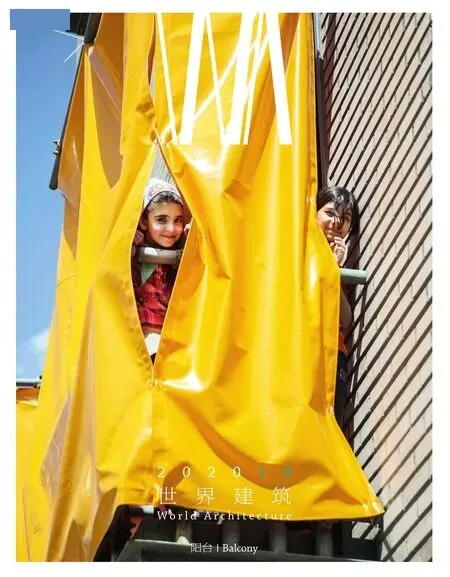
喚醒空間!城市生態(tài)陽臺(tái),河內(nèi),越南
2020-10-22 07:14:50建筑設(shè)計(jì)耕種建筑師事務(wù)所
世界建筑 2020年10期
建筑設(shè)計(jì):耕種建筑師事務(wù)所
Architects: Farming Architects
我們是來自越南及意大利的青年建筑師團(tuán)隊(duì),在越南開設(shè)了一家建筑工作室。2016年10月,我們?cè)诤觾?nèi)租賃了一個(gè)辦公空間。在了解河內(nèi)市周邊環(huán)境后,我們發(fā)現(xiàn),可能由于市區(qū)里的灰塵、噪音和防盜等問題,這里有很多陽臺(tái)都未被實(shí)際使用。市民幾乎不與外部環(huán)境或附近的鄰居互動(dòng)。我們把那些陽臺(tái)稱為沉寂空間。
考慮到上述情況,我們團(tuán)隊(duì)計(jì)劃在市中心租賃一所帶陽臺(tái)的住房,以便通過建筑設(shè)計(jì)手段打造友好、開放、多功能的空間,去喚醒這些沉寂空間。
解決方案
以鋼梁-綠植系統(tǒng)作為住宅的新外觀,為陽臺(tái)區(qū)域創(chuàng)造了雙重空間。
最大限度地將玻璃門系統(tǒng)擴(kuò)展到陽臺(tái),充分利用建筑物的自然光及自然風(fēng)。在以陽臺(tái)作為防曬屏障和防雨結(jié)構(gòu)的鋼梁-綠植系統(tǒng)中打造小微氣候,盡量將大氣候和周圍環(huán)境的不利影響最小化。
值得一提的是,我們研發(fā)了此類陽臺(tái)的升級(jí)版。即運(yùn)用復(fù)合養(yǎng)殖系統(tǒng),將這些沉寂空間轉(zhuǎn)化為生態(tài)陽臺(tái)。復(fù)合養(yǎng)殖系統(tǒng)是一種水體凈化系統(tǒng),其中,養(yǎng)殖魚類或其他水生生物產(chǎn)生的廢物,可以為水生栽培的植物提供營養(yǎng)物質(zhì)。同時(shí),由于定時(shí)水泵系統(tǒng)的存在,該系統(tǒng)不需要太多時(shí)間去護(hù)理。在結(jié)束緊張的市區(qū)工作之后,主人可以回家享用這個(gè)小小的陽臺(tái)空間養(yǎng)殖的魚類及種植的綠色蔬菜。
模塊化的不銹鋼熱鍍鋅鋼梁系統(tǒng),讓普通人能夠輕松地安裝及搭建。選用了空氣凈化設(shè)備。此外,種植區(qū)可以靈活安排以便用戶按照其習(xí)慣輕松移動(dòng)。外部的鋼梁系統(tǒng)也有助于防止從陽臺(tái)入室盜竊,確保安全。□(天妮 譯)
項(xiàng)目信息/Credits and Data:
主持建筑師/Architects in Charge: An Viet Dung, Roberto Iannetti, Pham Ngoc Linh
項(xiàng)目建筑師/Project Architects: An Thanh Nhan, Nelly Agliardi, Quach Hai Linh, Bui Huu Tung, Le Van Tung, DoThi Hien, Nguyen Phi Hung, Duc Chu, Bang Thanh.
建筑類型/Type of Project: 改造/Renovation
面積/Area: 35m2
項(xiàng)目年份/Project Year: 2017
攝影/Photos: Nguyen Thai Thach, Quang Tran
1 內(nèi)景/Interior view
We are young Vietnamese and Italian architects, with the intention of opening an architecture start-up in Vietnam. In October 2016,we returned to Hanoi to find a leasing office space.Surveying around Hanoi, we found out that a lot of balcony here are unused, probably because of dust, noise and burglary prevention problem of the urban area. Citizens hardly communicate – interact with the external environment, with surrounding neighbourhood. We call those balconies are dead spaces.
Being aware of the above mentioned, our team planned to rent a downtown house with the balconies in order to awake such spaces up by architectural solutions to create friendly –multifunctional open spaces.
Solution
The steel girder-tree system works as a new look for the house in order to create double space for the balcony area.
Maximum expansion of glass doors system into balcony takes advantage of the natural light–wind source to the building. Creating microclimate as well as minimising the adverse effects of climate and surrounding environment by dint of the steel girdertree system at balcony acting as a sun-proof barrier and a rain-proof structure.
Especially, we developed the second version of this balcony type by applying the Aquaponic system to let these dead spaces become the Eco-Balcony system. A system of aquaculture in which the waste produced by farmed fish or other aquatic creatures supplies the nutrients for plants grown hydroponically, which in turn purify the water. This system does not require too much time on caring thanks to the timer pump system. After stressful working hours in downtown, the host can come home and enjoy fresh fish-green vegetable from this little balcony space.
The stainless hot dipped galvanised steel girder system is modularised enabling ordinary people to effortlessly install and construct.
Select air purifying plants. Besides, the planters are arranged flexibly to be easily moved according to the user's habit.
The outside steel girder system also intends to functioned as to prevent burglary entering from the balcony, assure security.

11.12 陽臺(tái)內(nèi)景/Interior views

13 內(nèi)景/Interior view
評(píng)論
龍灝:世界各地城市居住建筑中的陽臺(tái)都是被“垂直疊放、不接地氣”的城市居民在家中可以直接接觸戶外的主要空間,由于其建筑物所在的大氣候區(qū)域、地點(diǎn)位置、建筑間距、樓層高度、文化傳統(tǒng)和經(jīng)濟(jì)現(xiàn)實(shí)下的住戶間社會(huì)關(guān)系等多種因素而呈現(xiàn)出不同的實(shí)際使用狀態(tài)。本案基于對(duì)具體建筑所處越南河內(nèi)的周邊環(huán)境分析與體驗(yàn),從改善建筑空間內(nèi)部使用狀態(tài)的角度出發(fā),營造了陽臺(tái)與套內(nèi)一體的化空間,室內(nèi)外材料、形式延續(xù)的設(shè)計(jì)手法及相關(guān)生態(tài)技術(shù)手段的運(yùn)用都可圈可點(diǎn),溫馨而有趣。看上去整體投資應(yīng)該也不會(huì)太多,算得上“性價(jià)比”較高的作品了。然而,位于熱帶季風(fēng)氣候區(qū)的居住建筑陽臺(tái)為避免灰塵、噪音和防盜問題而被改造為內(nèi)向性的空間是否因此失去了其空間的本質(zhì)意義?技術(shù)上,在不時(shí)會(huì)被強(qiáng)臺(tái)風(fēng)吹襲的地域,本案加建部分的建筑材料、構(gòu)件、構(gòu)造看上去可能也存在一定的安全隱患。
張昕楠:陽臺(tái)作為建筑室內(nèi)與場(chǎng)所聯(lián)通的中介,容納并喚醒了景物與事件的內(nèi)外關(guān)聯(lián),這也正如耕種工作室的河內(nèi)城市生態(tài)陽臺(tái)項(xiàng)目所力圖表達(dá)的那樣。在該項(xiàng)目中,模數(shù)化的金屬格網(wǎng)體系,一方面完成了將陽臺(tái)空間界面與天花界面的空間融合,另一方面也提供了容放自然與物件的格架,并以一個(gè)裝置化的垂直迷你花園豐富著展露于鬧市的圖景。這樣一種處理方式,提高了這個(gè)不大的房間的空間利用效率,更創(chuàng)造了一種可變的靈活。

14-16 室內(nèi)改造前后/Interior views before and after renovation
Comments
LONG Hao: Balconies in urban residential buildings all over the world are the main space where city residents can have directly contact with the outdoors in their homes, which are "stacked vertically and far from the ground". Due to the macroclimate of the region in which the buildings are located, the location,the space between buildings, the height of the floor,the cultural convention, the social relations between the households under the economic reality and other factors, the balconies are used in different ways. Based on the analysis and experience of the surrounding environment in Hanoi, Vietnam where the specific building is located, this project creates its balcony and integrated space from the perspective of improving the employment of the building space. Both indoor and outdoor materials, the continuation of the design approach and the use of relevant ecological techniques are commendable: warm yet interesting. It seems that the overall investment should not be too much,which can be regarded as a work of "better value for money". However, the balcony of the residential building located in the tropical monsoon climate zone has been transformed into an introverted space to avoid dust, noise and anti-theft issues. Has the space therefore lost its essential meaning? Technically, in the areas that are sometimes hit by strong typhoons, the building materials, components and structures added in this case also seem to have some potential safety hazards. (Translated by Dandan Wang)
ZHANG Xinnan: As the intermediate space of architectural interior and the environment, the balcony contains and awakens the internal and external relations between the landscape and the event. Farming Studio made such an attempt in their project Urban Eco-Balcony in Hanoi. In this project, modularized metal grids system, on the one hand, has realised the spatial mergence of the balcony and ceiling interfaces,while on the other hand, provided grillwork to store nature and daily objects. It performs as a mini-vertical garden installation, enriched the building's image exposed to the downtown cityscape. This approach enhanced the utilisation efficiency of the limited room space, and created an alterable flexibility. (Translated by WANG Xinxin)
猜你喜歡
工業(yè)設(shè)計(jì)(2022年8期)2022-09-09 07:43:20
北方建筑(2021年6期)2021-12-31 03:03:54
保健醫(yī)苑(2021年7期)2021-08-13 08:48:02
軍民兩用技術(shù)與產(chǎn)品(2021年10期)2021-03-16 06:05:30
北京測(cè)繪(2020年12期)2020-12-29 01:33:58
文苑(2020年10期)2020-11-07 03:15:36
現(xiàn)代裝飾(2020年6期)2020-06-22 08:43:12
學(xué)生天地(2020年36期)2020-06-09 03:12:30
小學(xué)科學(xué)(學(xué)生版)(2020年5期)2020-05-25 07:11:32
家庭影院技術(shù)(2017年9期)2017-09-26 03:41:45