
基于組成特性的肉骨粉種屬鑒別標志性變量挖掘
2020-12-02 16:38:48王夢妍姚玉梅韓魯佳
農業工程學報 2020年18期
高 冰,王夢妍,姚玉梅,高 菲,韓魯佳,劉 賢
基于組成特性的肉骨粉種屬鑒別標志性變量挖掘
高 冰,王夢妍,姚玉梅,高 菲,韓魯佳,劉 賢※
(中國農業大學工學院,北京 100083)
為了全面表征不同種屬肉骨粉的組成特性,并進一步挖掘肉骨粉種屬鑒別標志性變量,研究基于166個來源可靠的不同種屬肉骨粉樣本(豬、雞、牛、羊源),從基本組分、元素組成、脂肪酸組成和氨基酸組成4個方面全面獲取物料組成特性信息。對比分析不同種屬肉骨粉的69個組成變量,其中31個組成變量在種屬間差異性顯著(<0.05)。主成分分析(Principal Component Analysis,PCA)結合偏最小二乘判別分析(Partial Least Square-Discriminant Analysis,PLS-DA)對肉骨粉種屬間特異性進行探索性分析。結果表明,元素組成和脂肪酸組成可以為豬、雞、牛、羊肉骨粉提供特異性組成標志變量;氨基酸組成是反芻動物肉骨粉的特異性組成標志變量來源。綜合PLS-DA和單因素方差分析結果,以VIP值大于1,<0.05為指標,研究獲取了不同種屬肉骨粉之間的特異性組成標志變量,分別為:C10∶0、C18∶0、C18∶2n6c(豬肉骨粉);Ca、K、Zn、C18∶0、C18∶2n6c(雞肉骨粉);Sr、C14∶1、C17∶0、C17∶1、C18∶0、C18∶2n6t(牛肉骨粉);H、Mg、Sr、C10∶0、C16∶0、C17∶0、C17∶1、C18∶0(羊肉骨粉);Sr、Ba、C14∶1、C17∶0、C15∶0、C17∶1、C18∶0、C18∶2n6t、C18∶2n6c、絲氨酸(反芻動物肉骨粉);K、Zn、C18∶0、C18∶2n6c(哺乳動物肉骨粉)。該研究可以為肉骨粉種屬鑒別方法及其多元應用機理分析提供數據支持,并可以為肉骨粉多元應用細化至不同種屬提供理論基礎。
主成分分析;脂肪酸;氨基酸;肉骨粉;不同種屬;組成特性;對比分析;變量挖掘
0 引 言
肉骨粉是由畜禽屠宰廢棄物加工成的動物蛋白產品,曾作為重要的蛋白飼料在養殖領域廣泛使用[1]。在瘋牛病(牛腦海綿狀病)爆發前,對于肉骨粉的研究主要為其作為飼料的特性研究[2-3]。反芻動物飼用同源肉骨粉是傳播瘋牛病的主要途徑[4],因此,為了從源頭上控制朊病毒(瘋牛病的病原體)的傳播,世界各國紛紛制定了法律法規對飼用肉骨粉進行管控[5]。為了防止同源相食,合理地利用肉骨粉資源,肉骨粉種屬鑒別研究具有一定的意義。
在肉骨粉嚴格管控期間,相關研究集中在肉骨粉的無害化處理,主要利用肉骨粉的熱解、燃燒特性[6-7]及其殘渣的吸附特性[8]。近幾十年來,肉骨粉作為一種生物質資源,在材料[9-11]、燃料[12-14]、肥料[15-16]、飼料[17-18]、催化劑[19]、厭氧發酵[20-21]、吸附劑[22-25]等領域得到廣泛研究與利用。
肉骨粉組成特性復雜,不同的組成有不同的利用途徑[26],例如肉骨粉用作肥料、吸附劑和催化劑主要利用其元素組成中的鈣和磷;材料、飼料和厭氧發酵主要利用肉骨粉的脂質和氨基酸組成。肉骨粉種屬鑒別相關指紋圖譜研究表明不同種屬肉骨粉在化學組成上具有特異性與差異性[27-30]。有研究對肉骨粉的元素和氨基酸組成進行了表征分析[31-34],肉骨粉組成特性的表征可以為肉骨粉組成的工程利用數據與理論基礎,但是并未在不同種屬層面進行對比分析。因此,不同種屬肉骨粉組成特性表征研究是必要的。
本研究全面表征肉骨粉的組成特性,對比種屬間的差異性,并結合化學計量學方法,挖掘肉骨粉種屬間具有標志性的組成變量。該研究可以為肉骨粉種屬鑒別方法及其多元應用機理分析提供數據支持,并可以為肉骨粉多元應用細化至不同種屬提供理論基礎。
1 材料與方法
1.1 肉骨粉樣本的收集與制備
1.2 基本組分測定
測定全部166個肉骨粉樣本的基本組分,其中:含水率根據GB/T 6435—2014測定,稱取5 g樣本置于干燥皿內,在(103±2)℃的干燥箱中烘干至恒質量;粗灰分的含量根據GB/T 6438—2007測定,稱取1 g樣本置于坩堝中,在550 ℃的馬弗爐中灼燒3 h;粗蛋白的含量根據GB/T 6432—94,并通過凱氏定氮儀(KjeltecTM 2300,丹麥FOSS公司)測定;粗脂肪的含量根據GB/T 6433—2006,并通過全自動脂肪抽提儀(SoxtecTM 2050,丹麥FOSS公司)測定。
1.3 元素檢測
肉骨粉基質復雜,骨成分與非骨成分的元素組成差異較大[34],為了挖掘肉骨粉種屬間元素組成差異,采用歐盟標準方法(EC/51/2013)制備提取肉骨粉中骨顆粒,測定14種主要元素(C、H、O、N、S、Ca、P、Na、Mg、K、Fe、Zn、Sr、Ba)。每個骨顆粒樣本進行2次平行測定,分析樣本數量總計37個(豬源樣本14個、雞源樣本9個、牛源樣本9個、羊源樣本5個)。樣本的C、H、N、S元素含量可直接通過元素分析儀(Vario Macro,德國Elemental公司)測定,且按標準方法(ASTM E1755-01,2007)測定樣本灰分含量后,通過差減法計算獲得O元素含量[30];Ca、Na、Mg、K、Fe、Zn、Sr、Ba元素含量在樣本經微波消解后,通過電感耦合等離子體質譜儀(ICP-MS 7500,美國Agilient公司)測定;P元素含量通過連續流動分析儀(AutoAnalyzer3,德國Bran+Luebbe公司)測定。
1.4 脂肪酸檢測
肉骨粉樣本的脂質成分使用全自動脂肪測定儀(SoxtecTM 2050,丹麥FOSS公司)提取,并置于4℃冰箱,保存備用。脂質樣本經皂化、甲酯化、脫水后,得到脂肪酸甲酯,通過氣相色譜儀(GC-2014C,日本島津公司)進行脂肪酸種類及含量測定。分析樣本數量總計77個(豬源樣本21個、雞源樣本22個、牛源樣本17個、羊源樣本17個)。實驗室測定儀器為氣相色譜,參數如下:采用氫離子火焰檢測器(FID,日本島津公司);石英毛細管柱(RT-2560,Restek公司)長度100 m,內徑0.25 mm,膜厚0.2m。色譜分析條件如下[36]:進樣量1L,進樣口溫度為225 ℃;分流比為10:1;初始溫度100 ℃,保持2 min,以4 ℃/min速率升溫至160 ℃,以2 ℃/min的速率升溫至190 ℃,保持15 min,以2 ℃/min的速率升溫至200 ℃,以3 ℃/min的速率升溫至230 ℃,保持25 min;檢測溫度250 ℃,載氣為氮氣(純度為99.999%),氫氣流速為40 mL/min,氮氣流速為12 mL/min,空氣流速為400 mL/min,尾吹流速為60 mL/min。每個樣本做3次平行測定。脂肪酸甲酯混合標準品(47885-U)購買于美國Sigma-Aldrich公司。
1.5 氨基酸檢測
色氨酸利用分光光度計按照GB/T 15400—94進行測定;胱氨酸和蛋氨酸用L8900氨基酸分析儀(日本日立公司)按照GB/T 15399—94進行測定;天冬氨酸、蘇氨酸、絲氨酸、谷氨酸、甘氨酸、丙氨酸、纈氨酸、異亮氨酸、亮氨酸、酪氨酸、苯丙氨酸、賴氨酸、組氨酸、精氨酸和脯氨酸利用L8900氨基酸分析儀(日本日立公司)按照GB/T 18246—2000進行測定;分析樣本數量總計25個(豬源樣本13個、雞源樣本6個、牛源樣本4個、羊源樣本2個)。
1.6 統計分析方法
研究使用SPSS20.0單因素方差分析法(中的Duncan多重檢驗法對不同種屬肉骨粉組成差異進行統計學分析。置信水平設置為95%(<0.05)。采用主成分分析(Principal Component Analysis,PCA)[37]和偏最小二乘判別分析(Partial Least Square-Discriminant Analysis,PLS-DA)[38]基于組成變量信息對肉骨粉種屬間特異性進行探索性分析與定性判別分析。采用Kennard-Stone算法進行校正集和預測集的劃分,75%的樣本用來建立校正模型,25%的樣本用來模型驗證。其中,PLS-DA模型的靈敏度(Sensitivity)、特異度(Specificity)越接近于1,分類誤差越接近于0,說明肉骨粉種屬間特異性越強[39],變量投影重要性得分(Variables Important In Projection,VIP)大于1的變量被視為導致肉骨粉種屬間差異的主要變量[40]。2種方法均使用工具包PLS toolbox 8.0,在Matlab中實現。靈敏度和特異度計算公式如下
Sensitivity=TP/(TP+FN)(1)
Specificity=TN/(TN+FP)(2)
其中TP為真陽性的樣本個數;TN為真陰性的樣本個數;FP為假陽性的樣本個數;FN為假陰性的樣本個數。
另外,基于不同組成特性的PCA和PLS-DA分析所用樣本不一致,因此本研究僅在脂肪酸、氨基酸和元素3個組成層面分別進行種屬鑒別變量的挖掘,未進行不同組成特性變量的融合與對比分析。
《蘭納克》是一次尋根之旅,是一個民族主義者和小說家表達對本民族命運關切的特有方式,同時它也是一個政治諷喻,以魔幻現實主義的方式呈現了內受經濟衰退困擾、外逢強權政府壓制的蘇格蘭社會狀況,它更是整個西方工業社會的寫照,揭示了現代城市生活各種狀況的根源。在這部具有強烈“反烏托邦”色彩的小說中,格雷以諷刺的手法表達了對個人命運的關切和對社會政治經濟的不滿,批判了整個西方的政治意識形態。
2 結果與分析
2.1 基本組分分析
不同種屬肉骨粉的含水率、粗蛋白、粗灰分和粗脂肪含量如表1所示。不同種屬肉骨粉的基礎特性存在明顯差異。肉骨粉樣本的含水率相似,其中,雞肉骨粉的粗蛋白含量較高(<0.05);哺乳動物(牛、羊、豬)肉骨粉與非哺乳動物(雞)肉骨粉相比,其粗灰分含量顯著提高(<0.05),這可能是因為哺乳動物肉骨粉中含有較多的骨成分;不同種屬肉骨粉之間粗脂肪含量也存在明顯差異(<0.05)。
2.2 元素組成分析
如表1所示,不同種屬肉骨粉骨顆粒之間有10種元素(C、N、H、Ca、Na、K、Mg、Zn、Sr、Ba)存在顯著性差異(<0.05):C元素在非反芻動物(豬、雞)肉骨粉骨顆粒中的含量顯著高于反芻動物(牛、羊)樣本(<0.05),Sr、Ba元素在反芻動物肉骨粉骨顆粒中的含量顯著高于非反芻動物樣本(<0.05);K、Zn元素雞肉骨粉骨顆粒中含量顯著高(<0.05);與豬肉骨粉骨顆粒相比,Ca、Na元素在雞肉骨粉骨顆粒中顯著低(<0.05);與牛源樣本相比,Mg、Sr元素在羊肉骨粉骨顆粒中含量顯著高(<0.05),而N和H元素含量顯著低(<0.05)。
2.3 脂肪酸組成分析
脂肪酸C4:0、C11:0、C15:1、C24:0、C20:5n3和C24:1n9在不同種屬肉骨粉中均未檢測到;C14:0、C17:0、C18:0、C18:1n9t的含量在反芻動物(牛、羊)肉骨粉中要高于非反芻動物(豬、雞)肉骨粉中的含量,而C18:1n9c和C18:2n6c的含量則低于非反芻動物(豬、雞)肉骨粉中的含量;脂肪酸C13:0、C18:2n6t在反芻動物肉骨粉中檢出,在非反芻動物肉骨粉中并未檢出;C22:1n9、C20:3n3在非反芻動物肉骨粉中檢出,在反芻動物肉骨粉中并未檢出;羊肉骨粉中C10:0、C14:1、C17:0、C18:0、C18:2n6t和C18:3n3的含量顯著不同于其在牛肉骨粉中的含量(<0.05);C21:0和C22:0在豬肉骨粉中檢出,而在雞肉骨粉中未檢出;C18:3n6、C22:2n6和C22:6n3在雞肉骨粉中檢出,而在豬肉骨粉中未檢出;C10:0、C18:0和C20:0在豬肉骨粉中的含量顯著區高于其在雞肉骨粉中的含量(<0.05),豬肉骨粉中C18:2n6c的含量顯著低于雞肉骨粉;C18:2n6c在雞肉骨粉中的含量要顯著高于其在豬肉骨粉中的含量(<0.05);多不飽和脂肪酸在反芻動物肉骨粉(牛、羊)中的含量差異顯著低于非反芻動物肉骨粉(豬、雞)(<0.05)。
2.4 游離氨基酸組成分析
分析表1可知,除了游離絲氨酸濃度在反芻動物肉骨粉和非反芻肉骨粉之間存在顯著差異(<0.05),其余17種游離氨基酸濃度均無顯著性差異(>0.05)。牛羊肉骨粉間不顯著差異可能是由于樣本量較小導致,因此,本研究主要得到了反芻與非反芻肉骨粉的氨基酸組成差異,并進一步挖掘了反芻與非反芻肉骨粉之間的特異性氨基酸組成變量。
2.5 基于組成信息的不同種屬肉骨粉主成分分析
圖1a是基于元素組成信息的主成分分析結果。第一、二、三主成分分別占總變異數的32.04%、17.34%和10.12%。豬、雞肉骨粉樣本分布范圍較廣,且在第一主成分上與牛、羊肉骨粉有較好的區分;牛肉骨粉和羊肉骨粉樣本相互重疊且分布較集中;豬肉骨粉和雞肉骨粉有少量樣本重疊,在第二主成分上有較好的區分。這說明在元素組成信息中具有挖掘肉骨粉種屬間特異性的潛力。
基于脂肪酸組成信息的主成分分析結果如圖1b所示,第一、二、三主成分分別占總變異數的26.33%、9.62%和8.39%。反芻動物(牛、羊)肉骨粉樣本和非反芻動物(豬、雞)肉骨粉樣本分別落在第二主成分的正和負方向上,區分明顯;豬、雞肉骨粉樣本在第三主成分上有少量重疊,區分較為明顯。這說明不同種屬肉骨粉的脂肪酸組成信息存在差異,具有挖掘種屬特異性的潛力。
基于氨基酸組成信息的主成分分析結果如圖1c所示,第一、二、四主成分分別占總變異數的37.24%、17.85%和6.01%。非反芻動物(豬、雞)肉骨粉樣本和反芻動物(牛、羊)肉骨粉樣本在第一主成分上有明顯的區分;豬、雞肉骨粉樣本分布范圍廣,在第四主成分上有較好的區分;牛、羊肉骨粉樣本之間距離較近,這可能由樣本量較少導致。可見,反芻動物肉骨粉(牛、羊)和非反芻動物肉骨粉(豬、雞)在氨基酸組成信息上存在一定的特異性,該差異可能主要是由于絲氨酸的含量差異引起(<0.05)。

圖1 基于不同種屬肉骨粉組成信息的主成分分析
2.6 基于組成信息的肉骨粉種屬偏最小二乘判別分析
進一步對肉骨粉組成信息進行PLS-DA判別分析,其結果見表2(靈敏度和特異度均大于0.80的判別分析結果被突出顯示)。基于脂肪酸組成和元素組成信息的模型在判別1、判別2和判別3中均取得了良好的判別結果;基于氨基酸組成信息可以較好地判別反芻動物肉骨粉和非反芻肉骨粉。這進一步說明了不同種屬肉骨粉組分之間存在特異性。
2.7 肉骨粉種屬間具有標志性的組成變量挖掘
基于PLS-DA和單因素方差分析對不同種屬肉骨粉的潛在標志物進行挖掘。3種PLS-DA判別分析的VIP值如圖2所示。對于判別1(豬、雞、牛和羊),VIP值大于1的組成變量數量分別為16個(豬)、18個(雞)、18個(牛)和18個(羊);判別2(反芻動物和非反芻動物)中VIP值大于1的組成變量數為18個;判別3(哺乳動物和非哺乳動物)中,VIP值大于1的組成變量數為17個。其中同時滿足VIP大于1和<0.05的變量數分別為3個(判別1,豬)、5個(判別1,雞)、6個(判別1,牛)、8個(判別1,羊)、10個(判別2)、6個(判別3)。具體挖掘的不同種屬肉骨粉特異性組成變量見表3。

表1 不同種屬肉骨粉組成特性差異分析
注:同一變量不同種屬平均值標記字母不同,其差異顯著(<0.05);nd為未檢出;trace表示平均含量低于0.005%。
Note: Different mark letters in same variable show significant difference of different species (<0.05); nd refers to not detected; trace shows the content is lower than 0.005%.
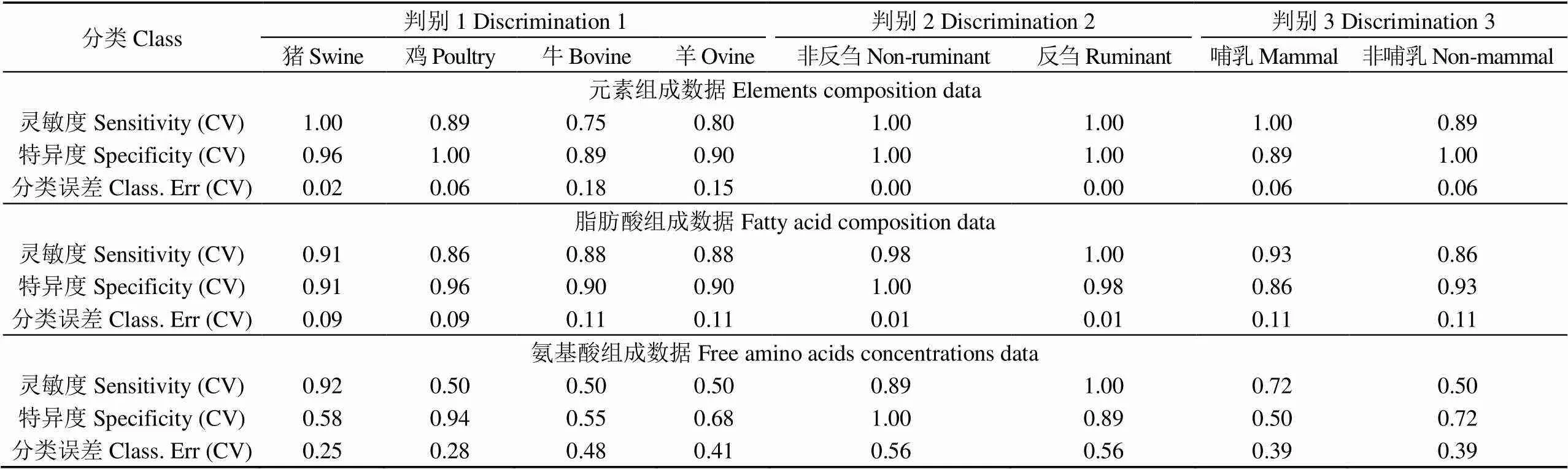
表2 不同種屬肉骨粉PLS-DA判別分析
注:CV 為交互驗證;Class. Err為分類誤差。
Note: CV refers to cross validation; Class. Err refers to classification error.
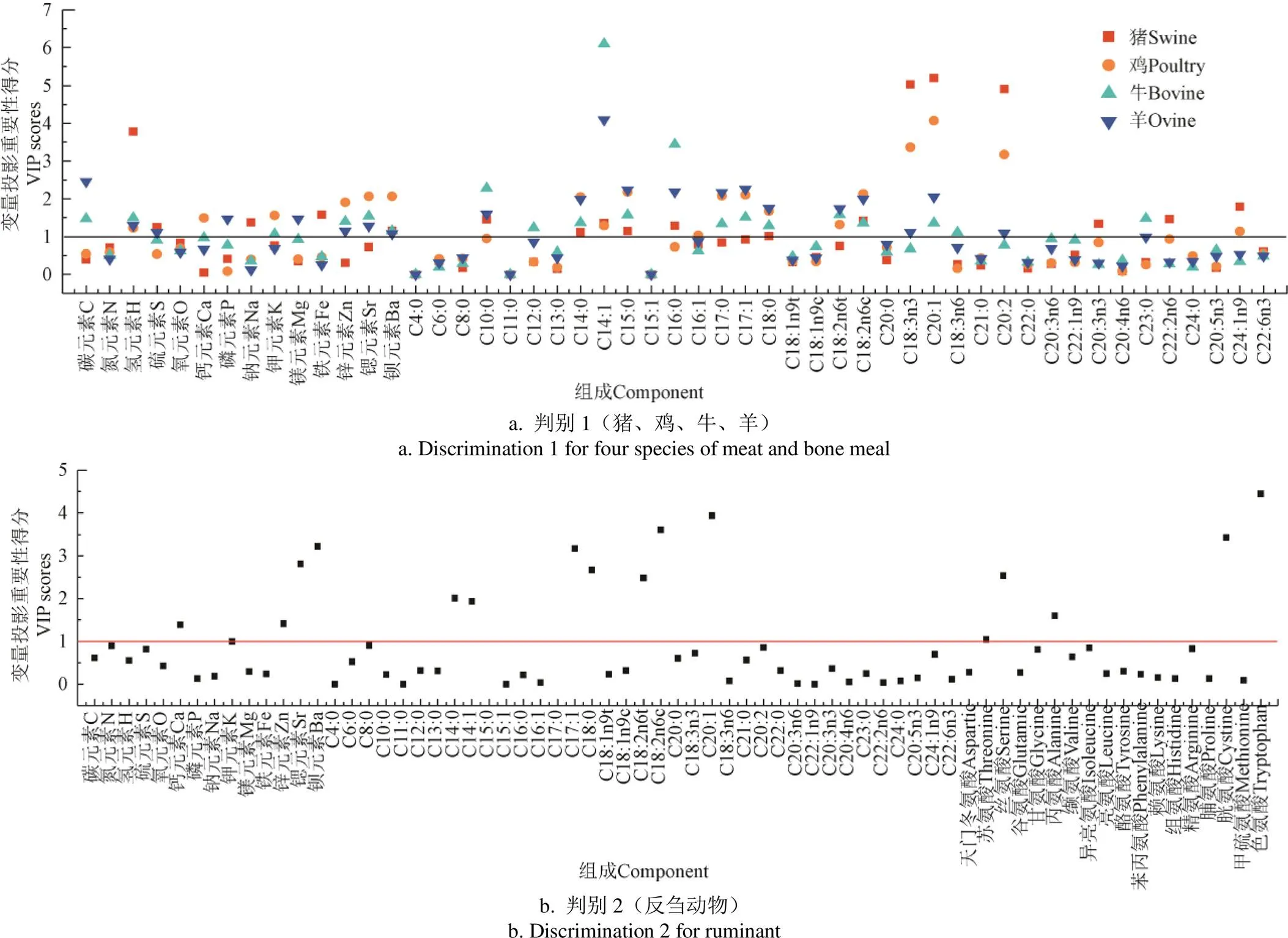

表3 肉骨粉種屬間具有標志性的組成變量
注:含量列參數的單位與表1相同。
Note: units of the parameters in content column are the same as those in Table 1.
3 結 論
研究結果表明,不同種屬肉骨粉物料特性在基本組分、元素組成、脂肪酸組成和氨基酸組成上均存在差異。PLS-DA結合單因素方差分析,表明脂肪酸組成和元素組成均可以對不同種屬肉骨粉進行判別分析;氨基酸組成可以判別分析反芻和非反芻肉骨粉。進一步挖掘獲得了不同種屬肉骨粉之間的特異性組成標志變量:
1)豬肉骨粉的特異性組成標志變量為C10:0、C18:0、C18:2n6c;
2)雞肉骨粉的特異性組成標志變量為Ca、K、Zn、C18:0、C18:2n6c;
3)牛肉骨粉的特異性組成標志變量為Sr、C14:1、C17:0、C17:1、C18:0、C18:2n6t;
4)羊肉骨粉的特異性組成標志變量為H、Mg、Sr、C10:0、C16:0、C17:0、C17:1、C18:0;
5)Sr、Ba、C14:1、C17:0、C15:0、C17:1、C18:0、C18:2n6t、C18:2n6c、絲氨酸可作為反芻和非反芻動物肉骨粉之間的特異性組成標志變量;
6)K、Zn、C18:0、C18:2n6c可作為哺乳和非哺乳動物肉骨粉之間的特異性組成標志變量。
本研究全面地獲取了不同組成特性數據,結合化學計量學方法鑒別不同種屬肉骨粉的可行性,并建立了系列種屬鑒別模型;進一步在不同組成特性層面,對肉骨粉種屬鑒別標志性變量進行了挖掘。研究結果可以為基于光譜的肉骨粉種屬鑒別機理分析提供數據支持,并可以為肉骨粉的多元工程應用細化至不同種屬提供理論基礎。
[1]Hendriks W H, Butts C A, Thomas D V, et al. Nutritional quality and variation of meat and bone meal[J]. Asian-Australasian Journal of Animal Sciences, 2002, 15(10): 1507-1516.
[2]Choppe W, Kratzer F H. Methods for evaluating the feeding quality of meat-and-bone meals[J]. Poultry Science, 1963, 42(3): 642-646.
[3]Kratzer F H, Davis P N. The feeding value of meat and bone meal protein[J]. Poultry Science, 1959, 38(6): 1389-1393.
[4]Nathanson N, Wilesmith J W, Griot Christian. Bovine spongiform encephalopathy (BSE): causes and consequences of a common source epidemic[J]. American Journal of Epidemiology, 1997, 145: 959-969.
[5]van Raamsdonk L W D, Prins T W, Meijer N, et al. Bridging legal requirements and analytical methods: a review of monitoring opportunities of animal proteins in feed[J]. Food Additives & Contaminants: Part A, 2019, 36(1): 46-73.
[6]Cascarosa , Gea G, Arauzo J. Thermochemical processing of meat and bone meal[J]. Renewable and Sustainable Energy Reviews, 2012, 16(1): 942-957.
[7]Beck J, Brandenstein J, Unterberger S, et al. Effects of sewage sludge and meat and bone meal Co-combustion on SCR catalysts[J]. Applied Catalysis B: Environmental, 2004, 49(1): 15-25.
[8]Mouchet F, Cren S, Cunienq C, et al. Assessment of lead ecotoxicity in water using the amphibian larvae (Xenopus laevis) and preliminary study of its immobilization in meat and bone meal combustion residues[J]. BioMetals, 2006, 20(2): 113.
[9]Lee J, Won M, Song K. Physical properties and antimicrobial activities of porcine meat and bone meal protein films containing coriander oil[J]. LWT - Food Science and Technology, 2015, 63(1): 700-705.
[10]Essandoh M, Garcia R A, Nieman C M, et al. Influence of methylation on the effectiveness of meat and bone meal protein as a bioflocculant[J]. Food and Bioproducts Processing, 2020, 122: 55-61.
[11]Piazza G J, Garcia R A. Meat & bone meal extract and gelatin as renewable flocculants[J]. Bioresource Technology, 2010, 101(2): 781-787.
[12]Vamvuka D, Papas M, Alloimonos N, et al. Evaluation of meat and bone meal as a secondary fuel with olive by-products in a fluidized bed unit. performance and environmental impact of ashes[J]. Energy & Fuels, 2017, 31(7): 7214-7222.
[13]Ariyaratne W K H, Malagalage A, Melaaen M C, et al. CFD modelling of meat and bone meal combustion in a cement rotary kiln – Investigation of fuel particle size and fuel feeding position impacts[J]. Chemical Engineering Science, 2015, 123: 596-608.
[14]Soni C G, Wang Z, Dalai A K, et al. Hydrogen production via gasification of meat and bone meal in two-stage fixed bed reactor system[J]. Fuel, 2009, 88(5): 920-925.
[15]Staroń P, Kowalski Z, Staroń A, et al. Thermal conversion of granules from feathers, meat and bone meal and poultry litter to ash with fertilizing properties[J]. Agricultural and Food Science, 2017, 26(3): 173-180.
[16]Liu X, Selonen V, Steffen K, et al. Meat and bone meal as a novel biostimulation agent in hydrocarbon contaminated soils[J]. Chemosphere, 2019, 225: 574-578.
[17]Al-Masri M. Productive performance of broiler chicks fed diets containing irradiated meat-bone meal[J]. Bioresource Technology, 2003, 90: 317-322.
[18]Zanu H K, Keerqin C, Kheravii S K, et al. Influence of meat and bone meal, phytase, and antibiotics on broiler chickens challenged with subclinical necrotic enteritis: 1. growth performance, intestinal pH, apparent ileal digestibility, cecal microbiota, and tibial mineralization[J]. Poultry Science, 2020, 99(3): 1540-1550.
[19]Wang S, Yuan H, Wang Y, et al. Transesterification of vegetable oil on low cost and efficient meat and bone meal biochar catalysts[J]. Energy Conversion and Management, 2017, 150: 214-221.
[20]Wu G, Healy M G, Zhan X. Effect of the solid content on anaerobic digestion of meat and bone meal[J]. Bioresource Technology, 2009, 100(19): 4326-4331.
[21]Andriamanohiarisoamanana F J, Saikawa A, Kan T, et al. Semi-continuous anaerobic co-digestion of dairy manure, meat and bone meal and crude glycerol: Process performance and digestate valorization[J]. Renewable Energy, 2018, 128: 1-8.
[22]Wang M, Liu Y, Yao Y, et al. Comparative evaluation of bone chars derived from bovine parts: Physicochemical properties and copper sorption behavior[J]. Science of The Total Environment, 2020, 700: 1-6.
[23]Makara A, Kowalski Z, Saeid A. Treatment of wastewater from production of meat-bone meal[J]. Open Chemistry, 2015, 13: 1275-1285.
[24]Coutand M, Deydier E, Cyr M, et al. Evaluation of laboratory and industrial meat and bone meal combustion residue as cadmium immobilizing material for remediation of polluted aqueous solutions: “Chemical and ecotoxicological studies”[J]. Journal of Hazardous Materials, 2009, 166(2): 945-953.
[25]Leng L, Zhang J, Xu S, et al. Meat & bone meal (MBM) incineration ash for phosphate removal from wastewater and afterward phosphorus recovery[J]. Journal of Cleaner Production, 2019, 238: 117960.
[26]Garcia R, Piazza G. Application of the elusieve process to the classification of meat and bone meal particles[J]. Applied Engineering in Agriculture, 2015, 31: 165-170.
[27]Han Y, Wang X, Liu Y, et al. A novel FTIR discrimination based on genomic DNA for species-specific analysis of meat and bone meal[J]. Food Chemistry, 2019, 294: 526-532.
[28]Gao F, Xu L, Zhang Y, et al. Analytical Raman spectroscopic study for discriminant analysis of different animal-derived feedstuff: Understanding the high correlation between Raman spectroscopy and lipid characteristics[J]. Food Chemistry, 2018, 240: 989-996.
[29]Gao F, Zhou S, Han L, et al. A novel FT-IR spectroscopic method based on lipid characteristics for qualitative and quantitative analysis of animal-derived feedstuff adulterated with ruminant ingredients[J]. Food Chemistry, 2017, 237: 342-349.
[30]Wang M, Han L, Yang Z, et al. Species discrimination of terrestrial processed animal proteins by laser-induced breakdown spectroscopy (LIBS) based on elemental characteristics[J]. Biotechnologie, Agronomie, Société et Environnement, 2019, 23(3): 137-146.
[31]Buckley M, Penkman K E H, Wess T J, et al. Protein and mineral characterisation of rendered meat and bone meal[J]. Food Chemistry, 2012, 134(3): 1267-1278.
[32]Parsons C M, Castanon F, Han Y. Protein and amino acid quality of meat and bone meal[J]. Poultry Science, 1997, 76(2): 361-368.
[33]Hendriks W H, Cottam Y H, Morel P C H, et al. Source of the variation in meat and bone meal nutritional quality[J]. Asian-Australasian Journal of Animal Sciences, 2004, 17(1): 94-101.
[34]Garcia R A, Rosentrater K A. Concentration of key elements in North American meat & bone meal[J]. Biomass and Bioenergy, 2008, 32(9): 887-891.
[35]Ockerman H, Hansen C. Animal By-product Processing and Utilization[M]. Boca Raton: CRC Press, 1999.
[36]Pu Q, Han L, Liu X. A new approach for species discrimination of different processed animal proteins based on fat characteristics[J]. European Journal of Lipid Science & Technology, 2016, 118(4): 576-583.
[37]殷勇,趙玉珍,于慧春. 基于多種變量分析方法鑒別食醋種類電子鼻信號特征篩選[J]. 農業工程學報,2018,34(15):290-297. Yin Yong, Zhao Yuzhen, Yu Huichun. Feature selection of electronic nose signal for vinegar discrimination based on multivariable analysis[J]. Transactions of the Chinese Society of Agricultural Engineering (Transactions of the CSAE), 2018, 34(15): 290-297. (in Chinese with English abstract)
[38]滑金杰,王華杰,王近近,等. 采用PLS-DA分析毛火方式對工夫紅茶品質的影響[J]. 農業工程學報,2020,36(8):260-270. Hua Jinjie, Wang Huajie, Wang Jinjin, et al. Influences of first-drying methods on the quality of Congou black tea using partial least squares-discrimination analysis[J]. Transactions of the Chinese Society of Agricultural Engineering (Transactions of the CSAE), 2020, 36(8): 260-270. (in Chinese with English abstract)
[39]劉賢,徐凌芝,高冰,等. 紅外光譜的陸生動物油脂中反芻動物成分鑒別分析[J]. 光譜學與光譜分析,2019,39(10):3189-3192. Liu Xian, Xu Lingzhi, Gao Bing, et al. Discriminant analysis of ruminant constituents in terrestrial fat and oil by infrared spectroscopy[J]. Spectroscopy and Spectral Analysis, 2019, 39(10): 3189-3192. (in Chinese with English abstract)
[40]Liu H, Guo X, Zhao Q, et al. Lipidomics analysis for identifying the geographical origin and lactation stage of goat milk[J]. Food Chemistry, 2019, 309: 1- 6.
Markers mining for species discrimination based on component characteristics of meat and bone meal
Gao Bing, Wang Mengyan, Yao Yumei, Gao Fei, Han Lujia, Liu Xian※
(,,100083,)
This study aims to comprehensively characterize the composition of meat and bone meal, and further to identify the specific variables of various species using a data mining method. Based on the component characteristics data, a comprehensive comparison and markers mining study were carried out for the meat and bone meal that produced by various species. 166 samples of meat and bone meal were produced from various species (55 swine, 43 poultry, 36 bovine, and 32 ovine) in different factories of China. Composition characteristics in the samples of meat and bone meal were detected from four aspects, including the proximate component, element, fatty acid, and amino acid composition. The results of proximate component show that there was a complex variation in the samples of meat and bone meal, leading to the difference in four species was not considered statistically significance. An one-way Anova variance analysis was conducted for the composition data of element, fatty acid, and amino acid. 69 component variables were compared, incuding 14 variables from element composition, 37 variables from fatty acid composition, 18 variables from amino acid composition, in the meat and bone meal from different species. Consequently, there were significant differences among species (<0.05) for 31 component variables, including 10 variables from element composition, 20 variables from fatty acid composition, 1 variable from amino acid composition. It infers that the component characteristics of meat and bone meal varied significantly in different species, particularly on the specific component variables. A Principal Component Analysis (PCA) combined with the Partial Least Square Discrimination Analysis (PLS-DA) was used to explore the species specificity of meat and bone meal. The results showed that the composition variables of element and fatty acid can serve as markers to idnetify the swine, poultry, bovine, as well as ovine meat and bone meal. The composition variables of amino acid were mainly marker sources of ruminant and non-ruminant meat and bone meal. Comprehensively characterization using the PLS-DA and one-way Anova variance analysis demonstrated that, taking the VIP value greater than 1, while< 0.05 as the united indicator, the specific variables were achieved in the meat and bone meal for the species of: 1) swine were C10:0, C18:0 and C18:2n6c, 2) poultry were Ca, K, Zn, C18:0 and C18:2n6c, 3) bovine were Sr, C14:1, C17:0, C17:1, C18:0 and C18:2n6t, 4) ovine were H, Mg, Sr, C10:0, C16:0, C17:0, C17:1 and C18:0, 5) ruminant and non-ruminant were Sr, Ba, C14:1, C17:0, C15:0, C17:1, C18:0, C18:2n6t, C18:2n6c and serine, and 6) mammal and non-mammal were K, Zn, C18:0 and C18:2n6c. These selected specific variables can provide: a sound theoretical basis for the multi-application of meat and bone meal from different species. The finding can also offer sinificant data support for the mechanism analysis and further application of meat and bone meal, particularly on the species identification method.
Principal Component Analysis; fatty acid; amino acid; meat and bone meal; different species; component characteristics; comparison analysis; markers mining
高冰,王夢妍,姚玉梅,等. 基于組成特性的肉骨粉種屬鑒別標志性變量挖掘[J]. 農業工程學報,2020,36(18):275-282.doi:10.11975/j.issn.1002-6819.2020.18.032 http://www.tcsae.org
Gao Bing, Wang Mengyan, Yao Yumei, et al. Markers mining for species discrimination based on component characteristics of meat and bone meal[J]. Transactions of the Chinese Society of Agricultural Engineering (Transactions of the CSAE), 2020, 36(18): 275-282. (in Chinese with English abstract) doi:10.11975/j.issn.1002-6819.2020.18.032 http://www.tcsae.org
2020-05-26
2020-09-10
國家重點研發計劃項目(2017YFE0115400)和現代農業(奶牛)產業技術體系建設專項資金項目(CARS-36)
高冰,博士生,主要從事生物質資源與利用研究。Email:gaobing@cau.edu.cn
劉賢,副教授,博士生導師,主要從事生物質資源與利用研究。Email:lx@cau.edu.cn
10.11975/j.issn.1002-6819.2020.18.032
X713;S879.9
A
1002-6819(2020)-18-0275-08
