未來非洲創(chuàng)新校區(qū):發(fā)展非洲科學領(lǐng)導力,比勒陀利亞,南非
2021-01-26 12:06:10建筑設(shè)計Earthworld建筑事務(wù)所
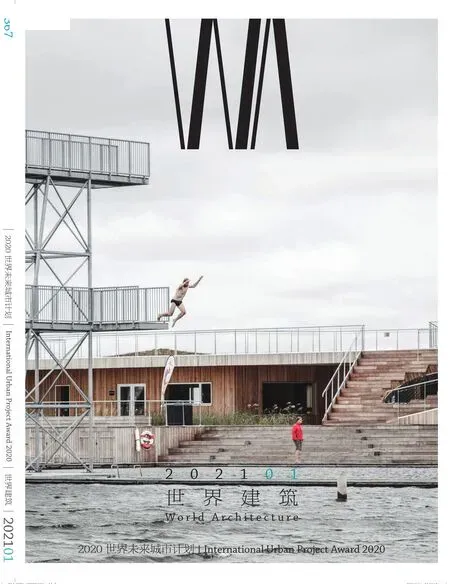
世界建筑 2021年1期
建筑設(shè)計:Earthworld建筑事務(wù)所
1 泛非洲研究中心
“該空間并非研究機構(gòu),至少不是傳統(tǒng)意義上的研究機構(gòu),也無法把它簡單視作一個校區(qū)……這是一個充滿創(chuàng)意之地。未來非洲不僅是學科之間研究的中心,而且是跨學科研究的中心(前者著眼于學科之間的聯(lián)系,后者是指‘兩個或多個學科相互促進,形成一種新的整體研究’)。”
——伯納德·史利珀斯
任務(wù)書提出要在非洲的大背景之下營造一片促進并加強跨學科研究的區(qū)域。該校區(qū)應(yīng)成為關(guān)注科學領(lǐng)導力發(fā)展的集合性研究之地。
未來非洲創(chuàng)新校區(qū)將為來自各種文化背景的博士后學生提供一體化的生活工作環(huán)境,促進多樣性文化及諸多學科之間的友誼、理解與協(xié)作。非洲學者分散居住的現(xiàn)狀使跨學科研究受到很大阻隔,這也連帶導致了極富價值的知識信息的流失。
校區(qū)包括280個居住單元(一居室、兩居室和三居室)、一個中央大廳(未來非洲中心)、幾個共用的研究空間及會議設(shè)施(包含一個250座的禮堂、兩個50座的多功能廳和6個與禮堂相連、可兼做翻譯間的休息室)。
“我們不能用制造問題的思維方式來解決問題。”
——阿爾伯特·愛因斯坦
未來非洲不僅關(guān)乎地點(所在地、意義),也關(guān)乎空間(建筑),更關(guān)乎建筑對其發(fā)展所處的生態(tài)環(huán)境所能做出的促進作用。
2 核心理念
2.1 開放性建筑、分解、三級系統(tǒng)和適應(yīng)性
為使得離場制造與現(xiàn)場組裝能夠并行,我們有意將項目的體系與構(gòu)造分解開,將一、二、三級系統(tǒng)進行整合并深化至家具設(shè)計的細節(jié)層面。為適應(yīng)個性化需求,這些系統(tǒng)靈活、適應(yīng)性強且促進使用者交互。
其構(gòu)造還體現(xiàn)了耐久等級。混凝土和磚石等一級結(jié)構(gòu)需用重型設(shè)備施工,鋼材及可后期定制的裝配材料等二級結(jié)構(gòu)則需要輕型設(shè)備,第三級結(jié)構(gòu)系統(tǒng)完全由使用者或非技術(shù)性工人手工組裝,且結(jié)構(gòu)具有未來適應(yīng)性。
第三級系統(tǒng)主要由木材構(gòu)成。膠合板和單板層積材被數(shù)字化地轉(zhuǎn)換為拼接碎塊,然后運送到現(xiàn)場,由非技術(shù)性工人在現(xiàn)場手工組裝。
這個開放性的建筑不僅考慮到了適應(yīng)性再利用和再循環(huán),且承包方式更具選擇性和包容性。這使該行業(yè)向較小眾的“參與者”和非技術(shù)性勞動者敞開了大門。未來非洲中心是由9名非技術(shù)性工人組裝的,所有構(gòu)件元素都控制在了可以手工操作的尺寸,鋼構(gòu)件都有特定的重量限制以方便工人攜帶。
2.2 再生設(shè)計與催化開發(fā)
將建筑分解為界定清晰的構(gòu)件元素提供了一種將制造外包給小微企業(yè)的可能性。構(gòu)件的精度與一體化由數(shù)字建構(gòu)領(lǐng)域的建筑師完成。裝配由非技術(shù)性工人在現(xiàn)場完成。這種對小型企業(yè)的調(diào)動對于失業(yè)率較高的經(jīng)濟體將產(chǎn)生很大影響。
設(shè)計的目的不僅是為了簡化對承包方的管理,也是為了建構(gòu)新型產(chǎn)業(yè)或微型企業(yè),這些業(yè)態(tài)可通過社區(qū)銀行籌集資金。新的小型工廠或企業(yè)利用數(shù)字化策略來縮小他們與正式培訓和市場準入門檻之間的差距。也就是說,教會一個工人操作數(shù)控機床要比培養(yǎng)一個熟練的木工容易得多。
非正式體系在發(fā)展中社區(qū)早已存在,如能通過質(zhì)量控制和適度調(diào)節(jié)來擴大其應(yīng)用,就能建立一個全新的民主工業(yè)化領(lǐng)域。
2.3 施工的民主化
開放建筑工業(yè)使小微企業(yè)能夠參與建構(gòu)大型項目是本項目的關(guān)鍵。負責制造和安裝第三級系統(tǒng)的承包方中,沒有一家從事過類似尺度的項目工作,也沒有一家生產(chǎn)過任何類似的構(gòu)件。使用基礎(chǔ)架構(gòu)成熟的企業(yè)無疑風險更低,但這些工業(yè)化機構(gòu)逐漸增加的成本及其僵化程度既有礙于創(chuàng)新,也無法提供有意義的聯(lián)動機會。
小型承包方的所有權(quán)程度為其帶來了極大的自豪感、意義和成就感。自工業(yè)革命將勞動力視做商品以來,我們的行業(yè)早已失去了上述特質(zhì)。
2.4 并行價值鏈與線性價值鏈
我們有意運用地方性的技術(shù)手段,而非已建立的、高度專業(yè)化的、引進的建筑體系。所有材料都在現(xiàn)場或場地附近直接加工。除鋁合金窗和機械、電氣、電子設(shè)備外,所有構(gòu)件都在距場地20km的范圍內(nèi)生產(chǎn)完成。將不同制造商的生產(chǎn)進行整合,在安裝之前只需處理一次材料,這種方式削弱了線性價值鏈的必要性。
2.5 系統(tǒng)思維/互聯(lián)性
該項目不僅作為空間、居住和庇護所存在,也是以人為本的體系的核心。第一、二、三級使用者都參與到了生態(tài)系統(tǒng)的構(gòu)建當中。地方經(jīng)濟、生態(tài)和景觀的融合是該項目的重中之重。項目及其在構(gòu)建過程中的影響與最終落成結(jié)果同等重要。
3 結(jié)語
發(fā)展過程中,區(qū)域環(huán)境如要達成社區(qū)、所有權(quán)、多方參與及理念一體化的建構(gòu)結(jié)果,則需通過空間透明性、民主化和決策加以實現(xiàn)。大學中,將共享設(shè)施建筑群置于住宅單元的中心位置是慣例,但這仍然形成了“中島”與“隔離”的情況。對平面形態(tài)的二次構(gòu)想是設(shè)置一個集中性的交互空間,該設(shè)計策略能促進合作、促進文化互動和友誼。協(xié)作/公共設(shè)施的中心是餐飲和準備區(qū)。出于文化多樣性的考慮,圍繞“餐桌”分享想法是此種組織模式的核心。我們在校園異地種植了56種孤生農(nóng)作物,使用者可自發(fā)探尋食材。這些關(guān)于新口味、口感和食材搭配的創(chuàng)造性互動使得景觀設(shè)計也成為了整體系統(tǒng)的一部分。(安德烈·埃克斯廷 文,天妮 譯)
1 A Pan-African Research Centre
"This space is not an institute, at least not in the traditional sense. Nor can you consider it a campus...... it's a place animated by ideas. Future Africa is designed to be a hub not merely for interdisciplinary research, but trans disciplinary research. (While the former looks at the nexus between disciplines, the latter refers to "two or more disciplines transcend[ing] each other to form a new holistic approach)". -Prof. Bernard Slippers
The brief called for the design of an environment that would facilitate and enhance trans-disciplinary research within the African context. The facility should be a place where collective research is done with a strong focus on science leadership development.
Future Africa is to provide an integrated live-/work environment for post-doctorate students from all cultures and backgrounds; fostering fellowship, understanding and collaboration among the vast diversity of cultures and disciplines on our continent. The diaspora of African academics has left scientists isolated. This often leads to discouragement and subsequent loss of valuable knowledge.
Its facilities include: 280 one-, two-, and 3 bedroom living units, a central hall (Future Africa Hub), several research commons, and conference facilities which consist of one 250-seat Auditorium,two 50-seat Multi-purpose Rooms, and 6 Break-away Rooms, linked to the Auditorium; also doubling up as Translation Booths.
"We can't solve problems with the same kind of thinking we used when we created them". -Albert Einstein.
Future Africa is not only about place (locality,meaning) nor space (building), but also about the contribution a building can make to the ecology within which it is developed.
2 Key Concepts
2.1 Open Building, Disentanglement, Primary,Secondary, Tertiary Systems, Adaptability
Systems and tectonics were deliberately disentangled to allow for parallel off-site manufacture and on-site assembly. Primary,Secondary and Tertiary systems were integrated all the way down to the detail level of furniture design, which were flexible and adaptable requiring user interaction to suit each individual's requirements.
The levels of permanence can also be read in the tectonics. The primary (concrete & masonry)required heavy equipment through to the secondary structures (steel also accommodating post-fitted services) required lighter equipment and the tertiary systems being completely hand-assembled by either the user or unskilled labour. Allows for future adaptability.
Timber was used extensively for the Tertiary systems. Plywood and LVL were digitally "converted"into puzzle pieces. Then brought to site and hand assembled by unskilled labour on site.
Not only does this Open Building allow for adaptive re-use and re-cycling, it also allows for alternative, more inclusive contracting. This opens up the industry to smaller "players" and unskilled labour. The Hub Building was assembled by 9 previously unskilled labourers. Elements were all kept to a scale which can be handled by humanhand. Steel elements were designed within speci fic weight restrictions to allow elements to be carried by labourers.
2.2 Regenerative Design/Catalytic Development
Breaking the buildings down in clearly de fined elements offers the potential of outsourcing manufacture to small and micro enterprises. The tolerances and integration of elements is done by the architect in the digital realm. Assembly is done by unskilled labour on site. The catalytic nature of mobilising these micro enterprises can be highly impactful on an economy with huge unemployment.
Design, not to simplify the management for the contractor but, to allow for the establishment of new industries and micro enterprises which can be funded by community banking; new small factories or Buros utilising digital tools to close the gap between formal training and market access, i.e. it is easier to teach someone to operate a CNC machine than to train a master carpenter.
Informal systems in the developing communities already exist; if these can be augmented with quality control and moderation a whole new sphere of democratised industrialisation can be established.

1 未來非洲中心外景/Exterior view of Hub

2 校區(qū)鳥瞰/Aerial view of campus

3 校區(qū)平面/Campus plan
2.3 Democratisation of Building
Opening the building industry up to allow for small and micro enterprises to participate in large projects is key to the project. Not one of the contractors responsible for the manufacture and installation of the tertiary systems have ever worked on this scale, nor have they produced anything of this nature. Using companies with established infrastructure are seen as low risk but the increased cost and rigidity of these industrialised organisations do not allow for innovation nor does it provide the opportunity for meaningful associations.
The level of ownership taken on by the small contractors resulted in immense pride, meaning and a sense of accomplishment; traits that has been lost to our industry since the industrial revolution when labour were reduced to commodity.
2.4 Parallel vs. Linear Value/Supply Chains
We deliberately curated local skills rather than using established highly specialised imported building systems. All materials were sourced directly with processing taking place on or close to the site. Apart from the Aluminium Windows and the Mechanical, Electrical and Electronic equipment,no manufacture were done further than 20 km from site. Integrating the production of the various manufacturers negated the need for linear value chains by material being handled only once before installed.
2.5 Systems Thinking/Inter-connectedness:
The building is not only space, accommodation and shelter but, central to a system where people are key. Primary, secondary and tertiary users all get to participate in the success of the ecosystem. Integration of the local economy, ecology and landscape was critical parts of the project. The project and the impact during construction is just as important as the final product.
3 Close
The environment resulting from the development must foster community, ownership, participation and thought integration through spatial transparency, democracy and choice. Conventional approach at universities call for clusters of buildings with some shared facilities central to the residential units. These still created islands and isolation. The re-imagining of this typology called for centralised spaces for interaction; these would facilitate collaboration, cultural interaction and friendship.Central to the collaboration/communal facilities are food and the preparation there off. With the vast cultural diversity on our continent the idea of sharing thoughts around "dinner tables" was core the organisation. The landscape design also formed part of the system by re-introducing 56 orphan crops and allowing foraging to explore alternative cuisines and creative interaction around new tastes,textures and colours. (Text by André Eksteen)
項目信息/Credits and Data
地點/Location: Future Africa, 40 South Street, Hillcrest Campus (Experimental Farm), University of Pretoria,Hillcrest, Pretoria, South Africa
客戶/Client: University of Pretoria, Future Africa
建筑設(shè)計/Principal Architects: Earthworld Architects cc
設(shè)計團隊/Design Team: Arné Gunter, Petri van Wyk,Madelaine Haycock, Christian Greyling, Erika Theunissen
項目負責人/Principal-In-Charge: André Eksteen
項目團隊/Project Team:
結(jié)構(gòu)工程/Structural Engineers: WSP
機械設(shè)計顧問/Mechanical Design Consultant: Acend
電氣承建/Electrical Contractor: DSP Consulting, Harm Boer
景觀設(shè)計/Landscape Architect: InSite
工程測算/Quantity Surveyor: VSB Quantity Surveyors cc
顧問/其他專業(yè)/Consultants/Other Specialists:
電氣工程/Electronic Engineers: Delportdupreez
可操作性原則是指為設(shè)計需要而設(shè)計的監(jiān)控系統(tǒng),以保證系統(tǒng)的可操作性,各建筑的管理工作的管理體系是不同的,管理的技術(shù)能力和水平的管理是不均衡的,而且并不是所有的管理者都通過我的教育專業(yè)技術(shù)培訓,一些管理者的素質(zhì)和能力以及技術(shù)水平都很低,所以在安全系統(tǒng)設(shè)計時必須注意各種形式的操縱,確保每個管理者都能有效的安全監(jiān)控管理系統(tǒng)的運行。
土木工程/Civil Engineers: Aurecon
給排水/Wet Services: BVi
項目管理/Project Managers: MDSA, SPE
地質(zhì)工程/Geotechnical: Verdicon
消防顧問/Fire Consultant: Chimera
健康與安保/Health & Safety: NCC
鋼結(jié)構(gòu)承建/Steel contractor: A-Leita Steel
木結(jié)構(gòu)/Structural Timber: The Woodsman
細木工/Joinery: Funkt
細木工銜接/Joinery CC: NuHome
遺產(chǎn)保護/Heritage: West Rand Heritage Consultants
承建/Contractor: JC van der Linde & Venter Projects
基底面積/Footprint: 7989.16 m2
總建筑面積/Total Floor Area: 24,015 m2
建筑使用面積/Net Floor Area: 12,673 m2
造價/Cost: 3850萬南非蘭特/385M ZAR
設(shè)計時間/Design Period: 2014.06-2015.10
施工時間/Construction Period: 2015.11-2018.11
攝影/Photos: Dook Photography (fig.1-4,6,7,11), Mighty Fine Production (fig.2), Lourens Uitenweerde - Eyescape Photography ( fig.5,10)

4 從會議中心看公寓/Viewing Housing Units from Conference Centre

5 公寓外景/Exterior view of Housing Units

6 未來非洲中心內(nèi)景/Interior view of Hub

7 會議中心內(nèi)景/Interior view of Conference Centre

8 未來非洲中心剖面/Section of Hub

9 會議中心剖面/Section of Conference Centre
評委評語
謝爾蓋·卓班:未來非洲創(chuàng)新校區(qū)的綜合功能包括了一個餐廳、一個會議中心、一棟研究樓和280個從單間到家庭套房的不同規(guī)模的居住單元。該項目利用了當?shù)氐牟牧虾唾Y源,它的美學設(shè)計及其多功能的品質(zhì)既是差異化的,又保持了一致性和獨特性。建筑的各個方面都與公共空間和公共活動相聯(lián)系,并支持研究人員和居民之間的互動。(龐凌波 譯)
Jury Statement
Sergei Tchoban: The complex programme of the Future Africa Innovation Campus includes a dining hall, a conference centre, a research building and 280 living units of varying scale, ranging from single bedrooms to family units. The project convinces with its use of local materials and resources, its differentiated, yet consistent and unique, aesthetic design as well as its multifunctional qualities. All aspects of the architecture are connected to public space and common activities and support interaction between researchers and residents.
曹嘉明:未來非洲創(chuàng)新校區(qū)是區(qū)別于傳統(tǒng)校園建筑而具有強烈地域特征的開放性創(chuàng)新之地。圍繞中央大廳和公共會議研究設(shè)施組成的280個生活單元,加強其相互之間的交流與協(xié)作,創(chuàng)造便利和共享交流的空間,同時對基地的生態(tài)環(huán)境給予了足夠的重視。該項目另一特點是輕量化,鼓勵參與者共同建造的建筑建造過程,同時對建筑材料審慎地可循環(huán)利用,突出了環(huán)保和綠色建造理念。
CAO Jiaming: Future Africa Innovation Campus is a place of open innovation with a strong regional identity that distinguishes it from traditional campus buildings. The 280 living units, which are organised around a central hall and public conference and research facilities, enhance communication and collaboration, and create spaces for convenient exchange and collaboration, while adequate attention is given to the ecological environment of the site.This project is also characterised by a lightweight building construction process that encourages the participants to build together, and by carefully recycling building materials, it highlights the concept of environmentally friendly and green construction.(Translated by PAN Yi)

10 公共研究中心外景/Exterior view of Research Commons

11 公共研究中心庭院/Courtyard of Research Commons
猜你喜歡
體育科技文獻通報(2022年3期)2022-05-23 13:46:54
北方建筑(2021年6期)2021-12-31 03:03:54
天津外國語大學學報(2021年3期)2021-08-13 08:32:18
遼金歷史與考古(2021年0期)2021-07-29 01:06:54
文苑(2020年10期)2020-11-07 03:15:36
現(xiàn)代裝飾(2020年6期)2020-06-22 08:43:12
現(xiàn)代裝飾(2020年4期)2020-05-20 08:55:08
科技傳播(2019年22期)2020-01-14 03:06:54
民用飛機設(shè)計與研究(2019年4期)2019-05-21 07:21:24
汽車工程學報(2017年2期)2017-07-05 08:13:02