巧用非謂語(yǔ)動(dòng)詞提升書(shū)面表達(dá)
2021-01-29 07:35:34四川綿陽(yáng)中學(xué)
瘋狂英語(yǔ)·新讀寫(xiě) 2021年1期
四川綿陽(yáng)中學(xué) 付 利
非謂語(yǔ)動(dòng)詞是英語(yǔ)表達(dá)中必不可少的部分。 非謂語(yǔ)動(dòng)詞包括不定式、動(dòng)名詞和分詞(過(guò)去分詞、現(xiàn)在分詞)。 因?yàn)榉侵^語(yǔ)動(dòng)詞同時(shí)兼有多種詞類(lèi)的特點(diǎn),譬如,從結(jié)構(gòu)上看,它具有動(dòng)詞的典型特點(diǎn)(時(shí)態(tài)、語(yǔ)態(tài));從句法功能上看,它具有名詞(主語(yǔ)、賓語(yǔ)、表語(yǔ)、補(bǔ)語(yǔ))、形容詞(定語(yǔ)、表語(yǔ)、補(bǔ)語(yǔ))、副詞(狀語(yǔ))等詞的特點(diǎn)。 所以熟練掌握、準(zhǔn)確運(yùn)用非謂語(yǔ)動(dòng)詞,對(duì)提升我們的書(shū)面表達(dá)有著很大的幫助。
Step 1 句法喚醒
1. (2020·全國(guó)乙卷)With thick glasses,eyes filled with wisdom and a mild nature, Mr Li is a genuine scholar.(過(guò)去分詞)
戴著厚厚的眼鏡,眼里充滿(mǎn)了智慧和溫和,李老師是一個(gè)真正的學(xué)者。
2. (2020·全國(guó)甲卷)Founded in 1950,the farm is famous and attractive,covered with a variety of fruit trees and beautiful flowers.(過(guò)去分詞)
建于1950年,這個(gè)著名且富有吸引力的農(nóng)場(chǎng),種植著各種果樹(shù)和漂亮的花。
3. (2020·全國(guó)丙卷)Since you are an expert at drama, we hope you would help polish our work,making it more interesting with lively lines and richer plots.(現(xiàn)在分詞)
因?yàn)槟闶菓騽》矫娴膶?zhuān)家,我們很希望你幫我們修改劇本,讓劇本更有趣——有精彩的臺(tái)詞和更豐富的劇情。
4. (2019·全國(guó)乙卷)I'm writingto work as a volunteerfor exhibition activityto be held in your art gallery.(不定式)
我寫(xiě)信來(lái)是想在你的美術(shù)館即將要舉辦的展覽活動(dòng)中當(dāng)志愿者的。
5. (2019·全國(guó)乙卷)Knowing well about traditional Chinese cultureand a good knowledge of English, I'm sure I can do something for the big event.(現(xiàn)在分詞)
因?yàn)槲沂熘袊?guó)傳統(tǒng)文化,且精通英語(yǔ),所以我相信我是能為這個(gè)重大活動(dòng)做點(diǎn)事情的。
6. (2019·全國(guó)甲卷)It's necessary for usto practice playing volleyballevery afternoon after school.(不定式)
我們有必要每天下午放學(xué)后練習(xí)排球。
7. (2019·江蘇卷)Secondly,compared with the boring and monotonous school uniforms,students can opt for their favorite style of traditional costumes.(過(guò)去分詞)
其次,和乏味單調(diào)的校服相比,學(xué)生會(huì)選擇他們喜歡的傳統(tǒng)服裝的款式。
8. (2019·全國(guó)丙卷)We'll have fun togethersinging, dancing, and playing games.(現(xiàn)在分詞)
我們將一起開(kāi)心地唱歌、跳舞、玩游戲。
9. (2019·北京卷)After returning home, I shared my experiences with my parents excitedly.(現(xiàn)在分詞)
回到家后,我高興地和父母分享我的體驗(yàn)。
Step 2 句法提點(diǎn)
一、結(jié)構(gòu)
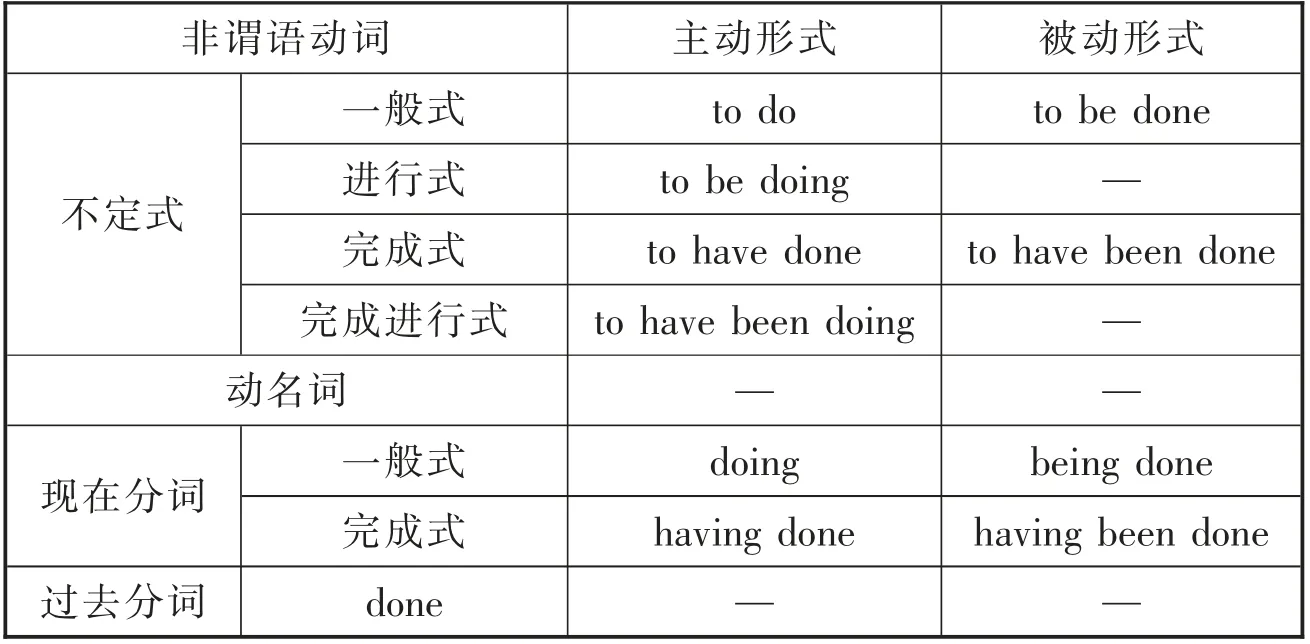
?
否定式:在to前面加not;在V-ing前加not。
二、非謂語(yǔ)動(dòng)詞的句法功能
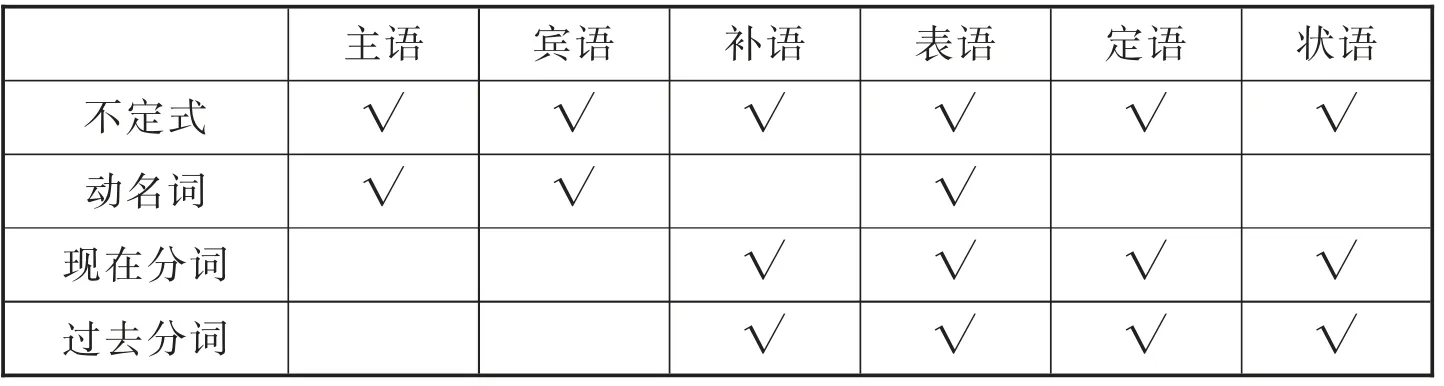
?
三、非謂語(yǔ)動(dòng)詞的復(fù)合結(jié)構(gòu):非謂語(yǔ)帶上自己的邏輯主語(yǔ)
1.His not comingto work on time made me a little anxious.
2. It's niceof youto help me.
3. It's necessaryfor usto learn English well.
四、分類(lèi)講解
(一)不定式
1. 作主語(yǔ)
To learn an art is hard. = Learning an art is hard. = It's hard to learn an art.
2. 作賓語(yǔ)
帶不定式作賓語(yǔ)的動(dòng)詞通常有:
want、wish、hope、offer、decide、help、learn、ask、refuse、promise、pretend、expect、dare、afford、plan、manage、agree、prepare、determine、long等。
(1)I wish to speak to the manager.
(2)We have decided not to go away after all.
(3)She refused to accept that there was a problem.
see、watch、notice、observe、discover、look at、listen to、hear、have、let、make、sense、feel接不帶to的不定式作賓補(bǔ)。
(1)What he said made me think of my childhood.
(2)Have you seen a plane fly over?
3. 作定語(yǔ)
(1)He is always the first to come to school and the last to leave.
(2)We're looking for a room to put these equipment in.
(3)He's a person pleasant to work with.
(4)The swimming game will be held in the swimming pool to be finished next year.
4. 作目的狀語(yǔ);和only搭配,通常作結(jié)果狀語(yǔ)。
(1)Everyone does regular exercise to keep fit.
(2)He woke up and looked out of the window only to find the world outside completely changed.
5. 作表語(yǔ)
(1)His wish is to become a painter.
(2)When I was young, my dream was to be a garbage collector.
(二)動(dòng)名詞
1. 作主語(yǔ)
(1)Working in these conditions is not fun but suffering.
(2)It's no use talking to him. You have to talk with the person in charge.
(3)It is fun playing with children.
2. 作賓語(yǔ)
(1)He tried to keep moving.
(2)She regretted not having followed her mother's advice.
(3)The driver had thought he would escape being punished.
常見(jiàn)接動(dòng)名詞作賓語(yǔ)的單詞和短語(yǔ)有:
admit、advise、avoid、consider、delay、enjoy、finish、include、keep、mind、miss、forbid、suggest、risk、resist、practise等。
can't help doing... 忍不住…… be/get used to doing... 習(xí)慣……
get down to doing... 開(kāi)始認(rèn)真…… insist on doing... 堅(jiān)持做……
set about doing... 著手…… object to doing... 反對(duì)……
pay attention to doing... 注意…… look forward to doing 盼望……
3. 作表語(yǔ)
(1)Seeing is believing.
(2)His hobby is collecting stamps.
(三)現(xiàn)在分詞
1. 作賓語(yǔ)補(bǔ)足語(yǔ)
(1)He stood there, watching the man making a sugar dragon.
(2)The man left us standing there alone, unable to find any help.
2. 作表語(yǔ)
The competition is quite exciting.
3. 作定語(yǔ)
(1)a reading room, a sleeping car, a washing machine, a walking stick
(2)Shut the machine making the strange noise.
4. 作狀語(yǔ)
(1)Having smoked heavily, he suffered lung cancer.
(2)Not knowing his address, I might as well give him a call.
(3)Having been in prison for many years, he didn't know what was happening around the world.
(4)Don't talk while eating.
(四)過(guò)去分詞
1. 作表語(yǔ)
(1)The shop has remained shut for a month.
(2)All of us were moved to tears.
2. 作定語(yǔ)
(1)We only sell used books in our store.
(2)The story written by a student is made into a movie.
(3)The old man, mistreated at home, lived a miserable life.
3. 作狀語(yǔ)
(1)Asked about his family, he kept silent.
(2)Seriously injured, he was sent to hospital immediately.
(3)Once released, the CD became a hit immediately.
(4)Given more time and money, we would have done it better.
4. 作賓語(yǔ)補(bǔ)足語(yǔ)
(1)Please speak to make yourself heard.
(2)The masters have to keep the dogs chained to make sure of safety.
Step 3 單句過(guò)手
根據(jù)中文提示,完成下列句子。
1. 女孩因?yàn)椴恢肋x擇哪所大學(xué),所以在網(wǎng)上查了很多信息。__________(know) which university to attend, the girl looked up lots of information online.
2. 托尼因?yàn)闆](méi)有被邀請(qǐng)參加聚會(huì),所以很不高興。
Tony was not happy for__________(invite) to take part in the party.
3. 掌握一門(mén)外語(yǔ)需要大量的記憶工作。__________(master) a foreign language takes lots of memory work.
4. 市民們對(duì)如何解決水污染問(wèn)題很關(guān)心。
The citizens care about how__________(solve) the problem of water pollution.
5. 我討厭和他說(shuō)話(huà)。
I hate__________(talk) to him.
6. 你注意到那個(gè)人在玩蛇嗎?
Have you noticed the man__________(play) with a snake?
7. 他看到門(mén)被推開(kāi)了。
He felt the door__________(push) open.
8. 你的工作是擦窗戶(hù)。
Your job is__________(clean) the window.
9. 看到小湯米在比賽中跑得這么快,我很吃驚。
I'm__________(surprise) to see little Tommy__________(run) so fast in the game.
10. 他的演講真感人,在場(chǎng)的聽(tīng)眾都被感動(dòng)了。
All the audience present were__________by his__________speech. (move)
11. 你要去參加明天舉行的開(kāi)幕式嗎?
Will you attend the opening ceremony__________(hold) tomorrow?
12. 他參加了昨天舉行的開(kāi)幕式,感到很激動(dòng)。
He attended the opening ceremony__________(hold) yesterday, .
13. 你認(rèn)識(shí)那個(gè)等在門(mén)口的白衣女孩嗎?
Do you know the girl__________(wait) at the gate?
14. 如果問(wèn)到你,就說(shuō)什么也不知道。
If__________(ask), you just say you know nothing about it.
15. 從高處看,這個(gè)體育館更漂亮。
__________(see) high above, the gym looks more beautiful.
16. 看看同學(xué)們的眼睛,我看到了同樣的興奮。
__________(look) at the eyes of my classmates, I read the same excitement.
17. 說(shuō)了很多次,他還是犯了同樣的錯(cuò)誤。
__________(tell) many times, he made the same mistake again.
18. 他感覺(jué)被邀請(qǐng)參加晚宴是一件榮耀的事。
He felt it a great honor__________(invite) to dinner.
19. 你可以用肢體語(yǔ)言來(lái)表達(dá)自己的意思。
You can make yourself__________(understand) by body language.
20. (2019·江蘇卷)李江和蘇華正在討論下個(gè)月接待英國(guó)學(xué)生的時(shí)候穿什么。
Li Jiang and Su Hua are discussing__________when__________the British students next month.
21. (2019·江蘇卷)鑒于以上的穿傳統(tǒng)服裝的優(yōu)點(diǎn),我們?yōu)槭裁匆虉?zhí)地堅(jiān)持穿單調(diào)的校服呢?
__________, why should we stubbornly insist on wearing the tedious school uniforms?
22. (2018·全國(guó)乙卷)首先,我建議你早點(diǎn)到,這樣你就能幫助主人準(zhǔn)備餐食。
To begin with, I would like to suggest__________so that you can help the host__________.
23. (2018·北京卷)老實(shí)說(shuō),在另一個(gè)不同文化里讀書(shū)掙學(xué)位不容易。__________,__________ is never easy.
24. (2018·北京卷)我坐在桌邊,一邊泡茶一邊解釋每一個(gè)步驟。
I sat at a table,__________.
25. (2017·全國(guó)丙卷)了解到我們校乒乓球隊(duì)在計(jì)劃招收新隊(duì)員,我寫(xiě)信來(lái)邀請(qǐng)你加入。
__________that our school table tennis team is planning__________, I'm writing .
Step 4 語(yǔ)篇活用
Ⅰ. 補(bǔ)全信息
用非謂語(yǔ)動(dòng)詞的相關(guān)知識(shí),完成下列文章。
假定你是李華,你的英國(guó)網(wǎng)友Nate上周五發(fā)郵件詢(xún)問(wèn)你新學(xué)期有什么計(jì)劃,但你因故未能及時(shí)回復(fù)。 請(qǐng)你給他寫(xiě)一封郵件,內(nèi)容如下:
1. 未及時(shí)回復(fù)的原因;
2. 新學(xué)期你的計(jì)劃。
注意:
1. 詞數(shù)100左右;
2. 可以適當(dāng)增加細(xì)節(jié),以使行文連貫。Dear Nate,
How is it going? I am terribly sorry for 1.__________(沒(méi)及時(shí)回復(fù)你的郵件)last Friday. I 2.__________(我上周一直忙于準(zhǔn)備一個(gè)重要考試). Consequently,3.__________(我沒(méi)有時(shí)間查看郵箱). Please forgive me.
As for my plans, schoolwork is of top priority to me this semester as all the seniors are facing“gaokao”. 4.__________(上課專(zhuān)注、積極向老師請(qǐng)教) would be my major strategies. Meanwhile, 5.__________(為了努力在學(xué)習(xí)和放松中取得一個(gè)平衡), I 6.__________(計(jì)劃每天做一些體育活動(dòng),比如游泳、跑步、打籃球). 7.__________(時(shí)間允許的話(huà)), I am hoping that I could take an online class 8.__________(提高英語(yǔ)口語(yǔ)和聽(tīng)力) on weekends.
Please accept my sincere apology for this 9.__________(延遲的郵件) and I would appreciate it if you could give me some suggestions about 10.__________(怎樣提高英語(yǔ)).
Best wishes!
Yours sincerely,
Li Hua
Ⅱ. 完整創(chuàng)作
(2020·全國(guó)甲卷)上周末,你和同學(xué)參加了一次采摘活動(dòng)。 請(qǐng)你為班級(jí)英語(yǔ)角寫(xiě)一篇短文,介紹這次活動(dòng),內(nèi)容包括:
1. 農(nóng)場(chǎng)情況;
2. 采摘過(guò)程;
3. 個(gè)人感受。
注意:
1. 詞數(shù)100左右;
2. 題目已為你寫(xiě)好。
題目:My Weekend