MADE IN CHINA
2021-08-27 05:47:56BYJESSEYOUNG楊哲思
漢語世界 2021年4期
BY JESSE YOUNG (楊哲思)

“I’m wearing the coolest shoes now, Feiyue,” The Vaccines lead singer Justin Young tells GQ. “Best travel shoe? Feiyue trainers. I live in them,” model Poppy Delevingne (who debuted her own Poppy x Feiyue range in 2020)admits to W magazine. “Feiyue!Nice!” tweeted K-pop megastar Lee Dong-hae to his millions of followers in 2012.
In nearly a decade since China’s“little white shoe” went global, it has counted mega-stars like Alessandra Ambrosio and Orlando Bloom among its fans, formed collaborations with international brands like Celine and Casio, and set up shops and billboards in London and New York.
In 2012, Feiyue established a flagship store in Paris and had just debuted in South Korea following a global media blitz. Many netizens at the time wondered at Feiyue suddenly becoming a thing on the international fashion circuit. The collective reaction was summed up by one commentator on Twitter, “Who told hipsters about Feiyue shoes? They’re strictly nostalgia items my parents’ generation buy.”
Outside a niche martial arts following—which long prized the shoes for their light weight and flexible soles—Chinese consumers had largely abandoned the cheap (once only 10 RMB a pair) and “backward”Feiyue by the 1990s. Domestic brands couldn’t keep pace with flashy foreign sportswear giants which had arrived to capitalize on a nascent consumer society after market reforms. Even while Feiyue-clad Shaolin monks graced the Olympic opening ceremony in 2008, sales had dipped to just 200,000 pairs a year, with only one retail store in Shanghai remaining.
The “rediscovery” of the humble Feiyue coincided with theguochao(國潮) or “domestic wave” movement that became prominent in 2018, a fad for domestic fashion and other trendy products with Chinese design elements.
The Feiyue fad has even infected the literary world. “My envious expression, watching [classmates] in their new [Feiyue] trainers. Running and leaping about happily; jumping high, jumping far. I’d think to when my mother would be able to buy me a pair of sneakers like those too; the kind of happiness that would make me not eat for three days,” remembered author Guo Baodong, better known as Bei Tu, in his semi-autobiographical short story “That Pair of Feiyue Sports Shoes” in 2018.
Similar stories of warm appreciation and budding sneakerhead consciousness can be found in Feiyue’s fan groups on Baidu Forums. Posters reminisce about the status attached to pristine white shoes, the care taken in avoiding getting them dirty, and their childhood PE classes. “When I was young, I often wore Feiyue shoes but I didn’t have much concept of the brand,”Beijing resident Mei Lin told TWOC,“[Feiyue] is my favorite, especially the classic white and blue with its childhood memories.”
For most fans, their image of Feiyue traces back to one design in particular: The Leap 501 shoe,first sold in 1963. Based on the plimsolls favored by Shaolin monks,its distinctive form became the prototype for all future Feiyue:lightweight vulcanised rubber soled canvas shoes, with a distinctive red-and-blue double chevron and the name of the brand in the Latin alphabet. The choice of materials dates all the way back to 1931, when Dafu Rubber Factory, a Shanghai tire-maker, began producing shoes as a sideline to make use of excess rubber.
From the 1930s to 1950s, Dafu helped supply the military with canvas footwear called “Liberation Shoes.” When demand dropped in peacetime, they turned to civilian sports shoes, seizing on the spirit of the Great Leap Forward to register Feiyue (“Flying Leap”)as a trademark in 1958. Over a million pairs were sold in the first production run. From that time into the 1980s, Feiyue and archrival Warrior (another Shanghai company with origins in Republican rubber factories) maintained a nearduopoly over the sneaker market.Peak production in the 80s topped out at 10 million pairs, making state-owned Dafu one of the biggest shoe manufacturers in Southeast Asia.
But Western brands like Nike and Adidas swiftly became the go-to brands. One observer noted on Weibo wryly, “You only see Feiyue shoes on foreigners.” This sentiment was echoed by Tian Bo of Shanghai retro shoe store Culture Matters,who helped repopularise the brand domestically. He conceded in an interview with Global Times that in the early 2000s his customers were mostly expats and tourists who were drawn by the kitsch retro look of his store, but now “60 to 70 percent of our customers are Chinese.”
Feiyue has enjoyed doubledigit growth at home over the past decade, fueled by “fashionconscious young people and whitecollar workers who are bored with mainstream brands,” according to Tian. Growing international tensions—including recent calls to boycott Adidas and Nike over the Xinjiang cotton controversy—have only helped matters.
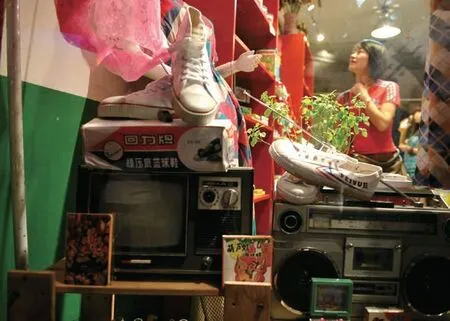
A retro theme is part of a Feiyue store’s branding in Beijing’s Nanluoguxiang neighborhood
But there is a question as to how much exclusionary nationalism actually shapes purchasing decisions,compared with nostalgia and more mature branding and marketing by domestic firms. “I don’t have a bias toward buying only domestic and not buying foreign,” says Mei. “I like domestic brands not only because they are Chinese but because they’re cost-effective and comfortable...between domestic and foreign brands, I choose what suits me best.”
Lai Tongyu, another sneaker fan,agrees. “The era of supporting domestic products under the banner of patriotism has become a thing of the past. Domestic brands need to be able to market to young people on their own strengths,” he argues. He sees the recent success of brands like Feiyue and Li Ning as a good thing, driven mainly by innovation. By 2019, sales of Feiyue had climbed again to 10 million pairs per year, recalling the brand’s glory days; however, the brand has been held back by trademark confusion,highlighting the growth pains in transitioning from a state-controlled to market-based economy.
For the last five years, a bitter war has raged over Feiyue’s trademark on three fronts—in courts, as well as consumers’ hearts and minds.Four companies currently claim a competing stake to the Feiyue legacy:Dafu, Warrior/Huili, Dabowen,and BBC International. In 2005,French national Patrice Bastian encountered Feiyue shoes while studying martial arts in Shanghai.Sensing an opportunity in their retro look, he offered to become Feiyue’s overseas distributor on behalf of Dabowen, a company which Dafu had authorized to use the trademark. Later, he registered the trademark internationally and set up Feiyue France, which was acquired by American company BBC International in 2014.
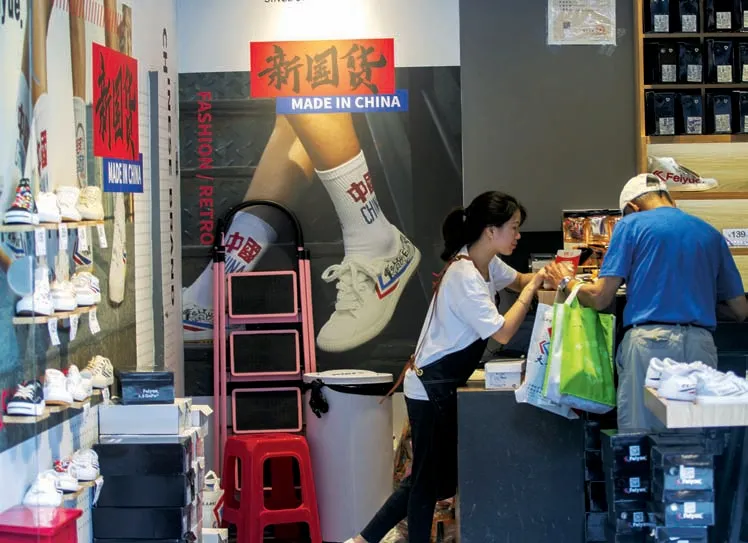
Nationalism plays a part in Feiyue’s marketing campaigns within China
Along the way, Bastian ran marketing campaigns based on Shaolin martial arts, and partnered with Delevingne, Casio, and others.He also made improvements like thicker soles and higher quality glue,which raised the price of the shoes significantly.
In 2016, former employees of the now-bankrupt Dafu re-registered the company and applied for the “Dafu Feiyue” trademark within China.Beijing’s Nanluoguxiang stands today as a trademark battlefield (at least domestically), with all three domestic players running their own Feiyue shops within a few hundred meters of one another, each trying to outdo the others with their exclusive designer collaborations and limited run co-branded sneakers.
The trademark battle has also spurred Chinese Feiyue makers to up their game, incorporating better quality material and hightop designs into their repertoire,and reaching out to big names for collaboration. In a typical year, there are now over 150 new designs and collaborations in China alone, with Disney, the “Peanuts” comic strip,and social media platform Douban being some of the more prominent partners. There’s even a Chinaoverseas Feiyue collaboration, the“Feiyue 1920” sneaker series.
Most consumers are probably unaware of such behind-the-scenes drama, though they benefit from the competition. “[Feiyue] gradually disappeared from my life...[many years later] when I saw those Feiyue sneakers again, my nose became sore and my glasses went blurry. I had to take off my glasses as tears fell on that long-lost pair,” writes Guo. Once an outdated relic of domestic tastes, the little white shoe seems ready to fly forward again—now with a new spring in its step.