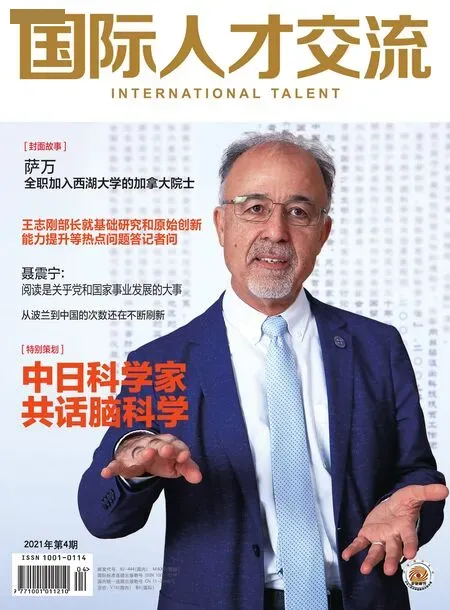
Mohamad Sawan:“Collaboration with China can never be enough”
2021-11-21 04:30:25ByWangYimingPhotobyLiYiwen
國際人才交流 2021年4期
By Wang Yiming / Photo by Li Yiwen
Mohamad Sawan is an internationally renowned scientist in the field of intelligent biomedical devices. As a Fellow of the Canadian Academy of Engineering, the Canadian Institute of Engineering, and of the IEEE, the Lebanese-born Canadian has made significant contributions in implantable and wearable medical devices based on smart microsystems. He is also currently the editor-in-chief of the esteemed medical journal IEEETransactions on Biomedical Circuits and Systems.
Professor Sawan received his PhD in Electrical Engineering from the University of Sherbrooke in Canada in 1990. In 1991,he became a postdoctoral researcher in biomedical engineering at McGill University in Canada as well as an assistant professor, and later professor at the University of Montreal, Canada,between 1991 to 2018.
In 2018, he joined Westlake University in Hangzhou, China, as a professor at the School of Engineering and founded the Cutting-Edge Net of Biomedical Research and Innovation (CenBrain).Within CenBrain, Professor Sawan focuses on researching innovative ways to diagnose and treat neurodegenerative diseases.He is currently involved with building brain-machine interfaces that integrate artificial intelligence technology to help decode and predict neural activities.
Professor Sawan has received numerous international awards,including the Elizabeth II Jubilee Diamond Award, the Lebanon Presidential Award, the Barbara Turnbull Award, the ACFAS Jacques-Rousseau Award, the J.A. Bombardier Award, the Shanghai Municipal International Collaboration Award, the Officer of National Order of Quebec, and a place in the Top Ten Discoveries of the Year by Québec Science Magazine.
Connections with China
In a recent interview, Professor Sawan said that being an academic has meant that he has built small connections with Chinese colleagues over the years.
“In 2005, I came to China for the first time, in a project representing the scientific community of the Canadian government.We went to universities in Beijing and Shanghai, including Tsinghua University and Shanghai Jiao Tong University. I established contact with more people and after that and our relations became stronger,” Sawan said.
Sawan was later appointed as an adjunct professor at Shanghai Jiao Tong University, and over the past years returned to China for one or two weeks at a time as well as sometimes spending summers here to oversee summer curricular courses.
“I also have many Chinese students, graduates, and PhD students in Montreal. This is how it started,” Sawan said.
Speaking of why he chose to work full-time in China, Professor Sawan explained that: “I like China. I have the feeling that Chinese culture is similar to mine because I am originally from the Middle East, Lebanon’s Beirut. I feel close to Chinese culture.”
“After staying in Montreal for a while, I had the feeling that I needed to change something. At that time, all I had in mind was that China would be a good place to go. Everyone knew China was growing, booming, and changing, and that attitudes and values in the U.S. didn’t meet mine. So for all these reasons, I wanted to go to China.”
“At that time, Westlake University was looking for professors,and I thought it as a good chance to move. Then I came to Hangzhou and met the university’s president Shi Yigong. It was not difficult for him to convince me to move.”
Researching and teaching around the West Lake
Professor Sawan’s research team at Westlake University was established in January 2019 and currently consists of 25 members,including senior researchers, PhD students, and research assistants.
“The reason why I was especially motivated or attracted to join Westlake University is that the university’s vision is international. We are not competing with Tsinghua or other local universities. We want to do something different. We aim to match institutes like Caltech,” Sawan said.
Regarding the differences of working and conducting scientific research in China versus Montreal, Sawan considers them rather “small.” “There are differences but I don’t think anything really major.”
During the interview, Sawan did mention a “little difference”among the students. “The students in North America are more independent and they are educated to say no, even to the supervisor, while Chinese students would never do so even if they considered that the supervisor was wrong.”
“Chinese students also work very hard. You can’t reach the students in Montreal after 5:30pm and on weekends, but in China, everyone, including the faculty and staff, is working all the time. I try to encourage the students here to get out of the lab and tell them that what’s important is the outcome, not the number of hours.”
“But actually in Montreal, I do graduate very strong Chinese students. Now they are the big guns in U.S. and everywhere,”Sawan added.
Asked about what he would like to see to improve regarding the university’s working environment, Sawan replied that, “Overall,I think universities have great conditions and I have no complaints.”
“The leadership of the university and from the government is very supportive. In one year from now, we will move to a new campus. We’ll then have more space and more facilities.”
Professor Sawan stressed that China can do more in the bio medical field. “Biomedical researches take more time to generate products and enter the market. But we have to invest in the long-term,” Sawan said, noting that China has the “capacity and conditions” in this field to do so.
“Biomedical sciences must be a priority in the future because of China’s aging population, as well as other stressors on health,”Sawan said, citing COVID-19 as a warning. “We’re working with China Center for Disease Control and Prevention (CDC) now to validate a biosensor to detect COVID-19 on-site.”
In terms of international cooperation in the field of biomedical research, Professor Sawan explained: “I know there are many programs led by different ministries and the National Natural Science Foundation of China to encourage collaboration with foreign countries, and I have participated in one of them.”
“I think it is important to maintain this kind of collaboration,”Sawan said. “Collaboration between Chinese colleagues and the outside world can never be enough.”
Current life and expectations
“I was born in a small city, kind of a village, and then went to big cities everywhere. So based on my experience, I would prefer to live in a city like Hangzhou; a beautiful green city,quiet, and not very big when compared with large and famous cities such as Shanghai and Beijing,” professor Sawan said.
He also spoke highly of China’s “rapid and tremendous development,” saying, “I remember I was not able to find a coffee in 2005, but now you can find Starbucks and all kinds of coffee in every street. It’s completely different.”
“I am happy to be in China. Now you have everything here,”Professor Sawan said. “And I like people in China as well. I have the feeling that everyone is happy and satisfied. If you go to a big city in the U.S. or Canada, you can see people fighting or shooting in the street because of problems related to their livelihoods, but here you don’t see that. You talk to the people and they are happy to talk to you.”
Professor Sawan expressed appreciation for the help his assistants and the university’s human resources department have provided him. “They have helped me solve many problems,”Sawan said.
But he also admitted that the language barrier still causes inconvenience. “You cannot disturb your assistant every minute.Now I can use the DiDi APP but I still need language help when I go to places like the hospital.”
In his spare time, Professor Sawan enjoys jogging, going sightseeing, and tries different restaurants in Hangzhou. He also participated in the 2019 Hangzhou Marathon.
According to Professor Sawan, many other countries, including his homeland, continue to offer him work opportunities but he believes that it’s not a good time to go back.
“I think the conditions in China now are great,” Sawan said. “I would be happy to stay for another five to ten years to continue my research.”